Friday, December 31, 2021

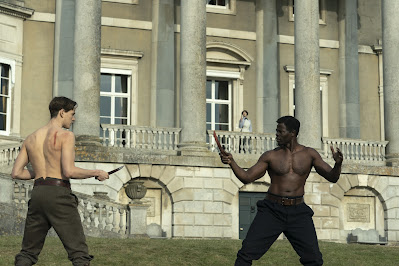
The Tragedy of Macbeth – a pacy though somewhat utilitarian retelling of the Bard’s Scottish Play (QFT until 6 January)

I hadn’t realised that Frances McDormand was married to Joel Coen. Such celeb trivia usually doesn’t matter. But how has it taken Coen so long to cast McDormand as Lady Macbeth? Does he not gaze at her over breakfast and see the face of someone who engineer treason? He should be checking for horses’ heads in his bed before settling to down to sleep. In this latest adaptation of Shakespeare’s work, McDormand and Coen coproduce The Tragedy of Macbeth. (Ethan Coen isn’t involved.)

The film hurtles through the plot like a teenage English student turning over pages to reach the good bits, arriving at the death of Duncan in record time. From there, things slow a little, until the wind gets behind the sails of Malcolm’s branch-camouflaged army and Macbeth’s days are finally numbered.

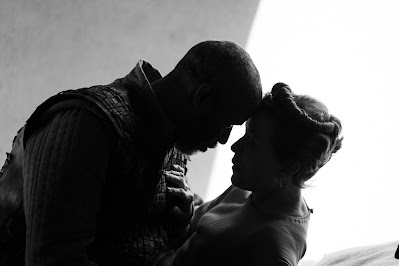
Denzel Washington flits effortlessly between confident and troubled monarch, forever talking to himself as he wanders through the near empty castle. McDormand deliberately underplays the emotion and femininity that is often laboured as Lady Macbeth. In fact, nearly every aspect (other than Macbeth’s visions) that could be heightened or stressed is calmed down: the set, the emoting, the flowery speechifying, the battles, the bloody deaths. This less-frenzied environment makes the dialogue no less potent, and allows the odd moment of bawdy Shakespearian humour to be snuck in.

It feels like every scene uses its own distinct stage, with the minimal cast spaced out as if social distancing was a thing in the 11th century court. The shape-shifting witches, all played by Kathryn Hunter, fly in and out of Macbeth’s increasingly contorted conscious. Coen plays with reflections in water (neatly adapting the usual cauldron), adding to this beautiful other-worldly creation that could hardly be more different from Justin Kurzel’s fabulous 2015 Macbeth (starring Michael Fassbender, Marion Cotillard and the unforgettable red mist).

Shot in black and white by Bruno Delbonnel, the squeezed aspect ratio (4:3, Academy 1.375:1 or 1.19:1 depending on which website you believe) gives The Tragedy of Macbeth an old-fashioned feel. The feel of the stage is accentuated by the crisp visuals, and expressionist lighting that pretends it’s always golden hour during the day, and there’s an ever present full moon at night. Geometric shapes and shadows decorate the modernist castle rooms and courtyard with pale plastered walls and zero clutter. There is only occasional torrential rain to disrupt a building with few ceilings. This is unlike any Scotland I’ve visited!

At times the dialogue becomes too humdrum and the staging is too utilitarian, reminiscent of a cheap 1970’s science fiction set without the flashing lights. Yet this movie is still a deserving addition to the already crowded market of Macbeth films and theatre productions with its distinctive style, a nifty 105-minute runtime, and some very memorable moments.

Now that McDormand and Coen have got the Scottish Play out of the way, maybe they could turn their hand to shortening and simplifying A Midsummer Night’s Dream!

The Tragedy of Macbeth is being screened daily in the Queen’s Film Theatre until 6 January. It’ll pop up on Apple TV+ on 14 January 2022. 

Update – The headline of the New York Times online review sums it up well: “The Thane, Insane, Slays Mainly in Dunsinane”!

Enjoyed this review? Why click on the Buy Me a Tea button!

Thursday, December 30, 2021

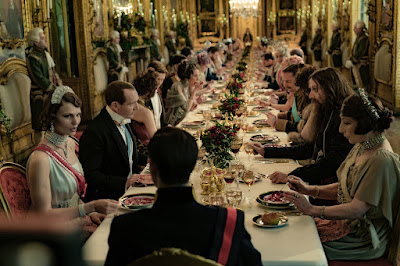
The King’s Man – counterfactual claptrap and mediocre mythology, a film that feels link two different-sized jackets sewn together

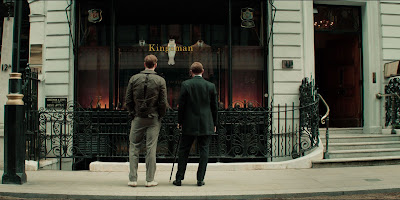
If the first Kingsman film was quirky and full of giggles, the sequel was vulgar (both in terms of tone and product placement). This third instalment, an origin prequel for the spy agency, ditches much of the silliness and the innuendo, but keeps the theme of villains building high-altitude bases.

The King’s Man weaves its mediocre mythology about jolly chaps seeking peace into the assassination of Arch Duke Ferdinand, the rise of Lenin, and US military strategy … while leaving the ultimate cause of the First World War at the feet of a shadowy Scottish skinhead (who feels like he has wandered straight in off the Trainspotting soundstage in a next door studio).

Yes, a goat farmer from north of Hadrian’s Wall who is fed up with English influence is apparently pulling the strings of Rasputin, Mata Hari and more to upset the world order and . The Scottish government should really ban this film from being screened in Scotland, or perhaps make it mandatory viewing to push for another independence referendum!

Gemma Arterton plays Polly – the name is clearly short for ‘polymath’ – an assertive nanny who’s a fine shot with a pistol, can crack secret codes, helps organise a below-stairs worldwide network of informers, and can still find time to whip up a tasty tart in the kitchen and utter 99% of the dialogue given to women in the film. Djimon Hounsou is the valet, Shola, who is diligent in his service and deft in combat, throwing himself at trouble as long as it doesn’t involve flying. The Kingsman trilogy doesn’t really deserve the talents of Arterton and Hounsou.

Polly and Shola work for, and, it turns out, alongside the Duke of Oxford (a nimble Ralph Fiennes, now too old to be Bond, but this is a great audition). The pacifist Duke is overly protective of his young son (Harris Dickinson), though the audience know more about the reason than the lad. Tom Hollander is a good addition to the cast, playing three warring cousins.

Expect bare-chested fighting, brilliant moustaches, overwrought dialogue, a forty-minute wait to uncover the first sniff of a mission, a rather well choreographed dancing fight sequence, lots of licking, a barely disguised traitor, and soaring music (Dominic Lewis and Matthew Margeson) that injects energy into the painfully long action sequences.

It’s vaguely entertaining, and there are some good stunts, but The King’s Man is dripping with stereotypes that even Horrible Histories would choose to avoid. There’s a lot of highfalutin talk about character and reputation, valour, duty and keeping promises, a scene that will take you back to a much better war time film (1917), while colonialism and is juggled alongside just war theory and a muddled sense of whether it can be patriotic to be peace-loving.

There’s a fourth Kingsman film in the works. The writer/director Matthew Vaughn will need to make his mind up whether he’s making comedy or action: the current mix fits poorly, like two different-sized jackets sewn together. Johnny English better deserves another sequel than anything bearing the label of Kingsman.

In the meantime, The King’s Man is playing in most local cinemas.

Enjoyed this review? Why click on the Buy Me a Tea button!

Tuesday, December 28, 2021

Titane – the coupling of unconditional love and a revving, twerking, killing machine (QFT, 31 December–6 January)

Browsing through this year’s film viewing before last week’s end-of-year Banterflix recording, I noted how strong a year it had been for French cinema. Petite Maman was the crème de la crème, but movies like Gagarine (a young lad Yuri tries to save his estate from being demolished, both named after the cosmonaut) and France (looking at the pressure social media puts on a TV news journalist) stood out too.

But having driven home from a screening of Titane, I’m not quite sure whether it’s a triumph of or a turkey. Julia Ducournau’s directorial debut covered a lot of ground and dealt with a lot of big issues: Raw featured a vegetarian veterinary student who developed a taste for meat.

And so it is with Titane. Where an ordinary film might meld together two themes, Ducournau takes on auto-eroticism (the vehicular meaning), serial killing, the loneliness of a parent whose child ran away, body modification, fire house machismo, and much, much more in her second full-length feature.

The film wants the audience to believe that Alexia’s behaviours and desires all stem from the titanium plate placed in her head after a childhood car accident. If that sounds far-fetched, then jump on board, as that’s perhaps the least fantastical element of the 108-minute story.

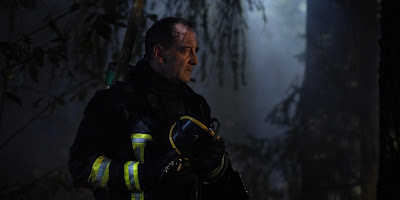
Alexia dances provocatively at car shows – though the Belfast Motor Show in the King’s Hall in the 1980s was tame in comparison with her after hours indecency – and is troubled by fans who want more than their eyes can saviour. Needing to evade the authorities who are searching for her after the escape of a witness to her ability to harm with sharp and blunt instruments – she is to hairpins what Hawkeye is to arrows – Alexia transforms from a socially distant, dangerous dancer into a voiceless man, Adrien, the son of a beefy fire chief who ran away as a child.

At times, this is a film about how excited we get around new cars, the opening shots glancing longingly at the sleek curves of a vehicle’s underside, not the last time we’ll see a chassis dripping with oil. Titane also explores how grief – and perhaps guilt – can override rational thought, and acts out a case study of how a leader of a close-knit team can try to constrain challenge and make everyone play along with their somewhat knowing misapprehension. Mixing unconditional love with denial is shown to be unhealthy.

The film also looks at ways in which our body shape changes and is changed: naturally, unnaturally, and everything in-between. The plot’s deliberate mirroring of father and son is quite calculated, as is the regular return to the cleansing effect of fire, and demonstrations of the wanton freedom that can be offered by dance. Key moments of the film are either marked by indistinct choral singing (including Back’s St Matthew’s Passion) or musical choices with rich lyrics (The Zombies’ She’s Not There and Lisa Abbott’s version of Wayfaring Stranger).

Agathe Rousselle makes a strong impression in her debut feature, shifting from being a model acting on the catwalk, to acting on set full of stunts, prosthetics, and an ever-changing body shape. Her ability to communicate dialogue without speaking is remarkable: at times, there are so few subtitles, you forget that the film is French. Vincent Lindon is the rugged father figure, nearly as broken and bruised as his reemergent prodigal son, and struggling to keep his figure and his authority as the year’s progress.

It’s no Chitty Chitty Bang Bang! The high degree of nudity early on in the film is strong – sexual but never sexy – yet as the plot continues, it’s soon impossible to tell where reality stopped and the remarkable prosthetics began … perhaps much earlier than we imagine. It’s just another layer in Ducournau’s tale of disguise and surprise.

If the purpose of cinema is to challenge and disturb, Titane scores highly and is both horrific and horrifying. This is not a comfortable watch, and together with the rest of the cinema audience, you’ll flinch and wince at some of Alexia’s self-inflicted injuries and extreme medical interventions.

Titane won the Palme d’Or at Cannes earlier this year, but isn’t for the feint-hearted or anyone who is easily shocked. You can catch Titane – the coupling of unconditional love and a revving, twerking, killing machine – at Queen’s Film Theatre from Friday 31 December until Tuesday 6 January. Whether it is a triumph or a turkey, Julia Ducournau is definitely a directing talent to watch. Her next film is unlikely to be any more comfortable to watch that Titane, yet it will be unmissable due to the wholehearted way she explores the body horror genre.

Enjoyed this review? Why click on the Buy Me a Tea button!
Tuesday, December 21, 2021

A Christmas Carol – a miserly loan shark’s night of revelation (Bright Umbrella at Sanctuary Theatre until 3 January)

Patrick Barlow rewrote the stage adaptation of 39 Steps in 2005, so it should be no surprise that his take on Dickens’ festive tale A Christmas Carol throws quick changes, discarded props, and puppets at a multi-roled cast of five.

The actors burst – and occasionally creep – in and out of at least nine entrances around the Sanctuary Theatre’s narrow stage as the audience are introduced to miserly loan shark Ebenezer Scrooge whose default behaviour is to squeeze the joy out of people no matter the season.

It’s Christmas Eve and Scrooge is having no truck with the carolling and revelry, feigning grief at the loss of his business partner Jacob Marley when it suits his purposes, and rudely declining his nephew’s persistent invitation to spend Christmas Day with his family.

But that night when the misanthrope goes to bed – dressed like Wee Willie Winky – he is visited by Marley and a troupe of wailing banshees. And so begins Scrooge’s descent into a self-reflective sleighride through three circles of his own personal hell.

Playing Scrooge, Glenn McGivern allows himself to be pulled, pushed, jumped on and even slapped as the ghosts wrestle with his conscience. And while the experiences may briefly cause Scrooge to ponder, Glenn snaps the character back to its stingy self and buckles down for the next visitation. Towards the end, there’s even a bit of gentle improv with the audience.

The obedient yet under-appreciated Bob Cratchit is played by Marina Hampton who also makes quite an entrance as Marley’s Ghost. Hampton provides a lot of the on-stage humour, reacting to Scrooge’s never-ending demands with clownlike gestures, and later gives life to the diminutive Tiny Tim puppet.

As Ghost of Christmas Past, Annina Watton cajoles Scrooge through witnessing the big moments in his life so far. After the interval, a rather sassy Ghost of Christmas Present sashays across the stage – a feather boa could quite naturally replace the rope! – as Christine Clark is well able to crank up the comedy. Soon it’s the turn of the faceless and demonic Ghost of Christmas Yet to Come with Declan King also playing Scrooge’s nephew Frederick.

This adaptation of A Christmas Carol is a pretty shouty piece, with lots and lots of banging and screeching, before calm descends for the show’s most tender moment as Bob Cratchit reads a bedtime story to his beloved son. Having been implored to “change while there’s still time” before resisting the ghosts’ revelations, Scrooge’s eventual redemption happens nearly instantaneously, an all-too-sudden attitudinal handbrake turn amid the play-within-a-play twist.

The Bright Umbrella cast under Trevor Gill’s direction has really got to grips with the irreverent script and delivers an entertaining and fast-paced, festive frolic. If anything, the levity in Barlow’s writing might require even more accentuated accent changes and flouncing around the stage, more flinging of snow, deliberate bumbling of props, eyebrow raising, and knowing nods to the heightened emotion and madcap action.

While the venue’s power problems on the night I reviewed denied the production many of the sound effects and all of the lighting changes that the company had planned, the show did go on and it didn’t feel like the performance was second class or that the audience had missed out.

A Christmas Carol continues at the friendly Sanctuary Theatre (on the junction of Castlereagh Street and the Albertbridge Road) until 3 January with matinee and evening performances.

Enjoyed this review? Why click on the Buy Me a Tea button!
Saturday, December 18, 2021

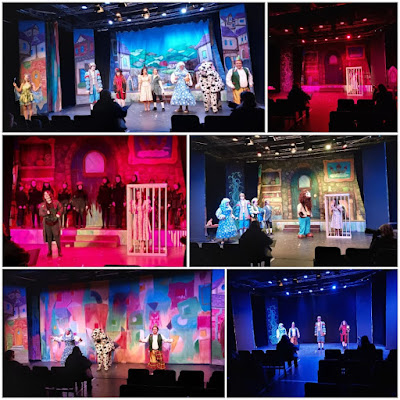
Jack and the Beanstalk – poverty, servitude, fast-growing pulses and aggressive giants (Belvoir Players Studio until 8 January)

Christmas must be the time of year when the greatest number of amateur dramatic participants – young and old – step on stage to entertain audiences. As a child I was taken just the once to the Grand Opera House to see the pantomime: it was “a cracker” according to Frank Carson. But over the years I was dragged privileged to attend many more local festive amateur operatic and dramatic society shows in small theatres and technical college hall stages between Lisburn, Belfast and Bangor.

Despite the peculiarities and constraints of rehearsing and staging a pantomime during a pandemic, Belvoir Players Amateur Dramatic Society have thrown themselves at the challenge with a double (and in some cases, triple) cast production of Jack and the Beanstalk.

The stage version of the fairy tale is reckoned to be 202 years old, first performed in Drury Lane in 1819 – and Ben Crocker’s script brings the familiar story of poverty, servitude, fast-growing pulses and aggressive giants up-to-date with Edena the Eco Fairy opening the show and waving her magic wand over key parts of the action.

With an unpaid giant tax bill mounting up, it seems certain this will result in forced marriage for the King’s daughter who’d prefer to be knocking around with the young son of dairy farmer Dame Trot than being a slave in the giant’s kitchen. Throw in Daisy the curtseying cow and a young ensemble that includes a genuinely creepy troupe of dancing cockroaches.

Walking on Sunshine gets the first act off to a strong start, with the hand-painted style of backcloths providing plenty of storybook atmosphere. All the set pieces that you’d expect to see in a traditional pantomime are there, spaced out across the two-hour show, including callouts to audience members, a (very brief) spot of ultra violet fluorescence, and even a couple of mildly saucy lines that are thrown over the young heads to tickle the adults.

The principals throw themselves into their roles. Particular plaudits are due to Sinead Fox-Hamilton (Edena) who has a great voice and a very good sense of timing with the rhyming script that ping pongs between cast members. Amelie Euler makes a fabulous giant’s henchman, dark and menacing, drawing out the audience boos playing baddie Slimeball. And Ellie Wisoner gives the King’s flunky Trumpet a lot of personality, particularly with her hilarious eye-rolling and gestures while disguised as an eavesdropping Christmas Tree.

Harrison Gordon (Jack), Nikita Muir (Princess Demelza), Teddy Bingham (King Bertram), Mark McClean (Simple Simon) and Gareth McGimpsey (the giant) played the other lead roles at the performance I attended. Special mention to the front and back ends of the rather dainty bovine thespian, David Bell and Chris Pegg.

The Saturday afternoon grandparent/grandchildren audience is a tough one to crack, and the lack of a bar means that every laugh is earned the hard way. I suspect that if Dame Trot (Robert McGregor) builds a few ad libs into their patter, it’ll be heartedly rewarded by the audience.

Some lovely harmonies cut through from the main cast when the ensemble join them for the big musical numbers. Musical director Wilson Shields and the band accompany the songs and provide some of the sound effects, though the addition of more effects – while adding to the technical complexity – might give more life to some of the longer dialogue-heavy scenes.

Belvoir Players have pulled off a huge achievement to have taught the choreography to three separate youth ensembles (who are a credit to Belvoir Players’ Theatre Academy) and rehearsed two separate casts for the pantomime. It also shows a huge commitment to local theatre, running auditions and allowing so many newcomers their first chance to perform a principal role. Hats off to director Roger Dane and choreographer Matthew Watson for making that possible.

With a good long run – pandemic permitting – between them the cast will have a chance to get 24 shows under their belts and really hone their collective performances. Jack and the Beanstalk continues at Belvoir Players Studio until 8 January.

Enjoyed this review? Why click on the Buy Me a Tea button!
Wednesday, December 15, 2021

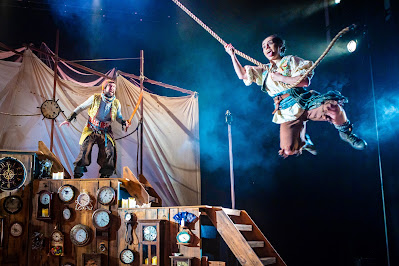
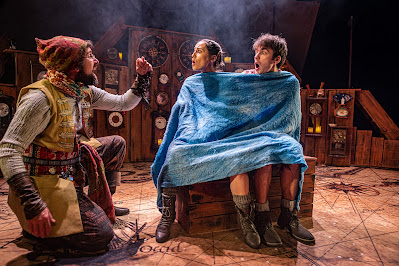
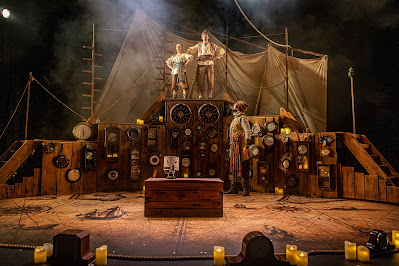
The Untold Truth of Captain Hook – storytelling with tiny details and swashbuckling fights (Replay Theatre at The MAC until 1 January)

The Untold Truth of Captain Hook was one of the last theatre shows I saw before Covid closed everything down in March 2020. Replay Theatre’s origin story for the pirate villain in Peter Pan was part of the 2019 Belfast Children’s Festival. And now the already well-developed production has returned to The MAC’s stage as their kids show for Christmas 2021 with a few updates.

James is a minute older, a foot taller, and a decade less spontaneous than his twin brother Peter. When their mother dies and their father breaks down and disappears, the brothers have to fend for themselves. But ‘better together’ isn’t always an enduring strategy, and when the two lads become separated, one grows up quickly while the other clings onto childhood out of a fear of further loss.

Clocks and candles adorn Diana Ennis seafaring set with a myriad of doors and hatches secreted in the wooden panelling. Niomi Liberante and Christopher Grant are back playing twins Peter and James, with Liberante acrobatically tumbling around the set with her character’s youthful vigour, while Grant matures from cautious seriousness to downright swagger.

Keith Singleton joins the cast as the narrator, an actor with a sparkle in his eye and a voice and a toolkit of gestures that draw the audience into his confidence. The twin’s mother and a number of other characters are performed by Christine Clare.

David Morgan’s tale of the twins growing up, becoming orphaned and dealing with setbacks as they find their way in the world feels fresh. The puns throughout – verbal and physical – are great, and the ending is satisfying as it draws together various strands to feed back into the wider understanding of the Peter Pan story.

About 40 minutes into the hour-long show, the story sails into quite dark waters for an extended period and I’m in two minds whether the narrator’s warning asides to the audience are necessary to lighten the mood, or whether the writing in that section just needed to be tweaked to more quickly steer the action into calmer seas.

Suitable for children (and parents of children) aged five and above, Janice Kernoghan-Reid’s direction values the small, intimate gesture – like folding an origami boat – as much as big swashbuckling fights and swinging out from a mast towards the audience. Shadows projected onto the set’s sails are nearly indistinguishable from the real ones.

Children and adults alike will understand the feeling of growing up in a hurry. They’ll know about promises being made … and broken. And they’ll remain intrigued to see which piece of the set Liberante and Grant will pop out of or disappear into next!

The Untold Truth of Captain Hook is docked at The MAC until 1 January

Photo credit: Melissa Gordon

Enjoyed this review? Why click on the Buy Me a Tea button!

Tuesday, December 14, 2021

Belfast – one tale from 1969 that was as disturbing then as it is now (UK and Irish cinemas from 21 January 2022)

Belfast lingers for 98 minutes in the microcosm of a single street in north Belfast in the summer of 1969. Paramilitary thugs have threatened Catholic neighbours who up until now have lived peacefully with their Protestant neighbours. Young Buddy (played by Jude Hill) witnesses the violence alongside brother Will (Lewis McAskie). His father (Jamie Dornan) works over in England leaving his Mum (Caitriona Balfe) and paternal grandparents (Judi Dench and Ciarán Hinds) to bring him up.

For the most part filmed in black and white, the historical action is sandwiched between colourful and rather artful drone shots of modern Belfast that suggest Van Morrison’s Days Like This may have come to pass. The action out on the street looks all the more violent for being captured in monochrome.

There’s a richness to the details captured in Belfast that’s often absent in other Troubles-related films. That the humanitarian and peacekeeping Star Trek is playing on the home’s TV set adds a layer of irony. The close-up shots of the scary Protestant preacher are really not that exaggerated, with beads of sweat trickling down his face as he threatens the congregation – including little Buddy – with eternal damnation. Scared not to go to church. Scared when they do go.

And with the film telling the story from Buddy’s perspective, he would have felt the presence of a larger-than-life preacher, much as he would not have seen the true context of the trouble on the streets around where he lived.

Ulster humour seeps through the film’s dialogue, particularly as Hinds finds ways to ignore his wife. Dench’s accent is poor but forgivable: maybe she was a blow-in to ‘the province’ fifty years ago? Van Morrison’s pronouncements around Covid will also have to be overlooked as his contribution to the film’s score is second to none. Community spirit abounds, boosted by the forces of opposition that cause the street to be barricaded at one end and patrolled through the night by local volunteers.

If the humour is authentic, so too is the strength of character of the women who held society together. Buddy’s Mum is no doormat and won’t be quickly bounced into agreeing to her husband’s plan to take flight. Balfe portrays a woman whose principles are strong and survive being tested, even if Buddy is marched back to the scene of a crime without quite thinking through the consequences.

Dornan swans in and out of town, loved by the kids, but in constant tension with his wife. The uncertainty about his true job, and his less binary way of analysing the changes in his street mean we fear that he might even be mixed up in the trouble. It’s both plausible and engaging.

Belfast is a film about identity and community, about the limitations and consequences of standing up to intimidation and gangsterism. It turns out that those themes are still as worthy of consideration in 2021 as they were in 1969.

Fictionalising any aspect of the Troubles is a dangerous game for a film producer or director to play. Local audiences will question their agenda, are they promoting that or misrepresenting that?

Kenneth Branagh walks a line that largely lets the viewer make up their own mind about what’s going on. Ostensibly, it’s about a family who want to live well with their neighbours and abhor the violence. But the film doesn’t fall into the trap of moralising and painting goodies and baddies. Instead, Belfast subtly paints a picture of a family tearing itself apart in parallel with the street they live on and, by inference but not often visualised, the rest of the city.

Is Branagh looking through a rose-tinted lens at a city that tore itself apart for a couple of decades. Yes and no. No one story can – or should be expected to – paint a picture of a whole conflict. Did everyone behave like Buddy’s family? No. But some did and their stories should be told alongside other (already more common) narratives. And the film does share the fears and motivations of those who thought they were ‘protecting’ their area.

Belfast will do well outside Northern Ireland. It tells a compelling story from the perspective of a young lad who is so naturally portrayed by Jude Hill. Branagh’s real success – if it actually matters – will be to not have overly wound up local audiences! And I see little reason why it should.

It’s clearly a very personal film for the writer and director who has based the plot on some of his own memories and experiences. The film ends somewhat ambiguously. But we all know that there was no happy ever immediately after in 1969. As the film closes, a dedication appears on screen that reminds us that what we have just watched didn’t resolve after a couple of months:

“For the ones who stayed. For the ones who left. And for all the ones who were lost.”

It’s a sobering and fitting end to a snapshot of Belfast and a family that were spiralling into crisis. Belfast goes on general release across UK and Ireland from 21 January 2022.


Enjoyed this review? Why click on the Buy Me a Tea button!
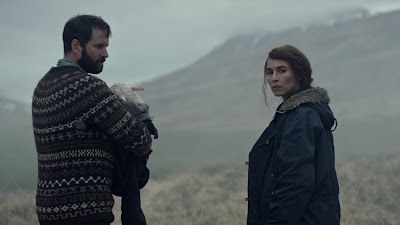
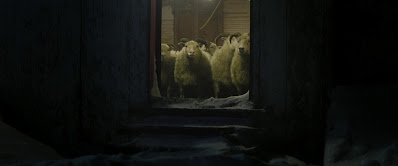
Lamb – a horrifyingly cute ovine tale from Iceland (QFT until 16 December)

Perhaps there’s an underground scene of humdrum Icelandic films, but certainly the ones that make it to the screens of Belfast don’t disappoint. Between the rugged landscapes and the quirky sense of what’s normal, their filmmakers concoct tales of the unexpected. Woman at War, my favourite from the 2019 Belfast Film Festival, was a crazy example of the finest.

Despite its name, Lamb is nothing like another sheepish Icelandic tale Rams. Instead of the frosty relationship between two bachelor brothers, Lamb drops in on the frosty relationship between a couple living on a remote sheep farm. There’s a lot of sorrow, little affection, and precious few words between María and Ingvar.

Much is hinted at, little needs to be said, and even less is spoken in Lamb. The opening sequence, with a spirit singling out a single ewe in the barn, followed by Christmas music on the radio is a hint at what will follow.

When the two farmers help birth a lambchild out in the sheep shed, their lives start to defrost. Little Ada is much loved and completes their broken family. But an upset ewe, the arrival of Ingvar’s brother, not to mention the sinister presence that the farmyard animals can detect, threaten the unconventional nuclear family. To what lengths will a parent go to protect their offspring?

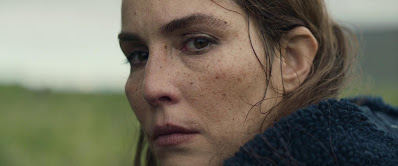
Noomi Rapace gives María a fierce on-screen intensity – at once lonely, sorrowful and expectant – while, opposite her, Hilmir Snær Guðnason copes with his inner emptiness by throwing himself at the rhythm of work on the farm. Björn Hlynur Haraldsson’s appearance as Uncle Pétur mirrors many of the audience reactions to the gradual revelation about Ada’s form, with sideways glances, denial, and then signs of love for the wain. However, the enduring flame that Pétur’s burns for his sister-in-law underscores the more menacing aspects of his disturbed personality.

Lamb combines a few moments of surreal comedy with acres of fantasy and borrows heavily from horror. The audience are made to laugh, feel warm and fuzzy at cuteness, admire an Equity card-carrying cat, and marvel at this unexpected but worthy addition to the list of Christmas movies. The locked-off camerawork places the characters against the stunning scenery and adds to the sense of suspense. The close-up shots of sheeps’ faces make me want to visit an open farm and take portraits of their flock.

Metaphorical? Magic realism? Lamb will leave you with a myriad of possible explanations for its 106 minutes of ovine storytelling. It’s a great feature directorial debut for Valdimar Jóhannsson. An Icelandic tale to warm your heart or make your blood run cold. Ewe You decide. Screening at the Queen’s Film Theatre until Thursday 16 December

Enjoyed this review? Why click on the Buy Me a Tea button!

Monday, December 13, 2021

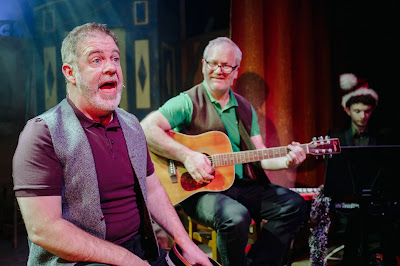
Grimes and McKee’s Christmas Album – rockin’ the Lyric Theatre until 30 December

Would it truly be Christmas in Belfast if Grimes and McKee couldn’t step onto a stage and bring merriment and mirth to festive audiences? My first experience was back in 2009 – Howl! performed in QUB’s Elmwood Hall while the Lyric was being renovated – but they’ve been actin’ the lig at Christmas since 1998 and there are families that loyally follow them from venue to venue to partake in their annual tinsel-tipped ritual. (2016’s The Nativity … What the Donkey Saw is definitely my favourite.)

This year, pandemic complications have allowed the comedy pair to escape the shackles of a single narrative (and other cast members!) and allowed them to weave together sketches with a series of recurring characters, accompanied by keyboard maestro and butt of their jokes, Matt Evans.

Grimes and McKee’s Christmas Album opens with a couple of lads from up the country who have met up in the big smoke. Jim Reeves meets Elvis Presley in the first of a series of wig-tastic musical giant encounters. And two failed shopping channel presenters try their hand at a Saturday morning cooking show before turning to online streaming to pay the rent.

It’s a vintage year for the comedy duo, but a few moments stand out from the show.

Firstly, the extended Christmas-themed Gospel reading in Ulster Scots (“the wee doll wi’ the name a Mary doin’ a line wi’ the lad Joseph, a chippie” who found the inn was “clean bunged to the rafters”) from midnight mass in Pomeroy is a moment of magical genius. The pair – particularly Conor Grimes – may have missed their true vocation!

And then there are the songs performed in the ‘Oirish’ folk club. Back in the days of Barry Cowan and David Dunseith, Radio Ulster’s lunchtime Talkback programme sometimes included musical skits. Somewhere in a box I’ve a recording of one of their Christmas specials from the late 1980s that was full of clever lyrics sending up contemporary issues. Last night’s creations were up there with the best of them.

When McKee launches into the open lyric “Boris did a protocol that Arlene didn’t like” the audience are quickly in stitches. After the interval, the satire returns with a tribute to “all the virologists on Facebook”. (For anyone seeking balance or searching for offence – that’s a polite way of flagging up potential whataboutery – Robin Swann earns a new nickname and senior Sinn Féin figures don’t get away unscathed in other sketches.)

It’s a flexible format that exploits the pair’s strengths. Grimes’ mannerisms and comedic delaying tactics feed off the audience’s warm response, while McKee’s tongue’s grasp of complicated dialogue and lyrics is a joy to the ears. The humour is less forced, and less crude, than some of the previous story-centric shows, rewarded with repeated howls of hysterical laughter that resonated around the Ridgeway Street wooden auditorium.

If you want your funny bone tickled, you can find Grimes and McKee’s Christmas Album in the Lyric until Thursday 30 December.

Enjoyed this review? Why click on the Buy Me a Tea button!
Sunday, December 12, 2021

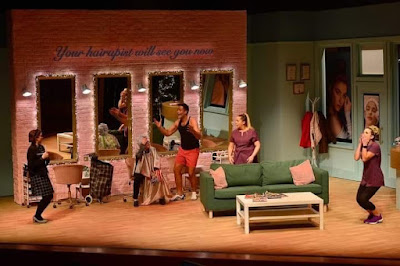
Jingle All the Hairspray – a great heart-warming hairytale of Newtownabbey (Theatre at the Mill until 31 December)

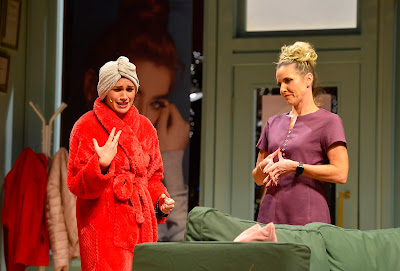
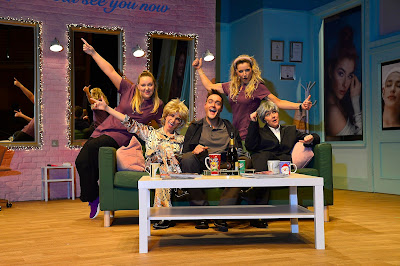
Ali has a lot on her mind. The owner of the Scary Bears Hair and Beauty Salon has an important inspection due on the eve of her final day owning the business. And a ten-year wedding anniversary to celebrate. All on top of the colourful customers bursting through her shop door looking to get their hair done or a treatment two days before Christmas.

Jingle All the Hairspray: A Christmas HairyTale a show about second chances – some people deserve them, others are surely only out to hurt you again – and being upfront about what you want in case there’s no tomorrow. And there are messages about looking out for one another, and not being a doormat to domineering and abusive partners.

The show’s anchor, Claire Connor (playing Ali) is first to step on stage with a scene-setting song that anchors the rest of the action. Caroline Curran plays her young assistant Tina while Jolene O’Hara and Mary Moulds spin through the beautifully eccentric clients. O’Hara’s characters start off outrageous (Tracy) and yet grow ever more larger than life (Courtney in need of some intimate topiary), while Moulds has great fun with the sweary old lady and regular customer Pauline.

Patrick Buchanan is the dreamy delivery man who catches Tina’s eye, but also metamorphoses into Ali’s overbearing and villainous husband.

As the playwright and a performer, Caroline Curran knows her audience and has crafted a well-structured script that leads the audience – with a few red herrings thrown in along the way – towards a final confrontation with a twist. And this year’s show throws in a lot more songs, and the cast’s voices are well up for it.

Curran’s sharp-tongued writing together with Garth McConaghie music pepper the plot with musical numbers that keep the comedy flowing whether the words are being spoken or sung. Buchanan is gifted the brilliant I’m just the Amazon man in the first act, while I bet no other show on stage this Christmas will manage to work ‘emphysema’ into a rhyme.

References to local places trigger audience laughs along with hearing aid difficulties, a tan that goes wrong, and a series of wedding emergencies. Although the show is sensibly marketed as being suitable for 16+, any vulgarity remains tasteful.

The mirrors in David Craig and Tracey Lindsay’s one room set create a spacious salon, while returning director Fionnuala Kennedy gives the script space to breath and gather its laughs without allowing the cast to race forward to the next gag. And attention to characters’ mannerisms (the way Ali’s husband pats the cushions with obvious disdain) really adds to the detail of the piece.

After the interval, the emotion ramps up as Ali’s future lurches towards catastrophe. You got us is a great song celebrating sisterhood, while the male characters are rewarded with Another good man got away and Get out! The second act includes a touching tribute to Julie Maxwell, Curran’s former writing partner and regular cast member in the Newtownabbey Christmas show until her sudden death in 2019.

It’s lovely to see the pattern of Rough Girls being repeated with the stage management team (Caoimhe McGee and Holly Greig) coming on stage at the end to take a bow on behalf of the wider production crew.

After a decade of Christmas shows in the Theatre at the Mill, Curran’s regular supporters will have their fingers crossed that she’s not doing an Ali and checking out of such a successful business. The hairytale of Newtownabbey is the latest in a long line of shows the team have produced and one can only hope that they’ll be back in December 2022.

Jingle All the Hairspray is filled with heart and soul. It’s a Christmas tonic that’s down to earth but very entertaining. Catch it in Theatre at the Mill until Friday 31 December.

Wednesday, December 01, 2021

Goldilocks and the Three Bears – not too daft, not too straight, but just the right mix of glam and fun (Grand Opera House until 9 January)

After a few pre-pandemic festive morsels that were on the stale side, the Grand Opera House’s Goldilocks and the Three Bears is an all singing, all dancing spectacular that feels familiar, yet modern and fresh.

Paddy and Dame May McFetty’s circus is in facing financial ruin if they can’t find a new star for the show. Joey the bumbling clown thinks he is the answer to their problems, and their daughter Goldilocks future happiness. Meanwhile, the evil Countess Von Vinklebottom runs a rival circus and has designs on the family of talking bears. Throw in a juggler, a tightrope walk, eight dancers, a very glitzy set, and the rampant Belfastisation of Alan McHugh’s script and you have quite a show.

There’s absolutely no let-up in the pace from the opening medley of childhood tunes, the introduction of the baddie (the audience don’t even have to be told to boo), and the boundless energy and chutzpah of Adam C Booth’s Joey ... you’d think Red Bull were sponsoring the theatre’s wings!

There’s nothing novel about the format – it’s a classic Qdos Crossroads Pantomime structure – but it’s incredibly well polished delivered. Ian Westbrook’s set with ever decreasing arches is emblazoned with hundreds of lights that set the mood of every scene. The circus theme is a good excuse to allow Alfio Macaggi to throw his balls and hats into the ring before returning to demonstrate his incredible upper body strength with a routine that will thrill any polercise aficionados in the audience.

May McFettridge (aka John Linehan) is in better form with a much less caustic audience repartee than I recall in 2019. Sidekick Paddy Jenkins fills a somewhat expanded role this year while newcomer Kia-Paris Walcott ably belts out her numbers as Goldilocks.

Norn Iron accents are to the fore when Mummy and Daddy Bear step on stage. While local legends Jo Donnelly and Marty Maguire are somewhat underused, one hopes that their connection with the panto and role within it will be long term and grow over time. Kira McPherson completes the furry family.

There’s a lot of glitter, just enough tame vulgarity to make the adults smirk over the heads of their youngsters, and pyrotechnics galore (a lovely shooting star effect at one point). There’s a noticeable reduction in the number of cast members on stage this year, but the simpler line-up improves the overall flow of the show. Aside from the human performers, a lot of effort goes into effects that are somewhat casually rendered as part of the show: a huge animatronic gorilla dominates the back of the stage in one scene and really deserves more credit. And Joey’s tightrope walk probably deserves a bit more drama.

If you’re looking for a traditional panto – not too daft, not too straight, but just the right mix of glam and fun – then Goldilocks and the Three Bears might be for you. Performances continue in the Grand Opera House until 9 January.

Photo credit: Brian Thompson.


Enjoyed this review? Why click on the Buy Me a Tea button!