Saturday, July 30, 2022

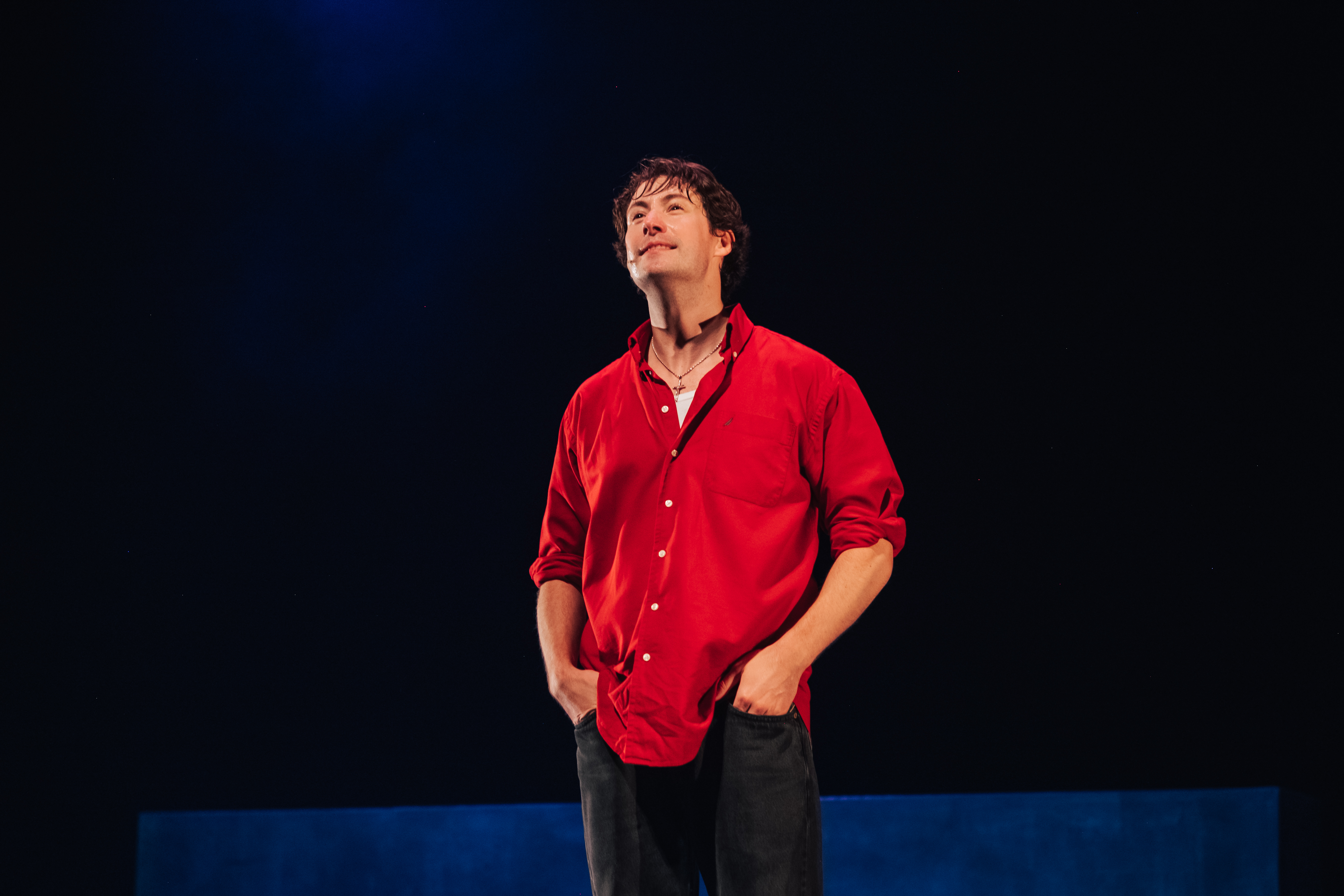
Breadboy – part lament, part hope-filled musical memoire (British Youth Music Theatre at Lyric Theatre until Sunday 31 July)

British Youth Music Theatre have been back in Belfast at the Lyric Theatre. They specialise in rehearsing and staging new musical theatre. Breadboy builds on two previous pre-pandemic runs of Paperboy, both adapted from the well-known memoires written by Shankill Road-reared Tony Macaulay.

The gist of the story is that pacifist Tony has outgrown his paper round and picks up a job working on the Ormo mini shop that drives around selling bread and sugary goodies to local residents. It’s 1977 and the King is dead, hormones are flowing, his school is auditioning pupils for a musical, and the streets aren’t always safe at night.

The production can be judged through many lenses.

The score, lyrics and book retain the recognisable essence of Tony Macaulay. Yes the younger and naïve paperboy who things happened to in 1975 has now matured into a 1977 breadboy who is figuring out what he thinks and feels about the dark and menacing aspects of society. But the countercultural and terribly uncool love of sci-fi and ABBA is still there.

Duke Special’s score stretches from poppy celebrations (Superstar) to sweet duets (The Burning, Invisible World), contains a tearjerker of a reprise of A River Runs Beneath Us from Paperboy, as well as beautifully dispensing with all unnecessary foreshadowing of key changes and just charges into the next line. The West Side Story medley that accompanies the auditions in the second act is superb and shows off the vocal talent of many cast members. Andrew Doyle’s use of Belfast vernacular creates a lot of humour in the dialogue and some crazy lyrics.

Another aspect of the production is the set and choreography that make extended use of crowd control barriers that can break up the stage, provide perches for the cast to loiter, all the while harking back to the days of conflict where they kept crowds away from bomb scares and unsafe buildings. The improvised Ormo van is stuffed full of bread and fizzy drinks. But the best wheeled prop is Tony’s typewriter table which is propelled at speed back and forth across the stage– along with the actor – like an air hockey puck during Stop The Press.

The Ormo van provides cover for the neat transition between 14-year-old Tony (Judah McKee) and his older self (Jude Leng) when the story jumps three years ahead in time. Both McKee and Leng deliver their at times dense dialogue, starting and stopping their explanatory asides to the audience with a click of their fingers, and expressing the growing unease with which the central character views his world.

Colin Bracken has fun with the role of a left-wing Elvis who is a wonderfully surreal presence in many crowd scenes, part of the internal world that Tony inhabited. He also neatly doubles up as a UVF hard man. Sam Downey is disco-tastic as tall posh Timothy, charming the girls and never missing a chance to steal the limelight for himself.

There’s romantic mirroring with Tony only having eyes for Judy Carlton (Millie Downes) who can’t even remember his name – “She doesn’t know that I exist / She’s like a vivisectionist who takes a scalpel to my heart” – and Irene (Juliette Pierce) who Tony brushes off despite her attempts to grab his attention over many year. Both actors have great singing voices for Tonight – the West Side Story subplot gives many of the cast a chance to show off their talents – but it’s Pierce who gets to develop her character from a quiet wallflower to a campaigning young woman seeking justice in the rehearsal room. But will Tony notice this kindred spirit?

Molly Houlahan also deserves a special mention for Denise’s comically-broad Belfast rendition of I Feel Pretty as does Iona Holt who injects a lot of life and plenty of attitude into Tony’s spirit-fuelled Granny. Interestingly, the audience on press night didn’t have the nerve to applaud her beautifully constructed and deliberately sectarian grace said before the Macaulay family tuck into a cooked breakfast.

Part lament, part hope-filled, Breadboy watches a young man grow up, shaped by mentors like his next-door neighbour Mt Oliver (Matthew Lawson) whose life is cruelly cut down, and figuring out what he wants to stand for and speak out about. The script manages to dilute the occasional moments of preachiness with a quick splash of humour (aren’t Alliance wishy-washy middle-of-the-road, but that’s what they say about ABBA). A final video connects the late 1970’s characters with the modern actors and the continued existence of physical barriers – peace walls – in the cityscape.

Staging a new work under the pressure of time with a large cast is always going to be a tricky exercise. A longer rehearsal window might have given directors Steven Dexter and Dean Johnson scope to improve some of the accents and helped relax some cast members into a better rhythm for their longer bursts of dialogue.

To have secured such solid choreography, singing and confidence with lines in such a short period, and kept the heart and soul of a coming-of-age story about coming to terms with a fractured world is a credit to the performers and the creative team.

One of the lyrics reads “the children of tomorrow will forget about the war”. Hopefully, the Breadboy and his van will pass by this way again and another group of youngsters will be able to bring the past and the future to life as they hone their musical theatre skills and make sure that the past is understood and not forgotten. 

Photo credit: Chris Hill

Enjoyed this review? Why click on the Buy Me a Tea button!

Wednesday, July 27, 2022

Joyride – a distraught mum and young lad find themselves while getting lost in Kerry (cinemas from 29 July)

When Mully (Charlie Reid) spots his father (Lochlann O’Mearáin) stealing the money raised at a hospice charity fundraiser in the memory of his dead mum, the young lad grabs the roll of cash and legs it before hoping into the front seat of a taxi and racing up the road. He’s somewhat startled to discover a baby sitting in the back seat. Even more perturbed when he finds the mother Joy (Olivia Colman) drunkenly snoring behind the driver’s seat.

Both Mully and Joy are on the run, from their past, their families, and their circumstances … but mostly themselves. Over 90 minutes, Joyride tours around the back roads of County Kerry, as we discover that Mully is far more paternal than new mum Joy, and the unlikely pair come to terms with what they should do next.

The dialogue is superb – “you’re a dose!” – even if “mentalist” is repeated ad nauseum. The visual humour includes “deadly” vignettes of Irish rural life. An enormous baby’s head on the back of a tractor trailer is unexpected and very apt. The showband artist is a treat. The server in a fast-food truck has an engaging attitude.

Colman throws herself into the role as an emotional trainwreck. If this can be described as a coming of age film, it’s middle aged solicitor Joy who is doing the growing up. There’s a beautiful scene – though opinion at my screening varied with one previewer describing it as giving her the “ick” – when an absence of formula or expressed milk is combined with a crying baby and the moment Joy’s milk comes. Mully’s experience of being around another baby in his family circle means he’s a bit of an expert at how a baby will root and latch onto a nipple. Joy’s utter exhaustion leaves the young Mully acting as her midwife. Soon mother and baby are relieved. With the film’s release colliding with Breastival and World Breastfeeding Week, it’s a lovely moment.

Overall the film is well named: a lot of different vehicles are purloined. Screenwriter Ailbhe Keogan sets up the film’s finale with an extreme moral test for the two parents. However, Joyride isn’t serious drama. It’ll be released on VOD or network TV long before anyone at the Academy of Motion Picture Arts and Sciences is troubled by it. Joyride is up there with Waking Ned in terms of its reliance on hapless public officials, empty backroads and Oirish stereotypes. But director Emer Reynolds delivers laugh out loud moments and plenty of escapism. You’ll either love it or hate it, but I hope it’s the former.

You can find Joyride will be idling with the door open in the Queen’s Film Theatre from Friday 29 July–Thursday 4 August and also showing in Movie House, Omnipex and Odeon cinemas. 

Enjoyed this review? Why click on the Buy Me a Tea button!

Tuesday, July 26, 2022

In the Name of the Son – frenzied portrayal of a man unable to find freedom (Grand Opera House until Saturday 30 July)

Within the opening ten minutes of In the Name of the Son, actor Shaun Blaney has conveyed Gerry Conlon’s journey into and out of prison, through his bespoke shop-lifting which was interrupted by the Troubles, his unexpected arrest for IRA bombings in Guildford, his father’s arrest and subsequent death in prison having travelled over the England to get him a solicitor, and the quashing of Gerry’s conviction.

Yet the tragedy has only begun. Richard O’Rawe and Martin Lynch’s play (based on O’Rawe’s book) demonstrates that Conlon might have been freed from his cell, the Belfast man was still imprisoned by the lasting effects of the miscarriage of justice, and in particular the death of his father. Conlon is driven to see the film In the Name of the Father go into production with a strong cast. But will the process be the end of him?

Blaney delivers a frenzied performance, leaping around the ingenious set from which there is no freedom, dancing, switching characters, and at one stage beating himself up in a particularly comedic fight.

This is precision theatre, with zero room for hesitation, never mind error. Layers of sound effects need to perfectly align with lighting cues and Blaney’s position on the set. Then, bang, onto the next, and the next. It’s the theatrical version of a giant set of unstoppable dominos falling over to create a beautiful pattern out of chaos. How director Tony Devlin can hold all the moving parts in his head never mind the technical team and the actor is a marvel.

At times, Garth McConaghie’s sound design takes on the quality of a film score with key moments in the script bolstered by sweeping strings. But it’s in the quieter scenes, sometimes without any dialogue, that the noise of pipes running through prison cells or the melee of a bar will enrich the one man show and lift the audience closer to the enormous Grand Opera House stage.

In the Name of the Son is not an easy play to watch. Conlon’s spiral into drink and drugs is very destructive. His lack of respect for others – particularly women – mirrors his lack of self-respect. His suicidal thoughts create bleak moments in a story that is becomes more shade than light as it progresses.

Levity comes in the least expected places: the toilets bogs at the Oscars turns out to be fertile ground for Conlon interacting with well-known actors and singers and demonstrating Blaney’s versatility.

But it’s the conversations with Conlon’s mother that are the most touching moments of the two-hour play. She’s portrayed as the one person who will stand up to Conlon, challenging his sense of survivor’s guilt and holding him to account.

In the Name of the Son continues in the Grand Opera House until Saturday 30 July. 

Photo credit: Johnny Frazer

 Enjoyed this review? Why click on the Buy Me a Tea button!

Saturday, July 23, 2022

The Pirates of Penzance – 175 teenagers, 10 days of rehearsal, 4 performances (Grand Opera House Trust Summer Youth Production until 24 July)

The Grand Opera House Trust delivers a swashbuckling summer youth production of The Pirates of Penzance with a cast well north of a hundred cramming onto the stage and aisles to bring Gilbert and Sullivan’s comic opera to life.

When young apprentice Frederic turns 21, he expects to be able to leave the pirate company he was accidently enrolled in and return to be a landlubber who can fall in love and marry … that is once he’s wiped out his former somewhat lily-livered pirate companions in the first of a number of calls of duty. The plan seems to be going swimmingly when a fine soprano catches his eye from amongst a “bevy of beautiful maidens”, but then her father turns out to be a Major-General and the lad’s leap year birthday unexpectedly extends his pirate service.

The cast and creative team really exploit the sense of comedy that pervades Gilbert and Sullivan’s score and libretto. With so many people to coordinate, the mammoth choreography keeps the stage alive with pockets of detail and clowning about. No one ever looks lost or unsure of what their character should be doing or emoting. A few times during the first act, while you could hear a principal cast member singing, it was hard to spot them against the sea of ensemble faces, a product of costume choices as much as direction.

The principals are all strong performers. Hats off to the pirate trio of Richard Collins (Frederic), Robbie McMinn (the Pirate King) and Tyler Barr (who brings just the right amount of tomfoolery to his role of Samuel). While the sign in the foyer drew attention to Thaii Berry slipping into Edith’s shoes, nothing about her performance would have suggested that an understudy was on stage alongside Caroline McMichael (Kate) and Ellen Taylor (Isabel).

The best entrance of the show was the arrival of the eccentric Major-General with Jackson Allen strutting on stage in his diving flippers and rubber ring. The absurdity suited the comic opera. And Allen’s diction and charisma nailed the Major-General’s iconic song to the delight of the audience. 

Lucia McLaughlin’s soprano voice effortlessly delivers Mabel’s ornamental melodies and lungtastic phrasing: surely one to watch for future light opera productions around Northern Ireland. And Grace Husarz’s treatment of Ruth (the older nurse maid who mistakenly brought Frederic onto the pirate ship and now hopes to escape with him as her husband) develops greatly in the second half when she can set down her basket of washing and become a full-fledged swashbuckling pirate with lots of entertaining side-eye. Another one to watch for comic musical roles.

Down in the orchestra pit, the band (mostly youth) under the direction of Wilson Shields do justice to Arthur Sullivan’s music. While the set, sound and lighting all assisted the story telling, one thing that was largely missing from this Summer Youth Production was a sense of the deeply political undertones of The Pirates of Penzance, lampooning the ineffective police, questioning the aristocracy (“contrasted with respectability, [piracy] is comparatively honest”) and questioning meaninglessness of being a slave to duty. It’s a lot to ask of a youth staging though at least the direction around Ruth’s character pleasingly acknowledged some of the outright sexism in Gilbert’s lyrics.

The breath-taking pinnacle of the performance comes near the end of Act One when the band drop out and the Pirate King uses his sword to conduct the vast ensemble who sing a beautiful a cappella version of Hail, Poetry in four or more part harmony. Wisely, director Tony Finnegan allows the cast to bow out at the end of Act Two with their party piece once more. It’s the moment that demonstrates the breadth of talent on stage, and cements the achievement of 10 days of rehearsal that have led up to the curtain rising in front of paying audiences.

With only four performances, the youth production’s run of the fully-fledged comic opera finishes with a matinee Sunday 24 July. When will you ever see 175 teenagers on, under and back stage involved in a musical production in Belfast again? 

Enjoyed this review? Why click on the Buy Me a Tea button!

Thursday, July 21, 2022

Where the Crawdads Sing – birds, beasties, bullying and betrayal in the marsh

The natural history embedded in the debut novel of Delia Owen jumps off the page and onto the cinema screen in Where the Crawdads Sing. The North Carolina waterways and marsh land, the insects, birds, crustaceans and molluscs are captured in glorious detail alongside their young documenter Kya.

Kya has grown up in a remote household that suffered from the domestic abuse of her alcoholic father which led to the departure of her mother, her siblings, and eventually even her father, leaving Kya to learn to survive and thrive on her own in the 1960s. She is known as ‘the Marsh Girl’ by the distrustful local townsfolk who never welcomed the family into their community and did nothing to protect the children. The only people looking out for her are Ma and Pa (Ahna O'Reilly and Garret Dillahunt) in the local store.

One lad she meets while pootling around the wetlands to collect mussels to sell takes an interest in her. Tate (Taylor John Smith) patiently schools Kya in the 3 Rs, and treating her with respect before completely ghosting her. A second young man Chase (Harris Dickinson) enters her life and is much less pure of heart and manipulates her emotions. His death is pinned on the strange Marsh Girl who the town has mythologised into a marsh monster. Her lawyer (David Strathairn) valiantly tries to deconstruct the mountain of flimsy speculation that is presented as evidence.

The film is constructed as a long series of flashbacks, occasionally interrupted by a courtroom drama. However, the flashbacks are much more interesting than the mundane legal scenes that are meant to sustain the sense of suspense. But we should be thankful that it’s only a two hour film and not a six-part mini-series.

Jojo Regina and then Daisy Edgar-Jones (Normal People) put life and soul into the central character, creating a warm albeit solitary persona who is more at home studying and drawing the marsh than interacting with the other humans who threaten to disrupt it and disturb her placid existence. Both their performances carry the somewhat undramatic scenes as we watch a girl grow up alone.

Much credit should go to the cinematographers who beautifully capture the birds and beasties of the marsh. And Kya’s shack and her archive of drawings are a tribute to the detailed eye of the production designers.

Ultimately, Where the Crawdads Sing is a story about mood. It’s about how a community can bully and betray someone who it should be protecting. It’s about alternative ways of living. About thriving and surviving when no one has your side.

Unfortunately, Where the Crawdads Sing is also about scratching your head to ask how a hermit can have such a natural sense of fashion and whether such an extensive wardrobe is realistic given their hand to mouth existence living off the marsh.

The final twist is true to the book but quite possibly unnecessary on film. Aside from prosecutor’s case in the court, the film leaves open at least one other explanation for the death at the heart of the story. The manner of the on-screen explanation, after more than two hours in the cinema mulling over the possibilities, somewhat ruined the feeling of intrigue.

Where the Crawdads Sing is being screened at the Queen’s Film Theatre and as well as The Strand, Omniplex, Movie House, Odeon and Cineworld cinemas. 

Enjoyed this review? Why click on the Buy Me a Tea button!