Monday, August 29, 2022

Her Way – trope-defying tale that trips up in its exploration of class and toil (QFT until Thursday 1 September)

A parent worrying about the education and prospects of their child. It’s a universal story. Her Way tells it from the perspective of an independent-minded, self-sufficient woman Marie in her late thirties whose son Adrein has a flair for cheffing but has been expelled from his college and is being drawn into weed and a career in the military rather than a life creating masterpieces in the kitchen. Her solution is to enrol him on a course in an expensive private school. But deflationary pressures affecting her own ‘street work’ career in Strasbourg means raising funds will be a struggle.

The good-hearted prostitute is also a much-visited movie trope. Marie (Laure Calamy) is neither presented as an object of pity, nor a woman to be lusted after. Instead, she’s confident, campaigning and unapologetic. She’s organised, keeping notes on her clients: mini-report cards on what they’re good at and how she can help them improve. She has tax returns to hand when her bank manager interviews her for a loan. Her golden coat is worn as a work uniform rather than a disguise or armour. She makes bold choices and lives with the consequences, all the while trying to transform the other people in her vicinity.

Young Adrein (Nissim Renard) veers from sullen through stoned to anger. But the moment he finally admits “I’m scared” unlocks something in the audience understanding of his character’s motivation.

Her Way suffers from unnecessary explaining: the director’s ability to let the audience see and sense the story is defied by the editor’s unwillingness to cut dialogue and scenes that only reinforce what we already know. An added ethical quandary somewhat derails what could have been a smooth approach to an already satisfactory destination.

Let down by all the men in her life, can Marie’s instinct to help people win out over the cost she pays by switching from the freelance life to a waged position? Her Way is a study on class. On opportunity. On the specific economic ethics of an industry in which some women are portrayed as being more trapped (pimped out in slavery) than those who choose to work the streets. But the lessons and questions can be applied much more widely than the story being told on screen.

Her Way is the second French film this summer to trip up in its exploration of class and toil. It’s a shame, because the vision and set up promises so much more than the finished product can deliver. Her Way is being screened in the Queen’s Film Theatre until Thursday 1 September.


Enjoyed this review? Why click on the Buy Me a Tea button!

The Border Game – playful yet deadly serious (Prime Cut Productions, now on tour around Ireland until 1 October)

After Puckoon, The Border Game is probably my favourite play to tackle the absurdities and complexity of the 310 mile line that splits north from south on this island. (Yes, I’d put it ahead of Friel’s Translations.)

Staged as part of last year’s Belfast International Arts Festival, Michael Patrick and Oisín Kearney’s play is back on tour with Prime Cut Productions. The tautness of the script is much improved now that the interval cliff hanger has been ditched.

An old customs hut now lies derelict on farmland that straddles the border. Once the scene of cross-community rutting by a farmer’s daughter and the son of the local grocery store, it’s now where local youths come to party, and where hungover Henry (Patrick McBrearty) spent the night to clear his head. When he wakes up he finds old flame Sinead (Cat Barter in this new tour) clearing up the mess from the partying trespassers.

McBrearty continues to revel in the comedy voices and playful skits as the pair reminisce about the good old days and belatedly deconstruct the ill-understood fault line that fractured their relationship. Barter really exploits the undercurrent of familiarity and the pair’s knowledge about how to press each other’s buttons. Their sparring, verbal and physical, is joyful to watch. Their commitment to full immersion in the mad disco scene seals the impact of a crucial beat in the plot.

Ciaran Bagnall’s set is still full of surprises, and the fact that a barbed wire fence is being fixed with cable ties is perhaps yet another metaphor for the political and policy sticking plasters that are applied to this island’s wounds as a form of damage limitation.

The cleverness of The Border Game’s construction is the way that it litters the production with clues about the pair’s history and the wider socio-political situation in the area while Sinead and Henry clear up the detritus that is spoiling the landscape in which they grew up together. It’s very playful, yet deadly serious as the character’s observe: “this place used to be the centre, now it’s the edge”.

After three nights in the Lyric Theatre, The Border Game is now touring through Galway (Wednesday 31 August), Dublin (Saturday 3 September), Market Place Theatre, Armagh (Wednesday 7), Roscommon (Tuesday 13), Monaghan (Thursday 15), Dundalk (Saturday 17), Sligo (Wednesday 21), Letterkenny (Friday 23 and Saturday 24), Limerick (Tuesday 27 and Wednesday 28), Drogheda (Saturday 1 October). 

Enjoyed this review? Why click on the Buy Me a Tea button!

Official Competition – deadpan Cruz toys with bickering Banderas and Martínez (Queen’s Film Theatre until 8 September)

Take three people with very definite but different creative methods. Throw them together to make a vanity project film for an aging tycoon. Sit back and enjoy the battle of wits and the mental and physical fireworks as they spark off each other in Gastón Duprat and Mariano Cohn’s film Official Competition.

Celebrating a significant birthday has turned Humberto Suárez (José Luis Gómez) towards thinking about his legacy. A building project might have been a more reliable choice, but he buys up the rights to a book that has impressed him, hires the best director, and insists on a preeminent cast.

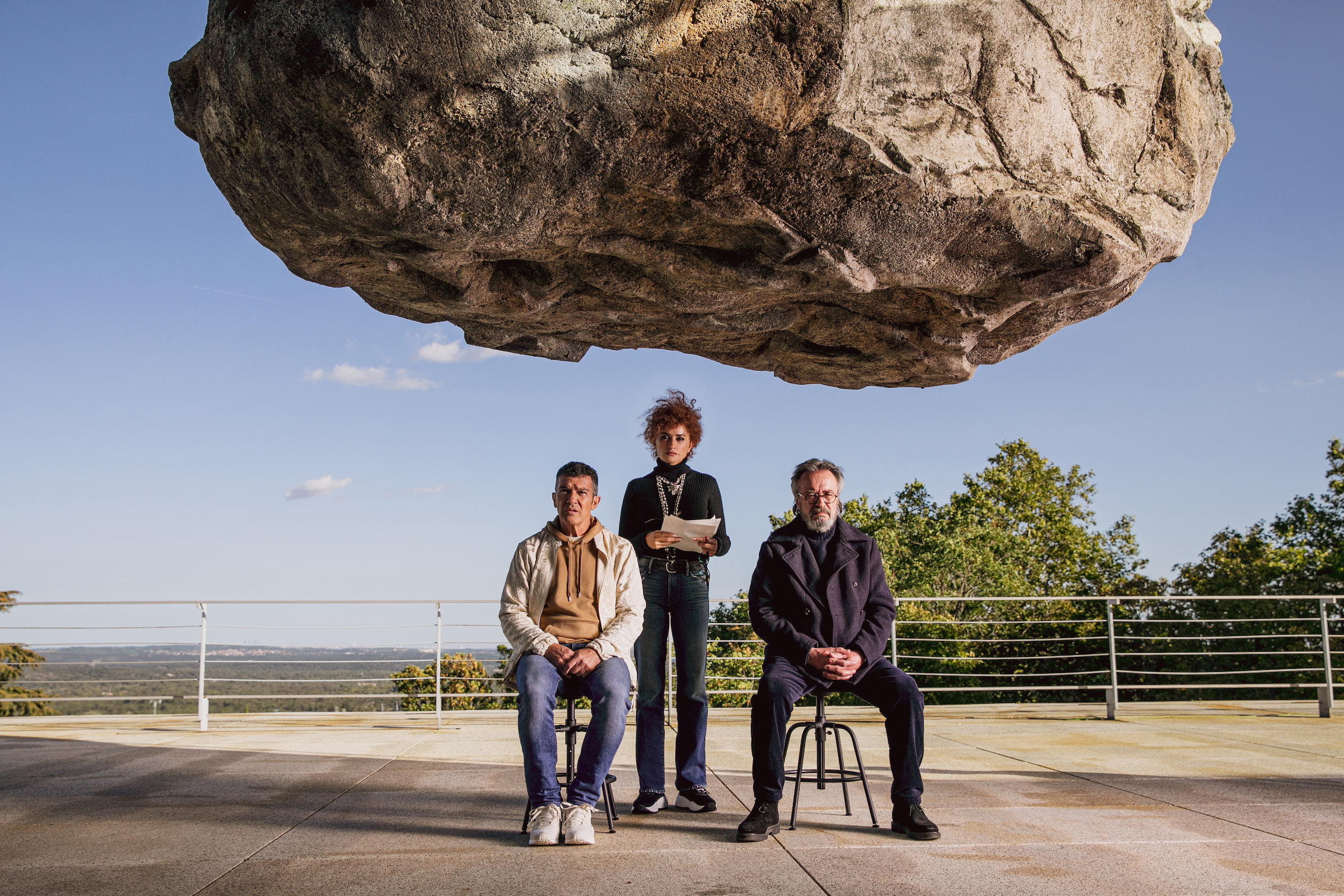
Lola Cuevas (Penélope Cruz wearing a crazy wig) takes on the project, adapting a book about two brothers. She rehearses Félix Rivero (Antonio Banderas) and Iván Torres (Oscar Martínez) in Humberto’s eerily empty brutalist headquarters. Her methods include provoking real emotion in the cast with her hilariously cruel stunts that instil fear and teach the pair about losing autonomy.

Cruz’s deadpan serious delivery wonderfully ratchets up the absurdity. The characters are beautifully observed. Humberto has a childish habit of eating ice cream and is reluctant to interfere with a movie process that he clearly isn’t comfortable with (we can only assume he’s never seen his niece ‘do that’ with a stranger before). Lola illustrates her script with mood boards of fabric, buttons and even breasts, Félix is an older star with young tastes. Image is everything. And Iván’s theatrical mentality and willingness to shun the trappings of celebrity culture totally winds up Félix. Can Lola’s unorthodox methods succeed in uniting the brotherly actors against their common enemy?

There’s a lot of humour – visual and witty dialogue – as the tension mounts towards the inevitable snap when professional jealousy cannot be swallowed any more. Official Competition becomes a beautiful study of what we think of as ‘great’, how tension can be positive, how a director can transform her cast, and leaves you wondering how much of the on-screen rehearsal process was inspired by real events and how much is imagined.

Official Competition is being screened at the Queen’s Film Theatre until Thursday 8 September.

Enjoyed this review? Why click on the Buy Me a Tea button!

Saturday, August 27, 2022

The Producers – highly entertaining satirical teen production (BSPA at The MAC until Saturday 27 August)

You need to throw a lot of energy and confidence at a production of The Producers if you want the parody to shine out above the dark source of the comedy. There’s a fine line between sending up Broadway musical theatre and falling flat on your face making jokes about Hitler and Nazis. But the audience are in safe hands with the teenagers from BSPA (Belfast School of Performing Arts) and their summer production.

Broadway producer Max is nursing his wounds after his latest musical closes after one performance. But soon after, his apparently straightlaced accountant (who has deep-buried notions of becoming a producer himself) points out that a deliberate flop could be more lucrative than a critically acclaimed success. So Max’s army of old lady investors are exploited, the rights are secured to a sure-fire disaster, and a terrible director is signed up. With everything in place, what could possibly go wrong?!

The ebullient Shane Ferris thrives in the central role of Max, using and abusing all around him to make a financial return after a run of bad luck. If anything, Ferris could perhaps push Max to be more outrageous in his buffoonery and become even larger than life. Michael Nevin first walks into Max’s office as a bashful and nervous figure. The ticks and mannerisms of accountant Leo Bloom are spot on. But it’s the revelation of the artistic side to Leo Bloom that makes the performance so entertaining and fulfilling as Nevin flip flops between the two sides of his character with such apparent ease. The pair belt out a raft of pleasing duets and have great comic timing.

Grace Conroy makes a charming if deliberately stereotyped Swedish actress Ulla and develops a good chemistry with Bloom/Nevin – the pair’s ballroom dancing in That Face has real elegance – while Keris Dodds milks her Nazi sympathiser playwright character for every last laugh.

The Producers revels in Mel Brooks’ Jewish humour, innuendo and the inappropriate celebration of fascism. Choreographer Adam Ashford is masterful with the Springtime for Hitler show within a show: the revolving swastika dance is probably the key moment in the production when everything falls into place and the brilliant awfulness of Max and Leo’s doomed musical is revealed.

While the rehearsal time for summer productions is short, director Peter Corry has introduced pleasing flourishes to the scene changes (though I do wish someone had bought about double the width of material for the black net curtain) and the swarm of aging nymphomaniacs tap dancing with their strollers was genius in its invention and execution. In certain scenes, it all becomes a bit too screechy: something to watch out for in shows that demand such energy from the performers.

If I could change one thing it would be to find a way to ditch the pre-recorded music tracks and bring in a live band. With no orchestra pit under the MAC’s stage and cramped wings, it’s not really an option. But while the cast and crew confidently navigated the myriad of sound cues, real musicians would have injected even more life and vitality into the sure-footed and highly entertaining production.

The Producers finishes its short summer run at The MAC with two shows on Saturday 27 August. It’s well staged, highly entertaining, and ticket prices are great value.

Enjoyed this review? Why click on the Buy Me a Tea button!

Wednesday, August 24, 2022

Bat Out of Hell: The Musical – great set piece Meat Loaf hits in a loud rock opera with a zany plot (Grand Opera House until Saturday 27 August)

At its best, Bat Out of Hell: The Musical is very good. An unusual set is enhanced with great lighting and special effects, a very loud PA, and terrific individual and ensemble performances to recreate many of the Meat Loaf hits you can belt out while driving up the motorway.

The plot is a bit bonkers. Elements of the Peter Pan story have been translated to a dystopian Manhattan where the Lost gang (stuck at age 18 due to frozen DNA) live in the subway tunnels while powerful tyrant Falco lords it over the city from his high-rise home. His daughter, Raven, turns 18, but despite Falco and his wife Sloane’s exciting story of how they became a couple, their daughter has been forbidden from leaving her home to spend time with the Lost, and in particular to ‘spend time’ with the motorbike-riding Strat.

The big set piece songs are beautifully performed. Live footage is relayed to a big advertising hoarding from Raven’s recessed upper room on one side of the stage. It’s not a perfect solution. Some of those at the very edge of the stalls or boxes can’t see the full screen, and it means that some of Raven’s songs are sung to camera rather than out towards the audience. But it does allow some detailed close-ups of props that bring personal touches to the narrative.

The direction (Jay Scheib) and choreography (Xena Gusthart) at the start of Raven’s birthday party are like something out of Calixto Bieito’s Turandot opera (performed by NI Opera on the same stage just over seven years ago). Stark choices for outfits and wigs, very sharp blocking, and beautiful detailing in the choreography.

Paradise by the Dashboard Light is a dazzling combination of props, costume and performance with real life couple Rob Fowler and Sharon Sexton (just back on tour after maternity leave) going the extra mile to make Falco and Sloane’s sultry flashback sequence sizzle. It’s also one of the moments that delivers the most physical humour and the first of several epic explosions. (Though the knowing use of comedy with more than a nod through the fourth wall to the audience – reminiscent of The Rocky Horror Show – is quite inconsistently applied throughout the show.)

The first act concludes with a sense of tragedy. Glitter cannons, flames and choreography are thrown at the titular song Bat Out of Hell. As the music ends, the cast are made to disappear as the red light focuses on the body of Strat. It’s one of several really well-crafted moments. (And it brings Henry the hoover and a large backstage team out onto the set to clean up for most of the duration of the interval.)

Martha Kirby (playing Raven) sings a mesmerising version of Heaven Can Wait at the opening of Act Two. Look out for Sharon Sexton’s entertaining “Mum dancing” when Sloane leaves Falco Towers to and joins the Lost gang during You Took the Words Right Out of My Mouth. There’s real narrative pressure to reunite Sloane with her abusive husband. (Spoiler alert: estranged couple gets back together, shock!) Falco successfully asks for forgiveness on the second of two attempts, yet there’s no sign of contrition, proper remorse, or consequences for his violent actions. Hmmmmm.

While Joelle Moses and James Chisholm’s characters Zahara (one of the Lost who works for Falco as a nurse) and Jagwire (her suitor) don’t get much time to develop their personas, their commanding voices are behind some of the show’s top musical moments (Two Out of Three Ain’t Bad and Dead Ringer for Love).

The grand finale ten-minute rendition of I’d Do Anything For Love (But I Won’t Do That) neatly bounces lyrics between the main characters to round off their stories. Throughout the two-and-a-half-hour show, Glenn Adamson flexes his pecs, leaps around the stage like a beefcake Tigger who has eaten too much honey, and sings ballad after ballad as Strat. It’s a feat of stamina and endurance as well as memorable theatre.

The highlights are tempered by a few moments when the show’s energy is allowed to drain into the subway sewer. Transitions between some scenes have awkward musical junctions. Jim Steinman’s music and lyrics are so much better than his dialogue. While the backing vocals from the ensemble can lift the most recognisable numbers up onto a different level, their impact is weaker in more mundane moments. And then there’s the quintessential Meat Loaf motorbike that regularly revs onto the stage before somewhat awkwardly and unnaturally reversing off stage like a mobility scooter that’s lost its reversing beep.

It’s the loudest touring musical theatre show I can remember. Very well mixed, but writing this review an hour after the show ended, my ears are still ringing. If the mark of a good show is that you’d happily return to see it again, Bat Out of Hell: The Musical is a winner. Catch it if you can before it finishes its run in the Grand Opera House on Saturday 27 August and then transfers to Dublin for a two week run.

Photo credit: Chris Davis

Enjoyed this review? Why click on the Buy Me a Tea button!

Monday, August 22, 2022

Anaïs in Love: a character whose lack of commitment is matched by the audience’s impatience with the story (QFT until 1 September)

There is nothing profound in this tale of a flirty, impertinent, light-fingered, nosey, quickly-infatuated, selfish and self-absorbed, twenty-something PhD student in rent arrears and lacking inhibitions who dresses like a pixie and abandons her family and work responsibilities to pursue an older lover’s wife across the country to a literary summer school. You’ll pick most of that up from the trailer for Anaïs in Love, so none of that counts as a spoiler.

“Who are you Anaïs?” asks someone who has got caught up in the chaotic web of the titular character played by Anaïs Demoustier. By the time the question is posed, the audience are already all too aware that they’ve seen the totality of this thinly drawn, one-dimensional character, along with her entire underwear drawer.

One creative constant in the film is the frantic speed at which Anaïs moves. On the run, always running late, she furiously bursts into nearly every scene, like a wrecking ball smashing through everyone else’s equilibrium, ruining plans, and telling lies to delay further trouble. It’s the best thing about Charline Bourgeois-Tacquet’s feature debut. (What’s the worst thing, I hear you ask? Anaïs choosing to make out on the beach with sand going absolutely everywhere. Every meal for the next week will have been seasoned with sandy teeth. Yuck.)

Never have so many people wandered in and out of a cinema screening at the QFT. Like children needing the toilet at a Minions movie, they traipsed in and out, often bringing fresh plastic glasses of drink back, presumably to thole the rest of the story. About five left and didn’t return. Two gave up about five minutes before the end. Our level of audience commitment mirrors the easily broken bonds being formed and rejected on-screen.

Denis Podalydès never quite looks smitten as the older man Daniel with whom Anaïs half-heartedly starts an affair, while his literary wife Emilie (Valeria Bruni Tedeschi) laudably resists before unconvincingly caving in to the allure of the young charmer. The final scene, set at the end of the summer with a trousered Anaïs (for the first time, devoid of her wardrobe of trademark floaty, flowery dresses) strangely feels like it is set several years later rather than only a month or two.

If you’ve got a spare 98 minutes, go and see My Old School or Prima Facie (which is absolutely extraordinary once the introductory panels are over and the proper theatre begins).

But if you insist on seeing Anaïs in Love – maybe you’ve heard about the cute lemur – it’s being screened in the Queen’s Film Theatre until 1 September.

Enjoyed this review? Why click on the Buy Me a Tea button!


Friday, August 19, 2022

My Old School – driven, delusional and dishonest: a fantasist hiding in plain sight (QFT until 25 August)

Television documentaries tend to be quite formal and serious. They’re often logical, breaking down something complicated into easy-to-follow steps. My Old School throws those constraints out the window and offers a fabulous cinematic alternative format.

The first 45 minutes uses the recollections of classmates and teachers to tell the story of what happened when new boy Brandon Lee from Canada joined the sixth year Bearsden Academy. He carried a briefcase rather than a backpack. He’d more stubble that most of the lads. Could answer more teachers’ questions too. Bit of a loner. Though opened up to a few over time.

The presentation is comical, aided by playful cartoon animations of the pupils and teachers, and a evocative soundtrack. The classmates, often filmed in twos in an old classroom set, are chatty, comfortable with each other, and it’s soon apparent that mixed in with the remembering is more than a little hearsay and myth. They’re quite matter of fact about how various incidents raised alarm bells, but never quite loudly enough for anyone to call Brandon Lee out as being twice the age he was pretending to be.

The tone then changes and a lot of the levity drops as the filmmaker begins to unpick the legend of this Glaswegian Peter Pan imposter and considers how Brian MacKinnon was able to enrol in the school as Brandon Lee with no documentation. Which school figure took the blame for that? How could someone turn back time and make his own second chance to pursue a particular course at university?

There’s something wonderfully non-judgmental about the adults looking back on their classmate. My Old School conveys their sense of tender sadness that someone so driven, delusional and dishonest could dupe them so successfully. The documentary also has space to celebrate the positive influence Brandon had over some of his classmates, someone who inspired their musical tastes and propelled some towards their grown-up careers.

Director Jono McLeod – who has a personal involvement in the story – disentangles the lore from the reality. Contradictions abound. Many of former students come to realise that the rationale they’ve built up and carried for 25 years does not stack up, even when ever so gently challenged. Footage from a school musical in which Brandon had a lead role confounds a fellow cast member Val, who remembers a key romantic scene very differently: she’s probably the one figure who is left with an “icky” bad taste in her mouth at the realisation that a 32-year-old man kissed her on stage. Yet like everyone else, she too isn’t defined by the duplicity. 

Not everything can be resolved. A couple of key figures are missing. While we hear Brandon Lee’s voice during interviews, he chose not to be seen on screen, so his interviews are lip synced rather brilliantly by Alan Cumming. The teacher likely to have been responsible for Brandon’s enrolment declined to take part. Neither did a present-day doctor who seemed to have seen through the ruse by the time she left school, inviting Brandon away for an end of term holiday in the sun with some other classmates. Her absence, in particular, leaves a lot of unanswered questions about how much some people knew, and why any teenager would want to holiday with a thirty-something fraud.

No one who answered the call of director McLeod is made to look foolish. Instead, the film reveals how unreliable we can be as witnesses to what’s right under our noses. How authority figures can cover for each other. How being dishonest doesn’t always equate to criminal behaviour. How humans can see past being wronged and marvel at what happened rather than become angry or vengeful.

My Old School is stylish and full of substance. It’s incredibly well produced, and is a joy to watch. While clearly a passion project for the director, he’s definitely a talented storyteller to watch out for in the future. Strongly recommended. It’s being screened at Queen’s Film Theatre until Thursday 25 August.

Enjoyed this review? Why click on the Buy Me a Tea button!


Tuesday, August 16, 2022

Nope – a comedy-horror science fiction allegory about our relationship with spectacle

Science fiction is rarely about space or aliens. It tends to be a lens through which audiences can examine human behaviour and the vices which cannot be shaken off. And so Jordan Peele’s Nope explores our fascination with spectacle, whether we can bare to avert our gaze from the big, the shiny or the horrific before getting sucked in, chewed up and spat back out. Doctor Who viewers will be familiar with the danger of looking into the eyes of a Weeping Angel.

Siblings Emerald and OJ (Keke Palmer and Daniel Kaluuya, always wearing something green and orange respectively) live in a rural ranch and supply horses to moviemakers. Their father dies when debris falls from the sky knocking him off his horse. Soon the adult children realise that their home has become a hotspot for unusual power fluctuations. Along with a friendly technician, Angel (Brandon Perea) from the local electronics store, and later an eccentric filmmaker (Michael Wincott) who specialises in capturing seemingly impossible shots, they try to wrangle their overhead nemesis and collect shareable evidence to prove what they’ve seen.

What level of proof is inconvertible? What risks would you take to capture something novel on film?

Spread over 130 minutes, Nope progresses from a hard-to-see animal worrier in the sky to a regurgitating creature that can be baited if you dare to suffer its rage. I’ll not spoil the details of what it looks like or quite how it behaves. Suffice to say, Nope isn’t terribly subtle. An APPLAUSE sign blinks above the evacuated audience seats in a flashback to a TV studio production that ran amok. A TMZ reporter lies injured on the ground worried whether his cameras have got the footage. The gonzo filmmaker wants to push beyond what’s necessary to get the best shot.

The allegory is well delivered, though the horror could have been a lot funnier, and the run time is seriously baggy. The jump scares pleasingly affect the characters on screen rather than the audience watching. Filmed for IMAX, my less flashy screening didn’t zoom in to remove the black bars at the top and bottom of the frame, which left the well-constructed shots smaller than necessary on the screen. The surround sound was superb in the ordinary cinema: the IMAX experience must be amazing.

Nope is being screened in the Queen’s Film Theatre and many other cinemas.

Enjoyed this review? Why click on the Buy Me a Tea button!

Monday, August 15, 2022

Hit The Road – a film about loss and separation tinged with humour to distract from the pain (QFT until 18 August)

Hit The Road is a beautiful, family drama. A road trip permeated by loss and imminent separation.

While a mother (Pantea Panahiha) sings along with the car radio in the passenger seat, and a father (Hassan Madjooni) slouches in the back with one leg in plaster, Farid (Amin Simiar) is at the wheel for his last journey with the family for a while. His full-of-beans younger brother (Rayan Sarlak) bounces around the back seat, and Jessy the lethargic family dog looks longingly out the window.

Large chunks of the film are shot in the car, much of it in long takes that allow the family dynamic and each individual’s mood to be measured and monitored. The mounting stress is disguised by family japes and some great moments of humour. Watch out for the (not so) competitive cyclist who denies that Lance Armstrong cheated and pulls a fast one on the race peloton without the family realising.

The youngster’s short urinary leash means that the family make frequent stops. It provides opportunities for Farid to receive last minute parental advice: “Once there, try to smoke less” suggests his mother as they sit outdoors and take alternative drags of a cigarette.

A cell phone is turned off and confiscated. “Act normal” is the instruction when they perceive that their vehicle is being followed. A masked guide with a sack over his head appears to guide them through the foggy countryside to their destination. There’s a pervasive sense of caution and paranoia that continually reinforces that this isn’t a normal drive through the Iranian countryside.

The older son is fretting but tries not to let on to the rest of the family. Meanwhile his younger brother can see through the fabrication that Farid is heading away to get married. The ailing dog provides some comfort. The father is mostly sanguine. The mother is putting a brave face on it, perhaps cognisant that they’ll make this journey again with their younger son in 10 years’ time if they are all spared.

Like the fictional family, director Panah Panahi is in no rush to reach the end of the road. Amin Jafari’s cinematography has time and space to let nature do its thing in the background of static shots. One of the final scenes is filmed from a distance as the sun begins to set and we hear the words of the tiny figures. There’s no need to see their faces, to watch their pain. It’s visible in their voices even through the subtitles.

There’s a surreal moment while the family camp under the stars. It feels like an unnecessary fuss in a film that’s achieved so much through the ordinariness and extraordinariness of this family’s journey towards the Turkish border.

The director’s filmmaking father has recently been sentenced to six years in prison. There is considerable jeopardy for Panah to film and tell this story. His own sister fled Iran. While the details are particular to Iran, Hit The Road is also a reminder that loss visits so many families across the world. The circumstances vary – plenty of Northern Irish families will have taken a child to a ferry terminal or airport to escape joblessness or intimidation – but the pain is universal.

Hit The Road is being screened in Queen’s Film Theatre until Thursday 18 August.

Enjoyed this review? Why click on the Buy Me a Tea button!

Sunday, August 14, 2022

Muldoon’s Picnic – snacking on imaginative words and great music (Lyric Theatre with Poetry Ireland)

Muldoon’s Picnic is an eclectic mix of poetry, prose and song, curated and emceed by Pulitzer-winning poet Paul Muldoon.

After a spot of nearly-too-clever word play and an opening song from the house band – more about them later – the stage was handed over to a set of guest artists. Roddy Doyle read the short story The Funeral from his latest collection Life Without Children about a newly orphaned drunk who amusingly identifies the fridge as the perfect place to set his noisy mobile phone while he pieces together his non-attendance at his mother’s funeral. The whimsical details and Doyle’s command of dialogue had the stalls chuckling and anticipating the next gleeful twist in the darkly humorous pandemic tale.

Next up was Eiléan Ní Chuilleanáin who brought the focus back to poetry with readings that showed off the breadth of her repertoire, before Zoë Conway and John McIntyre wowed the audience with their Irish folk music. Thirteen years after I first heard the pair at the Out To Lunch festival, their mix of fiddling, plucking, strumming and singing still conjures up the sound of four people on stage when there are only two. The instruments become extensions of the folk legends’ bodies, with the music conducted through loving glances and smiles. While the natural acoustic in the Lyric’s auditorium can sometimes be challenging for musical performances, the often rhythmic, sometimes ethereal Conway/McIntyre act sounded divine.

Muldoon clearly revels in the collaboration with his house band Rogue Oliphant. He throws out impossible stanzas – like No Skin in the Game’s celebration of academic superannuation or Lonesome George about a Galapagos tortoise – and the band crafts them into tightly constructed musical gems. Each player makes it look like a labour of love rather than just another night on an overseas tour.

The master wordsmith is definitely a poet rather than a lyricist. I can’t think of a songwriter who’d manage to squeeze Screaming Lord Sutch, Sarajevo and The King (Elvis) into a single verse. Yet as Conway and McIntyre point out, the popularisation of poems by setting them to music is a longstanding practice on this island.

Muldoon’s Picnic could simply have been an aural treat. Sure, some of the connecting introductions and programme junctions are linguistically dense, but the quality of writing throughout keeps delivering imaginative snacks: the notion of every Irish poet sinking into a peat bog will stick with me for some time.

The eponymous poet – though the show’s title is knowingly borrowed and not original – tries not to steal the limelight. He never bounds onto the stage to soak in the audience’s adulation for the previous performer. He waits in the wings and then half shuffles, half moonwalks back to the centre, a self-effacing ringmaster. And then, for the final number, the frustrated rock star bursts out of the performance poet’s shell, rapping the lyrics to The Workers with gusto while Rogue Oliphant carry the music in the background with Conway and McIntyre busking along. I fully expected Ní Chuilleanáin and Doyle to appear in the corner behind mics as dazzling backing singers!

A big hand to the tech team at the Lyric who made the one-off performance sound like it had been rehearsed for weeks (and to Pat on the monitor desk who quickly restored power when the bass amp decided to have a siesta).

Poetry Ireland’s sold-out three-night tour brought a lot of new faces to the Lyric Theatre: some there for Muldoon, but as many there to support other names on the bill, or in the case of someone sitting near me, just because it was advertised as an evening of cabaret. Getting me along to a poetry event would usually require subterfuge or some form of contract! But I can now add poetry cabaret to poetry slams as acceptable forms of engaging with the artform. 

Photo credit: Jimmy Fay

Enjoyed this review? Why click on the Buy Me a Tea button!
Wednesday, August 10, 2022

St Mungo’s The Ladies – GAA club satire completes the Grimes and McKee trilogy (Lyric Theatre until Sunday 21 August)

Rounding off the St Mungo’s trilogy, Grimes and McKee are back with St Mungo’s The Ladies.

When Dearbhla asks Uncle Club Chairman if she can start up a ladies team, she starts the ball rolling on an endeavour that will put Luganulk noses out of joint, ruffle feathers, undermine the patriarchy, and steal more than the men’s thunder.

Playing in the Lyric Theatre as part of Féile an Phobail, many in the audience clearly recognise the send up of familiar GAA club foibles. As well as well-caricatured rivalries between men’s and women’s teams, we overhear the gossip and the bitching behind the tuck shop counter, and discover the lengths a club will go to find a cure for an injured star.

The mimicry behind the characters is consistent and builds up as particular eejits reappear. The simple set serves the show well, and director Ciaran Nolan has the cast of three well drilled in the physical choreography that’s necessary to keep the comedy moving.

Alan McKee and Conor Grimes comfortably slip into their roles as the bolshy chairman and the full-of-ideas wish-you-hadn’t-asked vice chair of St Mungos. Caroline Curran is a capable edition to the team and well up for the singing, dancing and mucking about that comes with a Grimes and McKee production.

Favourite moments include the whistling teeth of historian Pontius, the baldy tire joke, Grimes miming playing an accordion, and a rival women’s team called the Lenadoon Countess Markieviczs. The show neither promises nor accidentally delivers a night of heady moral philosophy or high drama, but the linked sketches are good craic, although the stretched St Mungo’s material may be reaching its elastic limit.

Two seats away, I though a man might have injured himself laughing at the dodgy impersonation of a Kerry accent. Oddly, he was one of the few aspects of the show that didn’t feature in the running sideline commentary from the women in the seats immediately behind me. For the record, they thought the first half was too short and, like me, were somewhat surprised by the very abrupt ending.

St Mungo’s The Ladies continues at the Lyric Theatre until Sunday 21 August

Enjoyed this review? Why click on the Buy Me a Tea button!

Friday, August 05, 2022

The 4 Worst Things I’ve Ever Done – contemporary, intelligent, and absorbing (Brunswick Productions at Accidental Theatre until Saturday 6 August)

Confession might be good for the soul. Nihilism is liberating. Two ideas that are running through 22-year-old Erin’s mind as she sits down to hand over four life-changing and destructive episodes to her granny’s parish priest. If he’d had an inkling about what she might spew out – somewhat akin to a moment in the lead up to her first worst thing when she vomits over a trampoline – he might have had a swig of something to give him courage before hearing about Erin’s self-diagnosed sociopathic tendencies that resulted in the death of a family pet (and oh how the audience laughed in order to get past the extreme pain and discomfort of that moment), throwing herself at a stranger called Keith, letting down a best friend who deserved her support, and not being in a position to intervene when someone even closer did the worst thing.

In different ways, both her Granny and the priest are dismissive of elements of her Catholic (by upbringing) guilt. The former reckons everything – even Erin’s four worst and most disappointing moments – are part of God’s plan. The latter has the wisdom to show Erin the distance between the awfulness of what’s happened and her part in them. Ultimately, the play concludes that the joy of nihilism is less convincing in the cold light of day when you’ve knocked yourself and some of those you loved off the high pedestal upon which they once stood. Maybe confession is good for the soul after all, or at least, good for realising that someone else’s death can end up releasing you from the shame you’re carrying without asking for your own sacrifice.

Ewan McGowan’s script for The 4 Worst Things I’ve Ever Done moves through the four situations like a rollercoaster ride. There’s exhilaration as the audience climb up towards a moment of excruciating and brutally dark comedy and then release, gathering up downhill pace through accidental hedonism, a distressing moment of selfish ignorance before levelling out in a realisation of a lack of humanity before arriving back at where it all started.

Theatrically, that’s a lot of descent. More darkness than light. The early laughs – and there are some very funny lines – become less and less frequent. An explosive moment at the end of the first scene is both totally unexpected and a rather satisfying way to conclude that section of the story. Unfortunately, neither the script nor the direction provides an opportunity to enjoy such a perfect moment again at the next three junctions of the plot. While the ending has pathos aplenty, I’d have selfishly loved a moment of bathos to release some more uplifting giggles before the stage went dark for the final time.

The story arc provides a rich canvass on which Katie Shortt paints Erin. She can quickly flit between being terribly nervous to becoming super confident. At her very lowest, Shortt’s Erin is a broken young woman. With more time to develop the piece, an earlier scene – sitting opposite a silent best friend – could be built into something equally painful and gripping. A member of the audience in the front row is neatly worked into Erin’s world. Shortt has great fun with the central character, does a great impression of posh rugby lad Tom – a stereotype for sure but arguably a fairly realistic one – and could probably take on most of the other prerecorded voices that are currently played into the production.

Accidental Theatre is a perfect space for new theatre companies to hone their craft. Rory Gray creates some beautifully controlled scenes with the available lighting fixtures that heighten the sense of intimacy at key moments. The sound of a microwave is a truly chilling example of the attention to detail in his soundscape.

Northern Ireland theatre needs companies like Brunswick Productions to exist. It’s how new writers, young directors, producers, technicians and actors can hone their skills and test their work, their talents and their ambitions against real audiences. Producing The 4 Worst Things I’ve Ever Done will definitely not appear on the list of shame of any of those involved. It’s contemporary, intelligent, and absorbing. And hopefully, it’ll push the Brunswick team to build on their success and find the energy (and the cash) to come back with more new work in the near future.

The 4 Worst Things I’ve Ever Done finishes its run in Accidental Theatre at 8pm on Saturday 6 August.

Enjoyed this review? Why click on the Buy Me a Tea button!

Thursday, August 04, 2022

Carson and the Lady – humour, history and theatricality without slipping into soap opera (Lyric Theatre until Saturday 6 August)

Michael Cameron’s play Carson and the Lady begins as a rather neatly crafted drawing room play, set in 1914, in Antrim Castle, the home of Lord and Lady Massereene. Ethel Gillingham is dusting and preparing for a busy day at the castle. She’s a loyal servant in more than one way, though her propensity to say what she’s thinking does provoke her Ladyship.

Ethyl’s below stairs relationship with manservant Thomas Ballentine has not gone unnoticed. While he has worked for the Massereene family since childhood, his republican leanings and wish to see the English upper class return to England bring him into conflict with both his employer and his sweetheart.

There’s a joke that begins: What’s the first sign of madness? The reply: Suggs coming up the driveway. Well Ballentine is faced with Lord Edward Carson – Ned to the Lady of the household – coming up towards the castle in which he lives and works, along with 3,000 men from the Ulster Volunteer Force. Madness indeed, some might say.

The dialogue between the cast of four bounces brightly to and fro. Rosie Barry delivers delightful not so under-her-breath asides along with raised eyebrows and facial expressions while maid Ethel stands to attention in the background of scenes. Conor O’Donnell’s Ballentine can’t help but be outspoken, challenging the Massereene’s political views with his desire for freedom.

Rosie McClelland establishes Lady Massereene as flamboyant, unconventional, and quite the flirt. Lord Carson is played by James Doran as a self-reflective statesman, a man of substance and charm, open to learn. 

That openness is severely tested after the interval when the calendar has rolled forward to 1921 and Evan Morgan, the colourful 2nd Viscount Tredegar (played by O’Connell), shimmies onto the stage to conduct a séance at the behest of Lady Massereene. Her broad interest in spirituality and ghost hunts in the grounds of the castle are evidenced in history. Ding dong. That’s Lord Carson at the door. The forced collision of Evan and Carson’s worldviews in the one evening, even for dramatic effect, is quite a lot to swallow, though the risk mostly pays off.

Towards the end of the first act, Carson’s outdoor speech is ingeniously staged and enhanced by the audio effect as he addresses the UVF men – the unsuspecting audience – assembled for inspection. Live music improves most performances and McClelland’s rendition of The Lass of Aughrim accompanied by Barry on the drawing room Steinway piano is a lovely moment within the second half.

Historical theatre is hard to pull off. Particularly when the history is contested. But Cameron has a lightness of touch in his writing that combines humour and history, and director Colm G Doran keeps a sense of theatricality rather than soap opera as the cast convey the essence of Carson and educate about the role of Lady Massereene in her local community and within unionism.

Carson and the Lady continues in the Lyric Theatre until Saturday 6 August.

Production shots: Brian Thompson

Enjoyed this review? Why click on the Buy Me a Tea button!

Wednesday, August 03, 2022

Blood Brothers – slick production of classic musical (Grand Opera House until Saturday 13 August)

The premise of Willy Russell’s Blood Brothers is straightforward. Poverty forces a working-class mother in Liverpool to separate her twin baby boys shortly after birth. A single parent with an existing brood of children, she can afford to keep one, while the other is reared by her rich childless employer. Mickey has a lot of love in his passed-down holey jumper. Edward has a privileged upbringing, but finds a soul mate – a blood brother – in the scruffy lad who lives nearby and shares his birthday. As they grow up, the pair also attract local girl Linda.

“Living on the never never / Constant as the changing weather / Never sure / Who's at the door / Or the price I'll have to pay”

Blood Brothers is frequently described as a story of nature versus nurture. But it’s also about class and privilege, housing, worklessness, mental health, and whether you have the opportunity to make good choices. The UK is sliding towards a recession. Families like Edward’s will cut their cloth according to their diminished cash flow, at the expense of workers like Mickey who will be caught in a spiralling trap of unemployment and rising living costs. Songs like Easy Terms and Miss Jones feel very contemporary. Blood Brothers may be set between the 1960s and the 1980s, but a lot of its underlying issues are still pertinent in 2022.

Mickey’s Mum, Mrs Johnston, is brought to life by Niki Evans. She’s the strongest performer in the 14-strong current touring cast, with Evans throws her soul into her songs. Her much-revisited Marilyn Monroe number grows in terms of its poignancy and complexity each time it is reprised.

The initial mix of mostly serious yet partly comedy awkwardly flips in a moment of tonal dissonance when the young boys come onto the stage and turn up the laughter. Sean Jones and Jay Worley play Mickey and Eddie between the ages of 7 and 25. Initially, each man child is somewhat farcical with the gait of an infant. But soon the age discrepancy is no longer noticed as they mess around and get in and out of scrapes.

Still running nearly 40 years after its first performance, Blood Brothers is a product of its time and its setting in the early 1960s to mid 1980s. While three of the leads are women, the other two female roles are ancillary. The story is narrated by a man, framing the masculinity of the tale. The police are men. There’s an assumption that the unsexed baby will be a boy. It’s not entirely clear whether Mickey’s anti-depressant prescription is about the prison authorities making him docile or is genuinely treating his poor mental health. But what is certain is that his family’s insistence that he comes off the tablets cold turkey would today be seen as poor advice and muddies the sense of who is in the right and who is in the wrong in the later sections of the second act.

While love interest Linda doesn’t have a particularly rich characterisation in the musical’s book, Carly Burns works with what’s there to create a believable bond between her and the young lads. The narrator lurks in the background of many scenes, before coming centre stage to repeat warnings about the dangers facing the separated twins. Richard Munday doesn’t quite deliver the necessary sense of menace or vocal presence to give the role the full impact and significance to the storytelling.

Full credit to the tour’s production team: Blood Brothers is one of the few touring productions at the Grand Opera House this year with no noticeable technical snags on its opening night. The sound mix is particularly well balanced between the live band in the pit and the cast on stage. While the emotional heft and magic that the musical’s cult following so appreciate largely passed me by, it’s a quality show that had the audience quickly up on their feet at the end.

Blood Brothers is performing eight times a week for the next fortnight in Belfast’s Grand Opera House with the last show on Saturday 13 August.

Production shots (before some recent cast changes) by Jack Merriman

Enjoyed this review? Why click on the Buy Me a Tea button!
Monday, August 01, 2022

Iron Annie – fasten your seat belt for a messy roller coaster trip into gig theatre

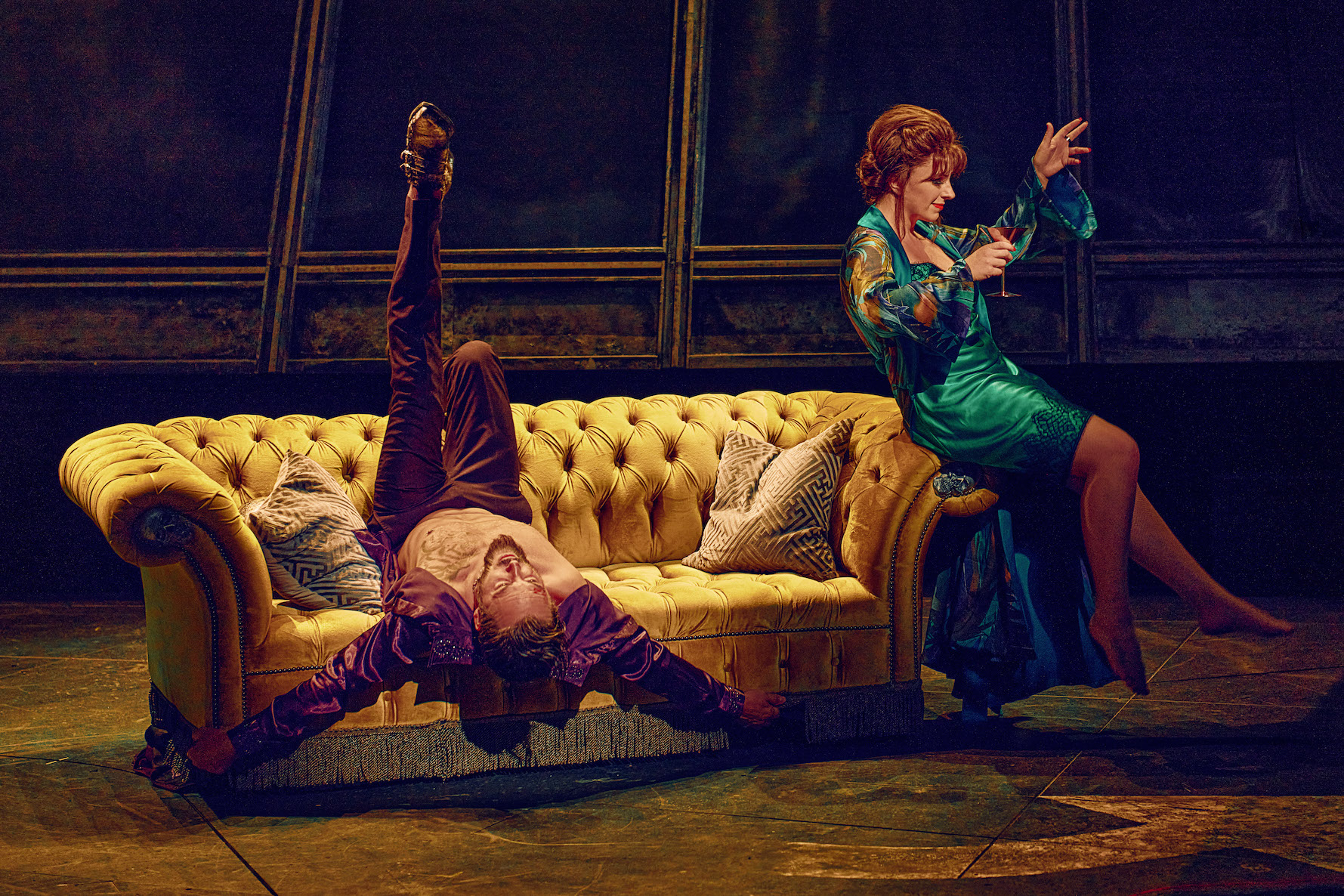
If Dundalk was a bigger town, Aoife might be a gangster. Instead, she’s the pill-peddling drug dealer most people seek out in the area. When someone catches her eye in a pub on a trip our west to pick up some gear, all is not as it first appears when their pants are dropped. Annie is a shape-shifting chameleon from Belfast with a Scottish accent who takes beanie-hatted Aoife’s breath away in the bedroom, and threatens to undermine her normal sense of always being in control.

Long-time readers of the blog will know that I’m usually unimpressed with films or stories that trivialise or celebrate drug culture. In the end, that aspect of Aoife and Annie’s life is really quite ancillary to Iron Annie’s main tale of queer love, a tale that was particular suited to be performed on the evening of the Belfast Pride parade. In fact, it’s so secondary that the play ended – and this won’t spoil the plot for you – with me still wondering what happened to 50 kilos of coke that I thought was still in the back of Aoife’s car.

What might have been a one act one-handed performance has been transformed into a piece of ‘gig theatre’ by director Rhiann Jeffery, adding a trad punk/trash metal four-piece band False Slag (lead, acoustic, bass and drums/percussion) and singer/guitarist Annie June Callaghan to create the soundtrack to accompany Aoife’s monologues. The additional bodies on stage step into some of the shoes of people Aoife meets and describes, as well as providing sound effects for some of the more esoteric moments (like recreating the noise of a colony of walruses in the second act).

Georgia Cooney is an intimate performer, right from the start looking into the audience’s eyes rather than over their heads and really working the near-zero distance between stage and stalls in Belfast’s Accidental Theatre. After the interval, the front row of the audience are inches away from a feverish and unexpected demonstration of what can only be described as stair dancing, which will surely be an Olympic sport in 2024. Aside from dancing, Annie June Callaghan brings The Dandelion Few’s ballads to life, giving space for the more hectic storytelling to settle while her words and music bring some calm.

While some of the vignettes feel a bit strung together rather than naturally flowing, debut novelist and playwright Luke Cassidy definitely has an eye for the surreal and the comedic. The resolution of scene at the Armagh wake for Aoife’s Nan has the audience’s chests heaving up and down with laughter. Yet the waves of erotic pleasure described in an early sex scene made me wonder about the ‘male gaze’ while I waited for Aoife to recover. (To put in context, there’s more sex in three minutes than I’ve seen in 30+ years of theatregoing, and that includes sitting through all of The Jerry Springer Opera in London!)

Iron Annie is a thrilling professional stage debut for Cooney who is a superb storyteller. If theatre is judged to be successful by it lingering in your head while you make your way home afterwards, Iron Annie scores highly. The quality of the performances and the novel musical theatre mashup definitely make up for any cracks in the narrative.

Iron Annie will be heading home to Dundalk’s Spirit Store on Saturday 6 August before gracing the stage of the Wee Red Bar as part of Edinburgh International Book Festival on Wednesday 24 August.

Enjoyed this review? Why click on the Buy Me a Tea button!