Sunday, February 26, 2023

The Life and Times of Belfast writer Mary Beckett #looknorth23

One of the weekend’s Look North! The North Belfast Festival events assembled a panel of authors to discuss the overlooked Belfast writer Mary Beckett.

Lucy Caldwell was joined by Jan Carson and Riley Johnson to discuss the work and impact of one of Ireland’s finest writers, an award-winning author who captured the voice of ordinary women at the time. And there’s a surprise appearance by a member of Beckett’s family.

The Life & Times of Belfast writer Mary Beckett was recorded and edited by me in Ulster University on Saturday 25 February 2023.

Enjoyed this video? Why not click on the Buy Me a Tea button!

Saturday, February 25, 2023

Silent Trade – bearing powerful witness to silenced voices of trafficking and abuse (Kabosh in Lyric Theatre until Sunday 26 February followed by Irish tour)

Furious rain was pouring out of the heavens and running down the street in torrents just outside the building’s door. Inside, the converted clothes shop was now home to a range of young women and children who had made their way to the shores of Italy and claimed asylum. A local church in the town of Scicli (in the south of Sicily) had bought the unused retail unit which had a set of apartments in its top storeys. Six years ago in April 2017, I led a team from across the UK and Ireland who visited some of the projects run by the Mediterranean Hope charity.

Esther walked down the stairs from the teenagers’ common room on the first floor. We knew not to ask people to tell their stories: retraumatising people is not an act of charity. But Esther (not her real name) volunteered and in nonchalant manner that I’ll never forget, this remarkable seventeen-year-old girl reduced a group of men mostly in their early twenties to tears as she somewhat offhandedly recounted her journey from Nigeria, through Niger, into Libya and across to Italy. At the time, I wrote:

I was prepared to hear about a hazardous sea crossing. That’s that part of the passage that is most frequently recounted in broadcast and print media. But what caught me off guard was the scale of the serial trafficking and abuse suffered by this orphaned seventeen year old.

The journey to the coast of Libya was a relay race, with Esther the human baton being passed – sold – from one person to another. She showed a scar on her shoulder, the result of a beating.

She spoke of three weeks spent with little food. She was told to pay back twice the amount that she had been bought for in order to be set free by one captor. Attempts were made to extort money from family back home, not possible in her case.

Clothes bought and hair styled, she realised what was ahead. “I can’t do this kind of job.” Her master showed her into a room, she was given condoms and tissues and assured “Don’t worry, the other girls will help you”. Initially reluctant, six months later, she cleared her ‘debt’ …

It’s not dissimilar to Rosemary Jenkinson’s new play Silent Trade gets under the skin of the human trafficking trade and the associated scourge domestic servitude, abuse that often happens right under our eyes in Northern Ireland. The dramatic action is staged in a long rectangular shape with corrugated walls, the size of a shipping container, set designer Tracey Lindsay’s visual aide-mémoire of how many people cross Europe, or die trying.

Precious (played by Lizzy Akinbami) is 26, working as a cleaner/nanny/skivvy. She’s from Nigeria and she’s trapped in Belfast. Trapped at the beck and call of posh-sounding Erin (Louise Parker) who has many needs but little impetus to look after herself when slave labour is on hand. Trapped without a passport and needing to pay off a promised visa. Trapped in her own company, forbidden from giving neighbours or mums at the school gate any notion of her true background. Trapped without any control over her future because when her domestic job abruptly ends, she’s faced with humiliation and even greater exploitation, working in an anonymous brothel run by roguish Rab (James Doran). Trapped by religion that values keeping promises and a culture back home that cannot wipe out her feeling of shame. Trapped by interpreters who might remember what they hear and pass it on. Trapped by the state authorities who might step in to ‘help’.
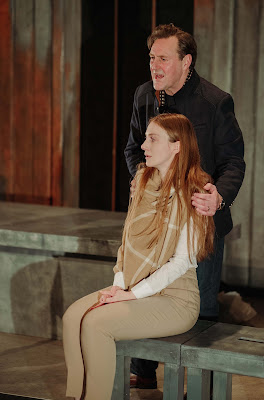
Jenkinson’s trademark sharp wit places funny lines in the mouths of evil characters. The audience chuckle the first few times, before the laughing stops. Doran’s Rab has a funny exterior that loosely disguises his deadly nature. There’s a swift realisation that everything Erin says has a cruel and demeaning barb. Parker shows remarkable poise and stamina as she exposes the haughtiness of the Belfast woman, seeking sympathy for her own middle class angst, while blackmailing and coercively controlling Precious. Parker also takes on the role of Suzanne, another ‘worker’ in the brothel who takes Precious under her wing and shows her the ropes. The character transition takes place in the time it takes to put her hair into a ponytail. Suzanne’s a more subtle figure, one who is chummy, but also needs to survive her own incarceration and internal trafficking.

Kabosh’s intention is to educate as much as to entertain. Precious’ tale is based on gathered stories from Nigerian women living in Belfast. And the take-home learning isn’t confined to Precious’ detention at the hand of racketeer. Later we see how Precious becomes trapped by the criminal justice system – ably brought to life by Seamus O’Hara – a pawn in their process to bring traffickers to justice at considerable cost to those who have been trafficked. Throughout, Akinbami portrays a woman who is without power, who looks down rather than up, who has to internalise her fear and what’s left of her hope.

There’s a deftness to the writing that demonstrates how many of the ‘bad guys’ are also trapped, without ever demeaning or diminishing the abuse suffered by Precious. Paula McFetridge directs boldly, never pulling back from introducing further discomfort. As the play hits its final scenes, Precious demonstrates a pleasing, plucky boldness emerges, and we are rewarded with signs that Precious has developed a resilience that will well be key to her self-saving.

Sitting in the stalls watching Silent Trade took my mind back to Scicli and Esther. She was pregnant when she spoke to us, with just 8 weeks left. Her grandmother in Nigeria knew that she was safe in Europe. But Esther hadn’t told her about her pregnancy, nor had she mentioned about being raped. This June, a little girl or boy may be turning six. I can hope that Esther’s abuse and trafficking was over. We saw lots of evidence of how Mediterranean Hope were caring for and equipping the women in their projects. But Silent Trade is a reminder that many people aren’t as lucky.

Silent Trade’s run finishes at the Lyric Theatre on Sunday 26 February and then tours through Antrim (Tuesday 28), Armagh (Thursday 2 March), Dundalk (Friday 3) and Dungannon (Saturday 4). Like other plays that give voice to people whose voice is suppressed or ignored, Silent Trade is a powerful introduction to a type of abuse that is prevalent in Northern Ireland. Abuse that should not be ignored. If enough people lack curiosity or deliberately turn a blind eye to what seems unusual, human trafficking and domestic servitude will continue.

Photo credit: Johnny Frazer

Enjoyed this review? Why not click on the Buy Me a Tea button!

Friday, February 24, 2023

Broker – a villainless tale of child trafficking, morally questionable but still intriguing (QFT until 2 March)

Hirokazu Koreeda’s Broker tells the story of what happens when a young woman who left her baby at a Busan church baby box returns and discovers there’s no record of the child. She ends up on an improvised road trip across South Korea with two traffickers who act as brokers to place infants with wannabe parents, doggedly pursued by a couple of detectives who are also making things up on the hoof as they try to secure an arrest.

The setup may be unusual, but what is more unexpected is the moral tone. The only innocent in the entire film is the baby at the heart of the story. Everyone else’s motives are at best dubious, but, more realistically, quite sinister. Yet there are no villains.

Director/screen-writer Koreeda goes out of his way to emphasise the benevolence of the two traffickers who are portrayed in a rather ‘hail fellow well met’ manner. A bent copper is never in doubt of her redemption. The greatest judgement is meted out on potential adoptive parents who are criticised for their aesthetic demands offspring when it comes to a baby’s looks. The film’s conclusion attempts to wrap up everyone’s lives – and the consequences of their actions – with a brightly coloured bow. No one pays much of a price for their actions, except the countless, unseen children who have been taken out of the reach of state protection and sold on the black market.

This is no coming-of-age road trip of self-discovery. In some ways, Broker is like an enormous fantasy satire: a feel-good send-up of child trafficking. Yet the dialogue and editing never suggests that it’s being done in a knowing way. Much of the film could also function as a giant tourism advert for the lush coastal scenery the motley crew drive through, though the opening minutes with torrential rain flooding the concrete steps through a residential area bring back memories of Parasite. That film’s Del Boy patriarch Song Kang-ho is the dry-cleaning, church-volunteer, baby-trafficking father figure in Broker. (Though his ability to lock up his business and cut off his customers from their laundry stretches credulity.)

Lee Ji-eun (the singer-songwriter who performs using the stage name IU) captures the complexity of the young mother: childlike in her interactions with a runaway kid the posse pick up along the way; world weary and abrupt when faced with irritating adults. Dramaturgically, Broker is a wild success. The gradual revelation of the mother’s backstory is superbly judged. 

Of course, the moral ambiguity – or total absence – doesn’t make Broker a bad film. It’s so well-crafted that you can drift in and out of just enjoying the action before mentally jerking upright and starting once more to analyse the subtext of what’s going on. Audience opinions will no doubt be divided: let me know what you think in the comments!

Broker is being screened at Queen’s Film Theatre until 2 March.

Enjoyed this review? Why not click on the Buy Me a Tea button!

Tuesday, February 21, 2023

Joyland – insecurity takes its toll in this stirring tale of patriarchal living in Pakistan (QFT until Thursday 2 March)

Three generations of the Rana family live under the one roof in Lahore. The grandfather rules the roost from his wheelchair. His younger son Haider (Ali Junejo) is out of work and helps out around the house, sharing the load with his sister-in-law. In a cultural surprise, Haider’s wife Mumtaz (Rasti Farooq) has a job at a local beauty salon. But the balance of familial responsibilities is upset when Haider finds well-paid employment, and Mumtaz’s freedom to work is curtailed. And there’s added discomfort when Haider finally reveals the nature of his job: he’s a dancer at an exotic-not-quite-erotic dance theatre, a role for which his self-conscious limbs and hip movements are, at first, quite ill-suited.

At the crux of Saim Sadiq’s Joyland are two women, the aforementioned Mumtaz, and Biba (Alina Khan), a transgender woman who Haider is meant to be making look good in her routines. While he resilience isn’t limitless, Biba tends to power on through the discrimination, the workplace gossip and backbiting, and the lack of respect she experiences. And the khwajasira dancer’s attitude attracts Haider’s attention. Meanwhile, at home, Mumtaz is drowning under the toxic masculinity and Haider’s lack of attentiveness, losing her job, her husband, her identity. The insecurity of both women is palpable but it is Farooq’s portrayal of sadness steadily building that pulls the story through to the film’s emotional conclusion.

Joe Saade’s cinematography picks stories out of ill-lit night locations and the 4:3 aspect ratio almost invites the film to seen as a television sitcom. The most memorable shot in the film involves an enormous wooden cut-out of Biba being transported on a motorbike with Haider peering out at the road ahead through her crotch; the second best image is the morning after as the sun rises and the cut-out is visible across the neighbourhood.

While the Pakistani government was upset that they reckoned the film was “glamourising transgenders [and] their love affairs”, perhaps they should instead have been more annoyed that the worst aspects of patriarchal and patrilineal culture were on show to the world. Joyland has been winning awards at film festival, and made it to the Academy Awards Best International Feature Film shortlist, though missed out on a nomination into the final five.

Joyland is being screened in the Queen’s Film Theatre from Friday 24 February until Thursday 2 March.

Enjoyed this review? Why not click on the Buy Me a Tea button!

The Commitments – it’s a ride of a show, even if the bravura music has to carry the weaker plot (Grand Opera House until Saturday 25 February)

The Commitments as a show is at its strongest when the band is in its infancy and are rehearsing (believably rough and anarchic) and then playing their first gig in the community hall slot vacated by the bingo (more polished, but full of raw soul).

Ian Mcintosh is a more than authentic frontman Deco with the laid-back charisma dripping off him as he works the Grand Opera House audience and casually struts around the stage scratching his belly. It’s a mystery – or testament to his control and talent – that his voice holds up on two-show days.

When Deco’s running late, the three Commitmentettes – Ciara Mackey/Emelda (previously on the Grand Opera House stage as the Lady of the Lake in Spamalot), Eve Kitchingman/Natalie and Sarah Gardiner/Bernie – ably give him a run for his money with their blended harmonies and stylish choreography (giving it all the elbows). And when Deco is back on stage, the backing trio really lift the vocals and make The Commitments sound like a properly produced band.

There’s on-stage brass from Stuart Reid’s trumpet and Conor Litten’s saxophone (technically woodwind, but still shiny!) along with keys from Stephen O’Riain (beautiful accompaniment for the haunting rendition of Otis Redding’s Mr. Pitiful) and drummer Ryan Kelly. Michael Mahony’s guitar and Guy Freeman’s bass make up the rest of the band along with musical director George Francis. There may be other off-stage musicians, but since the venue no longer provides reviewers with printed programmes, that remains another unsolved mystery …

Holding the rag tag bunch of musicians and singers together is Jimmy Rabbitte (James Killeen) who rather sweetly gets his own song in the untidy second half. Ronnie Yorke deserves a larger bow for his comedy bouncer Mickay.

The vitality of the musical performances is in sharp contrast with some rather flat dialogue that glues the scenes together. The concept of soul (and its relationship with sex and politics, ridin’ and the people) is overexplained, dramatic pauses hold on too long, and the end of the story is terribly abrupt but disguised by a pantomime callout to the audience and a mandatory stand up and clap along to the final chain of hits … which are worth the adulation. The final, final encore, in particular is a cracker worth waiting for. But next time Roddy Doyle is in the back of my car – which happened last year, a long story – I’ll be bending his ear about his writing for musical theatre!

Tim Blazdell’s dingy, concrete, high-rise flats set rather skilfully unfolds itself, with Jimmy’s flat effortlessly appearing along with his wise-but-ignored father (Nigel Pivaro, previously know to soap fans as Terry Duckworth) at regular intervals. On-stage drumkits on wheeled platforms often slow down musical shows, but The Commitments has mastered the mechanics and stagecraft necessary to get mics, amps and maracas in place without fuss. Great use of an electric scooter too (other than its hard to believe role in the plot’s conclusion). And keep an eye out for the unusually precise overhead lighting design that picks out individual cast members in crowded ensemble scenes to direct your attention to the most important action. Rather classy work by lighting designer Jason Taylor who also has to build in concert effects for the final medley.

High points include the covers of Four Tops’ Reach Out I'll Be There and The Persuaders’ Thin Line Between Love and Hate, together with the realisation that Heard it on the Grapevine should forever more be sung with a bag of hot chips in your hand (and mouth). Director Andrew Linnie works the cast of 20 very hard over the two and a half hours, and overall the Dublin humour and the strong music carries a show whose plot is wafer thin.

The Commitments continues in the Grand Opera House until Saturday 25 February.

Photo credits: Ellie Kurttz

Enjoyed this review? Why not click on the Buy Me a Tea button!

Saturday, February 11, 2023

Women Talking – the chance to write a new ending to a story that so far has been formed by others (QFT until Thursday 23 February)

When a group of men who have been accused of abusing women in their isolated Mennonite community in Mexico are arrested, the remaining menfolk ride off to post bail. The women left behind – the abused – realise they have three choices: to stay and do nothing; to stay and fight; or to leave.

In this particular colony, only the young boys are schooled, leaving the women functionally illiterate. The abuse – women and girls being subdued with animal tranquilliser and then raped – has been going on for decades. But the victims have been told they’re imagining the blood on the sheets and the pregnancies that sometimes ensue. It’s the work of ghosts or the devil. But then the face of one attacker is recognised.

“I used to wonder who I would have been if it hadn’t happened to me.”

You could probably transcribe any five-minute section from the first half hour of Women Talking and submit it as your answer to an essay question about abuse of power or how the patriarchy works and you’d score well.

In a week when some in the media and the public are choking over the realisation that a proportion of Presbyterian ministers admit that their denomination permits them to read the Bible in a way that says men and women are both made by God but that men shouldn’t have to sit under the teaching and/or rule of women, the wide spectrum of day to day actions and attitudes in the male-dominated religious community portrayed in Women Talking speak out even louder.

In the case of the film, the physical abuse and subsequent arrest of the men is based on real events. The women’s plebiscite to decide on what they should do is fictional, based on Miriam Toews’ book. But it’s an incredibly powerful way of exploring the issues and how the circumstances developed. When the votes are tied between staying to fight and leaving, a smaller group of families are appointed to make the decision for the rest.

And so teenagers, mothers and grandmothers gather in the barn to talk it out. Their time is limited as the men will return from the city the next day. Threads of debate and uncertainty run throughout the full duration of their Socratic discussion. If they leave their faith community, they’ve been told that they’ll be denied entry to the kingdom of heaven. Some are convinced, others have a bigger image of God. Their need to forgive is tempered with whether it’s possible to forgive and whether forgiveness can be offered with no contrition. Pacifism versus one women’s reckoning that “I will become a murderer if I stay in the colony”. Who is complicit in the abuse that has endured across generations? Are the men victims in some senses as well as the women? At what age will their sons have inevitably succumbed to the default and degrading macho culture. If they left, would the women be well equipped to be safe in the outside world? These are questions that the families debate in the mostly unheated and well-ventilated crucible of an upstairs hayloft which is curated by director Sarah Polley.

Consensus is reached – you’ll have to watch the film to find out what they decided – as dissenting voices convince themselves with very different and personal reasons to change their minds. There are strong performances right across the hayloft ensemble which includes Rooney Mara, Claire Foy, Jessie Buckley, Judith Ivey, Sheila McCarthy, Liv McNeil and Michelle McLeod. There are expressions of rage, shame, love and fraternity in abundance.

The community’s schoolteacher – a man whose family were once forced out of the community but it was convenient to allow him to return – sits with the women to write the minutes of their conversation. (He is journalling their discussion so the other men might be able to read it, not so the women have a record.) Ben Whishaw’s performance is gracious and deferential, a man with a servant heart who is damning his own future happiness by helping these women grasp the empowerment that has been denied them for so long.

The conclusion to the tale is less important than the fact that the issues have finally been aired: the power and misuse of religion; being trapped in cycles of abuse; the herd mentality that is hard to break free from even when lots of people know something needs to be addressed. Women Talking is full of hope. Of the chance to write a new ending to a dark story whose narrative has so far been influenced by other people. It’s 104 minutes of cinema that’s well worth catching at Queen’s Film Theatre where it is being screened until Thursday 23 February.


Enjoyed this review? Why not click on the Buy Me a Tea button!

Friday, February 10, 2023

Romeo & Juliet – families feud and lovers die in the capital of knife crime and haute couture (Lyric Theatre until 5 March)

It’s the summer of 2022 and Verona’s rival fashion houses are at war. A physical fight at the start of each act demonstrates that the verbal venom can quickly turn to violence when the Montagues and Capulets collide. So when Romeo Montague gets the hots for Juliet Capulet and they marry in secret, it’s never going to end well. Even so, the body count really ratchets up as friends and fiancés become entangled in Shakespeare’s tangled web of medicinal deception and deep depression in the capital of knife crime and haute couture.

The Lyric’s production of Romeo & Juliet is certainly ambitious. Previous local productions I’ve reviewed by c21 Theatre (2017) and Bright Umbrella (2018) had small casts and portable sets. The Lyric spreads the roles out over 16 actors (though only 15 appeared at the curtain call of the performance I reviewed!)

Robin Peoples’ giant set wraps around a Verona piazza with space for a colonnade, the mandatory balcony (above a garage door), the church and even a street café. A garish LCD advertising sign and espresso cups remind audiences that the action is set in modern times … though mobile phones are curiously absent.

Gillian Lennox’s costumes really sell the concept. Particularly the Capulet range of statement outfits, with Lady Capulet wearing the trousers (and the best dresses) in her household as Rosie McClelland assuredly takes on a role that successfully swaps lines traditionally delivered by her on-stage husband (Patrick Buchanan). The house of Montague feels a bit more downmarket, Castle Court to the Capulet’s Victoria Square, perhaps just a product of the blocking and the lighter dialogue.

The first act zings along. The opening fight. A well-to-do suitor is snubbed. A spot of unrequited infatuation. Gatecrashing a party. And the sense of forbidden love igniting a spark that could burn the whole house(s) down. For once Juliet’s speech on the balcony is actually out of Romeo’s reach! The lip-syncing revelry at the fashion show launch party is superbly directed. A fist-bumping friar. A menopausal nurse (the brilliantly expressive Laura Hughes) acts as confidant, passing messages and encouraging the outlawed liaison. The natural age range of the cast works quite well in establishing the domestic order of the families. It’s common for productions to make sizeable cuts to the original script, and Anne Bailie’s adapted version serves the production well.

It’s after the interval that the handbrake seems to come on. Romeo & Juliet is a tragicomedy, yet the feeling of tragedy is somewhat transitory while the comedy is rarely as raucous as it could be. The appearance and disappearance of Juliet’s bed – twice – is terribly elegant, but distractingly slow, losing emotional pace at a point in the play that the audience should surely be really leaning in to the growing feeling of dread rather than wondering just how much original music Chris Warner had to compose to cover the scene changes. The impressive soundtrack throughout the show is nearly continuous. A favourite moment is when the church doors open and organ music beautifully floods the piazza. But the low-level musak during some other scenes was irritating and felt like it could usefully have been faded out after establishing the new location.

Ray Sesay’s Friar Laurence is always a warm presence on the stage, bright and cheery, mirroring the Nurse in his fostering of good relations between fractious communities. (Though his lack of even feigned reaction to the discovery of three bodies in his crypt was a peculiar decision.) A little more spark and sizzle between Romeo (Adam Gillian) and Juliet (Emma Dougan) – or even lingering tender touches – would make them a more believable pairing. Though given everything else that Shakespeare is throwing at the plot, maybe subtle romance isn’t a crucial ask. It’s definitely the kind of show I’d want to return to near the end of the run to see how it’s developed and settled.

It’s pleasing to realise that nearly half the cast is made up of alumni from the Lyric Drama Studio back in the south Belfast theatre (including a couple of performers from last year’s excellent Blue Stockings production that really deserved to be in front of bigger audiences on the main stage): Steven Cook, Eugene Evans, Aaron Ferguson, Thomas Finnegan, Finnian Garbutt, Tiarnán McCarron and Lucy McCluskey.

On stage, we see parents creating the circumstances into which their children fall. We witness older adults bridging divides. And we watch impulsive youngsters acting rashly. It’s a production with bold ambition and courageous design choices. There’s no doubt that the Philip Crawford’s production of Romeo & Juliet for the Lyric gets the story across. The school groups amassed in last night’s audience enjoyed a novel and thoughtful production of a classic play on a scale rarely seen on a local stage.

Romeo & Juliet runs at the Lyric Theatre until Sunday 5 March.

Photo credit: Carrie Davenport

Enjoyed this review? Why not click on the Buy Me a Tea button!

Sunday, February 05, 2023

A Farther Shore – an old tale with a modern message (4 Corners Festival and Bright Umbrella, 15-18 February)

A Farther Shore retells the well-known story of Peter the Apostle, a fisherman by family trade who becomes a disciple of the “hill country carpenter” turned Jewish preacher Jesus of Nazareth. It follows the journey of the man who harvests the Sea of Galilee, showing great faith and much weaker faith as he becomes a “fisher of men and women”. After Jesus’ death, Peter becomes the leader of the early Christian Church. That much is familiar.

Glenn McGivern takes on playwright David Campton’s hour-long monologue in which Peter reflects on his life. You can almost smell the salt and the fish guts from the set that is strewn with nets, pots, ropes and bright plastic buoys. Peter may have lived two thousand years ago, but the modern-day setting (and Ulster Scots accent) suggests a more universal and contemporary truth in Campton’s writing. Lesser-known details are woven into the story, keeping even the most Biblically literate audience members on their toes.

McGivern demonstrates both a mastery of the weighty script and his adept understanding of the characterisation. Trevor Gills’ direction elevates the patterns that run through Peter’s thinking. Campton relishes the foreshadowing and parallels between the prophet Jonah (also the name given to Peter’s father in this play) and Jesus, as well as highlighting the parallels of seagoing and levels of adherence to heavenly commands between Jonah and Peter.

A Farther Shore explores the mystery of belief, stepping out in faith, tripping up in doubt, forgiveness and second chances. An interstitial duet (Philippa O’Hara/Trevor Gill) sits between the two acts (pre- and post-Ascension), dragging the audience back from Joppa/Jaffe to hint at the work of the ‘Apostle of Ireland’, St Patrick. The repetition of the phrase “do not call anything impure that God has made clean” (from Acts 10:15) throughout the play reminds today’s church that Peter encountered the Holy Spirit working in lives he hadn’t expected to be ‘inside the tent’ and realised that inclusion and welcome are meant to trump purity and piety.

An additional layer of meaning comes from the production’s venue: an old church that has recently been handed over to the Bright Umbrella Drama Co. on a fifty year lease. Fergus Wachala-Kelly’s black and white hand-drawn animations illustrate key moments in the narrative, though they would have more effect if the imagery lingered longer on screen and didn’t vanish from view so abruptly. Something that can be addressed during the rest of the run. And it’s always good to see George Spelvin’s contribution being publicly acknowledged in the programme!

Premiered on the penultimate day of the 4 Corners Festival 2023, A Farther Shore returns to the Sanctuary Theatre (1a Castlereagh Street) for another five performances between Wednesday 15–Saturday 18 February. And the theatre company would welcome opportunities to take the portable production to other venues, churches or organisations.

Enjoyed this review? Why not click on the Buy Me a Tea button!