Wednesday, May 31, 2023

The SpongeBob Musical – can science trump mayhem when trouble erupts in this submarine paradise? (Grand Opera House until Saturday 3 June)

Hold your nose and dive deep into the somewhat hallucinogenic underwater world of Bikini Bottom which is threatened by an imminent volcanic eruption. Fear is turning people towards making bad decisions and questioning good motives. Can a plucky trio make it to the second half to bring order to the panic, self-interested exploitation, and destructive powerplays?

At its best, The SpongeBob Musical is a madcap assortment of musical styles, colourful costumed underwater creatures, and a satirical take on capitalist business models, populist politics, media scepticism, blame culture, anti-science mentality and spooky prediction of how a society might react to a pandemic.

In its less impressive moments, SpongeBob becomes a gallimaufry of styles, crazy characters and trippy nonsense that don’t gel to deliver a coherent story or a consistent experience.

Cartoon watchers will spot favourite characters and recognise a couple of tunes amongst the wealth of new material by Aerosmith, Sara Bareilles, Cyndi Lauper, Panic! At The Disco and many more. Adults will raise an eyebrow and be careful to avoid mispronouncing some of the on-stage food joint names in front of young children in the audience.

A panoply of percussion lurks behind the The Krusty Krab fast food joint, augmenting the physical choreography of key cast members. Two of the costumed Electric Skate band members regularly step out from their separate booths to perform and act on stage. A toilet roll gag connects the dots around Covid for adults in the audience.

Divina De Campo is a bit lost playing the Chum Bucket proprietor Sheldon J Plankton, a schemer with a ‘big guy’ complex and a penchant for mass destruction, so a bit of a proxy for Putin if you’re overthinking the plot during one of the two show stops that temporarily halted proceedings on the first night of the Belfast run.

SpongeBob (played by the indefatigable Lewis Cornay) may find Patrick Star to be an unreliable friend, but Irfan Damani’s voice always impresses, particularly with Yolanda Adams’ gospel number Super Sea Star Saviour, accompanied by the full set of fanatical cultist Sardines. Sandy Cheeks the Texan Squirrel (Chrissie Bhima) is a good scientist and a great vocalist. But the really, whaley moments of wow come when Sarah Freer steps through the gears and brings Pearl Krabs to life every time she sings. The beautiful neon sponge choreography makes Just a Simple Sponge into a first act highlight (albeit slightly marred by Mr Krabs muted mic blocking out his interjections at the end of the number).

The second act is strong, opening with a pirate protest song that showcase Sam Beveridge and Eleanor Turiansky’s musical talents, and hitting its peak with Gareth Gates and his sea anemone chorus line deliver a great La La Land-esque moment of musical theatre in the second act with four-legged Squidward’s I’m Not A Loser.

On paper, the whole of this musical could be greater than the sum of its parts. There’s sufficient craziness in every aspect of the set, costumes, music, choreography, direction and Kyle Jarrow’s book to suggest that SpongeBob could be an ingenious and effervescent winner. Yet, even laying aside the technical issues that shouldn’t beset the remaining Belfast performances, for me the musical smouldered and failed to bubble up to the surface to match its theoretical potential.

The SpongeBob Musical continues its riot of nautical madness at the Grand Opera House, Belfast until Saturday 3 June. And don’t miss the merchandise stall where adorable Gary the meowing snail soft toys are on sale! 

Photo credit: Mark Senior

Enjoyed this review? Why not click on the Buy Me a Tea button!

Friday, May 26, 2023

Geppetto – grief observed and interrupted in this imaginative non-verbal tale for children young and old (Amadan Ensemble at Lyric Theatre until Sunday 28 May)

Geppetto brings old electrical appliances back to life in his repair shop. But he’s sad and depressed, missing his wife. Until something disrupts his doleful reverie, and a light appears at the end of his tunnel.

David Morgan’s wordless story is enlivened by a king of physical comedy and a queen on puppeteering. The lack of dialogue leaves Jude Quinn’s expertly controlled movement and facial expressions to drive the storytelling. As an audience member, you have the freedom to write your own internal tale about the unfolding action: but fear not, the clues are plentiful and you’ll not get lost.

After the central character has been established, Sarah Lyle joins him on stage and brings a particular piece of electrical equipment to life: you won’t realise the gap you’ve had in your life until you witness the Ceilidh dancing Anglepoise lamp that’s crucial to the storytelling in this production!

Everyone’s movements are subtle – though watch closely to observe how the repertoire of motions and gestures evolves – and the technical tricks that animate so many of the objects in the repair shop in so many different ways are incredibly intricate. Dave Marks’ score is synchronised with much of Michael McEvoy’s choreography, adding layers of mood and understanding to the non-verbal production that is suitable for children aged six right up to my age and above.

Director Gemma Mae Halligan has crafted performances that are gorgeous to watch. It’s an imaginative children’s show that should travel easily, not just because of the lack of translation, but also the familiar hook back to Pinocchio’s creator, and the way that the study on grief and remembering is universal.

It’s great to see another example of innovative and accessible children’s work being produced by a growing circle of Northern Ireland theatre makers.

Amadan Ensemble’s production of Geppetto continues its short run at the Lyric Theatre until Sunday 28 May.

Enjoyed this review? Why not click on the Buy Me a Tea button!

Wait For Me – brooding tale of taking back control amidst vice and abuse (Queen’s Film Theatre, Q&A on Saturday 27 May, screenings 2-8 June)

It’s grim up north, particularly if you’re trapped in a world of vice and trafficking. Alison works in a brothel in Yorkshire, having moved over when her father (played by Sean McGinley) fled Ireland. Karen Hassan portrays a steely young woman who blows hot and cold faster than a spring afternoon in County Antrim, but seizes a chance to take back control and try to make amends for the various dependencies that have had a negative impact on her family.

Her unlikely accomplice is Sam (Aaron Cobham), an almost silent, vulnerable young man, who lives with a feeling of guilt that he has let down his closest friend. Always nervous, hesitant and lacking confidence, his eyes light up and his soul shines when he’s holding a stills camera and capturing other people’s spirit on film. If everyone’s on edge and scared to death, it’s because the crime boss played by Neil Bell is just as evil as his henchman Barry (Theo Ogundipe) is menacing.

Director Keith Farrell shapes Wait For Me into a brooding feature which never rushes to reveal the next twist in the lives and connected relationships of the characters. Aside from depicting the harsh environment in which trafficked women and men live and ‘work’, the screenplay riffs off the theme that everyone could do with a decent, loving parent.

Bernard O’Toole’s story is strong, the pared back dialogue is fitting, and Hassan’s gritty performance is mesmerising. If only the film hadn’t been littered with so many visually tedious rack focus shots (using a shallow depth of field and adjusting the sharpness from one character to another and back) which distract from the already well-framed, well-written and well-acted scenes.

Wait For Me will be screened in the Queen’s Film Theatre from Friday 2 until Thursday 8 June. There’s an early screening on Saturday 27 May followed by a Q&A with actor Karen Hassan, director Keith Farrell, and producer Thea Burrows.


Enjoyed this review? Why not click on the Buy Me a Tea button!

Friday, May 19, 2023

Full Time – spinning plates and adulting while the world is throwing the kitchen sink at you (Queen’s Film Theatre until 1 June)

You can feel the stress building as the techno music accentuates the raised heartbeat of Julie who is rushing around her home, following the daily ritual of getting herself and her two children dressed, fed and ready for school and work. Any interruption to the choreography and the whole dance could collapse.

Full Time/À plein temps follows a week in the life of Julie, a single mum who is head chambermaid in a very posh hotel that caters for demanding guests who will complain as quickly as they’ll leave a shocking mess to tidy up. She commutes in and out of Paris from a suburban village. A public transport strike, on top of a late alimony payment and needing to slip out of work for a job interview in her old more lucrative industry, stretches her nerves and her childcare beyond their limits.

An hour after the mid-morning screening, I’m eating my lunch and my stomach is still in knots. My own uncertainties about an event I’m filming tonight – still don’t know the precise venue so can’t be sure what kit to set out to pack into the car – are incomparable to the perpetual pressure Julie ploughs through each day.

Director and screenwriter Éric Gravel never falls back on playing Julie as a victim. Instead, Laure Calamy is free to depict a resilient woman of infinite resource, a finder of solutions (her method of offloading the trampoline out the back of a van is magical), someone who perseveres in the in the face of despair. Calamy’s performance is worth the cinema ticket. Yet she can only dig deep for so long before something breaks and her spinning plates come crashing to the floor?

There’s a whole genre of films that examine working conditions in less glamorous sectors in the labour market. Ken Loach would have made the film a gritty tear-jerker. Gravel settles for a warmer tone, emphasising the busyness and the movement rather than lingering shots of panic and despair.

A different movie would have brought a violent threat into the mix to bring the story to a dramatic climax. Yet Gravel finds more mundane alternatives to exacerbate the crisis, eventually offering a dim light at the end of fictional Julie’s tunnel that could dial down one stressor (finance) but won’t eliminate any of her other aggravations. One final line of dialogue – “Have a good day” – is offered with the best intentions but seems stupendously naïve knowing Julie’s circumstances.

By revolving the whole story around Julie, the backstory of everyone else on screen stays paper thin. A whole universe of spinoff movies could examine the levers and demands on Julie’s hotel boss, on her team of coworkers, on her children’s nanny, on her best friend and her estranged husband.

Sitting in the warm comfort of a cinema, Full Time may be feel like an extreme example of difficult adulting, but it’s probably a heavily sanitised version of many people’s real life experiences of precarious working and living without any safety nets.

Full Time is being screened in the Queen’s Film Theatre from Saturday 20 May to Thursday 1 June.


Enjoyed this review? Why not click on the Buy Me a Tea button!

Sunday, May 14, 2023

Brainwashed: Sex-Camera-Power – an illustrated lecture that will change your viewing experience (Queen’s Film Theatre until Thursday 18 May)

Director Nina Menkes delivers an illustrated lecture on sex and power, the visual language of cinema, in the documentary Brainwashed: Sex-Camera-Power. The word ‘lecture’ may not immediately appeal to your lust for nipping out to the cinema. But rest assured, Menkes knows what she’s talking about, and after 20 minutes you’ll be sizing up the on-screen clips ahead of her commentary to detect whether the woman in the shot is the subject or (more likely) the object; recognising closeups of fragmented female body parts; spotting the slomo action; noticing that men are sexy when they’re moving but women are depicted still; tell-tale panning shots that scan across a woman’s body, undressing her with the camera; gendered lighting; hearing the orchestra crank into action to soften scenes of men once again ignoring their total lack of consent.

And when I say the lecture is ‘illustrated’, let’s be clear that there are a lot of bums, many boobs and even a few balls projected onto the silver screen. More than this reviewer has ever stumbled across at a 10 o’clock in the morning preview screening before. Yet not a single moment is titillating. In their original context, using the techniques that Menkes is deconstructing, the scenes will have dialled up the eroticism of these big-name movies. Yet the level of control in Brainwashed is such that neither tittering nor nudge nudge wink wink moments can be remotely entertained. You’ll soon be cognisant that the more glamourous a scene is, the more powerless the ‘object’ of that scene.

Much of what Menkes shares is obvious, and you’ll already be aware of some of it. What makes her pitch devastating is how when she strings the different elements together it becomes clear that a vastly male cohort of directors, working with mostly male heads of departments (who hire mostly male staff) on a film, in the hands of mostly male distributors, have created an ABC of filmmaking and patriarchy that is designed to deliver for male audiences by disempowering women on and off screen. This male gaze is very recognisable yet mostly ignored by audiences and not worthy of note by reviewers. Menkes and her contributors point out that it’s a double whammy of who and how films tend to be made. And even when a film is ostensibly feminist, about women, or directed by a woman, that’s no guarantee that the popular tropes won’t still permeate the final product.

Menkes doesn’t set out to become the sex police. The techniques she highlights are perfectly valid and effective cinematic tools of the trade. It’s just they’re used somewhat consistently and monotonously at the expense of women. In later parts of her discourse, Menkes demonstrates some alternatives and it’s plainly obvious that a variety of approaches and a more fulsome visual dictionary would be welcome. It’s all about choice, and changing the choices that are routinely made.

What she’s talking about isn’t constrained to the world of film. Sitting in the QFT’s Screen One watching Brainwashed I recalled the opening night of General Assembly, an annual ceremony that sees the outgoing Moderator of the Presbyterian Church in Ireland finish his year (and yes, it’s always been a man) and hand over the mantle of the office to the incoming Moderator. (Seriously, my scribbled notes from Brainwashed have two pages of scrawl about PCI!) Despite the business of the General Assembly being conducted by members who are nearly evenly split between ministers and elders, and there being a variety of sex and age across those members who have equal right to stand up and debate vote during the days of business, the opening night stage is stuffed full of men, the majority of whom are older, and they’re nearly all ministers. It’s a tableau of clericalism despite the denomination normally believing that’s not how they should be defined or organised.

It’s a choice. The liturgy of the evening isn’t so fixed that it hasn’t been adapted quite a bit over the years. Even without a new injection of creative thinking, there are already opportunities for readings and prayers to be given to those who would otherwise remain invisible. It’s a yearly choice to continue to visually and aurally portray that the power and authority rests with older male clerics and isn’t equally spread out across the membership of the General Assembly. That disempowers all kinds of people at the event, participating throughout the week, and belonging to congregations and perhaps watching online or hearing about it afterwards. Maybe not always a conscious choice but definitely a set of decisions that seem to be ratified without a second thought.

(My own sideways experience of this – as a man! – was turning up at two opening night’s in a row some 18 or 19 years ago as the husband of one of the incoming, then outgoing, moderator’s chaplains. Seats had been reserved for the wives of the two male chaplains at the front of the balcony. But it seemed to be so unexpected that there would be a female moderator’s chaplain on the main stage who might have brought a husband with her that both times I was told by the steward showing guests to their seats that there was no seat allocated for me (despite the ride down to the event in the big car with the other wives) and told that I should try and find one myself! The system expects things to be a certain way because other possibilities don’t usually need to be imagined. But enough of a bloke whinging about the second-hand discomfort of patriarchal thinking ...)

The parallels with Nina Menkes’ lecture are strong. A ceremony organised by a subset of people, showcasing the participation of a similar subset of people, is no more likely to change by accident than the world of cinema will stop objectifying women when those who happen to be and remain in power see no need to change. Now away from moderators and back to the world of movies.

Menkes issues a clarion call for fresh imagination, novel imagery, and more critical thinking in her industry of cinema. Her lecture is an eye-opening induction, and without trying, I found myself assessing the shot choices for Eurovision song routines and questioning what each country’s delegation was trying to achieve and who they were trying to attract to vote for them! And Menkes’ timely reminder will no doubt seep through into other avenues of life beyond cinema and church.

Brainwashed: Sex-Camera-Power is being screened at the Queen’s Film Theatre until Thursday 18 May.

Enjoyed this review? Why not click on the Buy Me a Tea button!

Thursday, May 11, 2023

Good Vibrations – a live score from a wonderful ensemble cast in this celebration of alternatives (Grand Opera House until Saturday 20 May + Irish Arts Center in New York from 14 June)

It’s easier to write about real people being portrayed on stage when they aren’t in the room.

The Terri Hooley depicted in Good Vibrations is equal parts hero and villain. He’s a gift to Belfast and beyond, though not necessarily a delight for everyone who loved or worked for him (and there’s a fair overlap between those two groups).

He’s portrayed as someone who wouldn’t – in fact, doesn’t have a bone in his body that knows how to – conform to the binary identities on offer when the Troubles start. He’s someone with a positive and rebellious ambition for the city he lives in, with a sense how the shared purpose of producing music and enjoying listening to it keeps people together. Yet the Terri on stage is also shown to be exasperatingly poor at managing his expanding suite of businesses.

He’s a promoter, an encourager, a dealmaker, a prophet, a husband and a father, but puts neither family nor fortune before fun and a feverish impetuousness that risks all he has to create a legacy of art and creativity. The cost is tearfully visible on the stage of the Grand Opera House. The ‘godfather of punk’ is quite a tragic figure, and the Lyric Theatre’s revival of the stage production of Good Vibrations is all the better for accepting that painful fact and threading it through the heart of the story. The man’s also an inspiration for turning up at opening nights and so graciously allowing his story to be simplified, tailored and tweaked for the fictional yet probably never too far from the truth version in Colin Carberry and Glenn Patterson’s stage adaptation of their 2013 film screenplay.

The two sides to Terri conspire to make wonderful drama. The war outside the door of his Great Victoria Street (nicknamed ‘bomb alley’) shop adds violent menace that puts any argy-bargy between punk bands’ egos into perspective. (What the theatre show can’t depict is the noteworthy brevity of the time between punk’s rise and its fall. And it’s on audience faces and in snatches of conversation overheard in the theatre bars that you realise the tightness with which so many involved in the scene back in the day cling to their memories, and how the modern punk scene continues to reinvent and still refuses to conform.)

The ensemble cast for this actor-muso production throw themselves into the shoes of some of the early punk bands – particularly Rudi, the Outcasts, and the Undertones. Other than sound effects and the odd piece of incidental music, everything is performed and sung live. Watch the cast’s mouths moving as they perform in harmony while pushing flight cases across the stage between scenes. It’s a much less raucous sound mix (thank you Ian Vennard) than the original version staged in the Lyric back in 2018, and it really allows the emotion and the lyrics to retain their power rather than letting rock and rhythm overwhelm.

Glen Wallace eases into the role of the central figure, happy go lucky, then haphazard. His fine voice is a revelation during one of the final songs, Laugh With Me, and if you sign up for one of Dolores Vischer’s wonderful Belfast punk music walking tours (there are some scheduled for Saturday 13 and 20 May) you’ll discover just how favourably Wallace compares with the real man’s vocal cords back in 1979/80!

Jayne Wisener plays the willowy Ruth Carr, Terri’s wife who supports his madcap schemes at first with her salary and security before cutting her ties and setting him free. Wisener’s second act ballad To Know Him Is To Love Him is beautiful for its poignancy (and neatly mirrors Darren Franklin/Dave Hyndman’s earlier rendition of Can’t You Understand) while her depiction of Ruth’s fraying patience adds emotional charge and grounds Good Vibrations as a deeply human story rather than one just about music.

Marty Maguire and Christina Nelson play Terri’s parents and add a lot of mirth in the many other roles they take on during the show. Playing an RUC officer more concerned with the possibility of catching petty misdemeanours than stopping intimidation on the streets, Maguire is on the receiving end of perhaps the best Hooley zinger of the show: “Excuse me officer, I’d like to report a civil war outside”.

Hats off to Odhrán McNulty, Chris Mohan, Jolene O’Hara, Gavin Peden and Dylan Reid who sing, strum and play their way through an album’s worth of music from Hank Williams’ I Saw The Light to Rudi’s Big Time, The Undertones’ Teenage Kicks (which punches out into the interval) and Stiff Little Fingers’ Alternative Ulster. And special mention to Connor Burnside whose drumming is energetic and powers up Katie Richardson’s arrangements and original music.

While Jack Knowles’ lighting design is muted, with a preference for back- and side-lighting characters’ faces, it leaves room for Jennifer Rooney’s choreography to light up the performers as she channels them in paths across the stage, creating frenzied moments of crowded ensemble, clean lines for some of the bands, and tiny details like how a guitar can be passed from one performer to another in an almost dancelike motion.

The penultimate scene strips away the musicians and the coattail clutchers. Terri stands alone with his life and legacy. Then a simple change of coat allows the story to time travel, a few seconds of magical theatre before the final encore.

I caught an early preview of the 2018 run of Good Vibrations, a Sunday afternoon matinee, on a quick trip home before, hours later, flying back to Skopje and the mayhem of the Macedonian referendum. While wowed by the ambition and the performances, I’d neither time to read up about the show beforehand now process the show afterwards, and didn’t write up a review. There’s been a bit more space to this year to connect the dots of the network of people and collectives that are referenced in Good Vibrations and continue to work today. I first got to know Marilyn and Dave Hyndman at Northern Visions (the NvTv community television channel) back in 2008/9 when they filmed a pilot episode of a chat show hosted by Donal Lyons and featuring local NI bloggers talking about blog posts. Amazingly, this Gogglebox for the blogosphere ran for eight episodes under the Ronseal title of Blogtalk … shamefully, when I look back, with an entirely male cast. It was only at Marilyn’s funeral last year that I heard more about the couple’s wider contribution to Belfast in the years before the television station, and it was moving tonight to see a version of them played by Cat Barter and Darren Franklin, depicting the couple whose anarchist bookstore Just Books and printing press shared a building with Terri’s first record shop.

There’s plenty more that could be said about punk and its counter-cultural dissonant relationship with the status quo of the day. Good Vibrations doesn’t have to be the last word on the topic, nor can it possibly present an encyclopaedic or comprehensive history. Instead what director Des Kennedy does so well is to celebrate the life and ethos of people who had space in their hearts for alternative ways of being. (A bit like the work and campaigning of Drs Paddy and Mary Randals in Navan who are featured in Sinéad O’Shea’s recent film Pray For Our Sinners.) Not quiet resistance, but right up in people’s faces.

Well worth catching a performance of Good Vibrations on stage at the Grand Opera House before Saturday 20 May, after which this Lyric Theatre production will take flight to New York’s Irish Arts Center from 14 June.

Photo credits: Carrie Davenport

Enjoyed this review? Why not click on the Buy Me a Tea button!

Sunday, May 07, 2023

Expecting – a couple knocked off course by the arrival of a newborn (c21 Theatre at The MAC as part of Deaf Arts Festival NI before touring NI and Edinburgh)

Expecting is the story of a couple who are having a baby. Shauna (Paula Clarke) is very much in control of her life, her identity and her career. Despite leaving school with only a handful of formal qualifications, she has a degree in fine art photography and her work is in demand. When Robbie (Eoghan Lamb) comes stumbling into her life, she’s wary, but the hard-working, self-giving bundle of energy wins her round. Ten years later, the arrival of a baby tests whether the couple will sink or swim.

Shauna is deaf, and the play explores some of the challenges of living and working in a world that is intolerant of difference: the need for interpretation and privacy to access services, discriminatory misunderstandings, wariness of being reliant on others. Underneath the love and his admirable work ethic, Robbie is suppressing the extent of his worries about financial security and his ability to be a good parent.

Charis McRoberts’ script engages sensitively with anxiety and postnatal depression. Stereotypes and well-worn clichés are avoided. Sitting as part of an audience that was at least three quarters made up of people from the d/Deaf community, it was great to hear laughter and reaction coming in waves depending on whether people were following the signs or the spoken English. Great effort had been made to ensure that no one audience was favoured or disadvantaged. In conversation with his on-stage partner, Lamb speaks and signs. His longer solo speeches were BSL interpreted at last night’s performance by Kristina Laverty who would step on stage and stand next to him. An English voiceover accompanied Clarke’s signed monologues. Fergus Wachala-Kelly created animated videos with built in captions to convey the inner thoughts of Shauna’s baby, also voiced by André Thiébot.

Expecting holds a mirror up to d/Deaf audiences that will rarely have seen their lives and experiences depicted on a local stage. The themes of the play are also universal, and Robbie’s hidden torment will connect with audiences as strongly as Shauna calling out her everyday trials living in a world strongly biased towards those who are hearing.

Representation is really important in all forms of art and media. If you don’t ever see yourself or people you know and care about being portrayed, then distance grows between you and the medium. It’s one of the arguments – backed by copious research over the years – for moving significant chunks of public service broadcasters out of London and into the north of England, Scotland, Wales and Northern Ireland.

Laying aside the practice of the time of young men and boys playing women’s parts, Shakespeare is reckoned to have created around 800 male characters and 150 female ones. The gender balance of more modern playwrights isn’t always much better. Musical theatre defaults to everyone on stage being all singing and all dancing … except for the grandfather figure who is remarkably spry while carrying a walking stick. People can be divided up and labelled using race, ethnicity, sexuality, class, rural/urban, ability, age, political ideology, faith, and any number of other ways. Most of these opportunities for inclusion can also end up as sustained gaps in representation.

A play like The Curious Incident of the Dog in the Night-Time can tell its story from the point of view of someone with autism. However, it’s difficult to name a play that happens to have a character with autism in it that doesn’t revolve around them. There’s room for both: almost casual representation as well as a more focussed look at particular issues and how they impact people.

Staged by c21 Theatre Company as part of the inaugural Deaf Arts Festival NI (co-founded with Cre8 Theatre who have been staging an adaptation of Sleeping Beauty this weekend), the production of Expecting is a very positive move and hopefully the start of a pipeline of shows that will service both specific or integrated audiences, and will provide a focus on deafness and hearing loss as well as mainstreaming the participation and casting of d/Deaf actors in other productions.

Stephen Kelly has adapted his direction of Expecting to keep hand movements visible to audience members and deal with the pacing issues that bilingual productions introduce. His behind-the-scenes learning (and passing his BSL level 1) is an important part of the overall process of improving accessibility and more fully serving a wider range of audiences.  This has been a recent theme of Northern Irish theatre with Replay Theatre captioning every performance of their children’s show PRISM and providing BSL or ISL interpretation at every other performance, and Lyric Theatre productions now routinely running audio described, captioned and BSL/ISL signed performances.

c21 Theatre are touring Expecting through Bangor (Thursday 11 May), Lisburn (Friday 12), Armagh (Saturday 13) and Newtownabbey (Saturday 20). Expecting will also be travelling to the Edinburgh Deaf Festival in August.

Enjoyed this review? Why not click on the Buy Me a Tea button!


Thursday, May 04, 2023

Lakelands – slow-burning exploration of rural isolation, sporting camaraderie and self-neglect (QFT until Thursday 11 May)

I’ve some understanding of the discipline required to be match fit for a sporting team. Readers who know me will be giggling. Obviously I’ve no personal experience – I’d think twice about running for a flight! – but back when I worked in IT, we had a placement student with us in the team for a year. Two or three nights a week, he rushed off at the end of the work day to catch a bus from the QUB Students’ Union to head home – Tyrone – for football training, returning in the wee small hours to grab some sleep before another day’s work. Then there’d be the GAA match at the weekend. Boozing was a no no. Such loyalty and commitment. And such a fear of the team coach that even if ill, the young lad would still travel down and turn up as the team’s full presence mattered whether you could play or not.

There are no passengers in the fictional team Cian (Éanna Hardwicke) plays for in Robert Higgins and Patrick McGivney’s new film Lakelands. At least, that what his GAA coach (Gary Lydon) says. The new season is just around the corner but some of the fellas are still refusing to treat their bodies like a temple and are sneaking out on the lash. A blow to the head outside a Cavan nightclub does little to improve Cian’s ‘form’ on top of the injury he’s already carrying. He lives at home in the Midlands, helping his emotionally repressed widower father (Lorcan Cranitch) with the heavy work on the family dairy farm. Can Cian cope with the pressure he’s under from all sides? Perhaps the greatest pressure is self-inflicted?

Hardwicke delivers a suitably moody and depressed performance for the taciturn lad who only gets a spark in his eye when he has a ball in his hand. Disruption to his doleful situation comes in the person of Grace (Danielle Galligan), an old flame who’s now a nurse in England but has returned home to care for her father. Galligan brings much needed warmth and understanding into the story, with Grace bringing perspective to the otherwise insular environs.

The film explores concussion, isolation and drinking culture, as well as what effect removal has on your identity and sense of belonging (whether that’s going to live and work in England, or being dropped from a team). Higgins and McGivney are to be commended for not supplying easy answers and neat solutions to every thread of the plot. That said, Lakelands is a slow burner, and what feels like a short story is stretched out over 100 minutes. Perhaps the frequent silences in the dialogue will give sporting audiences time to reflect on shortcomings in their own clubs. But for this outsider, the match could have been over long before extra time if the cinema had a button for 1.25 speed!

Lakelands is being screened at the Queen’s Film Theatre until Thursday 11 May.

Enjoyed this review? Why not click on the Buy Me a Tea button!

Wednesday, May 03, 2023

The Addams Family – will young love lead to the macabre family’s breakup? (St Agnes’ Choral Society at Grand Opera House until Saturday 6 May)

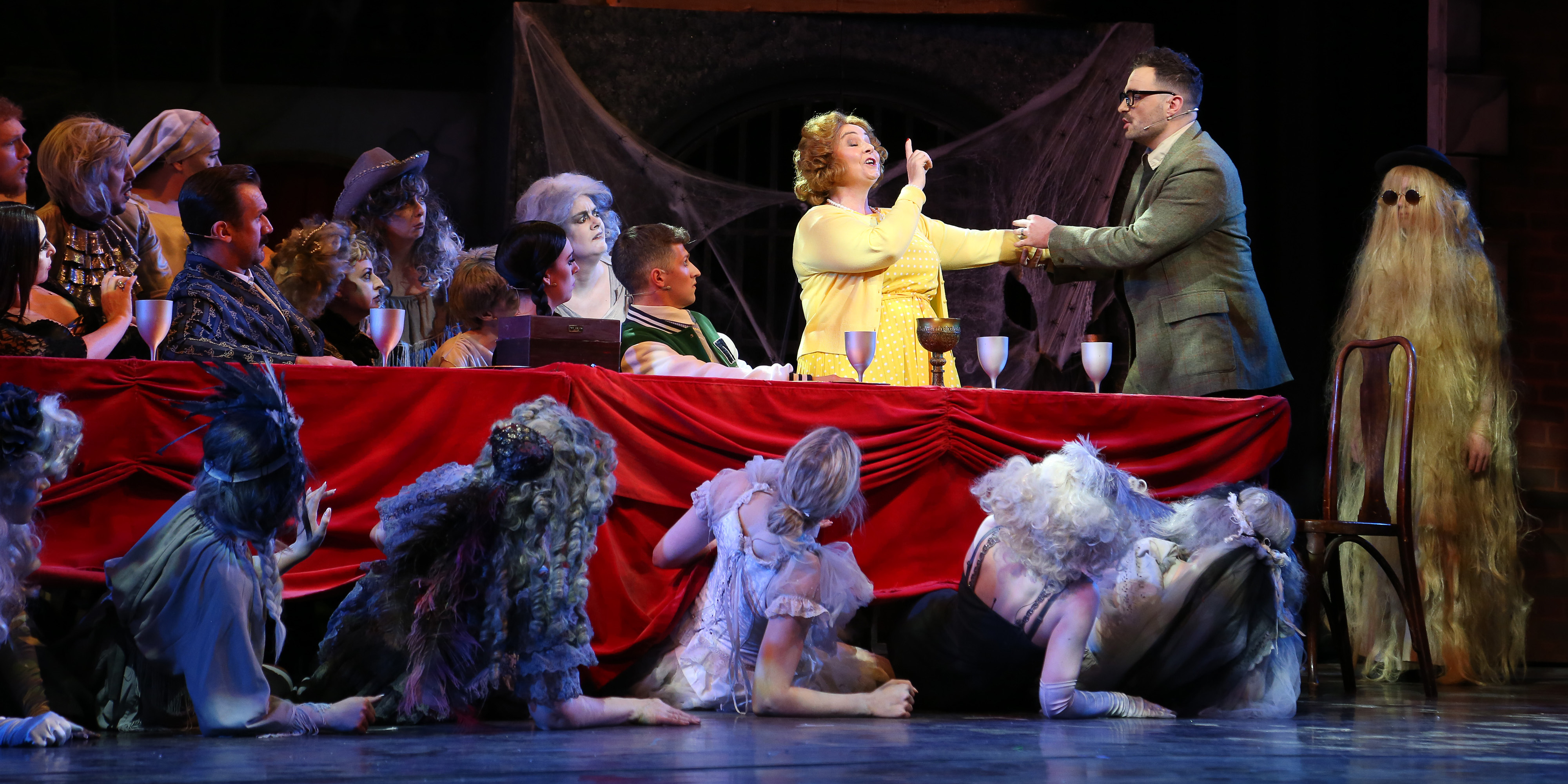
The 13-piece band strike up the overture and audience members of a certain age, who remember The Addams Family serial on Channel 4 (mid-1980s) or ITV (mid-1960s), click their fingers in time to the familiar tune. A severed hand meanders across the stage and a solemn family appear at the wrought iron gates of a cemetery.

The gist of the plot of the musical is that the daughter of the family, Wednesday Addams, has fallen in love. It’s pretty serious and Lucas is coming over for dinner and bringing his out-of-state parents. What could possibly go wrong in this high stakes encounter between the eccentric family who live in a gothic mansion in the middle of a New York public park and what seem to be a more tame family from Ohio. Could it be lead to the breakup of the Addams family?

Martin McDowell’s Uncle Fester emcees proceedings, an ebullient presence anytime he’s on stage. Aideen Fox shines in the role of Wednesday, owning the character’s deadpan demeanour, believably twisting her adoring father around her finger, and knocking every song out of the (Central) park. Daddy Gomez (Allen Gordon) fawns over the household matriarch Morticia (Lorraine Jackson) with the pair’s tango in the second a real highlight of Ann Marie Morgan’s choreography. Gordon and Jackson are vocally strong and Laura Kerr’s direction keeps them at the centre of attention, driving the story forward in scenes that could otherwise have become quite busy with the thirty or more ghostly ancestors dancing around in the background.

Andrew Reddy’s costumes deserve a mention: Wednesday’s tunic dress amplifies how her family defy cultural norms, while the Morticia’s elegant ballgown neatly transforms for the second act dancing.

The quality – and cost – of amateur productions is extraordinary. Set, sound and lighting are all to the standard you’d expect in a touring show passing through the Grand Opera House. But the programme also points to the community effort that makes a production like this possible. The months of weekly rehearsals produce quality performances. The choral pedigree of the society is apparent in the confident vocals and rich harmonies of both the principal cast and the ancestral ensemble. There’s also an army of people managing the props, wardrobe, make-up and welcoming the audience front of house. And how appropriate that local undertakers – Healy Brothers – were sponsoring the show!

The story embedded in the musical (by Andrew Lippa, Marshall Brickman and Rick Elice) is absent of the satire that cartoonist Charles Addams injected into his original macabre creation. Instead, the musical is almost wholly written for the laughs that can be found in the awkward encounter between the morbid Addams household and the differently weird outsiders who come to visit. Which makes for an entertaining show, and St Agnes’ Choral Society certainly squeeze a lot out of the material that is available in the book, lyrics and music. The flight choreography could be tightened up as the week goes on: Fester really needs better arm movements and something to do when he’s drifting towards the moon, one of the more bonkers elements of the story that really should have been cut in the last decade.

The success of the recent Addams’ spinoff show Wednesday on Netflix may have a lot to do with the selection of this musical for St Agnes’ Choral Society’s latest production. But they certainly have the performers and the panache to pull it off the entertaining romp which continues at the Grand Opera House until Saturday 6 May.

Oh, and can someone tell Morticia that the Paris Sewers really are worth visiting! We brought home a (toy) rat and discovered a Northern Ireland connection!

Photo credits: Nicola McKee and others

Enjoyed this review? Why not click on the Buy Me a Tea button!