Wednesday, November 30, 2022

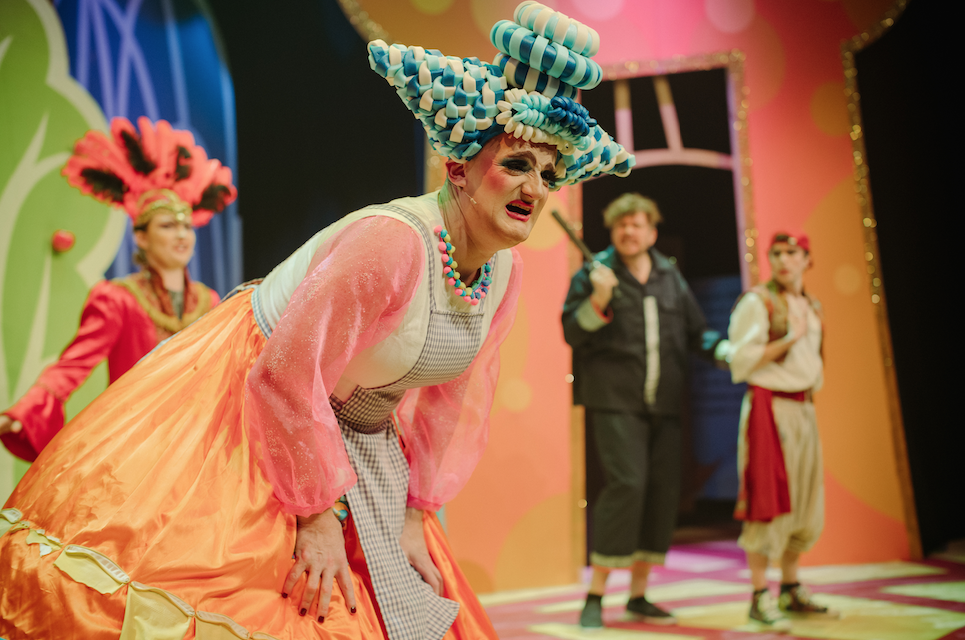
Aladdin – a pantomime that is bright and brash, confident and classic (Waterfront Studio until Saturday 31 December)

Audience participation from the very beginning? Tick. Cheesy Tik Tok songs and dancing? Getting the baddie’s name deliberately wrong? Throwing in a few phrases to go over the heads of the kids? Singing contest? Making fun of Glenavy, Lurgan and Bangor? Running through the auditorium? All ticked in Aladdin, this year’s Waterfront pantomime.

Neil Keery’s Widow Twankey owns the laundrette in Ballylaganbogey and struts around in bright dresses and high heel boots, lightly roasting a few favourite audience members in the front row. The ever-youthful Gavin Peden is back on his regular Christmas stage playing Twankey’s rascal of a son, Aladdin: a regular Peeping Tom who catches the eye of Princess Jasmine (Tanya Shields). Cue the arrival of a saddled-up policeman with a heavy French accent, played by the gloriously boisterous Rhodri Lewis. Chris Mohan’s evil Abanazar – or was it Abanabbeycentre? – encourages booing, while the sure-footed and shimmering Fairy of the Ring (Vicky Allen) dances the socks off the rest of the cast.

Will Aladdin get his “three gorgeous wee wishes for rubbing the lamp”? Will the Empress force her daughter to eschew the peasant and instead marry “a prince who doesn’t even sweat”? Will Widow Twankey fall for a scam? And “why is there a hippo in my garden?”

The tunes and moves (directed by Katie Richardson and Paula O’Reilly) that pepper the production provide a lot of energy, while the rich sound effects and wordplay add laughs. A prize will be awarded to the first child who asks “what’s a throuple?” on the way home! Stuart Marshall’s garish set is blessed with an upper deck, though it is underused in the frequent chase sequences.

Voyeurism, kidnap, a child playing in a washing machine, forced marriage, and scamming unsuspecting widows. Pantomime can take anything and put it through Widow Twankey’s mangle to create something fun and festive!

Aladdin is up to the GBL Productions/Waterfront’s usual high standard of Christmas fare with a Patrick J O’Reilly script that Chris Robinson moulds into a confident, family-friendly, classic panto with a cast of six. It’s bright and brash: you’ll not shed any tears, but you might be hoarse shouting by the end.

Aladdin continues at the Waterfront Studio until Saturday 31 December. In parallel, the shorter 75-minute Adult Aladdin will be tickling older late night audiences at the tail end of each week

Enjoyed this review? Why click on the Buy Me a Tea button!

Monday, November 28, 2022

Van Gogh: the Immersive Experience … bringing the artist to life in Carlisle Memorial Church, fittingly a building as old as the paintings

The style and works of the late-nineteenth century Dutch impressionist painter Vincent can Gogh are familiar. The Starry Night and Sunflowers are amongst the most searched paintings on Google. His face is recognisable through his vivid self-portraits. But what do we know about the man, other than he cut his ear off?

The traditional way of engaging with an artist’s work is either to look at it in two dimensions in a book or a website, or to visit one of the few galleries or museums that can afford to own or borrow their works. But modern technology can offer other opportunities, devoid of the original artefacts, but perhaps in more fulsome albeit less authentic ways.

The Van Gogh: The Immersive Experience has opened in Belfast. Fittingly it’s being held in a building that is the same age as many of the artist’s paintings, opening in 1876. The exhibition tells the story of the painter, his technique, and his works.

A series of illustrated panels give a sense of the artist’s life, the torment and mental anguish that affected his well-being, and ultimately foreshortened his life. A giant sculpture of his head is brought to life with video projections, a taster of what is to come.

At the end of the corridor of panels and reproduction paintings, you’ll step into the 20,000 sq ft white room and you’ll see the textures in more detail that you’d be able to squinting from behind a rope in a gallery. The floor to ceiling projections bring to life familiar, and less familiar, works by Van Gogh. Animations convey a sense of the brushstrokes and artistry, the exaggerated and often garish colour palette, the golden sunlight, the shimmering backgrounds. They also but also express a sense the artist’s psychosis.

Sit back on a deckchair and soak in the changing panorama as it cycles through its scenes, largely wordlessly building up a sense of Van Gogh’s work and world. There’s no rush, no need to quickly move on. Though if the colours and animations become too much, there’s also an endless supply of people watching as those around engage with the work, take selfies, and look up Wikipedia to find out more. An annex in one corner allows you to slip through the curtain into the artist’s bedroom, a physical recreation of another recognisable painting.

For those who buy the top tier ticket, a more personal immersion can be experienced in the VR room, allowing you to sit on a bar stool and swivel around as the virtual reality video moves you through Van Gogh’s world.

The immersive video space gives a sense of scale of the dimensions of the former church building. Frankly, in late November, it also conveys an impression of the poor insulation in nineteenth century buildings, so wrap up warm. Very warm.

A New York Times reviewer somewhat sniffily referred to “wall-size screen savers” which is both accurate and unfair. Exhibition Hub who produce the Van Gogh immersive experience use the portmanteau “edutainment”. The giant animations and reproductions do appeal to the Instagram generation; you’re buying a ticket to a place of perpetual selfie temptation. But you’ll struggle not to leave with a better impression of how a troubled artist could create such distinctive work, how he could be a commercial failure in his own lifetime, and perhaps leave with a sense that so many (including the viewing public) profit from his abstract genius.

I came away from the exhibition realising that there was much more to learn about Van Gogh. It’s an enticing introduction that might lead to reading a book or listening to podcasts to hear more about the visual images that are now locked into my memory. The Immersive Experience can be found in cities around the world, including Belfast.

Enjoyed this review? Why click on the Buy Me a Tea button!

Sunday, November 27, 2022

The Snow Queen – a rescue mission, a voyage of discovery, and a tussle between duty and belonging (Lyric Theatre until 31 December)

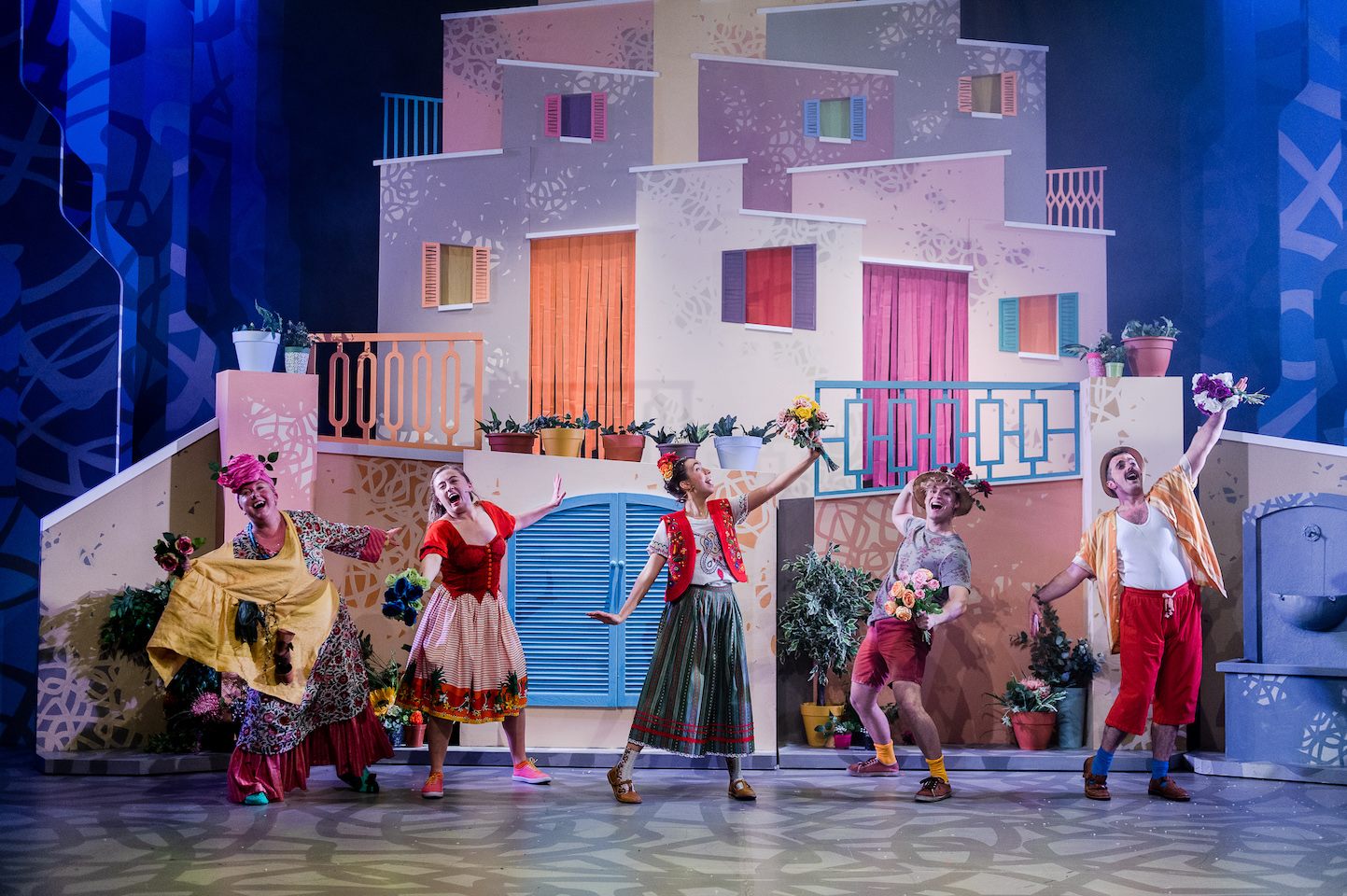
With an initial townscape that wouldn’t look out of place for a production of Mamma Mia, it’s Just Another Day in the Sun in Blomsterby according to the lyrics of The Snow Queen’s energetic opening number and the golden sunshine falling over the houses. Bookish Gerda (Calla Hughes Nic Aoidh) – can I pause to appreciate how much a bookish ten year old Alan would have been impressed with a character who never rarely sets down their book throughout a two hour show! – is well informed about the world around her. But she’s never stepped outside her town.

Her childhood friend Kai (Ben McGarvey) is increasingly consumed by wanderlust, wanting to visit the places around the world to which he dispatches orders for the town’s flowers. Gerda’s grandmother Rose (Christina Nelson) has green fingers, and a big family secret that she has held off sharing with Gerda. But when the cold wind of the Snow Queen (Ruby Campbell) blows from the north, her revelation sends Gerda off on a journey that will test her sense of belonging and duty while ascertaining her power to bring about change.

The Snow Queen has a strong ensemble cast. Aaron Halliwell and Darren Franklin – he’s back on the Lyric main stage just a few weeks after spending a month floating above it while playing the troubled photographer in Conor Mitchell’s Propaganda – occupy the sides of the stage, augmenting the Paul Boyd’s rich backing tracks with live percussion, guitars and keys. And if you’re sitting back a bit from the front rows, you’ll catch all kinds of gestures and humorous reactions to the main action. 

It’s particularly refreshing to see a Christmas show that has been written with three female leads. Nelson has a much more central role in this year’s show – playing three sisters, each holding an ever-more elaborate and outlandish staff. Nic Aoidh’s duet with Halliwell (The Girl Who Had Stars in her Eyes) is a vocal highpoint in the show. Meanwhile, Ruby Campbell switches from being a girl-about-town in early scenes to become the titular villain, dressed in cool flamboyant white, yet trapped in her position rather than being simply evil. Campbell’s voice and gestures carry across the stage, augmented by Mary Tumelty’s clever use of backlighting and Paul Boyd’s trademark shadow play.

Deborah Maguire’s choreography has been drilled into the cast, with lots of distinctive group movements to help differentiate between the characters in each new location. The gentle horror actions of Great Aunt Tanzy’s guards in Tick Tock is subtle but unmissable. The slippery dance reprise of Just Another Day in the Sun is both funny and symbolises the extensional threat to the good folks of Blomsterby. While the first quarter of the show is quite dialogue heavy – some pruning would definitely help enhance the ‘show, don’t tell’ storytelling – the pace noticeably quickens after the interval with a high-energy opening number and Eoin Robinson’s cartoon graphics that entice the young audience members to settle back into the journey to the Snow Queen’s home in Finnmark.

There are some great technical successes. The scene changes include neat effects to freeze over the town’s fountain (which hopefully doesn’t contribute to the flow of toddlers wanting to go to the toilet in the first half hour). The final switch from snowy Finnmark back to the Blomsterby town centre has a real wow factor, with the quick costume changes matched by the rapid transformation of the set. Stuart Marshall’s design serves the show well, while Gillian Lennox’s costumes have delicate detailing, like the red hair accessories of Tanzy’s guards toning in with Second Lieutenant Oakie’s military hat (worn by the versatile Christopher Finn). And it snows. Multiple times. Which should be mandatory for all family entertainment staged at Christmas. Expect vocal gasps from the audience when a familiar festival animal makes an appearance.

The young audiences packed into the Lyric Theatre will probably not realise that real life echoes some of the happenings on-stage. It’s natural for groups of creatives to form loose partnerships, working with each other over years, comfortable with each other’s foibles and methods. Much like the dramatic bond between Gerda and Kai – the two village folk who prove that they would go to the end of the earth for each other – it’s good to see Finn, Nelson and Maguire back working with Paul Boyd. But it’s also great to see new blood being tested on stage, with Nic Aoidh and Halliwell making their professional debuts this Christmas, and Paperboy alumni (2018 and 2019)  McGarvey returning to the Lyric stage.

The Snow Queen is a good reworking of the normally convoluted original tale by Hans Christian Andersen. It’s playing twice daily at the Lyric Theatre until 31 December, sharing the main stage with Grimes & McKee’s Christmas Craic’er while Pigeon & Plum’s Vaudeville Circus takes over the Naughton Studio.

Photo credit: Carrie Davenport

Enjoyed this review? Why click on the Buy Me a Tea button!

Monday, November 21, 2022

The Menu – horrific home truths served with a side of humiliation

Twelve guests travel by boat to Hawthorne* Island to experience an intense evening of fine dining. The kitchen staff and chef Julian Slowik live on the island in relative isolation, a cult-like group with military discipline. The bespoke menu turns out to be quite punishing to digest, full of crunchy home truths, and most courses served with a side of humiliation.

The Menu quickly establishes the sense that the chef (Ralph Fiennes) has lost respect for his high value paying guests who crave the exclusivity. The bread plate wheeze is conceptual and signals that the customer is not always right on Hawthorne. But it’s not until the fourth course – sous chef Jeremy’s The Mess – that the evening reaches the tipping point between very unsettling and totally horrific last supper.

At times, Peter Deming’s cinematography is reminiscent of shows like First Dates, with the camera peering into conversations around a particular table while other diners carry on in the background. That’s matched with shots that show off the sleek architectural lines of the restaurant. A lot of horror (for example, the ‘change of ownership’) happens at a distance; close-ups aren’t necessary to disquiet.

The Menu places fine dining onto the grill to sear. At a surface level, it’s about culinary artistry becoming the pursuit of the privileged few who place it on a pedestal and have no interest – or skill – to try and cook anything for themselves. It’s about the gap between service industry workers and their customers. It examines self-worth and depression. But there’s also a strong strand that judges people’s flaws – whether commercial, ethical or relational – and asks if they can ever own up to what’s wrong.

As the dining experience heats up, there’s a gradual increase in the amount of honesty – a wedding ring falls to the ground, symbolic of a customer’s infidelity – while the customers seem quietly resigned to their fate and don’t descend into hysteria despite the inevitable build-up to a grotesque final course.

Nicholas Hoult plays Tyler, a young foodie who, alone amongst the diners, was fully aware of what was to come when he stepped onto the island. His date, Margot, a late change of plan that threatens to upset the restaurant’s preparations, is soon seen as a kindred spirit by the chef. Anya Taylor-Joy revels in her central role, the outsider – a proxy for the cinema audience – eyeing up monstrous diners and seeing through the multiple levels of betrayal long before the more snobbish customers.

The Menu is a slow-burning satirical horror movie. The greatest jump-scare is someone clapping their hands together. But there is still plenty of karma being served out while blood is smattered about the island before dessert is served. You’ll find it being screened in the Queen’s Film Theatre and most other local cinemas.

* Whether it’s Hawthorn or Hawthorne with an ‘e’ is a mystery, with one used in the film, but the other appearing in the producer’s online content!

Enjoyed this review? Why click on the Buy Me a Tea button!

Saturday, November 19, 2022

Revved – tragic, intense, funny, and hard to wash off when you leave the theatre (Lyric Theatre until Sunday 20 November)

Eamon is trapped. His mind is replays the events of a night some years ago when he gave a lift to a couple of friends. Even though he was mad about cars – you had to be living in an area that’s boosted by the annual Donegal International Rally – he wasn’t really a boy racer with a heavy right foot. But a sense of longing crossed with an act of betrayal led to a moment of madness that forever changed the lives of the passengers and their driver.

Once upon a time, with Leaving Cert finished, Eamon wanted to rid himself from the small-town mentality and go off to study in Dublin, even if that would disappoint his best friend. Years later, those dreams are out the window. His contemporaries are in their final year of college. But Eamon still can’t escape, even when he turns up for the early shift at the petrol station.

A pimped-up ghetto blaster sits on a metal shelf in the back stockroom, squawking that “it’s three minutes past six”. The local radio station will continue to periodically interrupt Eamon’s remembrances before he shuts out the real world again and retreats to his well-worn road to destruction. He’s stuck in a depressing loop on the last weekend of the rally, with no notion of enjoying the buzz of the event.

“If in doubt, drift ‘er out.” Writer and performer Patrick Quinn curls his tongue around the Donegal accent and the expressive vocabulary of the rural area and rally driving. There’s an authenticity and a lyricism that helps carry the solo piece, and a lot of pure this and pure that, people getting langered, while everything’s cushty, though some people are a real dose!

Emily Foran’s direction of Revved emphasises the conversations playing out in Eamon’s head by turning foodstuffs on the shelves into puppet heads of people: a half loaf of bread, a six-pack of (southern) Tayto that towers over him, a bottle of football special (shaken and dropped on the floor) representing the girl he fancies, a blue pringle tube doubling up as a Garda officer.

A soundtrack of electronic dance merging into ambient beats sits underneath most of the one act play until the final minutes when Eamon is faced with the reality of life, his excuses and justification wiped away, no more dreaming, just the nightmare of that one night.

But it’s Quinn’s mesmerising performance, his piercing eyes, his willingness to embrace awkward silences that brings Revved to life. At one stage, it looks like Revved will become a treatise on betrayal and stunted ambition. But the final revelations spin it around to the question of forgiveness: whether it can be asked for, given, received. And whether someone can – or should – ever truly forgive themselves.

The ideas latch onto the audience during the 70-minute production. “Wouldn’t that be heavy to live with” said a complete stranger as we walked out of the auditorium. People wanted to – needed to – talk about the play. Other conversations went deeper than usual, much faster than expected, as people shared elements of tragedy that they carried in their lives. Typing this up a day later, my heart is still heavy, like the dark trace of engine oil that I can’t quite wash away.

It doesn’t quite have the twists and turns of Abbie Spallen’s three-handed, petrol station-based Pumpgirl, and the final half page of dialogue doesn’t seem as sharp as the piece deserves, but Revved is a great piece of new writing that deserves to be seen.

Revved is a tragic tale, intense, funny, and very poignant. You can catch the final performance on Sunday 20 November in the Lyric Theatre.

Enjoyed this review? Why click on the Buy Me a Tea button!

Friday, November 11, 2022

Black Panther: Wakanda Forever – long-winded sequel full of heart and the ethics of conflict (cinemas from 11 November)

The premise of Black Panther: Wakanda Forever is that the meteor metal vibranium has been found on the ocean floor far away from Wakanda. When the exploration mission is attacked, Wakanda is accused of being responsible. But another enemy is afoot, and T’Challa’s grieving sister, tech wizard Shuri (Letitia Wright) heads off with special forces chief Okoye (Danai Gurira) to find a clever student at MIT (Riri Williams played by Dominique Thorne and deservedly appearing in a TV spinoff next year) and restore order to the world. When their plan goes wrong, they end up at war.

The situation may be science fiction, but the storyline is very modern and familiar. A nation is dealing with border security, protecting valuable resources, mass displacement, and a strategic decision about whether the killing of a foreign leader might extend or prolong a war. Colonisation is at the forefront of people’s thinking. Death thrusts other family members into the spotlight and into positions of leadership. Add to that the threatened genocide of the surface people, and the realisation that vengeance is all-consuming.

In a world where ancestral power casts light as well as shadow over present-day thinking, can Wakanda continue to travel in the same direction as those who have gone before? Or make fewer mistakes and find an even more true and peaceful path?

The 161-minute duration leaves director and co-screenwriter Ryan Coogler plenty of time for ethics to be explored. There’s a powerful example of self-sacrifice to save a stranger. There’s a comparative analysis of world leaders and the power of a figurehead to incite and excite. There are pictures of a family who are grieving, divided and reunited to search for those who are lost. The line “the world has taken too much from you to still be considered a child” could have been lifted from Myanmar, Yemen, Ethiopia or Ukraine.

A throwaway remark notes that the discovery of vibranium outside their kingdom upsets their legends and beliefs. Science challenging culture and religion.

Sound is crucial to the story: the sound of (watery) sirens turns people into clifftop lemmings. The score – much of which celebrates Mayan music – is richer than most other films in this genre which would get away from swelling strings and plenty of brass when the fighting starts. Instead, Ludwig Göransson weaves together character themes and creates something much more lush and powerful.

For a sequel that could have been titled Blank Panther: Girl Power, it’s very noticeable that the first line of dialogue is centred around a man who needs to be healed (“Please allow me to heal my brother of this illness”) and then a ceremonial sequence as he returns to be with his ancestors.

Marvel fans will feel it’s a necessary and fitting acknowledgment of the absent character T’Challa (who had been the Black Panther in the first movie) and the much-loved actor Chadwick Boseman who died in 2020. But outside that universe of fandom, the long opening tribute may be an awkward start for anyone not bought into the on- and off-screen detail.

The Belfast Odeon leaving the houselights on until a patron left the screen to tell them fifteen minutes into the main feature was also less than ideal.

But all was well when Arthur Dent walked into shot. That was the moment that I knew everything was going to be okay! Martin Freeman is back as CIA agent and friend of Wakanda, Everett K Ross.

Black Panther: Wakanda Forever will please the fans as well as those of us who prefer superhero films to be more cerebral than violent. It opened in cinemas on 11 November.

Enjoyed this review? Why click on the Buy Me a Tea button!

Wednesday, November 09, 2022

Mamma Mia – a well-oiled show that celebrates the audience’s connection with ABBA’s classic songs (Grand Opera House until 26 November)

The ABBA jukebox musical Mamma Mia is 23 years old. You’ll probably already know the story from the film adaptation, and you’ll be familiar with the twenty of more ABBA songs that drive the drama.

Sophie’s getting married in the morning. Having rifled through her Mum Donna’s diaries, she’s found entries describing a rapid series of flings with three men, any of whom might be her father. So she’s secretly invited Sam, Bill and Harry to the wedding without telling anyone. Meanwhile, Donna’s making the final preparations at her Greek island taverna for her daughter’s big day, and is catching up with her old bandmates Rosie and Tanya who’ve arrived for the celebration.

The stripped back set and costumes are mostly a gorgeous sea of beige and pale blue (only turning pink for the final nuptials). Two curved walls are spun around to create a handful of locations, furnished with wooden chairs, café tables and bed. The band – as many keyboards in the pit as guitars! – plays an overture that crams in the melodies from numerous ABBA hits before a wistful Jena Pandya appears on stage as Sophie.

The show’s plot neatly dovetails a young woman’s search for the backstory to her identity with grown-ups coming to terms with their youthful actions. As the premise for a jukebox musical goes, this is one of the least flimsy, and you’re never left in a confused state wondering what’s going on.

Mamma Mia’s hidden strength is the connection between the audience and the songs. Teenagers in the audience know the material from the film. The irritating 60-something man sitting over my shoulder singing along with every song clearly knows the words from the 1970s and early 1980s.

Phyllida Lloyd’s wisely direction keeps the actors in character and breathes new life into fresh arrangements of the poptastic back catalogue before letting the numbers by Donna and the Dynamos stray into gloriously dazzling ABBA replica territory.

It’s is a well-oiled show with a huge cast. Catherine Johnson’s book quickly introduces a lot of minor characters early on who are then neglected for most of the rest of the first act. Sophie’s besties Ali (Jasmine Shen) and Lisa (Mariella Mazzilli) deliver a great Honey, Honey before disappearing until the hen night. Toby Miles’ time on stage as fiancé Sky is surprisingly fleeting.

The staging of Chiquitita by Donna, Rosie (Nicky Swift) and Tanya (Helen Anker) in the middle of the first act is the most playful. The flipper dance accompanying Lay All Your Love on Me is a moment of brilliance that surely deserves to be referenced in the encore. James Willoughby Moore’s superbly cheeky Pepper steals a lot of scenes and then earns the audience’s extended applause with a series of straddle jumps that demonstrate the dance technique and stamina hiding behind the clown act.

Mamma Mia never takes itself too seriously. The post-interface dream sequence Under Attack is wonderfully offbeat. Crowder/Harry’s Our Last Summer is perhaps the best of the Dads’ big songs, though Take a Chance on Me with Corbitt/Bill does inject some farcical energy into the build-up to Sophie finally walking up the aisle. The story ends as it began with Sophie and I Had a Dream before the lighting rig descends into view for the glitzy three-number encore that gets the audience up on the feet.

With a three-week run in Belfast before pantomime takes over the Grand Opera House, you can see Mamma Mia until 26 November. Warning: this show briefly contains bagpipes!

Photo credit: Brinkhoff/Moegenburg

Enjoyed this review? Why click on the Buy Me a Tea button!

Tuesday, November 08, 2022

The Banshees of Inisherin: a gruesome exploration of whether being nice is a virtue or a vice

Martin McDonagh’s The Pillowman is the most gruesome play I’ve attended. Within it were a series of grisly fairy tales. The retelling of the origin story of ‘The Pillowman’ chills me to this day when I recall being trapped in a theatre seat having to listen through to the awful end of the fable. Expert storytelling, but chilling in the extreme.

While The Banshees of Inisherin doesn’t deviate from that foundation, at first, McDonagh’s film seems like a quaint, rural tale of a grudge between two blokes from a century ago who live on an island off the west coast of Ireland. But the sense of horror soon ratchets up and up and up as a threat is first made, and then followed through with devasting consequences.

One day Colm wakes up and – hit by a depressed sense that he’s frittering away his days on this earth – decides that his dull mate Pádraic is no longer his friend. So he reneges on the daily ritual of going for a pint in the local pub at 2pm. Instead he composes an air for the fiddle and insists that Pádraic no longer make contact.

Brendan Gleeson is excruciatingly stubborn as Colm. He takes on the gait of an ogre from a myth as he ambles along the country lanes. Colin Farrell’s Pádraic is inane, with little self-awareness, a “whiny little dull-arse”! Until now, everything in life has revolved around his own wants and needs. He’s had a friend to talk to, a miniature donkey to spoil around the house as a pet, and a sister to look after him. Soon all of those crutches are put at risk.

The brightest person on the island – in terms of intelligence and fashion – is Pádraic’s sister Siobhán. She’s bookish, underappreciated and harbours ambitions that would lead her to the mainland. Kerry Condon gives the Siobhán an understated depth, struggling to believe the actions and motivations of the mad men that surround her, and slowly running out of patience. Other than Siobhán, the women in this character study of stubbornness and hostility are largely ancillary. The interfering post mistress moves the plot on; the wizened Mrs McCormick makes bold predictions.

Another tragic islander is young Dominic. While Siobhán gently but firmly spurns his advances, Dominic is also carrying the weight of the demons that come from being the son of the drunken and abusive local police officer. Barry Keoghan brings intrigue and pathos to a role that McDonagh uses to add to the growing pile of misfortune and heartbreak.

Tragedy seems to rush in to fill a vacuum of hope on Inisherin. It’s set against the background of the civil war, a conflict – somewhat misunderstood and ignored – that the island is insulated from by a thin strip of water. McDonagh explores what it means to be kind, whether it’s a virtue or ultimately a vice.

Sitting back in the comfy cinema seat, I couldn’t help wonder if the allegory could be fitted to the recent stand-off between the DUP’s Jeffrey Donaldson and Secretary of State Chris Heaton-Harris, each squaring up the other and not wanting to back down. Except the SoS lost his scissors and didn’t go through with the threat …

The Banshees of Inisherin is a superbly black comedy, so dark that it veers into unexpected horror. There’s a twist of Beckett in the air too. Expect it to be up for multiple nominations in the Academy Awards.

Enjoyed this review? Why click on the Buy Me a Tea button!

Saturday, November 05, 2022

Kiinalik: These Sharp Tools – apposite, uncompromising, shocking, and profoundly beautiful (until Saturday 5 November at The MAC as part of Belfast International Arts Theatre) #BIAF22

Theatre can kickstart conversation. It can contribute to conversation. Or, as in the case of Kiinalik: These Sharp Tools, it can be entirely based around conversation, between the artists on stage and the audience in the stalls.

For the first hour or more, Kiinalik is the most beautiful show. The back and forth exchanges between Laakkuluk Williamson Bathory and Evalyn Perry retell how they met on an Arctic expedition ship, a somewhat touristy journey from northern Canada to Greeland, through the melting glaciers on an ironically diesel-fuelled vessel. We hear about the other passengers, the landscape, the melting (“more melting means more melting”), the ways of life, the practical impact of colonisation, a government’s intentional relocation of indigenous people, desecration, violation, prejudice, discrimination. There’s science, history (though much of it is better described as “living memory”), multiple marginalisation, psychology and sociology, but always conversation.

The dialogue is often gentle, making it all the more powerful when Evalyn quietly admits she once campaigned with Greenpeace to stop all seal hunting. (Greenpeace now says that “the large-scale, commercial hunt is a world away from the traditional practices of Indigenous Peoples in the Arctic [who] have shown time and again that they understand how to protect the Arctic ecosystem they call home, and their hunting practices have never been a threat to seal or whale populations”.)

Images of the Arctic float past on two angled screens behind Evalyn and Laakkuluk. Ice flows. Birds. Settlements. Shots from land, sea and air. They’re controlled by video artist Elysha Poirier who sits to one side of the stage, weaving the imagery into the narrative. Facing her sits Chris Derksen with an electrified cello – sometimes sweet, sometimes sliding, sometimes distressed and dissonant – who accompanies Evalyn’s guitar, both making great use of loop pedals to build up the texture of the score.

The lights come up to allow audience members to discuss how far north we’ve ever been. ‘North’ and ‘south’ are contended and complicated in so many different cultures and places. When Evalyn sings a childhood song, North West Passage – after all, “you know you are at home when you know all the words” – the lyric mentioning “savage” jumps out. The pair’s overlapping experiences and family parallels bring them together. Their distinctive starting points orientate them in very different directions.

I could have listened to the pair all day. The most wonderful section sees the artists step away from their ice-fronted raised stage. They bounce back and forward in time with short observations. The relevant year appears over their shoulder on the screen behind. It’s a quick fire round of immersion in their own past lives and the history of their country. Chaotic, yet so easy to follow.

The appearance of an overhead projector – remember those! – is a clue that the mood may be about to change. Having established the ground rules and built a sense of respect, Kiinalik turns on its heel to become more in-your-face, testing whether the audience have truly entered into the spirit of respect and curiosity. Laakkuluk’s artistic practice of uaajeerneq – inadequately translated as Greenlandic mask dancing – combines fear, sexuality and humour in an intense and explosive performance as she moves through the audience. It’s okay that it feels uncomfortable ... the explanation that follows helps make sense of how you’ve felt and what it signifies.

Originally developed and co-produced by Buddies in Bad Times Theatre and Theatre Passe Muraille, Kiinalik is ultimately a provocation to explore the unresolved, to enter into a shared conversation that won’t necessarily include apologies or come to full agreement, but will be respectfully open to hear about hurts, listen to other perspectives about things you’ve long been told or believed, and feel fear without having to fight or flight. To find reconciliation without first having to bring about full resolution.

Kiinalik: These Sharp Tools is the most apposite of the pieces of queer Canadian theatre that have been showcased in Belfast International Arts Theatre. It speaks to these fractured islands in multiple dimensions. It’s uncompromising, shocking, and yet profoundly beautiful. The final performance is at The MAC on Saturday 5 November at 19:45. It’s a production you’ll not forget in a hurry for so many good reasons.

Enjoyed this review? Why click on the Buy Me a Tea button!

Friday, November 04, 2022

After Melissa: melancholic jigsaw puzzle of competing memories and unspoken secrets #BIAF22

After Melissa is a tragedy told through the memories of a Donegall man, an Egyptian woman who married into high society, and a younger woman who brings pleasure to many but is searching for fulfilment.

Ruairi Conaghan is the primary storyteller. He plays Eamon Quiery, a literary academic who worked in Egypt’s Mediterranean port city of Alexandria but has returned home to Donegal to raise Melissa’s daughter. As he pieces together what really happened in those heady years spent overseas, he recalls the voices of some of the women he knew well in a city that is portrayed as colourful and exotic. Justine’s wealthy husband Nessim had grown cold and she enjoyed the company of the “freckled, milky-skinned blow-in”. But Quiery was also smitten with a dancer in a local club, besotted with the woman’s vulnerability and his desire to protect this broken bird who has been disowned by her family.

Caitriona Hinds emerges from the shadows dressed in black. Her Justine is at first confident, later less guarded, and finally at peace with the tangled web that this group of lovers have woven. Melissa is talked about more than she’s listened to. But when Sanja Nović steps onto the stage, there’s an electric presence that gives her few choice lines more impact.

Over 90 minutes, the audience are able to grab pieces of remembrance and fit them together like a jigsaw puzzle, testing the different truths against each other to find congruence and detect contradiction. The characters engage because they are full of flaws and ambiguity. The dialogue plays with accents and vernacular.

The plot may be set in an oversexed Alexandria, but it also speaks to the unspoken secrets that are knowingly overlooked in everyday society and many families. None of the love and lust in the tale was free: it all came with a great cost. A sense of melancholy hangs over the heads of the characters like a charged cloud ready to burst with a heavy shower of rain.

Despite the long series of monologues, David Grant’s direction never lets Quiery become frozen to one spot on the stage. The simple set includes a garden seat, a typewriter on a desk and a kitchen table. (And always expect to see a suitcase in Jane Coyle plays!) The limited palette of simple sound and video effects are nearly unnecessary – other than the lines for the offstage Balthazar – given the strength of the writing and Conaghan’s hold over the audience.

The one-act play is inspired by Lawrence Durrell’s tetralogy of books – The Alexandria Quartet – which retell an overlapping set of stories from different characters’ perspectives, slowly twisting what the reader believes to be the truth behind the differing memories.

Examining the consequences that result from a set of liaisons in the cultural melting pot of Alexandria sounds more like a subtitled TV series that should be broadcast on BBC Four than a play you’d expect to see produced and performed in Northern Ireland. Yet the Irishness of the central character really lifts the concept of After Melissa into an intriguing work that can speak loudly about the concepts of home and belonging. About selective curiosity and incomplete memory. About whether the adults in the room can be trusted with an invisible child’s welfare. About whether love can survive and thrive when all the tea has been spilt.

You can catch After Melissa in the Brian Friel Theatre (straight in front of you when you walk into Queen’s Film Theatre) until Saturday 5 November as part of Belfast International Arts Festival, and then in Bellaghy (Thursday 10), Armagh (Friday 11), Downpatrick (Saturday 12) and Cushendall (Sunday 13). Photo credit: Linda Hutchinson

Tuesday, November 01, 2022

Lyra – a painful celebration of a beautiful life cut short (QFT from 4 November)

Lyra McKee was a ‘ceasefire baby’ born with a double shot of curiosity and empathy. Her mind always seemed to be racing ahead, ploughing through possibilities for stories, making connections with her enormous network of contacts. Those bonds lasted well beyond anyone’s ‘usefulness’ to a story or a project. So many people she talked to seemed to become a friend and adored her. (Though it’s only fair to add that she did manage to antagonise a few along the way too!) She could pick up a conversation months later with no time wasted getting back up to speed, or recall a detail about someone in the family and ask something incredibly pertinent.

Alison Millar’s film about her friend Lyra is an astonishing reminder of the young woman so many of us loved. A friend who hundreds, probably thousands, of us felt we should go out of our way to encourage when we’d meet.

Family camcorder footage takes us back to Lyra as an infant, always bespectacled, always playful. It’s painful to hear her voice again, with extracts from clips from mobiles of friends and family, and snippets of conversation from dictaphone-recorded interviews. It’s a joy to remember her dress sense, her coordination, her unbounding love for her young niece, and the way Marie the cat invaded her personal space at every available opportunity.

Fragments from Lyra’s writing are typed onto the cinema screen. Lyra wasn’t a fast writer: footage in the film includes her describing the “crippling” anxiety she felt when sitting down to write. She never wrote a long sentence when two shorter ones would have more effect. Journalistic in style, yet with sublime adjectives. There’s an unbearable irony that her investigations into unsolved disappearances and murders are now followed by a search for justice in her own killing.

On her return from a trip to the US, Lyra presented at the TedxStormontWomen event. The film includes a chunk of that talk as Lyra wrestled with her experience as a gay woman who faced disapproval and condemnation from organised religion in Northern Ireland (though in conversation she’d point out individuals who didn’t fit those stereotypes and characteristically ask why they were the exception) and the much more accepting attitudes she stumbled upon when the press junket visited groups and found out about their work in the aftermath of the shooting that killed 49 people in a gay nightclub in Orlando.

I’d put Lyra’s name forward for the trip. She’d only recently learned to drive, so we met up afterwards in Belfast Castle, somewhere she reckoned would be easy to park. I still wear a Kennedy Space Station pin on my coat that she brought back from the group’s visit to NASA. That sequence in the film is a lovely reminder of how those weeks away had broadened her understanding of the complexity of so many subjects, yet an excruciating reminder that the bundle of joy who described herself as “the most annoyingly curious person you’ll know” can never be bumped into on the street or at an event.

If Lyra is a celebration of a life cut short, it’s also a testament to a family – particularly through the actions of her mum Joan and big sister Nichola – who believed that wee Lyra should not be constrained by circumstance, post code or background. While Lyra might have been seen by others as an underdog, she found herself empowered to empathise with others and help tell their stories.

The grief of her family and her partner Sara is agonising is watch and listen to. The arc of the 92-minute film touches gently on the way that victims can lose their identity and become part of the latest chapter in a conflict/post-conflict/peace process narrative, spoken of by politicians rather than represented by families. The commentary on the political stasis at the time of Lyra’s death and funeral is so apposite to today’s stalemate at Stormont.

David Holmes’ unobtrusive soundtrack tenderly underscores the mood of the on-screen journalling of Lyra’s life. While a lot of the footage was captured by documentary maker Millar, Mark McCauley’s additional cinematography is outstanding with a rich use of light and taking full advantage of the widescreen format for the visuals across Belfast and Derry.

One advantage of previewing films in a near-empty cinema is that I can gurn my lamps out without too many people realising. But if you’re more game than me, you can watch Lyra in the Queen’s Film Theatre and other cinemas from Friday 4 November.