Saturday, June 28, 2025

2000 Meters to Andriivka – brutal first-person footage of a bloody push towards the liberation of a strategic village in the war between Russia and Ukraine (Queen’s Film Theatre on Sunday 29 June as part of Docs Ireland) #docsireland7

A slender forest between two minefields is the route into the village of Andriivka. Two kilometres of contested space. Capturing Andriivka back from the Russians will cut off their supply line to a larger city. It has been the heavily fortified front line for the Ukrainian counteroffensive in September 2023.

Film director Mstyslav Chernov (20 Days in Mariupol) and journalist Alex Babenko negotiate to embed themselves with a platoon intent on liberating the village. A flag is being carried to be hoisted if and when they succeed.

If you watch 2000 Meters to Andriivka in a cinema setting, the opening scenes of conflict in the trenches will be sonically and visually immersive. Enemy drones equipped with explosives are spotted. Incoming artillery fire from Russian troops kills two soldiers. The personnel carrier sent to evacuate the Ukrainian unit gets stuck. More casualties follow, including the soldier whose helmet cam footage we’re watching.

The sound of explosions. Turning around. Firing off a few optimistic rounds in the direction of a threat. It’s like a watching a video game. Except this bloody reality is what video games are based on.

The command centre uses overhead drones to gather intelligence on enemy positions. When the camera feed starts to lag, everyone goes blind. A suicide drone can be seen exploding over the suspected enemy position. Moments like these are clinical. The loss of life is unseen.

Other footage throughout the 106-minute film is harrowing. Battle footage from soldiers in the 3rd Assault Brigade shows dead bodies and burnt out vehicles that are left behind in the crawl towards the target. Troops apply tourniquets to injured colleagues while gunfire rattles over the top of their heads. Negotiating with the last Russian soldier inside a trench to surrender or else be killed with a grenade they’ll throw into his hide. At times you’ll feel like flattening yourself against the ground.

During one of the lulls in the fighting, a soldier contemplates the changes he’ll make to life when he gets out of here. Just smoking a “normal amount” might be on the cards along with an evening stroll. A colleague enjoys the act of rolling his own cigarettes: it’s relaxing and takes time.

Chapter slides document progress towards Andriivka. The battlefield supplies most of the soundtrack, with Sam Slater’s uncluttered score faded up like a wailing banshee only when there’s a quiet moment.

After 75 minutes the film pauses for a funeral and women’s voices are finally heard, as partners and mothers grieve and process the cost of the conflict. A forest of flags flutter above a graveyard. Then we return to a final push towards Andriivka in the face of falling odds as the overall counter-offensive stalls.

While the film shows the grit and determination of the Ukrainian forces who have been ordered to capture this strategic location, it ultimately reinforces the futility of war. When they arrive, there’s barely anything left in the village that stands taller than a person. A small cat is the only survivor to greet them. The same village will be retaken by the Russians less than a year later. The cost on all sides is huge.

It’s is not a film about heroism. It’s not even a film about right pushing back on wrong. Instead, 2000 Meters to Andriivka is a memorial to the men who took part in this one tiny part of a much larger and longer conflict. It marks the names and faces and so many who lost their lives. And it is a testament to what happens, and who suffers, when capitulation isn’t an option.

2000 Meters to Andriivka is being screened in Queen’s Film Theatre at 18:15 on Sunday 29 June, the closing evening of the Docs Ireland festival of international documentary film.


Appreciated this review? Why not click on the Buy Me a Tea button!

How To Build A Library – two women battle history and poor local government to rejuvenate three Nairobi libraries (screened as part of Docs Ireland) #docsireland7

Friday evening’s screening of How To Build A Library was an unexpected companion film to Thursday’s excellent The Shadow Scholars. We’re back in Nairobi, Kenya following two women who seek to rejuvenate a library.

Angela Wachuka and Wanjiku Koinange are ‘can do’ characters who have given up their jobs to form the Book Bunk Trust. They have a strong vision for transforming the McMillan Memorial Library – the city’s oldest library and for the exclusive use of (white) Europeans until opening its doors to everyone in 1958 – into a community space where everyone would be welcome and see themselves represented in the shelves which are currently dusty and full of titles purchased before Kenya’s independence in 1963.

The filming takes place over eight years (2017–2024). There are many setbacks, the least of which is Covid.

Structurally, the documentary’s ambition and raw material is very promising. The main library building is crumbling and unloved (post-independence, there was very little investment). The two satellite branches that they also control in Kaloleni and Makadara will take less work to turn around. The pair’s initial five-year contract is quickly at odds with the hard-to-navigate local government bureaucracy which is very slow and driven by political ambition rather than public service delivery. The team of librarians – who spend much of the film underlining that they are professional – are not on board with the women’s vision and appear to be actively working against it. Personal struggles threaten to dampen energy levels too.

The longitudinal study shows a build-up of culture clashes. The librarians openly speak in front of the cameras against Angela and Wanjiku’s plans. International funding is enthusiastically secured on the condition that a much longer lease is agreed with the local government. A royal visit brings publicity, but also echoes the colonial history that the project is trying to expurgate. After years of contact, the main political patron can still not remember Angela and Wanjiku’s names: this lack of attention to detail rather satisfyingly foreshadows her political downfall.

Yet there’s another cultural clash that seems to be allowed to remain under the carpet and unexplored by directors Maia Lekow and Christopher King. The cycle of affluent fund-raising galas and international aid suggests that decolonisation is easier to achieve than flattening class structures. The voices of some ordinary ‘library users’ are heard, but the very people and communities that the renovation projects are supposed to be benefitting aren’t allowed to become the heart of this tale.

As a lover of libraries – I’d happily work and/or live in one! – the scenes showing the refurbished satellite libraries full of young children and families are heart-warming. The power of archive is demonstrated powerfully in a later scene where the pair’s political nous has developed to the point that they are learning to ‘play’ the local political figures to move the project forwards.

However, some of the strings that have been threaded throughout the documentary’s narrative are left unsatisfyingly loose. The chief librarian confidently declares that he is “indispensable” … which is usually a sign that he’ll be forced to resign in about 10 minutes time. By the end of the film, he’s neither eating humble pie nor a fulsome partner in the project. The debate over how to classify the non-fiction books is never resolved. (The Dewey Decimal Classification system first devised in 1876 has a very American/European bias, so books about American and European literature occupy 810-889, with the rest of the world squeezed into 890-899, and all of Africa under 896. Why go to all the bother of revitalising the balance of books on the shelves if the non-fictional classification system will systemically devalue African titles.)

How To Build A Library successfully charts the ups and downs of managing a large project that has the potential to change lives. Material that critiques wider issues – the shocking failure of Kenyan public officials post-independence, and the reality of political priorities rarely having room for altruism – comes across as being timid in tone, and could have been more fully powerfully integrated into the narrative to show the parallels between the library project and Kenya in general. Scenes of street protests from 2024 (which continue to be in the news this week) are tacked on, although powerfully echo earlier scenes of protests around Kenya’s independence.

The Docs Ireland festival of international documentary film continues until Sunday 29 June. There’s still time to check out a range of fabulous screenings.

Appreciated this review? Why not click on the Buy Me a Tea button!

Friday, June 27, 2025

Born That Way – a couple’s commitment to radical inclusion comes full circle in this film that celebrates Patrick and Gladys Lydon (screened in Ulster Museum on Saturday 28 June as part of Docs Ireland) #docsireland7

Born That Way is a tender film that traces back Patrick Lydon’s journey from reporting on the Woodstock festival in America, to finding love with his soulmate Gladys in Ireland, and their joint selfless devotion to fostering ways of people of all abilities to live and work together, taking responsibility and contributing to the extent they can, realising their potential in a positive and culturally rich environment.

Patrick and Gladys set up the rural Camphill Community in Ballytobin, County Kilkenny before investing their time and energy in nearby urban Callan. Patrick Lydon describes the early Camphill communities as outliers to Ireland’s programmes of institutionalisation, using a social model that takes account of medical issues but finds ways to work and live together.

While sectarianism and racism are forms of prejudice much spoken about in modern Ireland – and there are many others I’m not listing – ableism is perhaps the most deliberately overlooked. Reasonable adjustments are sometimes made if someone goes out of their way to request them. Rarely is accessibility baked in from the outset. Rarely is the distinction dropped between carers and service users to create a radical inclusion where everyone is treated as a colleague and coworker.

Éamon Little’s film avoids steering into the ditch of hagiography, partly by showing so many clips of community in action – scenes where everyone becomes a star as they garden or build – and partly because it’s Gladys that we see adapting to Patrick’s failing health and including him in conversations and decisions in the same way we witnessed him doing with others earlier in the film.

Patrick and Gladys react to his diagnosis of Motor Neurone Disease by applying the same practices and principles that they had been living out for four and a half decades. Their investment in community was repaid when other people gathered around to create a modest accessible home in which he could live and be cared for.

A natural encourager, the pattern of Patrick effusively thanking the colleagues he’s working with on the extended garden is repeated as his health declines and without fail we hear him thank Gladys and carers for hoisting him out of a chair or into bed. He’s a man with a deep inner joy and peace, and a consistency even under pressure, that is incredibly winsome.

Born That Way celebrates the life of Patrick Lydon. The moving documentary also challenges viewers to find their own ways to build on the legacy he cultivated in Camphill Communities and beyond, to be blessed by others while in turn blessing them.

The 98-minute documentary is being screened in the Ulster Museum on Saturday 27 June at 11:30 as part of the Docs Ireland festival of international documentary film (which continues until Sunday 29 June).


Appreciated this review? Why not click on the Buy Me a Tea button!

Thursday, June 26, 2025

The Shadow Scholars – Kenyans being paid to complete other people’s university educations (screened in Queen’s Film Theatre as part of Docs Ireland) #docsireland7

As I walked up towards Queen’s Film Theatre for this evening’s screening, I was passed by scholars in their finery accompanied by their families fresh out of this afternoon’s graduation ceremony (School of Medicine, Dentistry and Biomedical Sciences) in the Whitla Hall. Years of study, assignments and exam success being celebrated.

Tonight’s film – The Shadow Scholars – examined the work of talented graduates in Kenya who cannot find employment and instead write essays and complete assignments for paying students in European and north American universities. How many of those graduating at Queen’s University Belfast had bought an essay or procured help with their coursework along their way to getting a degree?

How many – or how few – were caught?

Professor Patricia Kingori has been investigating this academic industry for a long time. It’s a step up from plagiarism. A transaction initiated by those with the financial resources (a 2,000 word essay with a seven-day deadline might cost the guts of £150) but lacking the time or the ability. The talented individuals – entrepreneurs you might say – will never be publicly credited despite completing someone else’s homework to a standard that won’t be spotted by markers.

Kenya became independent in 1963, ‘taking back control’ or ‘making Kenyans great again’ as modern political rhetoric might phrase it. Yet today, the lack of employment opportunities for graduates who ably demonstrate their subject knowledge, intellectual prowess and work ethic (often churning out papers for submission as students panic close to deadlines) means that some Kenyans are silently working for those descended from the colonisers. Both client and service provider benefit, though not in equal measure. The authors’ work isn’t acknowledged, their pay is low, and often reduced by the cut taken by account managers on popular websites.

It’s estimated that 40,000 people in the Kenyan capital Nairobi are working as shadow scholars. But the students paying for other people to do their coursework are also shadows. Millions of people have been awarded degrees that along the way involved passing off other people’s work as their own.

A 97-minute documentary that just unpacked the practice and ethics of faking essays could be quite a stretch. But the documentary writer and director Eloise King is a queen of her craft. Every time it felt like the story was about to complete its circle of discovery, the radius would pull out and another aspect would be thrown in for the next revolution.

While Kenyan people who successfully graduated from their own university courses continue to prove their academic proficiency in the high-pressure factory ‘essay mills’ where they may dispatch several pieces of coursework a day (not just a few times a term), their qualifications and their bank accounts will usually not gain them entrance to study post-graduate courses in the kind of institutions whose students are already paying them to do their work.

Born in Kenya before moving to St Kitts and then to London, Prof Kingori became the youngest black professor at Oxford or Cambridge, and the youngest woman to ever become a full professor at the University of Oxford.

The film reveals how her own PhD research was ‘stolen’ by a senior academic who submitted a paper to a journal. To say that the process of challenging this shady incident was disempowering would be an understatement. Despite her academic reputation and research topic, the film documents another more recent incident of a high-profile organisation using her work with duly acknowledging its provenance.

These experiences feed into Prof Kingori’s belief that there’s a racial and geographic dimension on top of a gendered way of looking at this disrespect. Another example of invisible power being wielded.

Eloise King rightly keeps The Shadow Scholars’ focus on those doing the work and writing the essays. (A failing student in the US is interviewed. She sold nude pictures in order to raise the funds to commission a stranger to complete an assignment.) This spotlight on the uncredited talent extends to Prof Kingori’s experiences of academic malpractice.

The documentary circles around again and explores the impact of generative AI on the fake essay industry. The number of requests is falling, causing financial hardship for the otherwise unemployed Kenyan providers (this on top of some governments cracking down and trying to ban selling websites – treating the symptom of contract writing not the condition of cheating students). Yet, students seem more likely to be caught using (free) AI to produce coursework than using (paid) shadow scholars. Maybe the tide will turn again? After all, it’s the students – whether panicking or lazy or inept – who create and sustain the market.

Does the practice of having the opportunity to complete a university education but getting someone else to the work mark those individuals forever? Will they carry on taking credit for other people’s effort in the workplace?

What is the point of a university degree if you haven’t done the work? (The value is already questionable in some subject areas as what is taught is of zero use in the workplace. My maths degree gave me the opportunity to pick up lots of computer skills in the huge gaps between lectures: the applied maths was of zero use in 21 years of full-time employment, and in the last 10 years as a freelancer, no one has asked if I even have a degree, never mind what the classification was.)

At the halfway point of the Docs Ireland festival of international documentary film (which continues until Sunday 29 June), The Shadow Scholars is my favourite film by far, well crafted, good storytelling, keeps expanding the viewer’s mind, presents complicated subjects without disguising their complexity. Keep checking in for other reviews in case something betters it!


Appreciated this review? Why not click on the Buy Me a Tea button!

Wednesday, June 25, 2025

Latina, Latina – an unhurried reading of a father’s memoir of a fascist train tour (DocsIreland in Queen’s Film Theatre on Thursday 26 June) #docsireland7

A phone call from Berlin forces an Irish geology lecturer working in Bolzano, Italy to travel to Berlin. She’s the next of kin for her estranged father who is unconscious in hospital after a fall. She spends the night alone in his apartment, reading from his detailed diaries, learning about his past, his interests, his friendships, and his travels across Italy.

What follows over 84 minutes is almost an illustrated novella, a radio play with light visualisation, a work of art with an accompanying verbal script. Latina, Latina has been labelled as a hybrid-documentary, though feels – particularly with the somewhat tragic ending – like it would more comfortably reside in the fictional side of the movie library classification system.

Director Adrian Duncan takes his audience on a trip down through Italy, with the woman’s father travelling with his friend Carlo, noticing sculptures and historical artefacts that celebrated the ideas of Mussolini’s Italy. A fascist bus tour – by train – if you like to reach the coastal city of Latina. And a tale of friendship.

Wendy Erskine leisurely narrates the travelogue diary entries without gratuitous emotion. Her voicing of the woman’s inner thoughts and memories have a little more expression, but are still unhurried as if sleepy after the journey to Berlin. The pacing is so relaxed that if this was a car, it would stall. The father studies architecture. The daughter’s interest lies in the rocks from which the buildings were constructed. Will her dive into his past encourage her to reconnect with her absent father.

The cinematography slowly pans across objects: it’s almost as if the audience are reaching out to touch them, to feel the texture of pages and rocks and textiles. The colour palette is dominated by shades of concrete grey with sporadic pastel bursts. Outdoors, the camera’s eye is caught by brickwork and statues. On the few occasions the camera stops and fixes its gaze, drops of rain will keep some movement in the frame. The images complement the narration. Periodically the geologist will appear on screen, played by Sabrina Mandanici.

Latina, Latina is a tale of melancholy, even before the sorrow hits. It is being screened at 20:15 on Thursday 26 June in Queen’s Film Theatre, followed by a Q&A with writer/director Adrian Duncan, as part as part of the Docs Ireland festival of international documentary film which runs until Sunday 29 June.


Appreciated this review? Why not click on the Buy Me a Tea button!

From Ground Zero – 22 glimpses into what has become normal for people living and creating under conflict conditions (screened at DocsIreland)

What happens when creative people are trapped in a conflict that threatens their existence and the lives of their loved ones, displaces them from homes into a series of tented cities, cuts off their supply of food and water, consumes all their nervous energy?

From Ground Zero is a curated anthology of 22 films made in Gaza. Each filmmaker’s response to their new situation differs. For some, the enduring conflict has inspired new artistic expression. For some, creating is a means of release. For one, it became too much and a gentle story about a donkey cart (“Taxi Waneesa” directed by E’temad Weshah) has been left unfinished after the death of her brother.

There’s a mix of video diaries, fictionalised incidents, poetic responses, testimony about what now passes for normal life, polemics about hopes and dreams, puppets, and even some stop motion animation. There are a lot of cats. There is a complete absence of politics.

Death has become numeric. Whole family circles of contributors have been killed in the collapse of buildings. Dying has become mundane and part of Gaza’s new normal. The matter of factness disguises the trauma. Several of the short films refer to previous periods of conflict and the enduring suffering and compound distress and insecurity.

Everyday objects have been imbued with new significance: a dress someone was almost killed picking up, an art portfolio that was a young woman’s route to a university course in a campus that was subsequently destroyed.

There’s a lot of frustration and futility. Chasing parachutes dropping food aid feels exciting until the men with the biggest trucks and toughest gangs pick up the supplies and don’t share them. Scraping flour off the road, now mixed in with sand epitomises the deep despondency. A story about a man fruitlessly searching for water, food and charge for his mobile phone ends with him still being thankful to those who couldn’t or wouldn’t help him.

So many scenes involve scavenging for wood to light fires to cook food and heat water. Without electricity and appliances, everything reverts to old-fashioned practices. The constant sound of overhead drones is the background sound to almost every film. Everyone is tired and exhausted.

Children explaining that their parents write their names in black marker on their limbs so their bodies would be identifiable in the event of them being killed in an attack. Jet plans road overhead. There are no secure underground bunkers in which to take refuge, only unstable building that could form your permanent resting place if rescue is not quick.

While there is despair, there are also bursts of happiness. Singing and dancing survive the war. The children’s stop motion animation project – which deserves a whole documentary to itself – is clearly therapeutic, helping youngsters process what’s happened to their homes and their families. Some of the younger contributors appreciate that there is beauty around them, even if they grasp it right now. A man (“24 Hours”, directed by Alaa Damo) rescued from the rubble of collapsed buildings – pressed up against other family members who died in the hours or days it took to be pulled free – still look thankful to be alive.

Just shy of two hours long, time flies as the 22 films paint their picture of life From Ground Zero. The sense of pain is searing. The circumstances that make this anthology possible (and necessary) are cruel. But the witness of resilience and human spirit rising above loss ultimately offers some hope.

From Ground Zero was screened as part of DocsIreland festival of international documentary film which runs until Sunday 29 June.

Appreciated this review? Why not click on the Buy Me a Tea button!

Doppelgängers^3 – three women present a challenge to the current testosterone-fuelled rocket race to live in space (DocsIreland on Wednesday 25 June)

Doppelgängers3 (cubed) is an avant-garde, experimental documentary that sees Nelly Ben Hayoun-Stépanian and two similar-looking women explore why conversations about Mars don’t seem be consciously attempting to learn from history.

Nelly sets out to ask whether there are voices missing from discussions and thinking around plans for off-planet living. With government-funded agencies and billionaire-backed private companies at the forefront of plans to put humans back onto the moon and ship them to Mars, is mankind – and in this case, definitely ‘man’-kind – doomed to repeat past mistakes.

Wikipedia sums up the goal of Elon Musk’s SpaceX Mars colonisation programme as “to establish a self-sustaining, large scale settlement and democratic, self-governing colony”, adding that “the motivation behind this is the belief that colonising Mars will allow humanity to become multiplanetary, thereby ensuring the long-term survival of the human race if it becomes extinct on Earth”.

Hmmm.

Colonisation has such a good track record here on Earth. Always fair. Always looking out for the vulnerable. Never trampling over other people’s rights. Never profiteering from other people’s work. Nothing to see here in the rich men’s plans to breed in space, devolve heavy industry to space, and experiment with capitalist colonisation!

Doppelgängers3 is neither comprehensive nor conclusive, but the film is definitely entertaining and articulates the problem space. The question of whether microbes found on other planets or moons should have rights may sound abstract and academic, but you don’t have to mull over the question for long before realising that every group of people or set of resources you exert power over will suffer by default unless there are good checks and balances, goodwill and grace.

The rationale for three ghostly doubles comes from quantum physics. Nelly’s near-clones – one of whom is given a crude ‘bob’ haircut to make her more closely resemble Nelly – represent parallel universes, where the main protagonist might have been fully Algerian, or fully Albanian, instead of being a mix of both.

If collective and inter-generational trauma influences how we develop and see our futures here on earth, how might we unintentionally drag our baggage into space? While research programmes looking at how cohesive groups can be sustained in cramped conditions over long periods have an element of interdisciplinary input, could a much wider set of voices bring surprising revelations and add notes of valuable caution?

The three lookalikes interview a range of experts, many of whom who bring good insight from well outside the normal space sector. But because the documentary is a provocation rather than a Master’s thesis, the quality of their views doesn’t need to be tested. Style tends to win out over substance in this zany venture.

What visually keeps dragging your mind back to asking whether this is an enormous satirical vehicle imagined by someone like Sacha Baron Cohen with Ali G or Borat about to appear around a corner. I doubt the participants were aware of the distant framing technique or the green screen effects that would be applied to their contributions!

Pussy Riot contribute to the soundtrack. While the film lives up to its promise of looking through a feminist lens, the queer aspect of the exploration is less developed, almost using the term as a synonym for ‘alternative’ rather than sexual or gender identity.

The three women dress in loud jumpsuits and don impractical spacesuits. They often carry a toy cat or allow real cats to interrupt the filming of interviews as a constant reminder of the Schrödinger's cat metaphor running through the film’s premise.

Along with the interviews, much of the 73-minute run time is devoted to their participation in a moon-living simulation. Without spoiling the film, it’s safe to say that some of the doppelgängers are surprised at how unsettling the haphazard experience is, while others are surprised by how much they want to keep investing in the experiment, albeit without due consideration of proper teamwork or rulekeeping.

The editing is novel, but this is gimmickry with a purpose.

Doppelgängers3 is being screened in the Beanbag Cinema at 18:30 on Wednesday 25 June. And there’s lots more still to come throughout the week in the Docs Ireland festival of international documentary film which runs until Sunday 29 June.


Appreciated this review? Why not click on the Buy Me a Tea button!

Tuesday, June 24, 2025

Only Fools and Horses The Musical – all the bits you’ll remember from the Peckham posy squeezed into two hours of gags and laughter (Grand Opera House until Saturday 28 June)

Bon soir mange tout. Brace yourselves because Only Fools and Horses The Musical is playing at the Grand Opera House this week, with all the classic elements bundled into a musical show by the original writer’s son Jim Sullivan and comedian Paul Whitehouse. Lovely jubbly.

John Sullivan’s original scripts for Only Fools and Horses have lasted well. The characterisation follows a pattern of individuals appearing cartoonish, yet carrying with them hidden inner turmoil. They’re flawed but forgivable, and in this stage production, full of melancholy.

Del Boy (Sam Lupton) pretends to be a sophisticated entrepreneur, throwing out phrases – in English never mind other languages like his favourite faux pas-ridden French – that don’t quite mean what he feels they do. Yet his real claim to fame is being the only family member who hung around to bring up his 13 years younger brother Rodney … at the cost of not finding love when he was younger.

Rodney (Tom Major who sometimes makes Rodders sould like Frank Spencer) is undermined and talked down to by everyone. So often he lives up to the jibe of being a bit of a “plonker”, yet at times he displays a sharp wit and has more than a smidgeon of Del’s ambition if only he would assert himself and properly step out of Del’s coercive shadow.

Down the pub, Boycie (Craig Berry) boasts about his good fortune and cultural prowess – he’s like a more-successful-but-still-bent Del – yet his lack of an heir hurts deeply. (I wonder if the cast noticed that the ‘Jaffa’ gag – Boycie is ‘seedless’ – gets a very different laugh in Belfast from every other venue!)

Trigger (Lee VG) is perhaps the simplest-drawn of the main cast, played as a village idiot, with no deeper dilemma to drive his character. (Though his Gaze Into My Ball song nearly steals the second act.) The audience cruelly delight at his ignorant mistakes, and revel in his Dave-ing of Rodney.

The stage version makes much use of the television show’s theme tune, casting it in a minor key when the mood needs to darken. It’s 1988 and Rodney is on the eve of marrying Cassandra, Del is about to meet Raquel, and Boycie and Marlene are navigating fertility treatment.

Into Peckham’s patriarchal and somewhat misogynist world step strong-minded women who see through the menfolk’s deceits. Unconfident struggling actress Raquel (Georgina Hagen) is the one to point out that what they all have in common is seeking hope against the odds, looking for a chance to do their best.

Unexpectedly, it’s Marlene – Boycie’s wife – who is cast as the moral backbone of the show. Played by Nicola Munns (who switches wig and costumes to become Cassandra), it’s Marlene’s unfiltered analysis that keeps everyone honest as she can’t help but blurt out the truth.

Alice Power’s set design with a central entrance and spinning walls allows the flat to turn into the Nag’s Head pub in an instant, sometimes without Grandad (Paul Whitehouse, who shows off his fine singing voice throughout) even having to get out of his seat. The five piece band belt through the original music by John Sullivan, Chas Hudges, Paul Whitehouse, Jim Sullivan and Stuart Morley, as well as covering atmospheric hits like Lovely Day and Holding Back the Years.

The well-established exaggerated caricatures make it almost impossible to build up any significant emotional jeopardy in scenes that in another show might trigger a tear or two. The biggest weakness with the touring production is the visible age gap between the casting and costuming of Rodney and Cassandra – the lanky lad looks like he might still be at school, while his banker fiancée could almost be Del’s age.

Director Caroline Jay Ranger sets up Only Fools and Horses The Musical to be played for laughs, with Sullivan and Whitehouse squeezing in all the classic moments you’d hope would be included. There’s even space to shoehorn in a chandelier and Uncle Albert. Cushty!

Catch it while you can at the Grand Opera House until Saturday 28 June before the yellow three wheeler and the Peckham posy head down to Dublin for the final week of the tour. Pot pourri!

Photo credit: Johan Persson

Appreciated this review? Why not click on the Buy Me a Tea button!

Saturday, June 21, 2025

Music For Domes – a midsummer melding together myth, memory and music from Ireland and Cambodia (Armagh Planetarium until Friday 27 June) #docsireland7

Melding together myth, memory and music from Ireland and Cambodia, Music For Domes creates a meditative and an almost hypnotic experience with its poetic on-screen narrative (Paul Doran) in English, Irish, Khmer and French with a soundtrack by Irish folk artist RÓIS and Barry Cullen that weaves together different cultural techniques, and visuals that evoke oppression and shared (cosmic) space.

The immersive documentary by Dawn Richardson leverages NI Screen archive footage is projected onto Armagh Planetarium’s star dome, utilising 360-degree footage and the powerful sound system that normally only gets turned up for rocket launches.

Much of the 45-minute film is therapeutic and poignant (the rendition of Bread and Roses) though there are also surreal scenes of RÓIS floating in a giant pink flamingo and an unforgettable moment from the UTV archive when Gerry’s People visited the Armagh Planetarium in November 1988. (Host Gerry Kelly welcomes viewers to the outside broadcast and introduces the show’s opening number, three dancers from X Appeal shaking their ‘heavenly’ bodies to a remix of the Doctor Who theme. I doubt that so much buttock and thigh has been broadcast on local TV since. Hopefully the dance troupe were able to attend the premiere screening on Friday evening!)

It’s a shame that the documentary’s captions don’t linger on screen to allow the three translations to be appreciated: there are fascinating glimpses at familiar spellings and sometimes enormously long French translations to encapsulate what can be expressed in short phrases in the other languages.

Music For Domes demonstrates how creative work can take advantage of the wrap around screen in a planetarium that almost hugs the viewer, with its carefully controlled environment designed to lift people out of the busy world and into far flung places. In this case, a fusion of the cosmos around us, the history of conflict that we carry with us, and music that can inspire. Hats off to Hosta Projects, Docs Ireland, NI Screen and the archives for making it possible.

You can catch the final two screenings of Music For Domes in the planetarium on Sunday 22 at 4pm and Friday 27 at 3pm.

And there’s lots more to look forward to when the main programme of Docs Ireland festival of international documentary film begins officially on Monday 23 June.


Appreciated this review? Why not click on the Buy Me a Tea button!

Thursday, June 19, 2025

Docs Ireland – documentaries of every shape and size from home and around the world (23-29 June 2025) #docsireland7

For a week at the end of June, the Docs Ireland festival of international documentary film brings real life stories to silver screens around Belfast with over 50 films.

Here are some picks that caught my eye and imagination from the bulging programme.

Tuesday 24 June

From Ground Zero takes 22 short films of varying forms and formats from 22 Palestinian directors about the untold stories of people living in the Gaza Strip amidst the devastating war. Queen’s Film Theatre at 20:30.

Wednesday 25 June

Filmed over ten years, North Cormorant Island explores the impact building a road had on a village who population sharply declined in Japan. A film about time, place, mortality and human relationships with the land and the sea from a director John Williams who also reflects on his childhood in a village in Wales. Queen’s Film Theatre art 13:00.

The Negotiator looks back at the life and work of Senator George Mitchell, best known locally for his involvement in the talks that led to the Belfast/Good Friday Agreement, but also involved in many other times and places. Directed by Trevor Birney. Cineworld at 18:30.

Doppelgängers3 offers an experimental vision of a future diaspora beyond Earth. Three doppelgangers attempt to answer the question if humanity is destined to live in space, how can we form a society that doesn’t replicate the same problems here on Earth? A psychedelic science fiction documentary with music by Pussy Riot, Colin Self, Mirrored Fatality and Asmodessa. Beanbag Cinema at 18:30. (reviewed)

Thursday 26 June

Atlantean is a quartet of films in which director Bob Quinn wonders – somewhat against the accepted wisdom – if the inhabitants of Ireland had much in common with the western seaboard of Europe and North Africa. It’s a musical, playful, and enjoyable romp. Queen’s Film Theatre at 13:00.

The Shadow Scholars – Patricia Kingori – the youngest woman and Black professor in Oxford University’s history – investigates the hidden ‘fake essay’ industry. If the world’s elite can pay for degrees they didn’t earn, and educated Kenyans cannot find jobs outside this industry, what is the real value of education? Queen’s Film Theatre at 18:00. (reviewed)

A State of Passion – after working around the clock for 43 days in the emergency rooms of Gaza’s Al Shifa and Al Ahli hospitals, British-Palestinian reconstructive surgeon, Dr Ghassan Abu Sittah emerged to find himself as a face of Palestinian resistance. This documentary includes news footage of the pale and shell-shocked medic – this was his sixth ‘war’ in Gaza – talking about the targeting of medics and hospital facilities. Why does he do it? Where does he find the strength to face it again and again? How does it impact his family? A film about passion. Queen’s Film Theatre at 18:15.

Latina Latina – a moving hybrid-documentary that looks at Italian fascist political ideology through the objects and buildings it left behind. Queen’s Film Theatre at 20:15. (reviewed)

Friday 27 June


Sane Inside Insanity: The Phenomenon of Rocky Horror explores what propelled Richard O’Brien’s concept from a modest stage plat to a cinematic and theatrical sensation. Released to coincide with the film’s 50th anniversary. Queen’s Film Theatre at 18:15.

Strange Journey: The Story of Rocky Horror – the definitive story of the stage show and film exploring their groundbreaking and transgressive themes, iconic performances and epic songs that took over popular culture. 

How To Build A Library – Over eight years, two Nairobi women transform an old whites-only library into a vibrant cultural hub and confront the lingering ghosts of Kenya’s colonial past. Beanbag Cinema at 18:30. (reviewed)

Saturday 28 June

Born That Way – Ulster Museum at 11:30 (reviewed

Sunday 29 June

Hunting Captain Nairac follows the search by an ex-republican prisoner for the undercover British soldier, one of the Disappeared. The screening of this film – still in the edit suite at time of writing – will be followed by a Q&A with director Alison Millar and some of the film’s contributors. Queen’s Film Theatre at 15:15.

The closing film of this seventh Docs Ireland is directed by Myrid Carten who took part in the pitching event in the first year of the festival. A Want In Her is an immersive, first-person account of the cost of love, and how difficult it can be to escape with artist Carton turning her camera on her missing mother, an alcoholic who has run away, exploring the decades-long clues in her family archives that have led to this moment. Queens Film Theatre at 18:00.

Mstyslav Chernov’s 20 Days in Mariupol looked at the first days of the Russian invasion of Ukraine. Now 2000 Meters to Andriivka turns Chernov’s camera on Ukrainian soldiers fighting their way through two kilometres of harsh landscape to liberate a village. The futility and abject sadness of war. Queen’s Film Theatre at 18:15. (reviewed)

And that’s not all ...

Orbiting outside the main festival week, Music for Domes: A Planetarium Documentary is playing in the Armagh Planetarium’s dome, an immersive film exploring how myth, memory and music shape shared patterns of belief and grief across time and sky. With music by Róis, it’s sure to be a beautiful experience. Friday 20 June at 19:30 (sold out), Saturday 21 at 16:00, Sunday 22 at 16:00, Friday 27 at 15:00.(reviewed)

28 Years Later – after a long wait, both the zombies and the uninfected humans have evolved in worrying ways (UK and Irish cinemas from 19 June)

For anyone not old enough to have seen the first two films (2002 and 2007) in the expanding franchise, 28 Years Later opens with a recap of the awful effects of zombies staggering and at times running amok across Great Britain. Three decades later, the whole British ‘mainland’ is quarantined, coastal waters are patrolled by international navy vessels to make sure no one escapes to infect continental Europe, and some of the (mostly naked) undead have evolved to run and demonstrate almost superhuman strength.

The action shifts out of the city to a sizeable community who are now living on the tidal Holy Island (Lindisfarne) with its long causeway and round the clock watchtower to keep any ‘infected’ at bay. For his male coming of age rite, 12-year-old Spike accompanies his father over to the mainland to be blooded. Armed only with bows and arrows, the young lad passage into adulthood involves learning that much truth has been forsaken and he is being lied to. (Welcome to ‘Nation Building Under Duress 101’.) The bulk of the film then follows Spike’s quest to get his mother treatment for her feverish hallucinations and debilitating ill health.

I signed off my June 2007 musings about 28 Weeks Later wondering if I’d have the stomach to go a 28 Months Later sequel. (I speculated that it might be called Vingt huit mois plus tard, but Alex Garland and Danny Boyle have neatly side-stepped the viral spread to Paris.)

If there were any jump scares, they didn’t trouble me as a nervous cinemagoer who normally avoids anything remotely related to the horror genre. This morning’s early screening may have helped: 10am in Queen’s Film Theatre is a fabulous time and place to start your day with two hours of zombies.

Instead, 28 Years Later comes across as quite an intelligent film with Alex Garland’s script asking what love and a good death means in a brutal world, and looking through the eyes of Erik the outsider who has dropped into the madness and is coming to terms with the post-apocalyptic abyss. While the community is led by a woman, it’s the men who seem to be exclusively trained up as warriors. Zombies didn’t manage to kill off the patriarchy. You can also view some of the worldbuilding, nationalism and isolation fortress mentality though a post-Brexit and post-Covid lens.

Director Danny Boyle makes heavy use of flashbacks not only to fill in characters’ backstories, but to show centuries-old history repeating itself. Great performances from Alfie Williams as Spike, Ralph Fiennes as a maligned and misunderstood Dr Kelson (with a nuanced view on humanity that beautifully extends beyond everyone else’s ‘othering’), and Jodie Comer as Spike’s vulnerable mum Isla. Flawed father figure Jamie (Aaron Taylor-Johnson) will surely have to get his just comeuppance in a later episode.

Teletubbies are terrifying, a troubling cultish character is belatedly introduced with more than a whiff of a dead and disgraced DJ/TV personality (who seems to be set up for a major part in the second in the set of three sequels that are being made), and a few shots in the film have become a tribute to the now felled Sycamore Gap tree along Hadrian’s Wall. Young Fathers’ score perhaps tries too hard to accentuate already cinematic moments. Surround sound effects are used so sparingly that they momentarily divert attention from the action when they occur. The substantial filming on an iPhone 15 is disguised by the use of rigs with proper lenses and bullet-time kill sequences.

28 Years Later is released on Thursday 19 June and is being screened in Queen’s Film Theatre as well as nearly every multiplex around.


Appreciated this review? Why not click on the Buy Me a Tea button!

Monday, June 16, 2025

Famine Fortune – the one about the last potato in Ireland falling into the hands of a half-wit and his hungry brother-in-law (Steel Harbour Productions)

Titanic jokes are still poor taste in Northern Ireland, but new play Famine Fortunes tests the comedy water with famine-related humour and – according to Belfast audiences – passes with flying colours.

The conceit behind Jamie Phillips’s play is that two Irish working-class men have come into possession of the last potato in Ireland during the famine. It presents a great opportunity to escape the blight forever, and a huge challenge not to be severely punished by the spud’s previous owner.

Jimmy and Mickey (Tyler Barr and Jay Green) live in the same small dwelling. Jimmy labours. His brother-in-law Mickey is widowed, work shy and (humorously) naïve. Working shifts for a boorish Englishman is their only chance of earning enough to survive. Otherwise, they have no food, no jobs, no prospects and no hope. Their home is sparsely furnished, and the cupboards are bare of everything other than a candle and some matches that regularly get lit in memory of their departed sister/wife.

The comedy is a bit patchy during the first few establishing scenes, but then the laughs reach pleasingly farcical levels when the English baddie appears on stage: George Glasby dressed in a bright red coat and modelled on an extravagant pantomime-sized John Bull. His presence – and his search of the compact property – leads to anatomical humour (there are only so many places you can hide a small potato) which delighted the Black Box audience. The arrival of Dopey Joe (Jamie Phillips) introduces further mirth and pathos as the village idiot and willing scapegoat takes the fall for desperate Jimmy and eejit Mickey.

Phillips has great comic timing as Joe, while Green has fun exploring the consequences of Mickey’s string of ill-advised actions. Famine Fortune is at its most effective when it wholeheartedly embraces its anti-English sentiment and bounces the rest of the cast off the impressively cartoonish Glasby. The sense of exploitation is cemented when the one-hour performance concludes by playing Sinead O’Connor’s song Famine.

Directed by Luke Mosley, Steel Harbour Productions recently toured Famine Fortunes through Armagh and Belfast.

Friday, June 06, 2025

Jane Austen Wrecked My Life – a whimsical and heart-warming romcom (Queen’s Film Theatre from Friday 13 June)

Laura Piani’s new film Jane Austen Wrecked My Life (Jane Austen a gâché ma vie) is a swooning romcom that diligently pays homage to the works of Jane Austen. By day, Agathe works in the English-language bookshop Shakespeare and Company in Paris. By night, she’s a left-handed author who has moments of vivid inspiration but mostly struggles to overcome her writer’s block. A colleague applies on her behalf to attend a Jane Austen writing retreat in England.  (Attendees of writing retreats will either feel seen or misrepresented!)

Setting a film in a literary environment is a great move even before Piani’s script for her feature debut picks up on so many tropes from Austen’s oeuvre: unrequited love and a friend who wants to become a lover, a man travelling long distances to make a big statement to a woman, sparky dislike turning to sparky amour … not to mention an opportunity to wear a corset, a Regency ball, and a lot of self-loathing. There’s even a modern reinvention of travelling by horse and carriage. Not sure that the llamas have a Georgian parallel.

Don’t panic if you’re not familiar with a detailed knowledge of Jane Austen. Agathe’s encyclopaedic familiarity with Austen quotes and phrases is used very gently. Camille Rutherford reaches into her character’s backstory as the survivor of a fatal car crash to create a sense of vulnerability that explains her sadness. The self-described “old maid” is prone to accidents that charm the audience. Her French friend (Félix, played by Pablo Pauly) is endearing until we realise he’d sleep with his reflection and lacks any form of commitment. Her needling English chap (Oliver, played by Charlie Anson) is modelled on Hugh Grant, at first snobbish, later a fellow drifter on Agathe’s wavelength.

While neither suitor induces a sense of panic or destiny, in a world that is tearing itself apart, Jane Austen Wrecked My Life is a whimsical and heart-warming romcom. It’s being screened in Queen’s Film Theatre from Friday 13 June.


Appreciated this review? Why not click on the Buy Me a Tea button!

Thursday, June 05, 2025

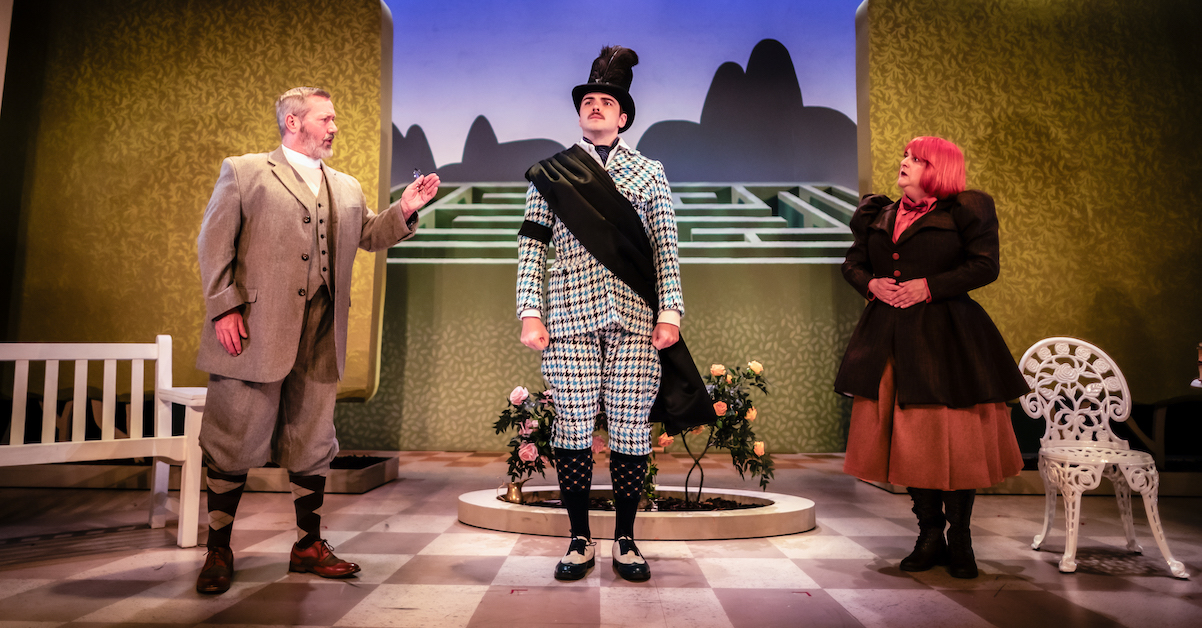
The Importance of Being Earnest – boisterous behaviour, bunburying and brilliantly bonkers entertainment (Lyric Theatre until Sunday 6 July)

Oscar Wilde sends up Victorian attitudes and social norms around gender in his 1895 play The Importance of Being Ernest. The Lyric Theatre’s new production is very much a case of plus ça change, plus c'est la même chose.

Men are economical with the truth and duplicitous in order to woo women. Their patriarchal noses are put out joint when women place barriers in the way of their half-baked plans. Yet Wilde doesn’t write women as solid feminist icons: they turn out to have red lines (like abject dislike of a name) that are as flimsy as the men they’re meant to be looking down on, and morals that can turn on a dime.

The success of Jimmy Fay’s direction is allowing every aspect of the play – the characterisation, the costumes, the props, the soundtrack, the scene changes, and, to a lesser extent, even the set – to be exaggerated. While a strong sense of a brewing farce is maintained throughout, the performances still retain an element of subtlety, never allowed to descend into an overly camp free-for-all.

Wilde’s script is full of phrases that are often quoted outside the context of the play. Conor O’Donnell revels in his role of Algy, whose assertion that “the pure and simple truth is rarely pure and never simple” is backed up by the use of an imaginary friend Bunbury as an excuse to escape unpalatable social events. O’Donnell relishes building up Algy as a figure of fun, demolishing plates of cucumber sandwiches and muffins, and rolling his eyes at the audience. His foundling friend Worthing (Adam Gillian) has a double life, using the name Ernest (his imaginary brother) when he’s gadding about in town, and reverting to his own name as Jack or John when at home in the country.

Allison Harding plays Lady Bracknell, a woman who is formidable, upright, straight-talking and no nonsense, and could probably be portrayed as being even more brusque and belligerent to add to the comic effect. Her mind is quickly made up on issues – until she changes it to suit her family’s circumstances – and believes that the proper place for men is at home. Given Lady B’s feeling of superiority over menfolk, little wonder that her daughter Gwendolen (Meghan Tyler) throws demure stereotypes out the window, draping herself over the furniture to take control and reel in the much-besotted Worthing, later physically circling her prey with her long nails out, and pronouncing one particular word with mischievous boldness (to the audience’s delight).

The second act switches from Algy’s home to a manor house in Hertfordshire where we meet young heiress Cecily, Worthing’s ‘ward’. Calla Hughes Nic Aoidh bounces on her toes as her impetuous Cecily gives into the charms of Algy who is pretending to be Ernest Worthing. Her giddy exterior and colourful attire (she’s an early adopter of last year’s big bow trend) is matched by her intense diary-keeping and expression of forthright views. After the interval, Cecily and Gwendolen alternate between love rivals and confidants, and Hughes Nic Aoidh energetically flings herself on the floor in ever-increasing gestures of forlorn disappointment. (There’s also a “never, never, never” that channels her inner Ian Paisley.)

Jo Donnelly appears as Cecily’s governess Miss Prism who has long carried a secret and harbours clandestine romantic intentions towards the local rector, Dr Chasuble (Marty Maguire), a man with a very flexible policy towards drop-of-a-(top)-hat Christening ceremonies. Across the three acts, Neil Kerry has fun playing Algy’s butler Lane (slow and precise, loyally covering for Algy) and the manor house butler Merriman (poker faced, quietly observing the madness around him).

Catherine Kodicek’s lush costume designs are ambitious, bright and detailed. Gwendolen and Worthing share matching dark stripes during their first attempted betrothal. Algy works his way through a progression of ever more outrageously pink outfits, twinned in the second and third acts with Cecily’s dress and boots. Worthing’s patterned suit and outlandish stovepipe top hat in Act 2 playfully add to the sense of his ridiculousness.

The show’s opening and scene changes are accompanied by Monty Python-esque animations from Neil O’Driscoll. At one point, a musical interlude demands that the audience join in. It’s totally over the top, but entirely in keeping with the mood that has been established. Garth McConaghie’s sound design ranges from buzzing bees to a spot of punk to finish the show. Stuart Marshall’s art nouveau set includes a playful garden maze, a detail that finally pays off during the third act.

The overall effect charms and delights, with thrilling humour on stage, yet with space to still appreciate the parallels between Wilde’s critique of attitudes in Victorian Britain (which he claimed were trivial) and modern Ireland (where they do not feel at all trivial). The wild ride of The Importance of Being Earnest continues at the Lyric Theatre until Sunday 6 July.

Photo credit: Ciarán Bagnall 

Appreciated this review? Why not click on the Buy Me a Tea button!