Oscar Wilde sends up Victorian attitudes and social norms around gender in his 1895 play
The Importance of Being Ernest. The Lyric Theatre’s new production is very much a case of plus ça change, plus c'est la même chose.
Men are economical with the truth and duplicitous in order to woo women. Their patriarchal noses are put out joint when women place barriers in the way of their half-baked plans. Yet Wilde doesn’t write women as solid feminist icons: they turn out to have red lines (like abject dislike of a name) that are as flimsy as the men they’re meant to be looking down on, and morals that can turn on a dime.
The success of Jimmy Fay’s direction is allowing every aspect of the play – the characterisation, the costumes, the props, the soundtrack, the scene changes, and, to a lesser extent, even the set – to be exaggerated. While a strong sense of a brewing farce is maintained throughout, the performances still retain an element of subtlety, never allowed to descend into an overly camp free-for-all.
Wilde’s script is full of phrases that are often quoted outside the context of the play. Conor O’Donnell revels in his role of Algy, whose assertion that “the pure and simple truth is rarely pure and never simple” is backed up by the use of an imaginary friend Bunbury as an excuse to escape unpalatable social events. O’Donnell relishes building up Algy as a figure of fun, demolishing plates of cucumber sandwiches and muffins, and rolling his eyes at the audience. His foundling friend Worthing (Adam Gillian) has a double life, using the name Ernest (his imaginary brother) when he’s gadding about in town, and reverting to his own name as Jack or John when at home in the country.

Allison Harding plays Lady Bracknell, a woman who is formidable, upright, straight-talking and no nonsense, and could probably be portrayed as being even more brusque and belligerent to add to the comic effect. Her mind is quickly made up on issues – until she changes it to suit her family’s circumstances – and believes that the proper place for men is at home. Given Lady B’s feeling of superiority over menfolk, little wonder that her daughter Gwendolen (Meghan Tyler) throws demure stereotypes out the window, draping herself over the furniture to take control and reel in the much-besotted Worthing, later physically circling her prey with her long nails out, and pronouncing one particular word with mischievous boldness (to the audience’s delight).

The second act switches from Algy’s home to a manor house in Hertfordshire where we meet young heiress Cecily, Worthing’s ‘ward’. Calla Hughes Nic Aoidh bounces on her toes as her impetuous Cecily gives into the charms of Algy who is pretending to be Ernest Worthing. Her giddy exterior and colourful attire (she’s an early adopter of last year’s big bow trend) is matched by her intense diary-keeping and expression of forthright views. After the interval, Cecily and Gwendolen alternate between love rivals and confidants, and Hughes Nic Aoidh energetically flings herself on the floor in ever-increasing gestures of forlorn disappointment. (There’s also a “never, never, never” that channels her inner Ian Paisley.)

Jo Donnelly appears as Cecily’s governess Miss Prism who has long carried a secret and harbours clandestine romantic intentions towards the local rector, Dr Chasuble (Marty Maguire), a man with a very flexible policy towards drop-of-a-(top)-hat Christening ceremonies. Across the three acts, Neil Kerry has fun playing Algy’s butler Lane (slow and precise, loyally covering for Algy) and the manor house butler Merriman (poker faced, quietly observing the madness around him).
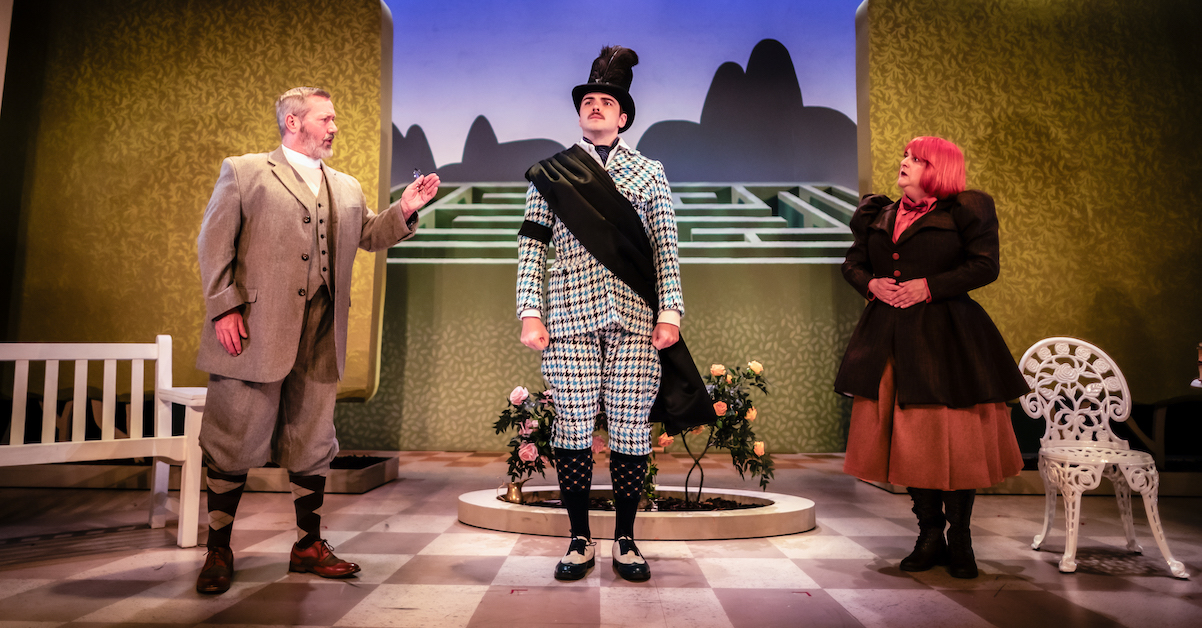
Catherine Kodicek’s lush costume designs are ambitious, bright and detailed. Gwendolen and Worthing share matching dark stripes during their first attempted betrothal. Algy works his way through a progression of ever more outrageously pink outfits, twinned in the second and third acts with Cecily’s dress and boots. Worthing’s patterned suit and outlandish stovepipe top hat in Act 2 playfully add to the sense of his ridiculousness.
The show’s opening and scene changes are accompanied by Monty Python-esque animations from Neil O’Driscoll. At one point, a musical interlude demands that the audience join in. It’s totally over the top, but entirely in keeping with the mood that has been established. Garth McConaghie’s sound design ranges from buzzing bees to a spot of punk to finish the show. Stuart Marshall’s art nouveau set includes a playful garden maze, a detail that finally pays off during the third act.
The overall effect charms and delights, with thrilling humour on stage, yet with space to still appreciate the parallels between Wilde’s critique of attitudes in Victorian Britain (which he claimed were trivial) and modern Ireland (where they do not feel at all trivial). The wild ride of The Importance of Being Earnest continues at the Lyric Theatre until Sunday 6 July.
Photo credit: Ciarán Bagnall
Appreciated this review? Why not click on the Buy Me a Tea button!




No comments:
Post a Comment