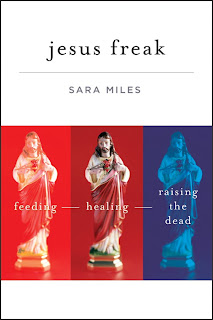
Sara Miles is back. A review copy of her new book Jesus Freak
its challenge to the religiosity of many Christian denominations, and the formula that congregations follow along with her experience as a chef that intertwines food and bodies as she looks at the ideas of the sacrament of communion alongside running a food pantry (all on the same altar table). Well worth a read, even if it is uncomfortable in places and you don’t agree with all her theology – there’s no harm in being forced to defend or revise your beliefs!
Miles continues to “sweep away the anxious formulas of religion” in her determination to transform others’ lives – as well as her own – by following what Jesus did: feeding strangers, loving and blessing those who have become like “non-people” in our communities.
“When Jesus enters into relationship with outcasts and shares in their social death, he starts a process of resurrection. The unclean become full, living people, born again. They are reincorporated – that is, re-bodied – into the community. And the community is healed into wholeness from separation, made new.
From the very moment of Jesus’ incarnation, God has been doing exactly this: restoring creation to order by entering a human body; staying with us in the darkest, sickest places; taking on social and finally physical death, so that we can all become one and rise from the dead.”
She brings readers back to the weekly food pantry at St Gregory of Nyssa Episcopal Church in San Francisco where tons of food are distributed from the church building, on and around the communion altar.
“… anywhere there’s food, spirit and matter intersect. And the power to feed – and particularly to share food with people outside your tribe – always has the potential to transform lives.”
Unlike much of the organised church, and in contrast to other food pantries Miles has visited, St Gregory’s isn’t hot on rules. It’s about inclusion, before it’s about exclusion. Drunks and junkies are welcome to volunteer as long as they aren’t high. It’s run by poor people, for poor people. “Russian and Greek Orthodox believers” as welcome to work as “Catholics, Hindus, atheists, Jews, Buddhists, agnostics, even an Episcopalian or two”.
“… anyone was welcome to jump in and start working. We were making a bet that what Jesus suggested was true: when you begin to expand your ideas of who the right people are, when you break down boundaries to share food with strangers, God shows up.”
Visitors to St Gregory’s insisted that their programme of giving food away must have required “a wonderful bishop, a lot of money, a better class of poor people, some mysterious kind of permission that allows you to be so cool and daring”. Which baffled Miles who asked
“What more permission do they need? ‘Receive the Holy Spirit’ isn’t enough?”
I’m very struck by Miles’ observation that
“God’s economy is one of abundance, not scarcity. By giving away the things God has given us, by giving as profligately and unconditionally as God does, we receive everything we need. We’ll stay hungry if we eat alone. We’ll be lonely if we think we can only share fellowship with the right people … We’ll never feel truly fed if we’re constantly competing to get our share.”
It’s as if Christians need to stop defending themselves and their culture and their rights, and instead stand up for other people’s beliefs first. Fight for the rights of Muslims, for the rights of gays, for those who want to speak and be educated in Irish, for those who want to be unified or remain in union with a different state to your own religiopolitical preference. Stand up for those who so often are oppressed, and perhaps the world will begin to believe that Christianity is worth defending too.
It’s not all about the food pantry. There was the night spent cooking in the charity restaurant, where her menu ended with the words
“Bread & Wine: Free. Eat with Jesus at midnight. All welcome, no restrictions, nothing for sale.”
Miles has been applying her growing faith and ever-expanding list of unanswered questions to other areas of life.
Her experience of hospital chaplaincy is not one of “turning ordinary humans into miracle workers who say magic words over a sufferer and restore the sick to perfect health”. Prayer doesn’t cure, but it can bring about healing, particularly through becoming embedded in relationship with God and with other people.
“[Jesus] doesn’t show us how to make a blind man see, dry every tear, or even drive out all kinds of demons. But he shows us how to enter into a way of life in which the broken and sick pieces are held in love, and given meaning. In which strangers literally touch each other, and doing so make a community spacious enough for everyone. In which the deepest desires of our hearts draw us to health. Don’t be afraid, Jesus says: your faith will make you well.”
Having touched on feeding, healing, forgiving, Miles ends with a chapter on raising the dead. It centres around a terminally ill woman, Laura, her son Gabriel, and her friend Gloria. Gloria’s status as an illegal immigrant coupled with California’s Proposition 8 legislation would mean she’d be likely to struggle – legally – to look after Gabriel once Laura died. Society defines family by what it excludes.
Miles’ favourite chant from her 1970s days of demonstrating and civil action was
“Two, four, six, eight, smash the family, church and state.”
She goes on to explain:
“I had absolutely no idea, back then, that this was Jesus’ chant. That it would turn out to be such a fundamentally Christian thing to say. Smash the family – smash the relations of power between men and women, young and old. Smash the church – break the relations of power between an official priesthood and the people of God, between manipulators of mystery and its helpless objects. Smash the state – break the relations of power that owe their existence to official violence, destroy the armies of the empire, break the iron bars of the prison house.”
In the end, there was new life for Laura, Gabriel and Gloria.
It’s not a book that quotes the Bible every second sentence, but the principles it highlights clearly fall out of the Gospel narratives.
Sara Miles is unorthodox. She’s hands on and practical. She loves Jesus, and loves people. She doesn’t wait to find clarity and perfection in the mess of this world. She believes that God gives her all the permission she needs to feed, heal, forgive and resurrect people she meets.
“There’s often a moment when I’m hanging out with a group of Christians – usually liberal Christians, the kind who care about global warming and inclusive language – and I see them glance at me as if I’m a total freak. I’ve embarrassed them by talking too much about Jesus. As if he were real.”
“Ordinary people still hope, suspect, and believe they can be Jesus.”
Video excerpt below from Sara Miles speaking about her new book at San Francisco’s Grace Cathedral.


 firmly with both hands.