Showing posts sorted by relevance for query planetarium. Sort by date Show all posts

Saturday, March 22, 2008

Armagh Observatory under financial pressure ... not sure if Planetarium affected

We were recently talking at home about Armagh Planetarium, thinking that in a year or so Littl'un will be old enough to wander around the exhibitions; she might stand a chance of sitting in the dark and getting something out of the star show, in awe at the thousands and thousands of pinpricks of light that would appear on the planetarium's roof. (Though all but one of the star shows require children to be 6+.)

So sitting tonight in Ballyhackamore's The Orient waiting for a number 67 to be prepared, it was disappointing to read in the Belfast Telegraph that the two hundred year old Armagh Observatory is under is severe financial pressure. The article didn't make it clear whether the recently renovated and reopened Planetarium (the public bit) is under the same threat as the Observatory (the science/research end).

This isn't the first post where I've made reference to my happy childhood memories of trips down to the Planetarium, and I hope the current difficulties won't mean that the next generation will miss out on an opportunity to look beyond the confines of Earth and start to explore the Solar System and universe.

To infinity and beyond ...

Saturday, June 21, 2025

Music For Domes – a midsummer melding together myth, memory and music from Ireland and Cambodia (Armagh Planetarium until Friday 27 June) #docsireland7

Melding together myth, memory and music from Ireland and Cambodia, Music For Domes creates a meditative and an almost hypnotic experience with its poetic on-screen narrative (Paul Doran) in English, Irish, Khmer and French with a soundtrack by Irish folk artist RÓIS and Barry Cullen that weaves together different cultural techniques, and visuals that evoke oppression and shared (cosmic) space.

The immersive documentary by Dawn Richardson leverages NI Screen archive footage is projected onto Armagh Planetarium’s star dome, utilising 360-degree footage and the powerful sound system that normally only gets turned up for rocket launches.

Much of the 45-minute film is therapeutic and poignant (the rendition of Bread and Roses) though there are also surreal scenes of RÓIS floating in a giant pink flamingo and an unforgettable moment from the UTV archive when Gerry’s People visited the Armagh Planetarium in November 1988. (Host Gerry Kelly welcomes viewers to the outside broadcast and introduces the show’s opening number, three dancers from X Appeal shaking their ‘heavenly’ bodies to a remix of the Doctor Who theme. I doubt that so much buttock and thigh has been broadcast on local TV since. Hopefully the dance troupe were able to attend the premiere screening on Friday evening!)

It’s a shame that the documentary’s captions don’t linger on screen to allow the three translations to be appreciated: there are fascinating glimpses at familiar spellings and sometimes enormously long French translations to encapsulate what can be expressed in short phrases in the other languages.

Music For Domes demonstrates how creative work can take advantage of the wrap around screen in a planetarium that almost hugs the viewer, with its carefully controlled environment designed to lift people out of the busy world and into far flung places. In this case, a fusion of the cosmos around us, the history of conflict that we carry with us, and music that can inspire. Hats off to Hosta Projects, Docs Ireland, NI Screen and the archives for making it possible.

You can catch the final two screenings of Music For Domes in the planetarium on Sunday 22 at 4pm and Friday 27 at 3pm.

And there’s lots more to look forward to when the main programme of Docs Ireland festival of international documentary film begins officially on Monday 23 June.


Appreciated this review? Why not click on the Buy Me a Tea button!

Thursday, December 10, 2015

Sleeping on the ceiling, staring at the Earth and what goes through your mind before launch? ESA's Jean-François Clervoy speaking ahead of Tim Peake's launch to ISS

Reposted from Slugger O'Toole ...

- - -

The little Osborne book of Space was well thumbed. Details of Russian and American space missions, orbiting the Earth, trips to the moon, and promises of a reusable Space Shuttle. Trips to the Armagh Planetarium and seeing the low res images being transmitted from weather satellites. I remember the first Shuttle launch being delayed ...

Ahead of Tim Peake’s launch at 11.03am on Tuesday 15 December from the Baikonur cosmodrome in Kazakhstan and rendezvous with the International Space Station, I spoke to veteran European astronaut Jean-François Clervoy. He’ll be the special guest on Tuesday at W5 in Belfast as part of a day of events at the science centre and Armagh Planetarium with the UK Space Agency to mark the start of the Principia Mission and the first British astronaut in space for over twenty years.

If you want to find out more about space nutrition and how space research affects local food production, find out how planes and rockets fly, as well as Jean-François Clervoy your own question, check out the details from W5 [PDF] and Armagh Planetarium. This year’s NI Science Festival (18-28 February) is themed around space technology and exploration and some events and tickets have already been launched.


Jean-François Clervoy flew on three Space Shuttle Missions in the 1990s. I asked him what goes through an astronauts head in the days running up to a launch?
Astronauts focus on their task they have to do at the time of take off, the checks in the cockpit, the proper donning of the flight suit. The flight itself – although it’s a fantastic event and experience in a lifetime – but psychologically we’re prepared months in advance so what’s happening on the 15th December is normal in Tim Peake’s life because that’s what he’s been preparing for for seven months …

The day of launch, usually you are full of serenity, you feel very at ease intellectually and mentally because you know that you’ve done everything that you had to do and you’re just thinking calmly about the extraordinary experience you’re going to have. So when it comes really close to walking to the rocket you feel excited because you’ve done everything you needed to do and you feel you’re ready – and people are telling you that you’re ready and the launcher is ready – and then when you sit in the capsule and you wait for the launch control centre to do the various checks then for ten to thirty minutes you have periods where you have nothing to do. Then you can let your mind float thinking about what you’re going to leave, thinking about your family. But you feel very serene because you are doing things that at this time of your life are just normal. You’ve been working on it for months. If just before going to the rocket someone tells you “sorry, we have to cancel the flight” or “we have to delay for one month because of a technical detail” then you would feel frustrated.
Tim Peake will be docking with the International Space Station. On one of your three Shuttle trips, you docked with the Russian Mir Space Station and stayed for a week. What will be the first thing he notices when the airlock opens?
He may likely feel a slightly different smell as the environment is not the same as in the Soyuz capsule … That will not be a disturbance that will attract his attention or priority.

The first feeling is meeting humans in space that have been there for some time. You met them several months before during your training and you feel happy – it’s like a [reunion] of your family. You get so close to your crew mates because you know you’re going to share something so unique, so extra-terrestrial, so extraordinary that you build up family links between crew members.

Joining with them in space is quite special because you know they’re happy to see you – “it’s nice to get visits” is what the Russians used to tell us when we went to Mir – and you know that you will be able to count on them to help you when it is your first flight.

You’ll not be totally at ease: where are things? where to put things? how to be efficient for basic logistic tasks? Usually we are very well trained for sophisticated tasks like space walks and robotics, activating complex scientific experiments, but for the daily activities – putting your clothing in the trash, getting the food out, cleaning, getting the vacuum cleaner out … These are things you don’t spend time training because it’s very basic. You just need practice …

When Clervoy was in space, he was relatively isolated from family and friends, there to do a job for 7-10 days and then come home. There will be a lot of pressure on Tim Peake to be communicating about what he’s doing while he’s in space working.
On the short duration missions even now the timeline of our agenda is so packed that we have only a chance once every week to do a real time Skype chat with family, but we have daily email synchronisation. On my missions [1994, 1997, 1999] we could do email. There were two or three synchronisations per day. From the [International] Space Station it’s almost like in the office in terms of connectivity. You can tweet, you can go through your email anytime, you can phone any phone number in the world starting by the country code, anytime, without receiving any bill! Some astronauts call their family every day for three minutes to [talk] about basic things; some prefer to wait once or twice a week for a longer period.

But in terms of feeling connected with family, it’s not as restricted as before. I have friends from the ISS who were calling their family about a problem in the house, seeing if the plumber did the right job. In terms of isolation, I think Tim will not feel that. He will see the Earth and he will be able to communicate anytime he wants with the Earth – of course, anytime within his spare time – you have one minute here and there in-between different activities.

Especially for Europeans who are from different member states of the European Space Agency they have some pressure to accept to do video conference with VIPs, with ministers, to report regularly, to use Twitter. It is relatively easy on a long duration space mission (six months) there is more free time. We know the rhythm that was imposed on the crews of the Space Shuttle is not acceptable for more than two or three weeks because you then get too tired. The number one priority for astronauts on long duration missions is to have enough sleep time!
What about sleeping in zero gravity? Light sleep inducing pills are available if you’re still awake two hours after bedtime but most astronauts don’t take those pills for long.
[Some astronauts] attach a pillow with a band to their forehead, keeping it pressing on the back of their head. It floats, which doesn’t help to rest the head – your head is at the same place whether you have a pillow or not – but they like to feel their head pressuring on the pillow.

Sleeping bags are relatively comfortable now. You can attach it in the four corners with bungees or strings to anywhere. Personally I used to sleep on the ceiling. That was quite fun!
Clervoy says that the ISS astronauts “don’t complain any more about the food”.
Life is nice. On board, their weekends are free. There is some housekeeping to do at the weekends, and some astronauts dedicate their free time for optional outreach activities – they record videos for kids and schools – but they have seven hours of free time on Saturdays and Sundays because we try to mimic the typical work week on Earth.

They exercise a lot, around one and a half hours a day dedicated to exercise, aerobic and anaerobic … Some come back from flight in better physical shape in terms of muscle than on the ground because they were not exercising that much before. But that’s quite rare: most of the time there is some atrophy of muscles.

There is a variety of activity: work on the computer, work on scientific experiments, operational work with rendezvous docking, spacewalks, robotics, some leisure activity, listening to music, watching movies (they have hundreds of DVDs on board) but the most favourite activity of most astronauts is to look out the window, to look at the Earth, at the sky. This is probably what marks the life of an astronaut forever the most from spaceflight. The thing I will remember the most from my spaceflights at the end of my life will be the earth seen from space.
Does that truly change your perspective on Earth when you return? Are astronauts different because you have seen the Earth from the outside … and you judge its problems and its crises differently because you’ve had that perspective?
I don’t think a spaceflight changes who you are. It definitely changes your perspective on Earth, the way you think about the Earth because first you see it on the background of the deep blackness of the cosmos. You don’t see stars unless you do something to see the stars. I know astronauts who forgot to see stars from space! To see stars you need to be in an orientation where the Sun and the Earth are not in the field of view and switch off all the lights in the environment where you are in the space ship and let your eyes adapt and then it’s marvellous. The stars don’t twinkle and you perceive very well their colour. They’re very crisp. You see the colour of nebulae with your naked eye. It’s fantastic.

When you look at the Earth it looks really unique, isolated, finite. When you see it with your own eyes it’s beautiful, you’ve tears in your eyes. Even if you are the most experienced commander like Matt Kowalski in the movie Gravity, three times in the movie you hear or you see the guy who has done it all – the commander who is over everything and this is his last mission – three times during the movie he says “Wow!” and the other one asks “What happened?” “You should see the moon reflecting on the Ganges over Nepal”. I’ve seen that.

You see the Earth and you become like a child totally impressed by the beauty of the planet because it is beautiful, it’s contrasted, it is alive. And uniquely from space for the first time in your life from space the field of view carries your vision beyond 2,500km around. You see far around. And what you see in that field of view evolves very fast. After ten minutes it’s all different. You cross the whole field of view that you see in less than ten minutes.

And what you see is beautiful. You see colours of phytoplankton blooming in the French Polynesia, you see glaciers, you see desserts, you see tropical forests, all this one minute after another. You go around in one and a half hours, so sixteen world tours a day. Every 45 minutes the sun sets or the sun rises. You see winter colours, all white, for 45 minutes when you fly over the north hemisphere, and the next 45 minutes you are above the south hemisphere where it’s the opposite season.
Do you dream about looking out the window looking down at Earth?
Oh yes. And I have plenty of movies and pictures from my flights. Sometimes I open my photo book and I look at that and I say “is this me who saw that in my life?” It is so extra-terrestrial in terms of sensorial experience that you feel it was in another life. You need to think concretely intellectually about it and the you remember, yes, it was me that did that. You have changes in your body, you see things that you’ve never seen before, you exchange with colleagues that you’ve never exchanged with before: it’s a totally different experience in terms of sensory, intellectual, and even spiritual experience.
Clervoy admitted that he’d love to be the one returning to the ISS. He was party of the ‘jury’ that selected Tim (who scored the best marks in his training and beat the Americans in Nasa’s underwater expedition training exercise).
He’s really a top guy and I would really enjoy flying with him. I would go with him eyes closed. This what I told the jury. There were looking at me: “what do you think?”

“That guy, I would fly with him anytime in space, I would take him with me anytime in space”.
High praise for the man who Clervoy describes as “the ideal astronaut”.

You can follow Tim Peake's progress on his blog, on Twitter @astro_timpeake and watch the launch and rendezvous/docking online.

Tuesday, July 04, 2006

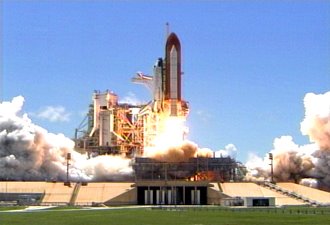
We have lift-off ... Space Shuttle Discovery


As a child, I remember watching the television at home waiting for the Space Shuttle Columbia to take off for the first time in 1981. My memory is that it didn't launch on the intended day, and it was sometime the next week that it eventually took off (to a smaller TV audience).

Memories of visits to Armagh Planetarium are fond - they had a suite of strange computers (MSXs?) for a while that accessed material off laser discs.

And I can remember going down to the local newsagent in 1986 - the Candy Box in Lisburn - on the night after the Challenger disaster to buy a copy of the papers. It was the first time I'd seen the UK papers with the front pages filled with a single image.

There was a sick feeling when Columbia disintegrated on re-entry in 2003. A sickness of being able to watch it happen from so many different angles. A feeling of disappointment that they'd come all that way to lose it right at the end.

The interest in all things space has waned, but not been totally extinguished, over the years. I'm looking forward to my baby daughter being old enough to go down to Armagh - assuming it reopens sometime soon (though their website suggests 31 July 2006!)- and enjoy her delight at seeing the space suit, the weather satellite display, and the enthralling star show in the planetarium. The overwhelming darkness, and the thousands of stars that just appear out of no where as your eyes adjust. Wonderful memories.

And so tonight, I sat on the edge of the sofa, watching the News 24 coverage of Discovery taking off. The fear of wondering how soon it would be out of danger as it powered into the sky burning half a tonne of fuel a second. It was a relief when the shuttle separated from the booster rocket, reoriented to take some photos of the booster, and manoeuvred into position to drop into the right orbit to catch up with the Space Station on Thursday.

Happy Independence Day.

Tuesday, February 17, 2015

NI Science Festival (19 Feb-1 Mar): maths, sound science, films, games, zombies & stars

The inaugural NI Science Festival starts this week and over 11 days it will explode 100 events in venues across Belfast, Derry, Armagh, Glengormley and beyond.

Festival Director Chris McCreery jumped from a career in lobbying and public affairs to set up and run the science festival. He told me at the festival launch that being able to programme so many events in its first year “reflects the vibrancy of Northern Ireland’s tech sector, universities and the real interest amongst the general public as well as public interest”.


We wanted to create a festival for all, focussing on both kids and adults … Science is such a core part of culture and society that it had to be celebrated.

There are hands-on workshops for children – and a world record breaking World’s Largest Science Lesson – as well as theatre, film, music and comedy for adults. Many of the shows have been developed specifically for the festival, and local universities, science bodies along with the Department for Employment and Learning and Belfast City Council have added their support.

The full programme is available on the festival website. and you can follow last minute updates @niscifest.

Some highlights ...

Thursday 19 February

The Internet’s Own Boy: The Story of Aaron Swartz // 7.30pm // Belfast Film Festival Beanbag Cinema // £6 // If you missed the screening of a shortened version on BBC Four, head down to the Beanbag Cinema at 23 Donegall Street to discover the story of programming prodigy and information activist Aaron Swartz. He co-founded Reddit, helped develop RSS, but also had a passion for social justice and political organising combined with an aggressive approach to information access that ensnared him in a two year legal nightmare. It was a battle that ended with the taking of his own life at the age of 26. A personal story about what we lose when we are tone deaf about technology and its relationship to our civil liberties.

Saturday 21 February

The Art and Science of Sound // 3-5pm // QUB Sonic Arts Research Centre // Free // SARC is an ear and eye-opening research facility dedicated to all things sonic. Between 11am and 2pm, they’ll be running workshops (booking required) and then at 3pm they’ll throw open the doors to everyone to get their hands on demos of:
  • Haptics in Virtual Reality - Ever wanted to be inside a video game? Well now you can! Come and experience virtual reality first hand with the Oculus Rift head mounted display and Leap Motion hand tracking.
  • Two Weeks - Lose track of real-time as you delve into the sounds of 'Two Weeks' – a sound installation compressing a whole week in one hour which will run on a loop for the duration of the open session.
  • Shaping sounds with gestures - Try out (or watch) two digital gestural interfaces developed to manipulate different types of audio synthesis, pre-recorded video files and live video feeds.
  • Robots in Education - This display shows how humanoid robots are used in Electrical Engineering to interactively teach students how to program.
  • The DIY sound-artist – Learn how to turn your Rock Band 3 controller into a polyphonic synthesiser, your Wii mote into an audio scrubber and your Xbox Kinect into a granular engine.

Sunday 22 February

Zombie Science: Brain of the Dead // The Black Box // 1-2pm, 2.30-3.30pm, 4-5pm // £6/£3 // A spoof lecture from the Zombie Institute for Theoretical Studies lifts the lid on the Zombie skull and peers into the brain of the infamous movie monster. Presented by expert Zombiologist Doctor Ken Howe. Brain of the Dead is the third show in the Zombie Science spoof lecture series, which has attracted sell-out performances at the Edinburgh Fringe Festival. This is the science you need to survive the inevitable zombie apocalypse!

Tuesday 24 February

The Higgs' Boson and Cancer Therapy // 7-8pm // Ulster Museum // Free // Belfast-born Prof Steve Myers will talk about our relationship as a civilisation with particle accelerators, sophisticated and often enormous machines that are normally seen as providing us with insight into the dawn of the universe. But they also have a use in the treatment of cancer, scientific research into the properties of materials and in security.

Armagh Planetarium Open Night // 7-9pm // Free // The planetarium is hosting a viewing session providing views of the Moon, planets and deep sky objects through our 12 inch telescope. Observations require clear sky. Pre-booking required if you also want to enjoy the free Beyond the Blue digital theatre show at 7.30pm.

Lifting the Lid: Ongoing Adventures in the World of Pseudoscience // 8pm // Sunflower Bar // £5 // Join Belfast Skeptics and Michael Marshall (Project Director of the Good Thinking Society and Vice President of Merseyside Skeptics) who will explain what happens when you begin to crack the surface of pseudoscience, revealing the surprising, sometimes shocking and often-comic adventures that lie beneath.

Wednesday 25 February

Sir Bernard Crossland Lecture: Alligator, Sex and Scars // 6-7.30pm // Riddel Hall // Free // Prof Mark Ferguson illustrate how unexpected discoveries open up new scientific and commercial opportunities.

Thursday 26 February

Turing Lecture // 5.30pm-8.30pm // Belfast City Hall // Free // The BCS and IET are bringing this year’s Turing Lecture to Belfast. VP of Global Technology at Cisco, Dr Robert Pepper will talk about The Internet Paradox: How bottom-up beat(s) command and control and discuss the next market transition to the Internet of Everything and the interplay between policy and technology as well as highlighting early indicators of what the future may hold for the Internet. FULLY BOOKED

Friday 27 February

Friday Salon: Stargazing with Mark Thompson // 1-2pm // The Black Box // £6/£3 // Join the “people’s astronomer” as he reveals the hidden nature of the universe and brings it to life with mind-blowing demonstrations.

Be An Astronomer for the Night // 6.30-9pm // BBC Blackstaff Studios // Free // Operate a real life telescope and take your own images of your favourite astronomical objects by joining Mark Thompson (BBC Stargazing Live) and astronomers from the Open University for an evening exploring the night sky with the Open University’s remotely-operated PIRATE telescope in Mallorca. Drop in to Great Victoria Street, no booking required.

Sunday 1 March

How to (Almost) Solve the Riemann Hypothesis // 1.30pm // The Black Box // £3 // Four years ago musician Colin Reid watched a BBC documentary about Leonard Euler's famous result pi squared over six. This is what happened next ... an alternative look at mathematics's most famous unsolved problem.

My Life As An Experiment // 8pm // The Black Box // £8 aged 18+ // A scientist puts his life, his career, and his field under the microscope in this theatrical essay on the scientific method as he communes with the Muses of Science: Curiosity, Diligence, Inspiration, and Obsession. Live music, songs, and flights of imagination, devised and produced by the always incredible Wireless Mystery Theatre along with Drs Ruth Kelly and Alan Trudgett from QUB.

Other events …

Make it Digital With the BBC is taking over BBC NI’s Blackstaff Studios on Great Victoria Street for three days. Open on Thursday 26th 10am-7pm, Friday 27th 10am-9pm and Saturday 28th 10am-7pm, you’ll find no end of interactive digital goodness: coding games inspired by Doctor Who, digital fabrication, gaming, robotics, workshops, Open University talks. You’re free to drop-in and join in the fun, though it may be worth booking for workshops with limited places. See the BBC’s programme brochure for details.

Playspace // Gaming culture takes over the Queens Film Theatre for a weekend of workshops, screenings and tournaments, including Halo on a cinema screen. Local game developers will be showing off their creations in the café/bar. See the QFT’s leaflet for full details and times of events over the two days, Saturday 28 February and Sunday 1 March.

  • Saturday 28 February at 3pm – From Bedrooms to Billions, the story of how a small number of individuals fuelled the creation of the video games industry.
  • Saturday 28 February 7.30pm – Tron and a panel discussion on the shared future of film and gaming at 7.30pm on Saturday.
  • Sunday 1 March at 6pm – Scott Pilgrim vs The World, a hilarious homage to the 8-big gaming world, based on Bryan Lee O’Malley graphic novels and directed by Edgar Wright (Shaun of the Dead).

Glasgow Science Centre’s Bodyworks exhibition is visiting W5 from Friday 20 to Sunday 22 February. Dozens of hands-on exhibits taking a look inside the human body, examining synthetic body parts and taking a 3D virtual journey through the body’s systems and a walk through a giant heart.

Following the NI Science Festival, watch out for the monthly science café that will be organised in the Black Box, along with the regular Friday Salon lunchtime events.

Thursday, June 19, 2025

Docs Ireland – documentaries of every shape and size from home and around the world (23-29 June 2025) #docsireland7

For a week at the end of June, the Docs Ireland festival of international documentary film brings real life stories to silver screens around Belfast with over 50 films.

Here are some picks that caught my eye and imagination from the bulging programme.

Tuesday 24 June

From Ground Zero takes 22 short films of varying forms and formats from 22 Palestinian directors about the untold stories of people living in the Gaza Strip amidst the devastating war. Queen’s Film Theatre at 20:30.

Wednesday 25 June

Filmed over ten years, North Cormorant Island explores the impact building a road had on a village who population sharply declined in Japan. A film about time, place, mortality and human relationships with the land and the sea from a director John Williams who also reflects on his childhood in a village in Wales. Queen’s Film Theatre art 13:00.

The Negotiator looks back at the life and work of Senator George Mitchell, best known locally for his involvement in the talks that led to the Belfast/Good Friday Agreement, but also involved in many other times and places. Directed by Trevor Birney. Cineworld at 18:30.

Doppelgängers3 offers an experimental vision of a future diaspora beyond Earth. Three doppelgangers attempt to answer the question if humanity is destined to live in space, how can we form a society that doesn’t replicate the same problems here on Earth? A psychedelic science fiction documentary with music by Pussy Riot, Colin Self, Mirrored Fatality and Asmodessa. Beanbag Cinema at 18:30. (reviewed)

Thursday 26 June

Atlantean is a quartet of films in which director Bob Quinn wonders – somewhat against the accepted wisdom – if the inhabitants of Ireland had much in common with the western seaboard of Europe and North Africa. It’s a musical, playful, and enjoyable romp. Queen’s Film Theatre at 13:00.

The Shadow Scholars – Patricia Kingori – the youngest woman and Black professor in Oxford University’s history – investigates the hidden ‘fake essay’ industry. If the world’s elite can pay for degrees they didn’t earn, and educated Kenyans cannot find jobs outside this industry, what is the real value of education? Queen’s Film Theatre at 18:00. (reviewed)

A State of Passion – after working around the clock for 43 days in the emergency rooms of Gaza’s Al Shifa and Al Ahli hospitals, British-Palestinian reconstructive surgeon, Dr Ghassan Abu Sittah emerged to find himself as a face of Palestinian resistance. This documentary includes news footage of the pale and shell-shocked medic – this was his sixth ‘war’ in Gaza – talking about the targeting of medics and hospital facilities. Why does he do it? Where does he find the strength to face it again and again? How does it impact his family? A film about passion. Queen’s Film Theatre at 18:15.

Latina Latina – a moving hybrid-documentary that looks at Italian fascist political ideology through the objects and buildings it left behind. Queen’s Film Theatre at 20:15. (reviewed)

Friday 27 June


Sane Inside Insanity: The Phenomenon of Rocky Horror explores what propelled Richard O’Brien’s concept from a modest stage plat to a cinematic and theatrical sensation. Released to coincide with the film’s 50th anniversary. Queen’s Film Theatre at 18:15.

Strange Journey: The Story of Rocky Horror – the definitive story of the stage show and film exploring their groundbreaking and transgressive themes, iconic performances and epic songs that took over popular culture. 

How To Build A Library – Over eight years, two Nairobi women transform an old whites-only library into a vibrant cultural hub and confront the lingering ghosts of Kenya’s colonial past. Beanbag Cinema at 18:30. (reviewed)

Saturday 28 June

Born That Way – Ulster Museum at 11:30 (reviewed

Sunday 29 June

Hunting Captain Nairac follows the search by an ex-republican prisoner for the undercover British soldier, one of the Disappeared. The screening of this film – still in the edit suite at time of writing – will be followed by a Q&A with director Alison Millar and some of the film’s contributors. Queen’s Film Theatre at 15:15.

The closing film of this seventh Docs Ireland is directed by Myrid Carten who took part in the pitching event in the first year of the festival. A Want In Her is an immersive, first-person account of the cost of love, and how difficult it can be to escape with artist Carton turning her camera on her missing mother, an alcoholic who has run away, exploring the decades-long clues in her family archives that have led to this moment. Queens Film Theatre at 18:00.

Mstyslav Chernov’s 20 Days in Mariupol looked at the first days of the Russian invasion of Ukraine. Now 2000 Meters to Andriivka turns Chernov’s camera on Ukrainian soldiers fighting their way through two kilometres of harsh landscape to liberate a village. The futility and abject sadness of war. Queen’s Film Theatre at 18:15. (reviewed)

And that’s not all ...

Orbiting outside the main festival week, Music for Domes: A Planetarium Documentary is playing in the Armagh Planetarium’s dome, an immersive film exploring how myth, memory and music shape shared patterns of belief and grief across time and sky. With music by Róis, it’s sure to be a beautiful experience. Friday 20 June at 19:30 (sold out), Saturday 21 at 16:00, Sunday 22 at 16:00, Friday 27 at 15:00.(reviewed)

Friday, September 13, 2013

European Heritage Open Days 2013 - this weekend (14 and 15 September)

It’s European Heritage Open Days weekend in Northern Ireland. It’s your chance to get inside over four hundred buildings without paying and to find out about their use and history.

This year the buildings will be joined by artists, poets, storytellers and other performers who’ll be giving the weekend a cultural slant. Settle into a pew and see the film To Kill A Mocking Bird in Belfast’s Rosemary Street Church at 8pm on Saturday. And check out the excellent Wireless Mystery Theatre who will be broadcasting old-time radio shows and commercials from Sawyers in the Fountain Centre every twenty minutes on Saturday afternoon.

Away from Belfast, the R-Space Gallery in Lisburn (32 Castle Street) is hosting Shrieking Sisters, a rehearsed play by Carol Moore and Maggie Croni about Suffragette Lilian Metge who attempted to blow up Lisburn Cathedral in 1914. Play on Sunday at 3pm preceded with by a guided walk at 2.15pm. Booking essential.

UU graduate Jonny McEwan – who’s responsible for the fantastic panels on the side of the Skainos building on the Lower Newtownards Road – has created a site-specific video installation that can be experienced in Armagh Public Library. Saturday 11am-6pm; Sunday 2pm-6pm.

But back to the buildings …

Every year people rave to me about the Belfast Central Library tour. The library is open to wander around most of the day, but the behind the scenes tour is at 11.30am (until 12.15pm). The Linenhall Library's worth a tour too. PLACE have organised a Mapping Belfast walking tour that will consider how Belfast has (and could) be mapped, and how this helps us understand the city. Leaves the front of PLACE (40 Fountain Street, near the back of Boots) at 11am. At noon another tour leaves the same spot to investigate the Art Deco buildings that can be spied across the city. Fully Booked.

The MAC’s architects are giving tours around the Cathedral Quarter arts venue at 10am and 11am on Saturday morning. Given my lack of appreciation for the outside of the building, and my ability to get lost inside its concrete floors, maybe I should book a place!

A bumper number of buildings are open in Derry this year. The Tower Museum is worth a visit, and a tour of The Playhouse will turn up some unexpected history. And if Derry's Freemasons’ Hall is anything like the Belfast one (also open in Cornmarket/Arthur Square), it’ll be worth a look inside. The Apprentice Boys' Memorial Hall is open too.

Downpatrick Court House – scene of some of my early blog posts about jury service – is running tours on Saturday. Both Armagh Observatory and Armagh Planetarium are open on Saturday.

A good selection of Lisburn churches – many of them listed buildings – will throw their doors open on Saturday ... but not Sunday! One year I’ll remember to call in Castle House (on Lisburn’s Castle Street), the former residence of Sir Richard Wallace.

You can get into Stormont Castle and see the polo-mint table the Executive sit around (a truly odd piece of furniture) on Saturday and Sunday. Parliament Buildings – which runs tours all year round – is open too. The Clifton Street Orange Hall – complete with minutes of an Orange lodge meeting in Irish – is open on Saturday.

Lots of buildings and events all across Northern Ireland. Check out the NI Environment Agency's EHOD website for times, maps and last minute changes. PDFs for Belfast and the six counties are available if you haven't been able to find a paper brochure.

Open House Dublin runs from 4-6 October, with 100 buildings open across the city. Much anticipated will be the chance to tour around Google's European headquarters in Dublin's Docklands. Open House Galway is on 10-13 October. The European Heritage Days website – along with its twinkly map – will allow you to explore wider flung opportunities.

Tuesday, February 21, 2017

NI Science Festival - space, stories, food safety, cognitive computing, astrophysics and quantum biology #nisf17

NI Science Festival is in its third year and still has a week to run. The programme is packed full of surprises and treats.

Reassembled, Slightly Askew runs at The MAC until 26 February as part of the festival and takes the audience inside the head of a patient with a life-threatening brain injury. You can read my preview of the show and interview with the playwright (who wrote about her acquired brain injury) over on the Culture Northern Ireland website.

Tuesday 21 February

Professor Dame Ann Dowling will deliver the the 16th Sir Bernard Crossland Annual Lecture in which she will discuss the role of universities in stimulating growth through the people they educate and through their research and enterprise activities. REGISTRATION CLOSED

Poetry meets science in the Black Box at 6.30pm tonight as MATRIX (the NI Science Industry Panel) teams up with the John Hewitt Society to curate an evening of talks and science themed poetry, culminating in a world record attempt for the most haiku tweeted at a single event.

Wednesday 22 February

Mew to TQ: Lighthouse Technology takes place at 2pm in W5. The Titanic Foundation and Commissioner for Irish Lights preview the 10 tonne, 7 metre tall, 130 year old Mew Island optic that will be coming to Titanic Quarter this summer. The talk will explore the science and the innovation related to lighthouse technology: illustrating that the Fresnel lens was a major scientific breakthrough, the pinnacle of lighthouse lens size, and the energy sources used to provide the light. See the event listing for details on how to book your free place.

The monthly Tenx9 storytelling event partners with the NI Science Festival for a second year to present an evening of true stories about “The final frontier”. Black Box at 7pm. Free entry; first come first served. Tenx9 is always a treat.

The Horizon strand of programming on BBC Two has been recently been repeating landmark editions of the long-running series which brings cutting-edge of science and technology to life and applies it to our everyday lives. Horizon's editor Steve Crabtree will curate a journey through the archives in Scanning The Horizon: The Health of a Nation, pulling out key moments of health discoveries and disease outbreaks. Through unique access to clips from the Horizon vaults, the Queen's Film Theatre audience can watch how medicine has evolved over the last five decades. Free but booking essential.

Thursday 23 February

Belfast City Hall will once again host the annual Turing Lecture, this year delivered by IBM Research's VP & Chief Science Officer of Cognitive Computing, Dr Guruduth S. Banavar. Beneficial AI for the Advancement of Humankind will explore cognitive computing, the technology breakthroughs that are enabling this trend, practical applications for the real-world, and ethical considerations guiding the development and deployment of the technology for the benefit of humankind. Get ahead of the curve and understand how cognitive systems will create new partnerships between people and machines to augment and scale human expertise in every industry, from healthcare to financial services to education. Free but registration required. From 5.30pm.

Friday 24 February

Dr Andrew Cannavan led the International Atomic Energy Agency’s Food Safety Assessment Team in Fukushima after the nuclear disaster and works closely with the Queen’s University Institute for Global Food Security. He'll deliver the Jack Pearce Memorial Lecture at 6.30pm in the QUB David Keir building, and will discuss his own experiences, emergency preparedness and responses to nuclear incidents. Free but registration required.

Saturday 25 February

Dr Niamh Shaw is a performer, scientist and engineer who is passionate about awakening people's curiosity. She attended the International Space University’s annual Space Studies Programme in 2015 in association with NASA and she was selected for the Crew 173 Mars analog mission (earlier this year in the Utah desert!) Niamh will explain about her plan to get into space within the next eight years and what it will take to become the first Irish Astronaut. Armagh Planetarium at 1pm or 3pm. £2. Booking essential - details in the event listing.

Sunday 26 February

St George's Market will be animated between 11am and 3.30pm with Busking Physicists use everyday objects to open up a new world of curiosity and understanding with their tricks and sights. The team from the Institute of Physics invite market shoppers to step into a realm of invisible forces and remarkable matter and to join in their unstoppably infectious physics fun!

Dame Jocelyn Bell Burnell will be in conversation with fellow physicist Jim Al-Khalili at 2pm in the Whitla Hall. The inspirational Belfast born giant of astrophysics is best known for her discovery of pulsars (rotating neutron stars that appear to ‘pulse’ since the beam of light they emit can only be seen when it faces the Earth). Her observation, made together with her supervisor Antony Hewish (he got the Nobel Prize, she didn't) is considered to be one of the greatest astronomical discoveries of the twentieth century. Tickets £6.

And Jim Al-Khalili returns to the Whitla Hall stage at 4pm to deliver a lecture introducing the field of Quantum Biology and examining the impact of recent research and what this means for our understanding of what life really is. John Stewart Bell (a QUB graduate) discovered Bell’s Theorem and his work on non-locality resolved a long standing dispute involving Albert Einstein and showed that Einstein’s views on quantum mechanics were incorrect. This first annual John Bell lecture honouring and recognises Bell’s contribution to the field of quantum physics. Tickets £6.

Monday, July 01, 2019

Apollo 11 – letting the first manned mission to the moon tell its own story (QFT until 11 July)


The 50th anniversary of the Apollo 11 mission to the Moon is just weeks away. While I’m not old enough to have been alive when lunar module Eagle touched down on the Moon’s surface, NASA’s space flights were the focus of displays and exhibits at childhood visits to Armagh Planetarium.

There’s no single authoritative and complete account of the mission. Last year’s First Man provided a window into the character of test pilot and astronaut Neil Armstrong. Nineteen years ago, The Dish told the quirky story of how pictures from the mission were beamed – or nearly, not beamed – around the Earth.

In recent weeks, it has been fun to dip into BBC World Service’s 13 Minutes to the Moon podcast which uses the final descent as its hook to explore hair-raising moments on that voyage as well as the build-up to the mission over the previous decade. Recommended listening.

Todd Douglas Miller’s documentary Apollo 11 constrains itself to the period of the launch until the crew arrive back on Earth and sit out 18 long days in quarantine. Never guilty of under-documenting anything, NASA’s film footage from numerous angles in the launch and mission control rooms and from the Saturn rocket, command and lunar modules is combined with the 30-track tapes of voice recordings.

There are no distracting talking heads. No looking back through halcyon spectacles. The complexity and significance of the mission is allowed to speak for itself. Split screen effects allow different perspectives to be compared. Simple graphics signify increasing speed and convey where we are in the timeline.

As we walk through the stages of the mission, Matt Morton’s excellent sound track provides the only external interference, setting a sense of tension and manipulating emotion as it pumps out booming heartbeats during the launch, and piano/string sequences as the Eagle heads back to dock with Columbia. The crew’s portable tape player supplies John Stewart’s Mother Country and the extraordinarily-apt lyric “just a lot of people doing the best they could”.

Rows of men (reckoned to be just one woman among 500 men) dressed in white shirts and ties (except a few extroverts with a sense of occasion wearing bowties) sit behind banks of warning lights, green on black monitors and sensor printers. Audience chests tighten and the cinema barely seems to breathe as we discover the three astronauts are being strapped into the rocket while a couple of engineers use wrenches to fix a leak somewhere below them on the huge structure.

Moments of mission audio jump out, phrases like Buzz Aldrin’s expressive comment “magnificent desolation” and his alter understatement “it’s been a long day”, as well as Neil Armstrong speaking of the “symbol of the insatiable curiosity of all mankind to explore the unknown”.

Apollo 11 offers a fresh look at a well-understood space mission. The over-familiar stock of photography is replaced with multiple angles of moving images from inside the heart of the mission, some of the footage being used for the first time.

There’s no subtitling, conveying the sense of sometimes garbled audio links that left experts on the ground fitting incomplete information together to understand the mission status. The panicky significance of the 1201 and 1202 program alarms flagged up during the lunar descent is somewhat lost to the inexpert cinema audience who are watching in real time. Armstrong’s manual search for a safe landing place is the subject of a quick discussion after they are safely landed.

In some ways, the hype-less Apollo 11 film underplays the drama of the mission. The filmmakers trust that the implicit danger and the obvious dedication of the NASA staff and Apollo crew are sufficient to carry the 93 minute film. Their bet pays off with a documentary that still enthrals and excites.

Apollo 11 is being screened in Queen’s Film Theatre as well as Dundonald Omniplex.

Sunday, December 09, 2012

Sir Patrick Moore


As a teenager I remember hearing Sir Patrick Moore delivering a talk one evening at Queen’s University. My memory is that he was speaking about mapping the moon, illustrated with slides of his own photographs of craters and the moon’s landscape.

My strongerer memory is that there was a loud bang in the middle of the lecture, which turned out to be the sound of an explosion at the side of the City Hall. Sad how so many events in Northern Ireland can be associated with a terrorist attack that took place about the same time.

Proudly eccentric, yet clearly expert in his field, Sir Patrick Moore communicated his love for space and science with passion and enthusiasm. He could convey complicated facts to amateur viewers and listeners in a way that was both engaging and accurate without watering the truth down to bland watered-down science. A character big enough that The Sky At Night has survived years of cuts at the BBC and remaining on air. And let's not forget his role in the show Gamesmaster!

What I hadn’t realised until today was that he had been director of the new Armagh Planetarium between 1965 to 1968 before Terrance Murtagh’s reign in the 1970s.

A fine example of an astronomer, a scientist, a broadcaster, a communicator … and a xylophone player.

Wednesday, August 30, 2017

The Farthest - two middle-aged space probes take a road-trip (QFT 1-14 Sep)

Bring tissues because this film is an emotionally charged fly past.

Given that the two Voyager craft have been flying through space for the best part of forty years, it’s entirely appropriate to devote two hours of cinema time to chart the drama of their conception, birth, life … and in a funny way, their after life in the film The Farthest.

The official, cut-back mission plan was to fly past Jupiter and Saturn, but the original big hairy audacious goal to go on a grand tour of the universe and the stated trajectory allowed the Voyager team to extend the flight path to take in bonus destinations of Uranus and Neptune if some key objectives were met.

The technology on board the vessels is as old as I am. At one stage, a scientist involved in the mission reminds the watching audience that there’s more memory on your car’s electronic key fob than the Voyager craft (which has a mere 32K across its six subsystems). More than a billion miles away from Earth, with signals taking hours to reach the yoghurt pot – well, antenna – at the other end of the wet string, the NASA team at the Jet Propulsion Laboratory reprogrammed each Voyager probe to give it new tricks as it prepared to fly past each new planet.

Irish director Emer Reynolds allows the construction, launch and flypasts to inject their own drama into the documentary that is dominated by talking heads that reflect rather than gloat. So much went wrong. So much more could have gone wrong. The Voyager programme ran in parallel with the Space Shuttle programme, and the Challenger tragedy casts its shadow over Voyager 1’s interplanetary success.

Mission specialists – who, it’s got to be said, age well – speak both of the scientific endeavour and their investment in the truly interstellar journeys, as well as unpacking the cultural and extraterrestrial communication aspects of the mission which included carrying a ‘golden record’ of songs, pictures and greetings from around the world. (A needle and cartridge as well as pictorial instructions on how to build a record player were included!) This softer side was all down to scientist and communicator Carl Sagan, who also forced NASA to agree to spin Voyager 1 to face ‘homeward’ to take a ‘family portrait’ of the solar system. Earth famously showed up as a ‘pale blue dot’.

Voyager 1 has now entered interstellar space, the first human object to do so. (You can track both probes’ progress on the JPL website.) While the energy source that powers the radios and remaining instruments will deplete over the next century, some of those involved in the mission soberly suggest that since the unpowered craft is very unlikely to collide with anything, it may continue to fly through space long after the dying Sun destroys the Earth!

Composer Ray Harman composed the soundtrack around the words being spoken, adding a flourish here and there to underline the on-screen action. If like the probes the film could have been re-edited while playing – perhaps that’ll be available in an interactive planetarium version with voting buttons? – I’d have removed some of the detail about the production of the record and concentrated on the science and the complexity of talking to an object the size of a school bus that is faster and faster moving further and further away from the Earth.

It’s a film about ambition and invention (kitchen grade tin foil was wrapped around the cabling), about perspective and loneliness.

Embrace your inner space geek, sit in the darkened cinema screen – to be fair, it’ll be no where near as dark as space – and watch the imagery that was sent back from the two middle-aged spacecraft. Open up your childlike imagination and wonder at the majesty of the solar system(s). And ponder our perch in the expanse of the universe.

The Farthest is being screened in the Queen’s Film Theatre between Friday 1 and Thursday 14 September. The 6pm screening on Monday 4 (the evening before the 40th anniversary of Voyager 1’s launch) will be followed by a Q&A with director Emer Reynolds.

Tuesday, August 30, 2011

European Heritage Open Days - Saturday 10 and Sunday 11 September - across Northern Ireland #ehod11

European Heritage Open Days are only around the corner. The time of year when buildings through open their doors and allow the public in for free to see inside buildings that are often out of bounds to casual observers.

Organised by the Northern Ireland Environment Agency (part of the Department of the Environment), more than 300 events and properties are being offered on Saturday 10 and Sunday 11 September.

Freemasons Hall in Arthur Square (formerly known as Cornmarket) beside the Squiggle

Last year, Littl’un and I took in a tour of Linen Hall Library, explored Freemason’s Hall in Cornmarket Arthur Square (and enjoyed a really cheap cup of tea with an amazing view), and wandered around the oldest church in Belfast, First Presbyterian (non-subscribing) in Rosemary Street.

This year there are numerous tours around Belfast: looking at the hidden history underneath Belfast’s streets; an architectural treasure hunt (organised by PLACE); tours of the newly restored Central Library; a walking tour around Victorian and Edwardian buildings by Young and MacKenzie architects (who designed Crescent Arts Centre); touring BBC Broadcasting House; as well as a look inside Stormont Castle (home of the NI Executive) and Parliament Buildings (home of the NI Assembly).

The Prisioner

First Church of Christ, Scientist (University Avenue/Rugby Road) was designed by Clough Williams-Ellis, the architect behind Portmerion which served as the backdrop for the original Prisoner series. Previous visitors rate it highly.

The rebuilt Lyric Theatre is offering three tours of its expanded premises – booking essential.

One novel addition to the normal schedule is a private home at 47A Ravenhill Road describing itself as ‘a family home build to a modest budget in a rational modernist idiom referenced to vernacular form’. Telephone pre-booking essential.

The Lock Keeper’s Cottage at Newforge is open … you could stop for a cup of coffee in the nearly Lock Keeper’s Inn café if you’re feeling thirsty!

Many of Lisburn’s city-centre churches are open on Saturday (with the majority paradoxically closed to visitors on Sunday). C J Lowry’s jewellery shop at the junction of Market Square and the top of Bridge Street has recently been restored.

Hillsborough Castle and Grounds are open to the public, as well as the nearby Court House, Fort and Friends Meeting House.

Armagh County Museum, Court House, Gaol, Public Library (treasure hunt for children), Observatory and Planetarium are all open, along with the Charles Lanyon-designed Tourist Information Centre on English Street – CANCELLED and the ‘flamboyant’ Gospel Hall on Mall West (which started out life in 1884 as a Masonic Hall).

Tours of the Maze / Long Kesh site are being organised on the Saturday. Pre-booking essential.

Some National Trust properties are open too – waiving their normal entrance charges.

European Heritage Open Day 2011 postcard

Copies of the EHOD brochure are available in local libraries as well as some arts venues. You also download the sections for Belfast, County Antrim, County Armagh, County Down, County Fermanagh, County Londonderry and County Tyrone.

This year, EHOD are also promising some free audio tours to download covering Belfast, the walled city of Derry and the Causeway Coastal Route. Warning: I didn’t have much success unzipping them on a Mac. You may have more luck on a PC.

Something for everyone … including the thousand or more delegates at Sinn Féin’s Ard Fheis which will be in Belfast over the same weekend.

Monday, January 28, 2008

Challenger ... 22 years ago

Space Shuttle Challenger exploded 22 years ago on 28 January 1986, killing all seven astronauts on board.

Back in July I blogged about my childhood fascination with space, with a little Osbourne book of Space that was packed full of facts and figures about the early Sputnik and Apollo space flights, trips down to Armagh Planetarium, watching the first Space Shuttle Columbia take off (second attempt) ... and the memories of the day when Challenger blew up a minute into its flight.

The iconic image of the Challenger disaster - 28 January 1986

The awfulness for the astronauts’ families who would have watched the death of their loved ones on live TV. Perhaps the best known member of the crew was Christa McAuliffe, a mother of two, and was to be the first teacher in space. Before the launch she spoke about her hopes for the mission:

“I cannot join the space program and restart my life as an astronaut, but this opportunity to connect my abilities as an educator with my interests in history and space is a unique opportunity to fulfil my early fantasies.

One of the things I hope to bring back into the classroom is to make that connection with the students that they too are part of history, the space programme belongs to them and to try to bring them up with the space age.”

Another teacher, Barbara Morgan trained alongside McAuliffe as her mission backup. Having returned to teaching a few months after the Challenger disaster. But she kept up her links with NASA, and was selected for astronaut training in 1988 and finally flew into space on mission STS-118 in August 2007.

Following the mission failure, President Reagan had to postpone that night’s State of the Union address. He commented:

“We will never forget them, nor the last time we saw them this morning as they prepared for their journey and waved goodbye and slipped the surly bonds of earth to touch the face of God.”

Monday, October 22, 2018

First Man – a window onto a space family’s fallibility and humanity


As a child, one of my treasured books was The Observer’s Book of Manned Spaceflight. I suspect that if I hoked through boxes in the garage, I’d find it sitting with a few other childhood books. It walked through the Sputnik, Mercury, Gemini and Apollo launches and looked forward to the Space Transportation Station (STS) programme, better known as the Space Shuttle).

Other space-related childhood memories include a Lego space brickset with little helmeted astronaut mini-figures, countless visits to Armagh Planetarium, a primary school project on the moon, and attending a lecture by Sir Patrick Moore about his photography of the moon in David Kier building, a lecture briefly interrupted by the sound of a car bomb going off at the side of the City Hall.

However, for me space is an intellectual interest. I’m too much of a coward to ever want to be launched into space in a tin can mounted on top of a furnace. Particularly after watching First Man, Damien Chazelle’s new film that examines Neil Armstrong’s journey into NASA and up to the moon.

It’s less a celebration of the achievement and more an examination of the character of the man who first planted his foot on the orbiting satellite, as well as those close to him.

Throughout the film we watch Ryan Gosling portray the man who continued to carry the grief of his daughter who died before her third birthday. While some incidents are fictionalised, nothing seems too far-fetched.

Claire Foy’s depiction of the Janet Armstrong brings a sense of the cost to the Armstrong of Neil’s workaholic mentality and emotionless character. We see her holding the family together, adapting to his changing career path – “I married Neil because I wanted a normal life” – as well as moods, and forcing him to be honest with his children about the dangers of his chosen profession. She is warm and worrisome, while he is cold and cocky: the difference between earth and space.
“When you get a different vantage point, you get a different perspective.”

We see a man who can focus his obsession and channel his energies into a task at the expense of relating to those around him. His most startling characteristic is his ability to sit in silence for a few seconds while everything around him is noisy and chaotic, figuring out what action would be best. It’s a surreal state of anti-panic. It’s this ability to step back from the frenzy and calculate his options that lingers in my mind a week after I saw the film.

While the fuel-constrained Apollo 11 landing on the moon is well known, the film devotes a lot of time to his earlier handling of a precarious and life-threatening situation during the Gemini 8 mission. Having rendezvoused and completed the first ever docking manoeuvre with another spacecraft in orbit, the co-joined spacecraft began to roll and tumble. Armstrong battles physical and mental pressures, isolation from ground control, and even manages to make a few calculations to stabilise the Gemini capsule and return to earth. Watch out for Ciarán Hinds’ appearance as a NASA boss, holding Armstrong’s future in his hands after the Gemini 8 incident.

In case you’d forgotten how much can go wrong in space, Justin Hurwitz’s score uses a lamentful theremin to mark important junctures! The vibration and stressed metal of rocket launches are contrasted with the quiet of space and the moon. The physical closeness of astronauts lying horizontally in the command module awaiting launch is contrasted with their attendance at the colleagues’ funerals.

I came out of the cinema wanting to rewatch The Farthest (the emotionally-charged tribute to the two Voyager space probes hurtling out of our Solar System) and track down a copy of The Dish!

First Man is a window – often a literal window (house, claustrophobic command module, quarantine facility, helmet visor) – into the family and friends of Armstrong. Gosling captures the isolation that surrounded Armstrong at home, at work and in space. Instead of sugar-coating his fallibility, First Man exposes his humanity.

Still playing in the Queen’s Film Theatre, Movie House and other cinemas.