Showing posts with label sport. Show all posts

Saturday, October 08, 2022

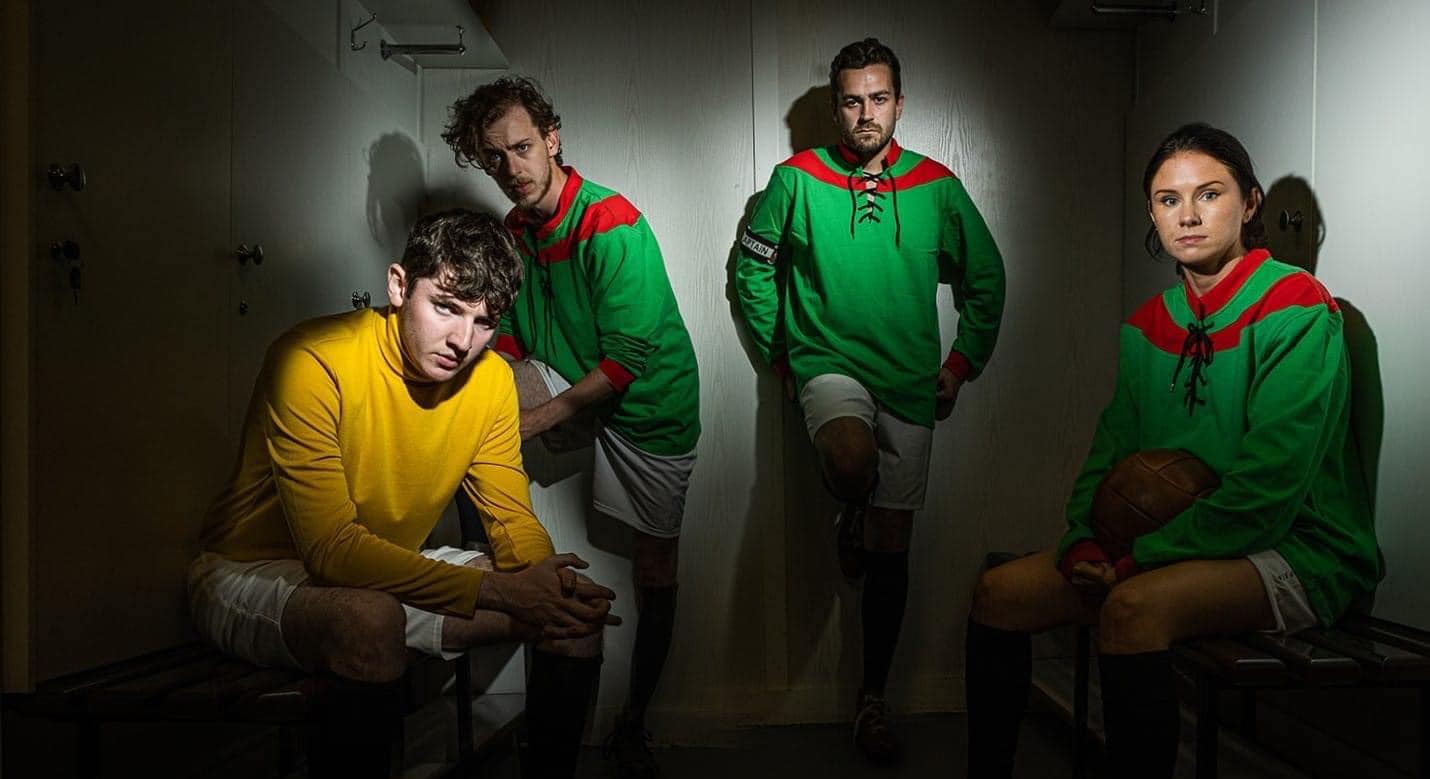
One Saturday Before The War – about the first time Glentoran brought home a European cup (Bright Umbrella at Sanctuary Theatre until Saturday 15 October)

“Vienna, my hole” is how one player reacts to the suspicious looking invitation for the east Belfast football side to play the best of Europe in the spring of 1914. One Saturday Before The War turns the clock back to that year when the Irish Cup champions Glentoran’s players were given two week’s paid leave from their shipyard jobs to tour through Europe playing a series of football matches, ultimately winning the Vienna Cup with a comprehensive victory over a Vienna Select XI side on 30 May.

Working with the eponymous history book’s author Sam Robinson, director Trevor Gill has imagined a series of scenes that explore the team, the time and the people over a two-hour show. There’s a real mix of styles, with the fourth wall increasingly broken and the audience brought into the world of the players. But with the east Belfast Sanctuary Theatre’s stalls filled with Glentoran fans, it’s hard to go wrong.

The 1914 team’s captain Paddy McCann (Thomas Galashan) – who switched from hurling to play soccer for Belfast Celtic and then picked up a job in the shipyard as a bonus for transferring to Glentoran – lives with sectarian abuse on the pitch. Forrest Bothwell plays Jack Boyd who is chased across Europe – presumably only in this fictionalised account – by his mother (Phillipa O’Hara) who berates him for setting off without his piece. O’Hara also plays team member Davy Lyner who may have had a familial link with the German Kaiser.

The elephant in the room throughout the footballing adventure is the deteriorating political situation across Europe, and several scenes visit the front in France where some of the players have returned to fight in the months after their victory in Vienna. Jack Watson’s Reike Voight brings an outside perspective to the battle on the pitch and afterwards in the trenches.

Remarkably, the script manages to poke fun at Linfield, and the cast sing rowdy Glens’ songs, use a choreographed dance routine to tell the story of a match, create a mesmerising silhouette as the young soldiers go over the top, and reduce the audience to tears as we learn about the poor health that plagues Paddy McCann’s family home.

One Saturday Before The War is brilliantly sweary in places, and contains a particularly convincing hairdryer moment as the manager berates the underperforming team at half time in the 1914 Irish Cup Final. Club banners adorn the walls of the theatre, branding the whole venue with team colours. Misbehaving moustaches add to the frivolity. There’s a real sense of farce as the team disappear into a bar instead of boarding their train to Larne.

The cast of four keep the show’s energy up throughout, and their cheeky interaction with the audience is rewarded. The video inserts are perhaps overly generous in length, baggy when compared with the tighter direction of the on-stage action. The closest the performance gets to scoring a home goal is the play’s ambitious conclusion which has more false endings and surprises than a Bond film. But that can all be fixed.

One Saturday Before The War brings a community’s history to life. It’s accessible, ambitious and reaches local audiences with nuanced storytelling that doesn’t shy away from uncomfortable truths. The production continues at the Sanctuary Theatre until Saturday 15 October. 

Enjoyed this review? Why click on the Buy Me a Tea button!

Saturday, November 16, 2019

GAA Maad – purposefully haphazard experimental storytelling #Outburst19

The title sums it up: GAA Maad. Áine and Vickey are mad about the GAA. Mad about the sport. Mad keen on their county team. Mad at the way the hierarchy has tended to relegate women to near invisibility. Mad with other diversity challenges too.

Vickey Curtis is loud and ebullient, a spoken word artist who fell in love with the GAA and her beloved Dublin before she fell in love with a woman. While visual artist and set designer Áine O’Hara – self describing as “arty, queer and into the GAA” – sits and calmly explains the history of the GAA (who knew that hurlers’ families used to get compensation if they died on the pitch?), Vickey overlays her own ornamental commentary.

They point out that the Ladies Gaelic Football Association was only founded in 1974, though ‘laydees’ have been playing for the guts of a century. The men’s game is still firmly in the closet, while women’s sides seem free to express their natural diversity. There are running jokes about the Brits … and Áine’s ever-the-bridesmaid Mayo.

Dramaturgically, GAA Maad is all over the place. The slither of a thread holding together the different scenes is at best tenuous, at worst snapped. The ending appears from nowhere without much warning. The stage entrances and exits are haphazard, with Vickey wandering around the Black Box Green Room carrying a tower of labelled IKEA archive boxes which contain the show’s props, yelling comments at Áine up on stage.

Yet this breaking of the rules and flinging out of convention brings a real warmth to the storytelling. Perhaps a good sign that the DUETS initiative by Irish Theatre Institute, Fishamble: The New Play Company and Dublin Fringe Festival is willing to take risks and experiment with form.

It feels very real, naturalistic rather than polished. Purposefully haphazard. The chattiness is deliberate and early on, Áine discusses her fibromyalgia while Vickie later describes being beaten up, both issues somewhat tangential to the sporting theme, but very relevant to the audience understanding that these two women are not fake. Urban and rural, butch and femme, opposites attract. The pair genuinely support Dublin and Mayo. They love the game, though differ on whether the GAA should be marching in Dublin Pride.

The flimsy feel is underpinned with some thought-out production values. Director Niamh Mc Cann insists that the projected imagery is deliberately brief, flashed up on screen for a few seconds at a time, just long enough to sustain a roar of audience laughter before being blacked out.

Everyone in the audience is given a handout. We sing along to support the doomed notion that “there’s always next year for Mayo”. I leave the show wearing my miniature Mayo flag, chosen on the way into the venue over the dark and sky blue Dublin flag because I instinctively wanted to support the underdog. But I also leave it embellished – as with the recent performance of Spliced – with a new understanding of the nuances of the GAA behemoth, and the origins of the Mayo curse. Now to find out whether Lisburn is in Down or Antrim …

GAA Maad was performed on the closing day of the 2019 Outburst Arts Festival.

Tuesday, October 29, 2019

Spliced – bruisingly honest reflection on the tribal worst of team sports and a challenge for quicker transformation (Chalk It Down Productions at An Cultúrlann until Wed 30 Oct) #BIAF19

Whether you’re steeped in GAA games, rugby, football, road-racing, netball, cricket, racquet sports, running or a complete lazy lump like me, the concept of being fully committed to a culture, the collective ambition of the team, and the shared pursuit is recognisable and universal.

Spliced is writer/actor Timmy Creed’s love letter to hurling. As a child, a teen and young adult he worked his way up the ranks and grew in experience, scored points, won medals and felt like a man.

There’s a physicality and fitness on display as the performer wields his ash hurl and bounces the sliotar off any available wall. Creed could give Belfast International Arts Festival’s closing dance artist Oona Doherty a run for her money when it comes to bouncing off walls. His level of fitness, never mind hand and eye coordination, is impressive to watch.

Simply lit with low-level spots that cast an army of giant shadows aping Creed’s every move on the white wall behind him, the show relies on one performer’s energy to fill the empty space. Slowly, Creed strips down the layers that his GAA activities and management have wrapped around him, choking his mental wellbeing. The soundscape and projection garbles as the values he thought were fundamental to Gaelic games are distorted.

There’s poetry and music in the rhythm of his recital of the 200+ GAA clubs in Cork. There’s a sickness in his recollection of the expected wilder activity – sex, drugs and alcohol – that came with “turning into a robot” and being a full part of the elite tribe.

Another location and a further sport confirm that Creed can bring other activities to life as convincingly as hurling. Broken and questioning, looking at life through “a new lens”, we listen to his reasoning as he figures out whether he can ever return to his beloved Bishopstown GAA, a source of love, loyalty and belonging, but also a mistress that sacrifices the individual for the cause of the tribe.

Spliced throws up a number of questions – including the one in the script: “how amateur is the sport?” – which could equally apply to many different pursuits.

The ending is deliberately low key. The switch from physical to cerebral is a hard shift, and while the audience are with Creed, the change of pace creates a few false endings. Creed may find that there’s more in common between the stage and the pitch than he hoped. The supposed salvation found in using theatre to challenge his old sporting orthodoxy is not immune from mental illness, poor coaching and destructive behaviour.

Spliced becomes a blur of good and evil. It’s got tension, passion, and real heart. Timmy Creed is certainly an artist to watch. You can catch Spliced back in An Cultúrlann on Wednesday 30 October at 8pm as part of Belfast International Arts Festival.

Saturday, July 20, 2019

The Open golf fans in Portrush are first in UK to experience Mastercard’s sonic brand

Golf fans at The Open up in Portrush are the first in the UK to hear Mastercard’s new sonic brand and see the associated animation when they pay for goods in the tented shopping emporium at the sporting venue.

Together with solutions provider Global Payments and card machine manufacturer Ingenico, Mastercard have developed technology to play its distinctive four-note melody on card payment terminals to indicate that a transaction has completed. Customers will soon become familiar with the company’s multisensory branding as it rolls out across physical, digital and vocal payment environments.


While often viewed as a credit card company, Mastercard nowadays position themselves as a technology company operating in commerce.

Their Dublin tech hub employs 550 people and is the global headquarters for Mastercard Labs. Executive vice president Ken Moore showcased the work of the Labs he heads up at an event on the fringes of The Open, of which Mastercard are the official card and a patron.

Moore described the role of the Labs as encouraging innovation and entrepreneurial muscle across Mastercard’s business and that of its customers. Separating the signals from the noise in the crowded tech space, he said that the Labs “convert [those] signals from emerging technologies and trends into opportunities”.

In light of AI and machine learning “making their way out of the labs and onto the high street”, accelerated by the power of new 5G mobile networks, Moore made three predictions:
  1. When improved connectivity is combined with the utility and power of the mobile phone, you will be able to operate [much more complex] banking processes on your phone than you can do today.
  2. Security will dramatically improve, with real-time processing able to spot patterns of bad behaviour.
  3. The utility of the value-added services that can now be built into electronic payments will dramatically increase and, as a result, the use of cash will dramatically decline. While acknowledging that it does take time for the public to become comfortable with new solutions, Moore was confident that the usage of cash will radically wane.

The Labs as a Service team consult with clients and help them ideate and launch new services. They also work with cutting edge startups and connect partners with innovators to shape the future of commerce.

Amy Neale, a Mastercard vice president, heads up their ‘Start Path’ startup engagement programme which identifies, mentors and partners with leading later-stage startups that want to scale and connects them with the payments platform company as well as its customers.

The six-month programme has worked with 210 startups around the world over the last five years. Irish startup RecommenderX was part of the 2018 alumni.

While the 37 or so fintech ‘unicorns’ (privately held startup companies valued at over $1 billion) steal a lot of press attention, Neale’s Start Path programme works with ‘rabbits’: real actual businesses building interesting tech!

Mastercard’s global R&D teams are experimenting with new concepts and technologies in Artificial Intelligence, blockchain, Internet of Things, mixed reality, new networks and quantum computing.

They have a goal of opening up financial inclusion https://www.mastercard.co.uk/en-gb/about-mastercard/corp-responsibility/social-sustainability/the-mastercard-labs-for-financial-inclusion.html for 500 million new consumers and 50 million businesses around the world, mostly in the poorest communities that do not today have access to financial services.

As well as modelling identity as a stool (with legs of people, devices and things), the Labs are working on new methods that can lower the cost of how a merchant can accept digital payment, as well as real-time proof of provenance techniques to address the estimated $5 billion cost of counterfeiting.

While barcode scanners are commonplace in grocery stores and even corner shops, not every good sold in a smaller independent retailers in rural parts of Africa may have a barcode, and it is common for multipacks (eg, nappies) to be split apart and sold separately in financially-challenged communities. A demonstration showed how a regular smartphone camera could scan goods passing underneath and match their shape, size and colour to pricing information, giving retailers transaction totals as well as accurate inventory information to inform their purchase of stock.

Another prototype projected a menu onto the restaurant table, allowing each diner to explore the menu and make selections. The same interface allowed bills to be split or combined by simple swipe gestures and supported contactless payment by tapping on the tablemat in front of diners.

The briefing and demonstrations from Mastercard suggest that the new sonic brand may not be the only innovation we see from their technologists in Dublin over the coming months and years.

Disclaimer: I took part in a technology briefing for journalists and hospitality at The Open at the invitation of Mastercard.

Tuesday, June 11, 2019

Diego Maradona – a life of promise and pain, a story of talent and discipline as well as chutzpah and cheek (QFT from 14 June)

New documentary profile film Diego Maradona suggests that the public, ebullient showman Maradona took over from the inner, less secure and more loveable Diego, plunging the footballer into the depths of substance abuse and away from the game that he so loved.

Maradona bore the burden of providing for his family from the age of 15, of feeding his craving for winning, of overcoming the hatred against him, of being unable to resist the opportunities that fed his addictions to women and cocaine, of becoming dependent on the Camorra crime syndicate for his supply of white powder, and of not being able to escape Napoli when he first asked to be released.

The high energy opening reveals the filmmaker’s hand and quickly establishes that Maradona is one of the all-time football greats and also seeds the doubt about whether he was ready for the fame and notoriety that followed his antics on and off the pitch. The audience are told that his success on the field is down to brain rather than brawn, with an understanding of how to adapt his footballing techniques to different situations, though we are also introduced to his personal coach who clearly boosts his already apparent high level of fitness.

The film concentrates on his time spent in Naples playing for the little-rated southern Italy team, building them up to national and European trophy wins, and the immediate aftermath of his fall from grace after encouraging Napoli fans to support Argentina in their World Cup game against Italy, recklessly staged in the Napoli stadium as part of Italia ’90. (That ‘hand of God’ moment from 1986 also features!)

Even recognising the peaks to which his career soared and the subsequent decline in personal and sporting fortune, the 130-minute run time is a tad indulgent and still doesn’t leave room to examine other aspects of Maradona’s legacy, for instance his political opinions.

Director Asif Kapadia never lets us see the people being interviewed about Maradona to be seen on-screen, relying instead on often grainy but very effective visuals from broadcast media outlets and behind-the-scene footage from family, fans and clubs. As someone who has never attended a professional football match, I am not really this film’s target audience, yet I found it strangely captivating as it unfolded the story of a life of promise and pain, of talent, skill and discipline as well as confidence, chutzpah and cheek.

Diego Maradona is being screened in the Queen’s Film Theatre from Friday 14 June and will also be shown in the Odeon on Thursday 13 June as part of Docs Ireland.

Saturday, May 13, 2017

Jawbone: a life on the ropes in a knockout film (QFT until 18 May)

Films sneak up and surprise you. There was a recent spate of films about jazz, a musical genre that turns out to be dark and moody and thus perfectly pitched to accompany the theatrical lives of key players over the years.

Jawbone is another such film. Men taking lumps out of each other while boxing for sport is not normally appealing to this reviewer. But Johnny Harris first screenplay, directed by Thomas Napper, delivers an intelligent and nuanced story as well as some tense fight scenes choreographed by the Clones Cyclone, Barry McGuigan.

While it starts off in a benefits office that cannot help but trigger memories of I, Daniel Blake. Jimmy McCabe (played by the film’s writer Johnny Harris) is not just fighting eviction from his home but is also up against the ropes fighting his demons and addictions.

A south London boxing club owner Bill (Ray Winstone) lays down the law when the prodigal son returns to train: no booze, no unlicensed fighting, no messing around. But Eddie, the boxing coach with an Irish lilt Eddie played by Michael Smiley, is less convinced by Jimmy’s comeback. This second chance calls the once rated fighter’s ability into question. But Jimmy needs money urgently and an unlicensed bid seems to be his only option.

Fitness, death, concentration and passion play out over 91 minutes along with a tense triangle of love, loyalty and trust between Bill, Eddie and Jimmy. This is an almost exclusively male film.

Much of the film is shot outside at night or in gloomy conditions, with atmospheric silhouettes throughout that benefit from a really dark cinema. Even when the action – somewhat inevitably – returns to the boxing ring, the brilliantly lit stage is surrounded by the baying crowd in darkness.

Paul Weller’s soundtrack of deep metallic strings emphasises the turmoil and distress. Such a great change from plinkity piano muzak. The camera allows the cinema audience to stare into the soul of Jimmy through his eyes. And in case they haven’t noticed, a line of dialogue helpfully reminds anyone not paying attention:
“Look at your man: when you look in his eye you see all of him”

The fight scenes are not allowed to dominate the film, but final bout was hard to watch and felt very much like a fight to the death. The make up and prosthetics illustrate why boxing is referred to as a blood sport.

Drink and boxing: if one doesn’t kill the other may, and Jimmy finds both difficult to give up. Harris, Winstone and Smiley are superb, balancing the emotional tension whilst teasing out the protagonist’s fight against addiction.

The ending is beautiful and has enough soul to irrigate your tear ducts. Jawbone is a story well told. It evenly matches great visuals, good sound, interesting characters and just enough sentiment to craft a tale of the unexpected.

Jawbone is being screened in the Queen’s Film Theatre until 18 May.

Friday, January 16, 2015

Alan's 16-point newbie guide to the Belfast Giants

I don’t do New Year’s resolutions. But unintentionally, I find myself half way through January 2015 and a theme of “trying new things” is developing without much effort on my part.

Tuesday week ago I found myself at a Belfast Giants ice hockey match for the first time. It was the first leg of two against the Cardiff Devils.


1. Wear a jumper. The Odyssey Arena is a huge venue, and together with the freezing lump of ice in the middle and the not quite packed stands, you’ll feel a chill for the first hour or so. This is obviously why so many spectators wear Belfast Giant’s replica shirts sweaters over their clothes in the arena. (If you want your shirt signed, head up to the bar afterwards and many of the Belfast Giants team and coaching staff will appear dressed in their natty suits.)

2. If you have a ticket, you’ll have a block and a door, row and seat number. There is no reason to turn up early. The evening we attended, doors opened at 6pm for a 7pm start. The match – and the entertainment bits in-between the three 20 minute periods of ice-hockey – will stretch out until at least half past nine. Some other newbies at the match were expecting a fourth period ... clues about the rules are few and far between!

3. There’s no perfect seat to get a close-up view of the ice or a good overview of the action. But there are worse seats. At the east end of the Odyssey arena, round towards Door 3, there’s a small elevated platform with four comfy seats on it all on their own: fonacab’s Front Row Seats. The ‘winners’ may look lonely, and slightly uncomfortable with the Subway mascot sits on their knees.

4. You can easily eat your ticket price in food during the evening. You’ve two and a half hours to fill. Some types of food will be exhausted and run out before the evening is over (for instance, no more cheese for the nachos, no more sausages for the hotdogs). That fact shouldn’t encourage you to over-eat too early in proceedings, since you’ll only get hungry again and buy more. Don’t you’re your food down: you’ll sit a long time with your indigestion. But eating is one of the few comforts possible during the moments of tedium while items of food from Subway, Boojum and Pizza hut are thrown at the crowd. Your chances of catching food are increased by sitting near the front and having a small cute child on your shoulders.

5. The music before the game starts will be deafening. A rule forbids music while the game is in progress so you will get some relief … until the referee spots something and stops play. Then the music will crank back up and it feels like the referee waits until the sting finishes before starting play again. At times it will feel like there’s a tune for every kind of foul.

6. If the Belfast Giants score a goal there will be a blast of Belle of Belfast City fiddledeedee music and the crowd will go wild. If the opposition score, the electronic scoreboard will silently increment their goal count and the game will continue without any ceremony. It’s quite possible to miss the opposition scoring a goal: it looks and sounds just like normal play. The Giants’ supporters don’t even boo. How can there be sport without booing?

7. There are drums: it is Northern Ireland after all. You can take the sectarianism out of one local sport, but you can’t get rid of the drums. Thump. Thump. Thump. Go Gi-ants. If the drums are to stay, a bigger repertoire of chants and rhythms are needed. At least reintroduce 2 4 6 8 Who Do We Appreciate? [insert name of sponsor]

8. Irritatingly, while the PA system in the Odyssey Arena seems perfectly tuned for music and adverts, the occasional announcement to tell you that “player mumble has been fowled by mumble and there will now be mumble” are very indistinct. Yet these are the bits of audio newbies desperately want to hear.

9. It’s not obvious which team is which. Take the night – my first time – I was there. The four Cardiff Devil fans sat in their own half of a stand wearing red team shirts. There was a red-shirted team on the ice. (And as the players hunch over with their sticks you can’t see the logo on the front of their shirts.) The local fans – boosted by blow-ins from sponsors and youth organisations offered several hundred freebie tickets – wore shirts (see above) with a white background. And there was a team wearing a white background shirt on the ice. Fooled you. The Belfast Giants were wearing red; the Cardiff Devils white. Go figure.

10. The puck is small and moves fast. You may not see it. The players probably don’t see it a lot of the time either. The puck is either hidden behind the legs and sticks of the biggest bunch of players on the ice, or that is where it used to be.

11. If a local breakfast radio presenter like Citybeat’s Stephen Clements comes onto the ice at half time during one of the intervals and asks spectators to throw their pucks into the centre of the ice, don’t throw a real one in case he hasn’t heeded the warnings on every wall and noticeboard in the Odyssey Arena that “it’s your responsibility to watch out for flying pucks”. He’s only expecting the numbered foam ones that have been handed out, not the odd real one that’s lying under your seat.

12. A blue semicircle sits in front of the goal net. I’m told it’s called the “goal crease”. The goalkeeper often stands in it. But not always. It’s not clear whether the blue semicircle is intended to keep the goalkeeper in, or other players out. It’ll not be the only mystery.

13. Players enjoy a bit of rough and tumble. Not quite full Saturday afternoon wrestling play acting, but not far off at time. Sometimes one of the referees will decide to take action. Often they don’t. If the spectators had voting buttons they could bet on whether particular incidents would be spotted by referees.

14. Despite being played on ice, the players stay upright for a surprising amount of the time. However, they could learn a thing or two about speed from figure skaters. If any camogie or hurling players could adapt to the ice they would speed the game up and give the Canadians a run for their money.

15. Sadly Google Glass has been shelved (in its current incarnation). Apart from the risk of being smashed by an incoming puck that’s flown over the Perspex safety barrier, an augmented reality app to tell you which player is which (you can’t read the back of the shirts at a distance), who’s on the subs bench and random factoids would be incredibly useful. In the meantime, bring an ice hockey nerd with you to the match, or adopt one nearby in the stadium.

16. It was a really friendly experience. The EventSec guys who show you to your seat were a delight and full of information. Long time fans were happy to answer ignorant questions and fill in gaps in our knowledge. The atmosphere was good. The cheering wasn’t that feverish, and the mid-week sides seemed to be playing at less than full power. The score was 4-3 to the Devils, but that’s nearly immaterial.

So how was my first Belfast Giants game?

It’s sport. And quite like the last sporting event I attended, which was a Warriors NBA match in Oakland, San Francisco about eight years ago. [My memories are of foul tasting cheese in the hot dogs, 45 minutes play spread over 3 hours, and a very poor shot-to-basket ratio that amazed me given my notion that they’d be like the Harlem Globetrotters.]

So despite very low expectations, I enjoyed the Giants more than I thought I would.

I think I’d go back – occasionally – armed with a jumper, a printout of the rules, and a flask of hot milky tea. Perhaps even a flask of sausages: you could make a killing selling black market hot dogs when the concession stands run out!
Friday, July 27, 2012

Red Arrows fly past ... Victoria Square, but not over Belfast City Hall!

I was in a meeting in London on 6 July 2005 whenever there was an enormous roar of jet engines and the thought that we were about to be caught up in a 9/11 attack crossed most people's minds in the room. The noise passed and the meeting continued. About an hour later we heard that the Red Arrows had flown past Trafalgar Square to celebrate London winning the 2012 Olympic bid. (The next day, I was back in Belfast, but colleagues were caught up in London's deadly 7/7 attacks on three underground trains and a double-decker bus.)


At lunchtime today, hundreds of people loitered in the heavy rain near the front of Belfast City Hall. Many took refuge in shop doors and shop fronts down Donegall Place.

With seconds to go, many stepped out into the middle of the road (and played chicked with the driver of a red lorry who seemed bemused at why his road was no longer clear). Photographers aimed their lenses straight up the street to get a shot of the red, white and blue plumes going over the City Hall's dome ...

For people standing at the Burger King side of the street it was a case of all sound no picture as they heard the roar of the planes as they flew well to the east, perhaps more over Victoria Square than the City Hall! People stood around bemused, as if wondering whether the fly past had happened yet.

A damp squib, but nonetheless, Belfast marking the start of the 2012 Summer Olympics in London. Don't expect to read too much on the blog about the Olympics!

The big screen in the grounds of Belfast City Hall will be showing action from the Olympics and Paralympics over the next few weeks.
The Red Arrows are also doing a fly-past in each of the four UK capital cities to mark the start of the Games. They will fly over City Hall, up Donegall Place and out over south Belfast at approximately 1pm on Friday.


The opening ceremony promises to be a spectacular occasion as we look forward to a summer of sport with the Olympics and Paralympic Games.


Those coming along to Friday`s celebrations at City Hall will also be able to take part in an Olympic sing-along as part of the opening ceremony, with song sheets being provided.


There will be daily coverage of the Olympics on the big screen until 10pm or 11pm as local athletes including Alan Campbell (rowing), Peter and Richard Chambers (rowing), Wendy Houvenaghel (cycling), Paddy Barnes (boxing), Michael Conlan (boxing) and Lisa Kearney (judo) compete.


The opening ceremony is scheduled to finish at midnight and anyone wishing to stay until the end is reminded to check public transport times and plan their journey home in advance

Monday, May 07, 2012

"a broadsheet man in a tabloid world" - Roy Hodgson - Radio 4 Profile

Radio 4's thirteen minute Profile programme this week turned its attention to Roy Hodgson, the new England football manager. As a non-sports fan who normally skips this kind of podcast episode, it was interesting to discover the background to the man who will either be lauded or vilified by the time this summer's Euro football tournament finishes.

Speaking five languages - at least well enough to communicate with European players in their native tongue - and described as "a broadsheet man in a tabloid world", Roy Hodgson has a history of picking up weak teams and "turning water into wine", with the notable exception of his brief six month spell at Liverpool.

Well worth a listen (starts 30 seconds in). Some other recent episodes to highlight: Jeremy Hunt, Kim Jong-un, Jimmy Wales (founder of wikipedia) and - what felt like an April Fool spoof but wasn't - Dame Edna Everage.

Monday, May 24, 2010

Marathon madness

Two runners dressed as bananas running in the Belfast Marathon 2010 - photo by Nicky Getgood

I’m coming to this debate fashionably late, but still unfashionably irritated.

The organisers of the Belfast Marathon mooted the idea of shifting the 26 mile race from its traditional May Day Monday to the first Sunday in May. (I say “traditional” as I can remember one girl in my Lisburn primary school who never came into class that Monday as she lived in Belfast and her Dad took her down each year to see the marathon.)

Various good reasons have been voiced to move from the Monday back to the Sunday.

  • Running on the middle day of a long weekend allows more far-flung competitors to travel to Belfast on the Saturday and return home on the Monday.

  • There is less normal traffic on the roads on the Sunday than the bank holiday Monday, so the traffic disruption would be less. This reduces the cost and pressure on the PSNI.

  • With the centre of Belfast difficult to access by car during the morning of the marathon, traders in the city centre feel they would lose less business if the worst of the marathon passed on Sunday morning when they’re already closed. (Northern Ireland Sunday trading is generally only between 1pm and 6pm.)

Local church denominations have collectively struck back at the plan, suggesting that the closure of roads to allow the safe passage of the marathon would disrupt normal Sunday services at many of the churches found along the marathon route. Presbyterian Moderator Stafford Carson was joined by Church of Ireland Bishop Miller in speaking out.

Belfast City Council have postponed any move away from the Monday until 2012 at the earliest, and promised a period of public consultation before re-examining their options.

The churches’ approach really annoyed me. (And I’m an active member, so this is coming from a frustrated insider!)

They’re not wrong. If the marathon did switch to Sunday morning, they’d definitely find that buildings were cut off from vehicles, and some Christians would choose not to take part. Some of those people choose not to take part in lots of other events that occur on Sundays.

But it seemed like such a all-embracing negative approach to take. And one taken so forcefully to the doors of the local media who featured interviews with senior clergy.

Where was the balance? Where was the outward looking church that wasn’t self-obsessed with its own comfort?

What I expected the churches to say would have included ...

  • While they’d regret that some Christians might not take part, they appreciate that many already fly across to London to run in its marathon on a Sunday. I’ve never heard of minister preaching against anyone running the London marathon, though I’ve heard at least one pray for a member of the congregation who was running it!

    After all, the Church of Ireland put out a press release to highlight the Bishop of Tuam, Killala and Achonry Richard Henderson who was took part in the London marathon on Sunday 26 April “to raise funds for Christian Aid through the Church of Ireland Bishops’ Appeal and for local and Anglican charities”.

  • Many people find that a Sunday morning is the only day they don’t need to rush into work, and do their long training run while the roads are quiet in the build up to the big event. So the churches may realise that there’s little difference between pounding the streets for 18 miles while training two Sundays before the Belfast marathon and running the full thing on a Sunday along with lots of other sweaty competitors.

  • While it might be inconvenient to be cut off from church buildings, it would be an opportunity to demonstrate to the world that church buildings aren’t the priority. After all the old hymn says: “The Church is not a building, The Church is not a steeple, The Church is not a resting place, the Church is the People!”

  • Many people could instead walk to a nearer church: one that they perhaps normally drive past on the way to their normal Sunday morning congregation. People could meet in each other’s houses, perhaps gathering with older house-bound friends who can’t get out to church.

  • Some churches cancel evening services on Easter Sunday or if Boxing Day falls on a Sunday) to suit members. And Easter Sunday morning services are some of the most poorly attended of the year – something put down to family get-togethers and caravans - despite the importance in the Christian calendar. So when it suits churchgoers (rather than runners), some denominations already have form!

  • Most crucially, the churches could volunteer en masse to help steward the marathon. What could be closer to a demonstration of practical Christian faith than handing out water to thirsty runners and cheering them on their way?

Presbyterian congregations are all busy writing mission plans at the moment. Maybe some still have time to slip in these ideas before it’s signed off?

Heaven forbid that civil society should challenge Christianity and be pushed away and rejected out-of-hand rather than the opportunity be taken to engage. You could always ask yourself where we’d find Jesus?

(Photo by Nicky Getgood via Flickr.)

Update - Lila Gribben gives another, thoughtful, perspective over on her blog.

Saturday, July 18, 2009

Ferry Aerobics?

While the P&O ferry is laid out a bit like an plane, not everyone sits up straight! Some take the opportunity to do some exercises ... aerobics, yoga, or just preventing DVT - deep vein thrombosis?

Meanwhile, it is a good opportunity to state the obvious and say that posting has been sparse as I've been away on holiday. But no doubt some Scottish adventures will be relived in coming days.

Saturday, March 28, 2009

Starting, returning & switching - Belfast Film Festival, Primeval & The Boat Race

Belfast’s Film Festival – the 9th Jameson Belfast Film Festival to give it its full title – kicked off on Thursday night. Over 130 screenings from over 30 countries. Feature length films as well as shorts. Documentaries as well as drama. New Irish cinema, Indian films, World cinema.

Belfast Film Festival banner

Screenings that I’d like to get along to – but probably won’t! – include:

  • David Hammond - The Music of Film – Tuesday 31 March at 8pm – a tribute to the life and work of the late David Hammond, including a showing of The Magic Fiddle followed by a performance by Arty McGlynn (guitar) and Nollaig Casey (fiddle).
  • Place/Lives of Spaces – Wednesday 1 April at 7pm – a talk about curating and communicating architecture through film followed by the screening of the films from The lives of Spaces exhibition which looks at nine very different spaces. [reviewed]
  • Urban Hymns: The Movie – Thursday 2 April at 8pm - showcasing the local musical talent that performed one night during the Queen’s Festival in May Street Presbyterian Church. [reviewed]
  • Prods and Pom Poms – Saturday 4 April at 5pm – documenting the journey of a cheerleading squad from Belfast’s Sandy Row as they head towards the regional championships in Glasgow. [reviewed]
Primeval logo

Primeval is back on ITV tonight. While I normally get drawn in for a couple of episodes, there are just too many dinosaurs for my liking. Roaaaaaaaar.

When it comes to watching sport, I don’t. With only two exceptions: the London Marathon and the University Boat Race between Cambridge and Oxford. Two sporting events where the participants put in a lot of training and expend an enormous amount of energy pounding around the familiar streets and pulling themselves through the water along the Thames. Two events in which I don’t break sweat as I watch them! Revelling in other people’s preparation and team work. Wonder what that says about me?!

The Boat Race logo

I normally blog about the University Boat Race after the event. This year, I’ll warn you know in advance that the 155th meeting between Cambridge and Oxford is on ITV1 (UTV) on Sunday from 2.20pm to 4.30pm. As usual, watch out for the sleight of hand as the presenters transfer from the start line to the finish (on a fast boat up the river) just before the race starts. ITV are giving up their rights to broadcast the boat race twelve month early, and it was announced a couple of weeks ago that the race will switch back to the BBC from 2010.

PS: Clocks go forward tonight.

Tuesday, March 24, 2009

Belfast/UUJ to host world fencing championships

At first I thought it was yet another story about tribalism and Belfast's ever-lengthening peace walls.

"Belfast to host fencing world championships"
2009 World Fencing Championship logo

But no, it's a lot more positive than that.

The story is about the city hosting the Junior and Cadet Fencing World Championships in April.

The "athletes from 85 countries across the globe go head to head" (more like spike to spike) "in individual and team competitions in both the men's and women's Foil, Epee and Sabre weapons", all taking place at the University of Ulster's recently upgraded sporting facilities out at Jordanstown that were opened by Lord Coe back in November.

Entry is free to spectate at the competition events that will run from Sunday 5-Monday 13 April out at Jordanstown. The programme is available, though no start/finish times yet.

DCAL Minister Gregory Campbell alongside a furry animal at the launch of the 2009 World Fencing Championships

You're also free to dream up suitable captions for the picture of DCAL Minister Gregory Campbell that UU used to illustrate their press release, or to generate puns to describe the event and point them out to me in the comments below!

Update - You can follow the championship and look back at the competition on their blog.

Sunday, September 21, 2008

A tale of a taxi driver and a Tyrone victory

Congratulations to Tyrone on their victory in this afternoon’s All Ireland final.

Down in Dublin a couple of weeks ago, the taxi driver who picked a group of us up at the station stopped his cab and, in jest, threatened to throw out one person in the back who had just declared their support for Tyrone in the upcoming semi-final.

Funny when the same taxi driver was sent my his firm to take us back to the station the next afternoon, complete with mock upset and calls back to the depot to complain that he’d been sent to drive Tyrone supporters around the city!

At least with a scoreline of ...

Kerry 0-14 1-15 Tyrone

... I’m confident of who won - without having to do any complicated cross-cultural multiplication! The things I didn’t get taught at school.

Monday, September 08, 2008

Queen’s egg-heads keeping one foot on the ground

You’ve heard of Deep Blue? Well this afternoon, Techdigest publishes a report on Deep Green, a Pool-playing robot “developed by a team of Queen's University egg-heads” (their words, not mine).

Unfortunately, not Queen’s University of Belfast, but in Kingston, Ontario, Canada.

Robotic pool setup - Deep Green

Mounted on a gantry above the table (hint: shift the table before you rack up the balls at the start!) the system features overhead cameras and a robotic wrist that holds the cue and tries not to rip the baize.

Robotic pool wrist - Deep Green

It made it to the cover story of the IEEE’s Computer Magazine where you can read about the contraption in more detail.

Robotic pool in action - Deep Green

Sunday, May 25, 2008

Red Bull gives you wings ... and a fast ride down the hill at Stormont

There was a family atmosphere up at Stormont estate this afternoon as people enjoyed the sunshine and soaked in the thrills and spills of the Red Bull-sponsored soapbox cars hurtling down the twisty course laid out on the main Stormont driveway. The grey car pictured immediately below from Ruddell Metals in Hillsborough was the eventual winner - with a cracking time down the course.

Big screens and a live commentary kept the crowds informed of what had gone wrong at every turn ... though this one did go on the blink near the end of the afternoon.

Not everyone made it all the way to the bottom of the course ... and there were a few tense moments as the condition of crashed drivers was checked before showing the much-anticipated action replay of the crash.

While some of the cars might have had serious engineering behind them - though all were gravity powered - no engines allowed - some had obviously skimped on the brakes and invested in roll cages instead.

And performance down the hill wasn't enough. A bit of am dram skills didn't go amiss as successful teams did a bit of song and dance before pushing their eye-catching vehicles over the start line. The final winners were:

  • 1 - Ruddell Metals (Hillsborough)
  • 2 - Top Gunners (Lisburn)
  • 3 - Couch Potatoes (Lifford)
The final ramp - which served as the finish line as well as a method of breaking braking the cars - sorted the sheep from the goats. Very few cars, managed to come to a halt without something falling off.

A great event to have up at Stormont, well stewarded, good weather, and the shuttle buses were busy. And even if the traffic wardens were working overtime ticketing cars that had parked in-between the police cones near the Stormont gates, at least they had the sense not to ticket everyone parked on the Belmont Road pavement near the Old Holywood Road and Massey Avenue.

Update - Check out teedee's great slideshow on Flickr and his photographs of the afternoon's racing.

Saturday, May 24, 2008

Something for the weekend - Red Bull Soapbox racing at Stormont

Looking out the window of Stormont's Long Gallery last Monday night, we could see a colourful arch across the main avenue. But by the time we emerged (after the Barry and Basil show) it had gone.

Now it looks like it was in preparation for Sunday's Soapbox racing organised by Red Bull - basically cars powered by gravity that will hurtle down the windy track (with hay bales at each side) until they reach the bottom.

About 44 teams have been busy building their light-weight vehicles and will be competing between 1pm and 5pm tomorrow - Sunday 24 May.

To help with parking, a Park and Ride scheme will be in operation from Dundonald High School and Holywood Exchange - £5 to park and a free bus up to the Stormont gates at Massey Avenue.

Starting at 11am, there will also be a fleet of ten buses running from Chichester Street out to the front gates of Stormont on the Newtownards Road - £1.50 per person.

If the weather holds up, it could be a spectacular day's entertainment! Update - It was ...

Friday, May 02, 2008

It's a Marathon ... puffing around Belfast on Monday

If you get Monday off work, and you're not partaking in the Festival of Fools street theatre or the Cathedral Quarter Arts Festival, then spare a thought for the quite mad fit folk who will be pounding around the streets of greater Belfast. For Monday is the annual Belfast Marathon.

Belfat Marathon 2008 route

Same route as last year, but a bit dryer than last year’s dampness! The five day weather forecast for Belfast shows Monday as a bright sunny day sandwiched between a damper Sunday and Tuesday.

Not quite exciting enough to televise like London’s marathon, but the same length and the runners will be just as out of puff!

Friday, January 18, 2008

Hula Hoops (Richard Knerr) and Bowls (Ceriann Davies)

Two stories caught my eye in today's in-flight reading.

Richard Knerr died on Monday 14th in Arcadia, California, aged 82. It's unlikely you'll have previously heard of his name, but you will be familiar with some of the products his company introduced to the world.

According to today's Independent, Wham-O was a garage-based start-up in Pasadena.

"In 1957, Knerr and [university buddy Arthur 'Spud'] Melin bought the rights to a plastic flying disc that had been developed by a former air force pilot named Fred Morrison after he watched students at Yale university throw pie tins to one another. Thus was born the 'Pluto Platter', soon to be renamed the Frisbee."

They sold 100 million over the next 30 years. And after "an Australian business acquaintance brought a rattan hoop to Los Angeles and showed them how to whirl the device around their hips" they introduced the Hula Hoop to the mass market.

The Wham-O DIY fall-out shelter (retailing for $119) was a lot less successful!

Richard Knerr who successfully produced and marketed the Hula Hoop

I usually avoid the sports section of newspapers - but one story escaped ...

Bowler Ceriann Davies

Twenty nine year old Ceriann Davies was today due to step onto the bowling rink again at the World Indoor Championships. She made history last Saturday when she "became the first woman to win a match at an event that has been almost solely male territory since its inception 29 years ago" (The championships are as old as Davies!)

Having reached the last 16, she's due to play the current world champion Alex Marshall - who's never played a woman before! Her advice to him was to "just get your head down and play a normal game".

Amidst the fuss over her success, Davies reflects "I suppose it is one for the girls ... but I'd rather be talked about for the quality of the bowls". She added, "the qualifiers are open to every man, woman and beast to play ... I'm the beast."

(I'll update the post with the results of the match and a link to the articles when I'm properly online later in the weekend.)

Update: She lost on a tie-break. You can read a blow-by-blow account over in Saturday's Independent. Some quotes from the press conference afterwards.

"That was the most enjoyable game I've ever played, and I lost," said Davies. "I don't think I could have played any better. I didn't do anything wrong. But I've learned so much. I hope that for future years I've done enough so that people will think, rather than being that token chick in the tournament, I was a player to be reckoned with."

"Jesus, what a match," said Marshall, wiping his perspiring brow. "She was absolutely brilliant. She wasn't just getting one shot in, she was getting three up. I was expecting a hard game against her, but she was absolutely awesome. I didn't have a clue what length to play. Every time I changed it I was losing it. It's probably the toughest game I've ever played."

"I like him even more now," Davies said. "I wish he was an arsehole, but he's not. It's just a pity I couldn't live up to the hype. Sorry."

She did manage to win the world mixed title on Sunday with her bowls partner David Gourlay, and is progressing though the rounds of the Ladies World Bowls Championship too.