Showing posts with label Ofcom. Show all posts

Wednesday, October 01, 2014

Reflections on Ofcom's 2014 Communications Market Report for Northern Ireland

Over the summer Ofcom published their 2014 Communications Market Report (CMR), an annual snapshot of communications, broadcast, digital media and postal markets. [I’ve a habit of blogging about the CMR report every year.]

Earlier today, an Ofcom seminar explored some of the Northern Ireland-specific aspects of the research and invited discussion. In the end, those present focussed almost solely on digital media literacy and the state of local and devolved government websites and their ease of access to online and offline users. I’ll return to that subject, but first some comments on some findings in the report that the room didn’t want to focus on!

MOBILE

CMR2014 provides evidence to back up what we all know. More and more people are using more and more of the internet on the move. A consequence of this is that websites that aren’t responsive or tailored for phones, phablets and tablets see their usage go down.

Over the last two years, tablet ownership in NI has risen from 9% to 29% and up to 45%.

Smartphone ownership jumped 10% up to 55% in a year as old mobile plans finish and upgrade cycles leave few alternatives to ‘smart’ mobiles. But beware a digital notspot is opening up of people who can’t afford or can’t manage smartphones. Consumer plans are not cheap if you want a modern handset. Online first strategies by public and private sectors can never fully replace Human-to-human interfaces. Citizen Advice Bureaux and libraries have a role. However, it’ll take pubs, schools, third sector organisations, churches and frankly everyone in the community to fill the gaps and help.

Accidental border roaming is still a thing. For me, Three Free at Home is a godsend for roaming. I’m only interested in data. But voice, texts, data used as if you were at home in Ireland, France, Switzerland, US, and 12 other countries. Hopefully a disruptive offering that spreads.

3G coverage is Northern Ireland has always lagged behind Great Britain. At the same conference last year I’m pretty sure I bemoaned how poorly mobile companies were treating NI customers. A single UK-wide coverage target for 3G operators frankly did nothing to encourage rollout in NI. In the last year our 3G coverage has risen from 61.9% to 82.1% … largely on the back of 4G rollout and the rollout of new masts.

4G licenses for traditional operators came with regional targets which will help, though they’ll only be measured at a point in the future, many years into the licence. Definitely more carrot than persuasive stick.
  • 79.2% of premises in Northern Ireland have outdoor 4G coverage.
  • Well above the UK average of 73% and miles above Scotland 57% and Wales 45%.
  • That’s must be mostly down to EE who have reached 72% of premises in NI in a year (over a third of NI geographically). Frankly, that’s outstanding.
  • O2 went live during the summer; Vodafone seem to be active too. With shared masts – like the one outside my house – their 4G coverage is in a belt that basically covers Belfast, Lisburn, Castlereagh and parts of North Down councils. Nothing in Derry.
  • Three are promising to hit Ballymena, Belfast, Lisburn and some other locations by the end of the year, but not Derry or Newry.
  • It’s not all good for EE. My mobile SIM switched from Vodafone network to EE yesterday and at home in Lisburn I’ve gone from great Vodafone signal (the mast is literally a stone’s throw away) to a really weak EE signal that barely supports EDGE.
Shared infrastructure brings its own consumer challenges. When you're inside your house with the windows closed and can clearly hear the fans of the grey base-station cabinet on the other side of the street, there are no phone numbers, no operator names, and no markings on the boxes. O2 picked up a tweet about the fault, Vodafone didn't take any interest. A third party firm installs and maintains them and ended up sending someone over from Scotland the next week to scratch their heads and ponder why the fans were all running at full speed.

RADIO

I got my first DAB radio at the end of 2000. A Psion Wavefinder. I brought it with me as a prop to the Ofcom seminar, but it remained on the stage under my chair as the conversation never made it to radio! Psion reckoned it would be a design icon. Still looks better than most DAB sets. Unfortunately, it was a struggle to use beyond Windows XP Service Pack 1.
  • There weren’t a lot of stations on DAB to listen to in NI back then.
  • 14 years later there is a noticeable improvement in the number of stations, and the variety of coverage.
  • However, quality [which was always a point of debate even back then] has tanked, with commercial channels squeezing two mono music channels into the space of a single stereo channel.
  • DAB has really turned into digital AM … with bigger batteries.
  • I drive a small car, a Toyota Aygo. The new totally revamped Aygo was launched this summer. It’s got a touch screen, sat nav, go faster stripes. But the basic model doesn’t have DAB. Nor the next model up. Only when you get near the top of the price range is a DAB set provided.
  • DAB radio is still seen as a costly gimmick.
DAB radio ownership in Northern Ireland was 19% five years ago, 28% three years ago [some kind of survey blip?] down to 24% last year and now back to 30%.
  • Way below the UK average of 44% and rising slower than Scotland and Wales who have already caught up with England. We’re behind and will get further behind.
31 DAB stations (13 BBC, 18 commercial) now that the national commercial multiplex has been extended to NI. Only 4 local commercial stations on DAB. Barrier of entry (financial and technical) needs to fall.

There’s good news with improvement in some receivers that present themselves as radio tuners and make no distinction between bands. You flick between FM and DAB and internet-streamed channels by turning the dial, oblivious to the distinction between the frequency band or transport medium. Good audio sells; DAB on its own will not.

There have been some improvements in DAB transmitters and coverage.
  • BBC transmitters in Ballycastle, Bangor and Newtownards … though they won’t help DAB reception Radio Ulster (the biggest station in the country by some measures) since it’s on the commercial multiplex.
  • But will Radio Foyle ever make it onto the DAB platform?

With DAB growing slowly, equipment that’s been on kitchen worktops for 10 years may start to fail. There may be an upgrade cycle. Which is good news for trials of DAB+ (which offers better compression and ultimately offers more channels in the same frequency allocation); the introduction of a new (dare I say, better) standard that isn’t supported by early DAB receivers may not be quite so consumer unfriendly.

Community radio is still alive with 12 station in NI still broadcasting. But the going is tough. Thirteen months after further licences awarded in June 2013, none of the new stations are on air.

TV

Northern Ireland households continue to value satellite as the main TV platform.
  • 52% of households in NI; up to 56% in rural areas.
  • (Overall NI is 11% above UK average of 41%).
  • Reflects cable network rollout being less pervasive in NI.
  • Not great news for a community TV station like NVTV which launched on Monday on channel 8 Freeview, Channel 159 on Virgin Media, but not on satellite. Only 41% of households (assuming Belfast largely follows the NI trend) primarily use Freeview (33%) and Cable (8%). Some will find NVTV online.

From memory, NI were quick on the uptake of HD television sets. But with that upgrade done, we’re thran when it comes to investing in smart TV sets. Wise in my opinion given the many competing standards, support and apps. Purchase levels are much lower than GB and rising more slowly.

We hold our own with levels of online TV/video watching.

In terms of share, the report shows NI as the only nation with share of the 5 PSB channels (BBC1, 2, channel 3/UTV, Channel 4 and Five) less than half (49%).
  • Regionally, London only area with lower share (46%).
  • I wouldn’t panic. Lies, dammed lies and statistics.
  • If you were to view RTE as PSB – but data not directly available as BARB TV monitoring doesn’t include RTE - then I reckon Northern Ireland’s PSB share would be higher and out of the comment zone.
  • However, there is a general trend that Wales, Scotland and NI have less viewing of the ‘establishment’ channels than English regions. And if you view London as a very diverse city with many people living and working there but not born there, perhaps that explains London’s overall lack of connection with the establishment too?
  • Ofcom NI’s James Stinson also pointed to the very different picture if PSB broadcaster’s overall family of channels are added into the mix. Adding in BBC 3, 4, CBeebies, CBBC, news, Parliament, E4, Move4, 5 USA etc means that the PSB broadcasters still have the lion’s share of viewing.
I’m been off the BBC Audience Council for two and a half years now, so I’m rusty. But from a BBC licence fee perspective, the figures look like Scotland and Wales continue to hit the network production targets more consistently than Northern Ireland.

While I’ve heard a spirited defence, I worry when the studio and crew of a series like Sunday Live moves to London that the production roles remaining behind are still valuable, but capacity and reputation is not being built in the sustainable manner that was intended. Network production in the nations is not yet working as intended.

MEDIA LITERACY

There’s an annex to the CMR report that looks at adult media literacy.

One disturbing chart shows claimed hours of internet usage a week.
  • Across the UK 16.9 hours but only 13.8 hours in Northern Ireland.
  • Home usage down at 10.1 hours (against 11.2 hours UK). Not too significant.
  • The big drop is usage at work or place of education, down from 4.0 hours nationally to 2.4 hours in NI. That's NI running 40% below UK average.
  • Despite the talk of the internet freeing us from our desks, rural digital hubs, the knowledge economy, Project Kelvin’s fast fibre optic link to North America, we’re either not as addicted (hard to believe) or behind in exploiting the opportunities.
Shrinking from 26 to 11 district councils (one aspect of the Reform of Public Administration) is a huge opportunity to revamp the accessibility of local government services and have a much more level playing field, sharing applications and services across councils. (After all, rates do affect the housing market, but not as much as they should.)
  • I see little public effort being made to develop local government service frameworks that could be adopted by all 11 councils to cheaply offer the services that larger (and more go-ahead) councils have implemented. And the facilities offered by the NI Direct portal fall far short of Gov.UK.
  • As my generation grows old and the one behind adopt Google Glass and are glued to screens, the pattern of phone calls to access services needs to efficiently move online.
Ofcom’s Digital Quotient research [you can still take the test] suggests that children between the ages of 6 and 7 on average have a higher digital confidence than adults between the ages of 45 and 49.

(At the moment, peak confidence is at ages 14-15.) I’d argue that standard deviation for the 45-49 year old bracket (and the subsequent age categories too) will be such that the quotient ranges are very wide.

With a subset of the population unable or unwilling to take advantage of online service provision, they must not be left behind, even in an age of austerity and taking people out of the loop.

The Millennium Generation have been blessed with new technology!

Lastly I note that Northern Ireland is falling behind contributing to Wikipedia. There is a twitter account @StormontEdits that should automatically tweets when someone up at Stormont modifies a page on Wikipedia – could be for a good reason or could be for a less. Looks like our shared wiki future is some way off.

- - -

Several parts of this afternoon’s discussion took my mind back to a week spent in Louisville, Kentucky just over two years ago. Part of a group of eleven from NI/RoI on a US State Department-sponsored Boston College-organised study trip about e-Governance, we visited a community broadband organisation Connect Kentucky. Broadband penetration in rural parts of the Kentucky state were appalling with huge gaps in provision due to cost and lack of commercial return.

When Louisville Free Public Library flooded, the opportunity was taken by its director Craig Buthod to convert space on the first floor into adult literacy classrooms and a jobs/CV club with staff teaching adult to read, and helping them prepare application forms to seek employment. The library was a place of learning and opportunity. Libraries NI do a little of this, but like bank branches, the library network is shrinking. Ahoghill no longer has a library. Nor a Citizens Advice Bureau. But it does have a health centre and pubs.

My third memory from Kentucky was a visit to the state capital in Frankfort. A very small IT team were truly agile, churning out new state government web services and citizen journeys, taking weeks to implement and deploy new applications for the Commonwealth of Kentucky that could also be reused in frameworks shared with other states.

Saturday, April 13, 2013

Extra DAB radio stations coming to Northern Ireland - Digital One licence extended

Provision of DAB radio in Northern Ireland has been weak since its inception.

When originally set up, DAB radio had two national multiplexes (bundles) of radio stations (one with BBC stations, the other commercial) that were transmitted all across the UK, supplemented with local commercial multiplexes.

Due to frequency constraints – avoiding interference with frequencies already crowded with FM stations in the north and south – the national commercial multiplex was not licenced to operate in Northern Ireland, leaving us short of digital channels and making the DAB radio proposition considerably weaker, demonstrated by low public awareness of DAB in surveys.

A frequency – DAB channel 11D – has become free that will allow an additional multiplex to transmit across Northern Ireland, and the UK's national commercial operator Digital One has applied to extend into Northern Ireland.

Ofcom consulted during a four week window during February and March, and I read in the Irish News this week that Ofcom had approved Digital One’s licence extension to Northern Ireland, and an additional six transmitters (Divis, Carnmoney Hill, Londonderry, Brougher Mountain, Strabane and Limavady) will start to be built this year.
  • Existing BBC national multiplex: Asian network, Radio 1, 1Xtra, Radio 2, Radio 3, Radio 4, 4 extra, Radio 5 Live, 5 Live Sports Extra, 6 music, Asian network, World Service
  • Existing local commercial multiplex, operated by Bauer Digital Radio: Citybeat, Classic FM, Cool FM, Downtown Radio, Heat, Kiss, Q102.9, TalkSport, UCB UK + BBC Radio Ulster*
* Since the BBC national multiplexes transmit on the same frequency right across the UK, the channels on each have to be identical. So local BBC stations like Radio Ulster are carried on local commercial multiplexes. Since different multiplexes use different transmitter sites, this explains why DAB coverage for Radio Ulster and Radio 5live are not identical in Northern Ireland.

You can check your predicted DAB coverage on the Get Digital Radio website.
  • The Digital One Network being extended to NI carries Smooth, Smooth 70s, Classic FM, Planet Rock, BFBS (GB rather than the NI station already on FM), TalkSport, Premier, UCB UK, Jazz FM, Absolute, Absolute 80s, Absolute 90s.
There is some overlap – Classic FM, Kiss, TalkSport and UCB UK – between the Digital One national commercial multiplex and the existing Bauer local commercial multiplex. There is also an anomaly that local station U105 has so far avoided the expense of entering the local DAB market, even though another UTV-branded company operates DAB multiplexes in England.

Also worth noting that other than a novel technical experiment a couple of years ago, BBC Radio Foyle is not available on DAB, even from the transmitters in the north west.

The Irish News quotes Ofcom’s head of digital radio Neil Stock:
“This move puts Northern Ireland on a par with the rest of the United Kingdom, giving radio listeners the opportunity to tune in to a far greater number of services.”

Digital One predicts its new services will include indoor coverage for 74% of households and 70% of the road network (suspect that's 70% of motorway and primary A roads).

An older coverage map from Arqiva (who run the transmitters) was included in one of Digital One’s proposal documents.


There were relatively few responses to Ofcom's consultation, but nearly all were in favour of Digital One's extension to NI:
  • I think all DAB services should be extended as soon as possible to Northern Ireland.
  • I beleive that if Ofcom did not grant a licence toDigital One it would be tatamount to Racial diacrimanation [sic]
  • It is simply unfair that we in Armagh and the wider population of NI are not able to receive the range of digital stations that, not only GB residents, but those in Belfast can. May I add that it would surely be unthinkable for any other Government agency to suggest that many people are able to avail of the services already available to those who happen to live in major centres of population. It would be inaccurate to refer to a postcode lottery, since a lottery is chance, whereas digital radio coverage has been specifically planned and implemented to exclude hundreds of thousands of eagerly would- be listeners. Can we in Armagh and other areas please have equality of coverage?

Update - The ten new stations launched on 26 July.

Monday, September 13, 2010

Rural digital divide ... and sales of ties and lunchboxes during a recession

Ofcom released their 2010 Communications Market Report for Northern Ireland back in August. On Thursday, they followed up the report with a panel discussion that looked at the some of the issues raised in the report.

Ofcom panel looking at the 2010 Communications Market Report for Northern Ireland

One of the people attending the event was Sinn FĂ©in’s Phil Flanagan, a district councillor in Fermanagh. He asked a brace of questions that articulated the rural digital divide as clearly as I’ve ever heard it described. I caught up with Phil afterwards and he explained some (though not all!) of the issues he’d earlier raised.

Rural homes tend to be a long way from their telephone exchange, which results in low broadband speeds. Lying far away from transmitters, often with trees or hills in the way, television reception can be poor, and some areas have weak FM radio reception … and certainly no DAB.

Mobile reception tends to be patchy in areas of low population density, with a greater distance between mobile masts, and no incentive for mobile operators to upgrade to offer 3G. In border areas, there’s the additional hassle and cost of roaming as mobile handsets seek out the strongest signal no matter where it comes from.

It’s the worst of all worlds: the infrastructure is light, yet the isolation demands good communication, entertainment in the home, ways of ordering and trading online.

One of the other learning points came from panellist Neil Gibson (Oxford Economics) who gave a thorough layman’s explanation of the curious recession we are living through and pointed to the likely problems we’ll face as the economy recovers. With low interest rates, many people are still spending. Yet interest rates will rise, and at the same time jobs will be cut and salaries/overtime reduced.

But Neil’s take home observation was that sales of ties and lunchboxes goes up during a recession! Discuss ...

Friday, August 20, 2010

Tech Camp, SARC and Ofcom’s 2010 Communications Market Report for Northern Ireland

Tech Campers (and a leader) sitting with their laptops

As well as being fun and fulfilling, each year’s Tech Camp offers a glimpse into the impact of technology on ever-changing world of teenagers. In previous years, a minority of campers have brought along their own laptops. This year, the vast majority were inseparable from their lap warmers.

In previous years, late night conversations down the campers’ corridor could be easily detected from the other side of the building. They would congregate in someone’s room or the communal kitchen. This year, there was no need to shhhh them. There were still bleary eyes in the morning … but from the tap tap of keyboards and late night MSMing between each other rather than face-to-face chatter.

It’s already the case that some parents of campers will be more likely to confirm that their children are alive and well by monitoring Facebook than expecting a phone call home or even a text message.

Over the years there has also been a notable increase in the ability to shoot and edit video. And perhaps an improving understanding of film grammar – though few would express it that way! The kind of technology that the leaders share and guide them through during the week is becoming less surprising. There’s still much to learn and apply, but the magic is diminishing.

SARC Sonic Lab layout

Perhaps one exception was our visit to SARC – the Sonic Arts Research Centre at Queens University. Stereo sound, surround sound, but few have contemplated – never mind experienced – the kind of all-encompassing surround sound diffusion set-up in SARC’s Sonic Laboratory.

Audiences and researchers enter the lab at ground floor level and walk out onto an acoustically transparent, modular grid floor suspended 4m above the structural floor of the lab located at lower ground floor level. Approximately 7m above the audience area is a technical gantry spanning the perimeter of the lab and nine motorised ceiling panels which can be independently lowered to ground floor level. The ceiling panels are rectangular aluminium box trusses (2m x 1m) from which loudspeakers, stage lights and/or microphones can be suspended.

With over sixty speakers positioned around you as well as above and below, you can perceive sounds moving around you in a way not possible with headphones or even a sophisticated cinema setup.

One camper suggested afterwards:

“... having seen SARC I need to re-evaluate everything I previously thought was amazing!”

As I said, Tech Camp is a reminder that technology is changing. So too is the annual Communications Market Report for Northern Ireland published by Ofcom. I’ve blogged about previous years’ reports, so will just point to some of the changing patterns in communications that are highlighted in this year’s tome that was released on Thursday morning.

Over the past few years there’s been a gradual increase in the number of households which don’t have fixed-line phones. Sometimes down to short term rentals, student housing, lack of finance. But also likely to be a sign that for some people, mobile coverage and mobile broadband (as well as other places they can get online – work, perhaps – or scrounge wifi) means that they can live without a landline.

  • 18% of NI households are now mobile-only (21% of urban households) compared to 14% across UK.

  • 2G (GSM/GPRS) mobile coverage in NI reached 89% in 2010. That’s higher than Scotland (87%), but falls short of the 99% coverage in England. (Note that mobile coverage is expressed as percentage of postal districts where are least one operator reports at least 90% coverage. So some folk in the other 11% of NI postcodes will still get some GSM coverage.)
Chart comparing 2G and 3G mobile coverage in Northern Ireland (showing 90% coverage in postal districts)
  • 3G coverage is a mere 40%, lagging far behind the UK average of 87% and lower than Scotland (66%) or Wales (69%). The coverage map confirms many people's impressions of 3G coverage. No surprise that use of 3G handsets is lower (18%) in NI compared to the UK (26%).
Graph showing 3G coverage in (90% coverage in Northern Ireland postal districts) by number of operators
  • Yet 14% of households in NI claim to be accessing the internet via mobile broadband (up from 8% last year), not far off the UK average of 15%. And 8% of NI households use mobile broadband as their only means of accessing the internet. (UK 6%.)

After years of lagging behind, the percentage of NI households with broadband (70%) has caught up with the UK (71%).

But we like our electronic gadgets!

  • NI is the gaming capital of the UK with 52% of NI households having a games console (PS3, Wii or Xbox 360). It’s the same pattern for hand-held portable consoles (DSi/DSi Lite or PSP): 37% of NI households have one compared to 30% across UK. Though Microsoft marketeers should note that Xbox is less popular that other parts of the UK!

  • 37% of NI adults use an iPod/MP3 player (compared with UK average of 32%). For people living in the Belfast metropolitan area, that rises to 42%. The household ownership of iPods/MP3 players (45%) is five percentage points higher than the UK average.

When it comes to media literacy and accessing local council/government websites, only 16% of adults in NI with internet access had visited a local council or government websites, compared to UK average of 26%. (Scotland is lower than NI with a figure of 13% of people.)

While I've been looking at the Northern Ireland report, versions are available for England, Scotland and Wales as well as an overall UK edition. This year, as well as the 137 page PDF report, Ofcom have also released a summary of the base data, PDFs of the charts, and created (SEO-friendly) web pages for individual sections. At the same time, they've hugely increased the number of spelling mistakes and formatting errors in the main report!

Wednesday, July 22, 2009

Northern Ireland 3G coverage ... another digital divide?

Northern Ireland experiences many different digital divides.

  • There are areas in geographic folds that suffer poor FM radio reception, never mind the pockets which don’t have any (or indoor) DAB reception.
  • Freeview coverage isn’t total, and is unlikely to significantly improve until digital switchover can start in NI around 2012.
  • As well as problems of cost/age/interest that prevent some households from investing in computers and broadband, there are also commercial and technical availability constraints that mean that cable and broadband/DSL doesn’t pass by everyone’s front door or farm yard.

When it comes to mobile, GSM (and GPRS) mobile coverage reaches a lot of parts it didn’t ten years ago. But 3G is a different story.

Earlier in July, Ofcom published coverage maps for the five UK 3G providers as their networks stood at the end of 2008.

There’s a real divide. Living in or commuting between some post codes - like Greater Belfast - you’ll think 3G is ubiquitous. Live elsewhere and maybe one or more likely zero providers will cover your area.

I’ve cut out Northern Ireland so you can make some basic comparisons. Purple indicates areas with outdoor coverage that met the technical criteria behind Ofcom’s assumptions. (They’re listed in alphabetical order of company, rather than by percentage coverage.)

Ofcom's map of 3G coverage in Northern Ireland at the end of 2008 - H3G (Three)Ofcom's map of 3G coverage in Northern Ireland at the end of 2008 - O2Ofcom's map of 3G coverage in Northern Ireland at the end of 2008 - OrangeOfcom's map of 3G coverage in Northern Ireland at the end of 2008 - T-MobileOfcom's map of 3G coverage in Northern Ireland at the end of 2008 - Vodafone

Saturday, February 28, 2009

Media Literacy - UU and Ofcom conference

On Friday, the University of Ulster and Ofcom hosted a conference about ‘Media Literacy for the 21st Century’ up on the Magee campus.

“85% of what youngsters learn about digital media happens outside formal education.”

It was well organised, and there was a good line up of thought provoking speakers, who provided different perspectives on the state of media literacy in Northern Ireland and the future paths it might take. This post isn’t a proper report on the day – just a reflection on the points that struck me enough to jot them down at the time. Most of the sessions were filmed and should appear on Youtube in a day or two. (I’ll update this post with a link when they appear)

Stewart Purvis – fresh from his RTS gold medal award win the night before in London – highlighted some of the relevant actions in Lord Carter’s recently published Digital Britain interim report. (He’s chairing the Digital Britain Media Literacy working group alongside his work as Ofcom Partner responsible for content regulation.)

Anthony Lilley (Magic Lantern Productions) provided further insight. He remarked that the call of “you don’t come around with the grandchildren often enough” from grandparents (an act mediated by footfall) is now being replaced with “you don’t post enough pictures online” (an act mediated by Flickr). Have sales of teak plummeted with digital media moving away from TVs in cabinets sitting in curtain-drawn living rooms?

Services need to be designed with the consumer in mind, person-centric, rather than being technology or system based. He finished with a demo of CBBC Bugbears which left me marvelling at the cartoon lip-syncing to the uploaded audio. (Must stop thinking about the technology!)

From Anthony Lilley’s perspective, new media seems to have two offers:

  1. Things only possible through new media (like World of Warcraft, rating other children’s worries, etc);
  2. Extending existing things through new media (eg, Facebook which is really an extension of phone calls and letters).

Michael Callaghan (UU lecturer and research team lead for Serious Games & Virtual Worlds) transported us into the field of virtual worlds, currently inhabited by over 30 million virtual avatars. At the end I was still a bit unconvinced, and left wondering about the mass-market, real world uses.

Paul Moore (Head of UU’s School of Creative Arts) talked about a literacy project he’d got involved in. Unlike may projects which are so well backed and supported, this one was set up with failure as a possibility. Take a rural school with no particular history or enthusiasm for technology, use only the equipment they already have, and see what difference can be made to pupil’s understanding of a book by going wider than the normal comprehension techniques and allowing them to explore and express through making short videos.

One point that resonated was the reminder that technology can profit children (and adults) who may otherwise find it hard to communicate and express themselves through writing and talking. Kids with learning difficulties are frequently exceptionally creative when it comes to editing together films and photo montages, with an eye for detail and a patience and concentration that other kids lack. Technology can be liberating and not constraining.

Before and after lunch, the first year UU Creative Arts students (and some helpers) ran a quick series of workshops looking at

  • Social Networking - "Twitter's no use" so they missed the fact that at least two people in the audience had been tweeting through some of the sessions;
  • Blogging - which seemed to be run by a non-blogger, though I was late arriving so could have got this wrong;
  • Youtube - demoed playing back clips but not actually uploading one; and
  • Gaming - which I didn’t get to.

Given the range of conference attendees, it would have been better to run a couple of flavours of each workshop – one aimed at sheep dipping complete novices, and the other starting conversations amongst existing addicts. But at least it whetted people's appetite.

The afternoon panel discussion highlighted the definitional question that had endured throughout the day:

What exactly is media literacy?

Everyone wants to increase media literacy. But it’s a bit slippery to get clarity and agreement on its definition. With his typically wise and topsy turvy thinking, Anthony Lilley helped by defining what it was not. It’s not IT literacy in the sense of fixing broken PCs. And it’s not just about understanding how the (old) media (newspapers, radio, TV) works – though that’s a part.

But it’s about individuals being able to make their full contribution as a citizen to society and not being excluded by an inability to make contact, inaccessible content and inappropriate conduct. It’s about not being illiterate and missing out on the opportunities that are only possible through new media (going back to Lilley’s two-pronged description of new media above).

Personally, I was disappointed that the conference attendees was so unrepresentative of the creative technology (new media) companies and organisations – like those under the umbrella of Digital Circle – that have so much to offer in creating those new possibilities and opening up new ways of fulfilled citizenship. Instead, the room was dominated by educationalists and the new media wing of old media broadcasters. Not sure why it happened that way, but it was unfortunate.

Eileen Kelly (Director of Educational Guidance Service for Adults/EGSA) referred to the need for media literacy to become part of general literacy, as well the need to embed it in the adult education agenda.

Yet Bernard McCloskey (Northern Ireland Screen’s Head of Education) was concerned by continuing narrow definitions of literacy, for example the reading & writing focussed Draft NI Literacy Strategy (link not found) which largely ignores any non-traditional aspects.

Media literacy could be driven through formal education and extended (adult) education, through the context of family (eg, using POS (parent over shoulder) as a way of digitally literate children educating their illiterate parents), through community organisation that can extend their reach through adoption of new media tools (and raise awareness in the process), and of course through the traditional media in partnership with other bodies.

Training teachers in the presence of pupils or immersing the entire teaching staff of a school for a day might be more effective than the old approaches of taking one teacher out of school for a day’s training.

One key problem today is the standard policy of schools to severely restrict internet access on school networks. Kids’ mobile phones have better and wider connectivity than many school facilities. There have got to be more creative ways of keeping safe without constraining the art of the possible. (A common theme from US teachers’ podcast The Tech Teachers.)

As well as talking about the BBC’s role in partnership with the wider community, Mark Adair (BBC NI’s Head of Corporate and Community Affairs) touched on the corporations’ sixth public purpose

“in promoting its other purposes, helping to deliver to the public the benefit of emerging communications technologies and services ...”

(Though it’s a theme that permeates the first three purposes too.)

Visiting professor, Adam Singer (deputy chair of Ofcom's Content Board) gave a closing address that’s worth listening to when it appears on Youtube. He talked a lot of mulch (and that’s not an insult). But in the meantime, I’ll leave you with his through that

“People cluster where the bandwidth is – rail, roads, network, ...”

In her closing remarks, Ofcom NI’s Joanne McMullan (Head of Broadcasting and Telecommunications) announced:

  • the launch of MediaLiteracyMatters.net which seeks to draw together initiatives promoting media literacy across the UK. touched on the need and agreement to work in partnership;
  • the formation of a Media Literacy Network in Northern (with founding partners Ofcom, Northern Ireland Screen, BBC NI, EGSA and UU/Paul Moore);
  • a Creative Technology lunchtime event in Belfast on March 26 ... details tba.

As I think about our four year old Littl'un asleep in the room next door, her ability to access and consume information, as well as her skills in creating it, will be key competences as she grows up. Her ability to judge appropriateness and nuances around formality and security will need to be second nature in a way I didn't need to develop during the first half of my life. Her literacy will need to range across the written word, spoken word, electronic word, as well as a barrage of visual images.

Question is, will I ever catch up with her?

Wednesday, December 10, 2008

Ofcom, PSB2, POBAL and a menu

Browsing the responses to phase 2 of Ofcom’s Second Public Service Broadcasting Review, I clicked through to read the contribution from POBAL - a local umbrella organisation for the Irish language community.

POBAL's response to phase 2 of Ofcom's PSB 2 review?

A surreal joke from POBAL? A mistake by Ofcom? Or a hidden code that we need to get Dan Brown to decipher and interpret? Or the restaurant which will be hosting the PSB team's Christmas dinner?

Update - 5pm - It's now been fixed and the proper response from POBAL published in place of the menu. However, it does raise an interesting a naughty question in my mind. If someone was to send in a surreal response to a consultation - a drawing, or something written in crayon - would it have to be published alongside the more sensible contributions. And who regulates common sense? (Perhaps topical in light of the IWF's recent decision and U-turn.)

Though in the interests of spending taxpayers money wisely, and not frustrating the nice people at Ofcom, I want to make clear that I'm not suggesting that anyone tries out an overly creative response to any of their future consultations!

Thursday, June 19, 2008

Broadband and online usage

Ofcom Nations and Regions Communications Market Report 2008 (Northern Ireland)

The last of a series of posts looking at the results in this year’s Ofcom Nations & Regions Communications Market Report for Northern Ireland.

In general, broadband availability is highest in urban areas. And the highest speeds will be achieved by the more densely populated built-up areas where people live a lot closer to their exchange than in rural populations.

Yet broadband take-up is highest in Northern Ireland’s rural communities! Could that be the long dark evenings with only the village pub open for entertainment. (I stereotype ridiculously.) Could it be that fewer folk in rural areas have access to high speed internet as part of their day jobs, so have to rely on it at home? (Though rural commuters are pretty common.) Or as mobile networks become slower and less reliable the further away you go from the densely populated urban areas, does mobile internet become less appealing, leaving broadband the only option?

Belfast has a particularly low broadband penetration, in line with Ofcom’s “small towns”, but markedly lower than Derry.

With an average age of 35, Northern Ireland has the lowest aged regional population in the UK after London (34). As expressed in a previous post about mobile, the hypothesis is that Derry has the youngest population in NI, taking full advantage of gadgets and gizmos, which may explain some of the differences between the Derry and Belfast figures.

Northern Ireland online video TV watching

So no surprise that 34% of those surveyed in Derry had used the internet to watch TV or video content, compared to just 21% in Belfast.

(Though for online radio listening, Belfast (10%) is pretty much level with Derry (9%) – perhaps reflecting the fact that dialup/mobile is good enough for radio, and it’s also been around longer online.)

And if Derry is characterised by being young, perhaps Belfast’s low broadband uptake is due to a higher number of people living in rented or short-term accommodation, unwilling to take out lengthy rentals or unable to install equipment. Does Belfast have a significantly more temporary population that Derry? More migrant workers in Belfast? More students? (Though they’d be the very people to push for cable or DSL to be installed in a house.)

Ofcom’s raw figures show that use of wireless hubs is more popular than average in Northern Ireland (53%) with peaks in the rural east (58%) and border areas (56%). Hot spots (made choice of term) in Swansea, Yorkshire, Newcastle upon Tyne and the rural east/south east of England can top the NI peak.

Northern Ireland (19%) has a higher than average (17%) use of mobile phones to listen to audio content (such as radio, MP3s or podcasts). Again, Derry technorati shine out at 23%, though behind the audiophiles in Liverpool (25%) and Birmingham (27%).

And we’re far behind Scotland when it comes to our media stacking habits and multi-tasking while using the internet.

Media stacking while using internet

Back to broadband ...

Northern Ireland trumpeted its 100% broadband availability ahead of anywhere else in the UK. On the ground this translates into 360,000 broadband connections, of which 680 are satellite. Virgin Media pass by the door of 30% of NI households.

The Ofcom report also highlights a couple of Fibre trials in NI. In conjunction with the Department of Enterprise, Trade and Investment (DETI), Virgin Media is installing 20Meg broadband to 70+ houses in Lavinia Square, a social housing development near the Ormeau Road in Belfast, using Fibre To The Cabinet/Kerb technology. And up the street, Bytel are supplying Fibre To The Home into another ten houses – capable of 100Meg, but limited to 20Meg for the trial.

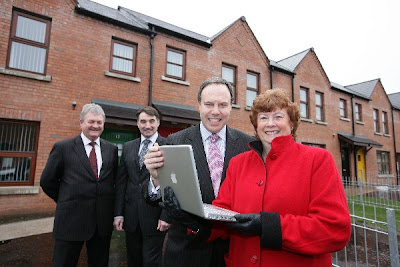
Photo (c) fibresystems.org - Enterprise Minister, Nigel Dodds visits the site of the Next Generation High Speed Broadband Trials on the Ormeau Road, Belfast. Pictured from left to right are: Alan McLeod, Virgin Media's New Developments Manager; John Simpson, Managing Director of Bytel Ltd; Minister Nigel Dodds; Alderman Geraldine Rice, Chair of Clanmil Housing Association.

A further 43 homes will be connected as part of the second phase by October. And a formal project evaluation is due by the end of the year. DETI is funding the project to the tune of £67k to install the infrastructure. However, much of the £33k cost that was poured into the ground used to dig the trenches in which to lay the fibre optic cable could be avoided if the developers planned this in to their foundations!

Tuesday, June 17, 2008

Number of mobile-only homes on the increase - 3G lagging rest of UK

Ofcom Nations and Regions Communications Market Report 2008 (Northern Ireland)

Mobile cropped up a lot in this year’s Nations & Regions Communications Market Report (general overview). Northern Ireland continues to have amongst the highest mobile ownership in the UK.

Across Northern Ireland, just over one in ten households no longer has a fixed telephone line, replying on mobiles instead. Focusing in on the two largest cities and that proportion more than doubles: around a quarter of household in Derry (27%) and Belfast (23%) rely solely on mobiles.

Chart showing households with no land lines and only mobiles

There is a general hypothesis that Derry has a younger-than-average population that take full advantage of everything techie. So living off a mobile fits that stereotype. But what about Belfast? Could this reflect the larger number of rented properties in Belfast, with more transient occupiers (students, migrant workers, etc) who have landlords that prohibit the installation of telephone lines/cable etc or find the minimum contract periods too restrictive or too costly given their circumstances?

Or maybe Belfast really is buzzing and city dwellers expect to be out most of the time, making a home phone line and answering machine a nuisance compared to mobile voicemail. Whatever the reason, the lack of a fixed line does mean opting out of higher speed broadband services, and moves internet usage towards work/college and mobile devices.

Last year Ofcom highlighted the issue of inadvertent or unavoidable cross-border roaming which was driving up many people’s mobile bills. Two of the mobile networks operating in NI – O2 and Three – have responded by launching new roaming tariffs or boltons which alleviate the problem of excessive charging . During the year, the EU also curtailed mobile roaming charges within Europe – which could cut some previous high call charges in half.

The level of cross-border roaming reported in the 2008 report was similar to last year. And awareness of the new tariffs in the worst-affected border areas was a paltry 20% – whereas awareness in Belfast where roaming frankly isn’t a great problem, was up at 42%. Sounds like there’s still room for improvement. (Perhaps the corporate business community has been targeted with the advertising rather than individual border consumers?)

There’s a very stark contrast between the well-established GSM (2G) mobile coverage – with over 99% of all NI post code areas having at least one mobile operator serving them – and the extremely limited local 3G coverage (44%).

3G coverage in Northern Ireland is poor

Across the UK, 90% of the population live in an area served by at least one 3G operator. The Northern Ireland figure stands at just 44%, far lower than Scotland (72%) and Wales (68%).

Amazingly, London has 100% coverage. In fact, 100% of London is served by not just one, but by four or five operators!

Yet, the marketing must be getting through, as Northern Ireland take-up of 3G mobiles stands at 17%, equalling the UK average.

But if you don’t live around Belfast, Lisburn, Holywood, Bangor, Carrick, Antrim, Derry or Coleraine – think twice before you bother to save up for the 3G Apple iPhone just yet, as you might be stuck on EDGE with no 3G coverage!

And while GSM (2G) coverage is high, Northern Ireland has the lowest overall satisfaction with mobile phone reception (78%). Rural areas are markedly lower at 59%. Could that be driven by the poor 3G reception? Or maybe all those drumlins in Down are creating a lot of localised black spots?

Mobile network use in Northern Ireland is dominated by O2 with 59% of mobiles using their network. The other network providers run: Orange (14%), Vodafone (14%), T-Mobile (4%), Virgin (4%), 3 (3%), other (2%).

Away from mobile ...

At the report launch, Ofcom highlighted that approximately 38 of Northern Ireland’s 191 telephone exchanges are now unbundled and offer competition to BT through one or more of AOL, Carphone Warehouse, Sky and Tiscali. While quite a low proportion of exchanges, it does represent 51% of the population, and an improvement on the 10% figure at the end of 2006.

Northern Ireland has the most rural population of the UK, so some of these exchanges may never be sufficiently commercially lucrative o be unbundled. Across the UK, the unbundled figure is much higher, with 80% of UK households connected to unbundled local exchanges.

I’ll cover broadband in another post.

Sunday, June 01, 2008

NI - not the gogglebox champions

Ofcom Nations and Regions Communications Market Report 2008 (Northern Ireland)

So having had a general look at Ofcom’s Nations & Regions Communication’s Market Report for Northern Ireland and a look at the radio figures, it’s now time to see that the almanac has to say about our TV habits.

The average Northern Irelander certainly isn’t top of the gogglebox chart - watching only 3 hours 12 minutes of TV each day, 24 minutes less than the UK average. Mind you, a shade over three hours of TV every day isn’t bad going. That’s 22 hours 24 minutes of telly a week - just under a full day. Thank goodness for media stacking - people using two or more different types of media at the same time.

Media stacking while watching TV

Across the UK, viewers are deserting the five main terrestrial channels (BBC1/2/ITV/C4/five), but according to Ofcom NI “the PSB channels in Northern Ireland are not haemorrhaging like the rest of the UK regions”, with audience share only falling 5 percentage points (down to 66%) since 2003 compared to a 12 point drop (to 64%) UK-wide. Only one other ITV region dropped less than 10 percentage points of share since 2003, so this kind of loyalty is unusual.

Access to digital television

Away from just the terrestrial channels, the take-up of digital television (DTV = cable, Freeview, satellite) has locally risen from 69% in 2006 up to 79% in Q1 2008. Northern Ireland still lags behind the UK average of 85%. If you live in an urban area you’re more likely have DTV in your home than rural friends. And more likely in the east of the province (85%) than the west (66%).

“In multichannel homes, the most popular channel choice [in NI] beyond the five PSB channels was ITV2, with a 2% viewing share, followed by E4 (1% share) and the Disney Channel (1%).”

Before the report’s launch, I hadn’t realised that RTE availability and take-up was just so high in Northern Ireland. Guess who was brought up in a house that had no RTE aerial!

A massive 71% of the local population can pick RTE1/2/TV3/TG4. (Not sure from the wording whether that’s a theoretical reception or whether it’s folk with an aerial/cable and TV channels tuned in.)

Viewing of Republic of Ireland TV channels in NI

And roughly one third of NI adults (16+) watch RTE1/2 daily, and 40% watch at least once a week. (TV3 and TG4 viewing is a bit lower.) Viewing is skewed towards border regions with daily RTE 1 viewing up to 44% in Ofcom’s border area whereas Belfast viewing is just 9%. And the access to RTE and TV3/TG4 is valued:

“We asked respondents how they would react to not having access to channels from the Republic of Ireland. Around two-fifths said that losing RTÉ 1, RTÉ 2, TV3 and TG4 would be ‘a major problem’ and that they would be ‘very unhappy’, while roughly another third said that it would not be a major problem, although they would prefer not to lose them. The remaining proportion of respondents said that it would not be an issue.

By channel, the loss of RTÉ1 would be a major problem for 28% of respondents, rising to 49% in the border region. Corresponding figures for the other channels for Northern Ireland as a whole (and for the border region) were: 26% (47%) for RTÉ2, 16% (35%) for TV3 and 15% (34%) for TG4.” (slight adaption from original wording)

Trend of local early evening news viewing

No doubt due to Northern Ireland’s conflict and political shenanigans, we lead the UK in viewing of early evening regional news programmes. While the trend across the UK is wobbling, and trending downwards, Northern Ireland viewers are watching an increasing amount of early evening regional news.

So that’s an overview, radio and TV done. Just online and telecoms scheduled to post later in the week.

Thursday, May 29, 2008

A quick DAB at Ofcom’s radio figures

Ofcom Nations and Regions Communications Market Report 2008 (Northern Ireland)

Part two of a look at Ofcom’s Nations & Regions Communication’s Market Report for Northern Ireland that was launched this time last week. So what does the Almanac have to say about radio?

Norn Iron likes its radio.

The quarterly RAJAR figures quoted by Ofcom show that BBC Radio Ulster/Foyle remains dominant – partly at the expense of the BBC national radio channels (except Radio 1) – with a stonking 25% of the local share of listening hours compared to much lower tallies for regional BBC services in England (10%), Scotland (9%) and Wales (15%).

Share of listening hours by nation (RAJAR 2007)

Our share of listening to available local commercial stations is 31%, roughly in line with the UK average, a bit higher than Wales (27%) but lower than Scotland (43%).

But at 7% share, local listening to national commercial stations (like Classic FM, talkSport etc) is low: at least four percentage points lower than the rest of the UK. Unsurprising given the lack of variety of stations to listen to.

Perhaps the most differentiating stat about Northern Ireland’s share of listening hours is the 10% allocated to Ofcom’s Other category – a basket which includes RTE Radio as well as community radio and short term licensed stations. That’s eight percentage points higher than the UK average. (RTE are shortly to ditch MW broadcasts.) RTE listening figures for Northern Ireland are scarce - I can't find any - and the UK quarterly RAJAR survey only covers UK-based radio stations. But the community stations are contributing some of the listening in the 10% too.

Number of community radion stations (average per million head of population)

A total of fourteen community licences have now been awarded in NI - seven are already on air. Per head of population, this is more than double any other region of the UK, and serves to further highlight NI’s love of local – local news, local gossip, local radio.

But what about digital? AiB’s all about the widgets, gizmos, and things that don’t last long but do look shiny.

Northern Ireland’s two DAB multiplexes (local commercial + BBC national stations) cover approximately 87% of the population. The UK-wide commercial multiplex - Digital One - doesn’t cover Northern Ireland: apparently not enough available digital spectrum to squeeze it in!

“The implementation of DAB in Northern Ireland is particularly constrained by the presence of analogue television in Band III in the Republic of Ireland. After the Wiesbaden Agreement in 1995, one channel (Channel 12) was made available for DAB and its use is shared between Northern Ireland and the Republic. A consequence of this is that only two multiplexes are broadcast in Northern Ireland, the BBC’s multiplex and the Northern Ireland ‘local’ multiplex, operated by Score Digital.” Appendix D: Options for DAB replanning from Ofcom’s Radio –Preparing for the Future report

But with only a poxy 20 stations available to listen to, your jaw will hardly hit the ground when you realise that the local ownership of DAB radio sets has only risen from 11% to 13% over the last year, compared to a four percentage point growth across the UK (now up to 22%). At the moment, DAB’s limited audience reach wouldn’t pay for new stations like U105 to rent a slot on the local commercial multiplex. Though back in 2000, RTE did (unsuccessfully) apply for slots on the local commercial multiplex.

(All this talk of DAB does want me to reminisce about one of the early DAB receivers: the curiously-styled and pulsating Psion Wavefinder that eventually fell foul of the USB drivers in Windows XP Service Pack 2 before working again with the more recent XP SP3.)

And even the raw awareness of DAB lags behind. Just over half (54%) of those surveyed in NI have heard the term “DAB digital radio” compared to 75% across the UK. (Can’t find any mention of awareness in previous year’s reports to compare back to.) But perhaps part of the long term answer is some kind of reorganisation of the multiplex structure - like Ofcom are proposing for Freeview to squeeze HD into the same spectrum. It's all in the hands of the recently formed digital radio group to come up with a way forward for the digital radio industry, and more importantly, the listeners.

Proportion of respondents who have ever listened to radio via DTV, Internet or mobile phone

Widening out from DAB to listening to the radio by any digital means (Freeview/Satellite, Internet or a Mobile phone), Northern Ireland is still the Luddite region of the UK.

In Northern Ireland, you’re three times as likely to live in a household where someone has watched TV or video online than one in which someone has listened to the radio online!

Proportion of adults living in a household that has used the internet to watch TV or video content

(Except if you live in Belfast where the video stat is unusually low, but the radio figure is in line with other local regions.)

Online radio listening doesn’t seem to be affected by broadband penetration (the thin green line), pointing to the fact that radio was, and still is, usable over dialup connection speeds or GPRS.

(Charts all reproduced from Ofcom's report.)

Tuesday, May 27, 2008

Ofcom's Nations & Regions Communication's Market Report - what does it say about Northern Ireland?

Ofcom Nations and Regions Communications Market Report 2008 (Northern Ireland)

The launch of Ofcom’s Nations & Regions Communication’s Market Report has become an annual event. AiB mentioned it back in 2006. It’s basically the results of a huge survey carried out across the UK (backed up by figures from various Ofcom stakeholders – telcos and broadcasters etc) looking at television, radio, telecoms and (new for this year) a section on converged communications.

It’s kind of the Wisden Cricketers’ Almanac for media and comms anoraks.

For their 2008 report, nearly six thousand people were interviewed across the UK in January and February, with 629 surveyed in Northern Ireland. The analysis is published in four parts – England, Scotland, Wales and Northern Ireland. The NI report was launched by Ofcom NI in their shiny white and friendly offices in Belfast’s Gasworks on Thursday morning.

Denis Wolinski (Director of Ofcom NI) at the launch of the Nations and Regions Communications Market Report 2008 (Northern Ireland) in Belfast

That’s Denis Wolinski (Director of Ofcom NI) on the right, the only one in the room with a Manchester United mug – he was pleased with the previous night’s result in Moscow!

Now Northern Ireland might be small, but it’s not uniform in its tastes and can be sliced and diced in so many ways. So for the first time there wasn’t just a rural/urban comparison for the NI stats. From this year it includes figures for east/west of the Bann (both further divided into urban/rural).

And then there are specific figures for Londonderry/Derry and Belfast as well as Small towns (Enniskillen, Omagh, Newry, Dungannon, Armagh, Ballycastle, Cookstown, Coleraine) and Border areas (Derry, Newry, Strabane, Portstewart, Warrenpoint). Forgive me for thinking Newry was a small city rather than a small town!

There’s enough in the report for a series of blog entries, so I’ll eek it out and bore you over the next few days! (Some of the raw only slightly processed data is also available from Ofcom for download and further analysis.)

But a few facts and figures to whet your appetite:

On average, people in Northern Ireland watch less TV than the rest of the UK. And our viewing of the main five terrestrial TV channels is “not haemorrhaging like the rest of the UK regions”.

We’re the Luddites of digital radio with the lowest awareness of DAB, lowest ownership of DAB radios, and the lowest number of people who’ve ever listened to radio by any digital means (DAB, cable, Freeview, online, etc).

With highest speeds and DSL availability in urban areas, broadband take-up is actually strongest in rural areas. And if you have broadband, use of wireless hubs is particularly popular in Northern Ireland with particular peaks in the rural east and border areas. Though Swansea, Yorkshire, Newcastle upon Tyne and the rural east/south east of England can top that.

Inadvertent mobile roaming across the border is still a problem, and very few people affected are aware of the new tariffs that O2 and 3 have introduced to address the issue. If you live in Belfast you’re twice as likely to know about the new tariffs than someone living in a border region.

3G covers only 44% of NI – yet take-up of 3G handsets equals the rest of the UK (with an average of 90% 3G coverage).

Northern Ireland has a higher than average use of mobile phones to listen to audio content (such as radio, MP3s or podcasts). Derry is particularly high, though behind the audiophiles in Liverpool and Birmingham.

I’d never heard of the term media stacking before seeing the report. Basically, using two or more different types of media at the same time. Like rubbing your tummy and patting your head. Perhaps, watching TV and talking on a mobile or surfing the internet.

Comparison of indigenous minority language articles and contributors on Wikipedia

And the Ofcom random stat of the year ... as of January 2008 there were over 6,000 Wikipedia articles in Irish and over 2,000 in Ulster Scots. Trivial Pursuit, here we come.

Two years ago it felt like Northern Ireland was on the wrong side of the digital divide. But the 2008 figures offer some hope. I’ve update the quick summary table from the blog post two years ago to give some kind of rough comparison.

Comparison of some Northern Ireland digital divide figures from Orcom Nations and Regions Communications Market Reports from 2006, 2007, 2008

We still lag behind, but not by as much.

See later more detailed posts covering radio, TV, mobile & fixed telecoms, broadband and online.