Showing posts with label indigenous. Show all posts

Saturday, July 05, 2008

Ulster-Scot(s) light & On Eagle's Wing

Sitting in a cafe in Portstewart, flicking through the papers on the window-sill and wondering ...

Why is "The Ulster-Scot" weekly paper (possibly distributed with Saturday's Newsletter) completely devoid of anything actually written in Ulster-Scots?

I'd have hoped that the Ulster-Scots Agency would have been promoting the language, as well as the culture.

But interesting to read that John Anderson's On Eagle's Wing musical is being revived in the Grand Opera House from Sep 29 to Oct 4 this autumn. (Also playing in Derry's Millennium Forum Oct 14-20 and Dublin's Helix Theatre 0ct 11-12.)

We went along to the (free) filming of the musical in the Odyssey back in May 2004. An amazing evening, with many foot-tapping tunes. But the show struggled financially to gain traction in the US.

It tells the story of 18th century emigration from NI shores (including Groomsport) across to America, building communities that would have a long-lasting influence on the US, and struggling with cutting family ties and persecution.

Well worth getting a ticket.

Tuesday, May 27, 2008

Ofcom's Nations & Regions Communication's Market Report - what does it say about Northern Ireland?

Ofcom Nations and Regions Communications Market Report 2008 (Northern Ireland)

The launch of Ofcom’s Nations & Regions Communication’s Market Report has become an annual event. AiB mentioned it back in 2006. It’s basically the results of a huge survey carried out across the UK (backed up by figures from various Ofcom stakeholders – telcos and broadcasters etc) looking at television, radio, telecoms and (new for this year) a section on converged communications.

It’s kind of the Wisden Cricketers’ Almanac for media and comms anoraks.

For their 2008 report, nearly six thousand people were interviewed across the UK in January and February, with 629 surveyed in Northern Ireland. The analysis is published in four parts – England, Scotland, Wales and Northern Ireland. The NI report was launched by Ofcom NI in their shiny white and friendly offices in Belfast’s Gasworks on Thursday morning.
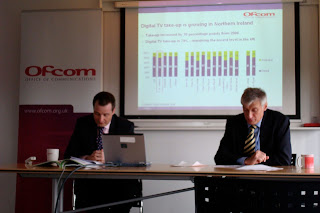
Denis Wolinski (Director of Ofcom NI) at the launch of the Nations and Regions Communications Market Report 2008 (Northern Ireland) in Belfast

That’s Denis Wolinski (Director of Ofcom NI) on the right, the only one in the room with a Manchester United mug – he was pleased with the previous night’s result in Moscow!

Now Northern Ireland might be small, but it’s not uniform in its tastes and can be sliced and diced in so many ways. So for the first time there wasn’t just a rural/urban comparison for the NI stats. From this year it includes figures for east/west of the Bann (both further divided into urban/rural).

And then there are specific figures for Londonderry/Derry and Belfast as well as Small towns (Enniskillen, Omagh, Newry, Dungannon, Armagh, Ballycastle, Cookstown, Coleraine) and Border areas (Derry, Newry, Strabane, Portstewart, Warrenpoint). Forgive me for thinking Newry was a small city rather than a small town!

There’s enough in the report for a series of blog entries, so I’ll eek it out and bore you over the next few days! (Some of the raw only slightly processed data is also available from Ofcom for download and further analysis.)

But a few facts and figures to whet your appetite:

On average, people in Northern Ireland watch less TV than the rest of the UK. And our viewing of the main five terrestrial TV channels is “not haemorrhaging like the rest of the UK regions”.

We’re the Luddites of digital radio with the lowest awareness of DAB, lowest ownership of DAB radios, and the lowest number of people who’ve ever listened to radio by any digital means (DAB, cable, Freeview, online, etc).

With highest speeds and DSL availability in urban areas, broadband take-up is actually strongest in rural areas. And if you have broadband, use of wireless hubs is particularly popular in Northern Ireland with particular peaks in the rural east and border areas. Though Swansea, Yorkshire, Newcastle upon Tyne and the rural east/south east of England can top that.

Inadvertent mobile roaming across the border is still a problem, and very few people affected are aware of the new tariffs that O2 and 3 have introduced to address the issue. If you live in Belfast you’re twice as likely to know about the new tariffs than someone living in a border region.

3G covers only 44% of NI – yet take-up of 3G handsets equals the rest of the UK (with an average of 90% 3G coverage).

Northern Ireland has a higher than average use of mobile phones to listen to audio content (such as radio, MP3s or podcasts). Derry is particularly high, though behind the audiophiles in Liverpool and Birmingham.

I’d never heard of the term media stacking before seeing the report. Basically, using two or more different types of media at the same time. Like rubbing your tummy and patting your head. Perhaps, watching TV and talking on a mobile or surfing the internet.

Comparison of indigenous minority language articles and contributors on Wikipedia

And the Ofcom random stat of the year ... as of January 2008 there were over 6,000 Wikipedia articles in Irish and over 2,000 in Ulster Scots. Trivial Pursuit, here we come.

Two years ago it felt like Northern Ireland was on the wrong side of the digital divide. But the 2008 figures offer some hope. I’ve update the quick summary table from the blog post two years ago to give some kind of rough comparison.

Comparison of some Northern Ireland digital divide figures from Orcom Nations and Regions Communications Market Reports from 2006, 2007, 2008

We still lag behind, but not by as much.

See later more detailed posts covering radio, TV, mobile & fixed telecoms, broadband and online.

Monday, March 17, 2008

Happy St Patrick's Day

Happy St Patrick's Day

Belfast City Council - St Patrick's Day carnival and concert

Belfast City Council are putting their name and weight behind a carnival parade (leaving the City Hall at 12 noon), and a concert in Custom House Square between 1pm and 3pm featuring Mutya Buena (formerly of Sugababes), Nae Goats Toe (an Ulster Scots folk orchestra), Four Men and a Dog (“toe tapping blend of traditional Irish favourites”) all pulled together by Pete Snodden.

And there will be lots of other events across Northern Ireland to keep you busy ... unless you're stuck in school or work!

PS: I can't really be bothered to comment on the Paul Rankin publicity stunt to gather together lots of people called Patrick in Trafalgar Square on Sunday. Didn't Dave Gorman do that first?

Friday, March 07, 2008

How to speak Ulster-Scots

From Laurence White's column in tonight's Belfast Telegraph describing Culture Minister Edwin Poots' reluctance to attend Irish language events.

Due to his fear of being unable to understand what would be going on, he hasn't accepted any invitations since his appointment. Maybe simultaneous translation will have to provided - like many meetings in Wales in which speakers can tend to freely switch between English and Welsh.

But Poots has managed to attend five Ulster Scots events - conducted in English!

The Belfast Telegraph's Laurence White them delivers his killer line:

"To be fluent in Ulster-Scots all you need is a Ballymena accent and a poor grasp of spelling."

A bit unfair really on both the indigineous minority languages recognised in NI?

Update - The Ulster Scots Heritage Council got a letter printed the following evening!

Tuesday, February 19, 2008

Belfast Nashville Songwriters’ Festival etc

A little celebrated fact is that Belfast is twinned with Nashville, Tennessee. Yee haw. Maybe that explains Hugo Duncan’s dominance on the afternoon airwaves! But it’s not something that’s talked about very much. Dolly Parton doesn’t seem to come and lead the St Patrick’s Day parade (what would she sing - Peace Train?) ... in fact, last time she appeared at the Odyssey, her reluctance to allow video screens on the side of the stage meant that a lot of fans complained they couldn’t see her during the sell-out show! She's coming back in June 2008 ...

Mayors of Nashville Bill Purcell and Belfast Jim Rodgers

There’s even a joint publication – The Belfast Nashville Story - written in 2007 as Nashville celebrated its 200th anniversary of incorporation, highlighting the cultural aspects that Belfast and Nashville share together with the role played by the many “Ulster Scots emigrants and their descendents”.

Even less talked about than the special relationship between Nashville and Belfast is Nashville’s promiscuity ... it hasn’t just signed up in union with Belfast, but has relationships with Edmonton (Alberta; Canada), Caen (Basse-Normandie, France), Pernik (Bulgaria), Magdeburg (Germany) and Taiyuan (Shanxi, China).

Though on closer inspection, Belfast has a fair few sister cities too: Belfast (Maine US), Bonn (Germany) and Hefei (China).

logo of the 4th Belfast Nashville Songwriters Festival

But putting all that behind us, the 4th Belfast Nashville Songwriters’ Festival kicks off tomorrow.

5 Days, 75 Songwriters and 28 Concerts

Nanci Griffith will no longer be singing From a Distance, but will be in concert at The Empire on Botanic Avenue on Thursday night as well as appearing “in the round” at the Kings Head in Balmoral on Friday. (Update - But if you haven’t already got a ticket, her concerts are sold out.)

And as if timed to coincide with and reinforce the Belfast-Nashville connection, one-time Belfast flâneur Jett Loe has finally uploaded the long-awaited Chapter 78 of Letter to America podcast, recorded in his new home of Nashville.

Friday, August 24, 2007

Watawieh! All yorlye gwen? (Norfuk = a indigenous minority language)

“An indigenous language is one that is native to a region and spoken by indigenous peoples. This language would be from a linguistically distinct community that has been settled in the area for many generations. Indigenous languages may not be national languages, or may have fallen out of use, because of language deaths caused by colonization, where the original language is replaced by that of the colonists.” (Definition adapted from Wikipedia.)

Now in Northern Ireland, Irish and Ulster Scots are recognised as indigenous languages.

(c) Telegraph

But cast your eyes across to the other side of the world to little Norfolk Island in the southern Pacific Ocean. As a result of settlers who arrived from Pitcairn Island (which has been in the news for the wrong reasons over the last couple of years), some of the population speak Norfuk (or Norfolk), an amalgam of English and Tahitian. About half the 2000 islanders speak Norfuk, and it featured on the Telegraph’s daily podcast earlier this week.

Watawieh! All yorlye gwen?
(Hello! How are you all?)

While part of Australia, Norfolk keeps a distinct flag, national anthem, and even stamps passports (including Australian ones) on the way into their territory.

As organisations across Northern Ireland work to boost the understanding and appreciation for Ulster Scots and Irish, Norfolk islanders have been fighting to preserve their disappearing language. It’s now being taught in school to the island’s 300 children, and the UN will be including it in the next edition of Unesco’s Atlas of the World’s Languages in Danger of Disappearing.

Norfolk government spokesman, Peter Maywald says:

“It’s now undergoing a renaissance. People are more interested in their culture and historical roots than they were before.”

Some pages of the island’s newspaper are now translated from into Norfuk (from English) and there are even plans to build a cultural centre to showcase this unusual creole language.

And if you want to brush up on your Ulster Scots, check out A Kist O Wurds at 7pm each Saturday evening on Radio Ulster (starting back on 1 September). It's surprisingly accessible and fun!

Update: Radio 4's Word of Mouth will be include a feature about Norfuk on Monday 3 September at 11pm, repeated on Tuesday 4 September at 4pm, and available for seven days on Listen Again.