Showing posts with label ofcomcmr. Show all posts

Friday, August 20, 2010

Tech Camp, SARC and Ofcom’s 2010 Communications Market Report for Northern Ireland

Tech Campers (and a leader) sitting with their laptops

As well as being fun and fulfilling, each year’s Tech Camp offers a glimpse into the impact of technology on ever-changing world of teenagers. In previous years, a minority of campers have brought along their own laptops. This year, the vast majority were inseparable from their lap warmers.

In previous years, late night conversations down the campers’ corridor could be easily detected from the other side of the building. They would congregate in someone’s room or the communal kitchen. This year, there was no need to shhhh them. There were still bleary eyes in the morning … but from the tap tap of keyboards and late night MSMing between each other rather than face-to-face chatter.

It’s already the case that some parents of campers will be more likely to confirm that their children are alive and well by monitoring Facebook than expecting a phone call home or even a text message.

Over the years there has also been a notable increase in the ability to shoot and edit video. And perhaps an improving understanding of film grammar – though few would express it that way! The kind of technology that the leaders share and guide them through during the week is becoming less surprising. There’s still much to learn and apply, but the magic is diminishing.

SARC Sonic Lab layout

Perhaps one exception was our visit to SARC – the Sonic Arts Research Centre at Queens University. Stereo sound, surround sound, but few have contemplated – never mind experienced – the kind of all-encompassing surround sound diffusion set-up in SARC’s Sonic Laboratory.

Audiences and researchers enter the lab at ground floor level and walk out onto an acoustically transparent, modular grid floor suspended 4m above the structural floor of the lab located at lower ground floor level. Approximately 7m above the audience area is a technical gantry spanning the perimeter of the lab and nine motorised ceiling panels which can be independently lowered to ground floor level. The ceiling panels are rectangular aluminium box trusses (2m x 1m) from which loudspeakers, stage lights and/or microphones can be suspended.

With over sixty speakers positioned around you as well as above and below, you can perceive sounds moving around you in a way not possible with headphones or even a sophisticated cinema setup.

One camper suggested afterwards:

“... having seen SARC I need to re-evaluate everything I previously thought was amazing!”

As I said, Tech Camp is a reminder that technology is changing. So too is the annual Communications Market Report for Northern Ireland published by Ofcom. I’ve blogged about previous years’ reports, so will just point to some of the changing patterns in communications that are highlighted in this year’s tome that was released on Thursday morning.

Over the past few years there’s been a gradual increase in the number of households which don’t have fixed-line phones. Sometimes down to short term rentals, student housing, lack of finance. But also likely to be a sign that for some people, mobile coverage and mobile broadband (as well as other places they can get online – work, perhaps – or scrounge wifi) means that they can live without a landline.

  • 18% of NI households are now mobile-only (21% of urban households) compared to 14% across UK.

  • 2G (GSM/GPRS) mobile coverage in NI reached 89% in 2010. That’s higher than Scotland (87%), but falls short of the 99% coverage in England. (Note that mobile coverage is expressed as percentage of postal districts where are least one operator reports at least 90% coverage. So some folk in the other 11% of NI postcodes will still get some GSM coverage.)
Chart comparing 2G and 3G mobile coverage in Northern Ireland (showing 90% coverage in postal districts)
  • 3G coverage is a mere 40%, lagging far behind the UK average of 87% and lower than Scotland (66%) or Wales (69%). The coverage map confirms many people's impressions of 3G coverage. No surprise that use of 3G handsets is lower (18%) in NI compared to the UK (26%).
Graph showing 3G coverage in (90% coverage in Northern Ireland postal districts) by number of operators
  • Yet 14% of households in NI claim to be accessing the internet via mobile broadband (up from 8% last year), not far off the UK average of 15%. And 8% of NI households use mobile broadband as their only means of accessing the internet. (UK 6%.)

After years of lagging behind, the percentage of NI households with broadband (70%) has caught up with the UK (71%).

But we like our electronic gadgets!

  • NI is the gaming capital of the UK with 52% of NI households having a games console (PS3, Wii or Xbox 360). It’s the same pattern for hand-held portable consoles (DSi/DSi Lite or PSP): 37% of NI households have one compared to 30% across UK. Though Microsoft marketeers should note that Xbox is less popular that other parts of the UK!

  • 37% of NI adults use an iPod/MP3 player (compared with UK average of 32%). For people living in the Belfast metropolitan area, that rises to 42%. The household ownership of iPods/MP3 players (45%) is five percentage points higher than the UK average.

When it comes to media literacy and accessing local council/government websites, only 16% of adults in NI with internet access had visited a local council or government websites, compared to UK average of 26%. (Scotland is lower than NI with a figure of 13% of people.)

While I've been looking at the Northern Ireland report, versions are available for England, Scotland and Wales as well as an overall UK edition. This year, as well as the 137 page PDF report, Ofcom have also released a summary of the base data, PDFs of the charts, and created (SEO-friendly) web pages for individual sections. At the same time, they've hugely increased the number of spelling mistakes and formatting errors in the main report!

Thursday, June 19, 2008

Broadband and online usage

Ofcom Nations and Regions Communications Market Report 2008 (Northern Ireland)

The last of a series of posts looking at the results in this year’s Ofcom Nations & Regions Communications Market Report for Northern Ireland.

In general, broadband availability is highest in urban areas. And the highest speeds will be achieved by the more densely populated built-up areas where people live a lot closer to their exchange than in rural populations.

Yet broadband take-up is highest in Northern Ireland’s rural communities! Could that be the long dark evenings with only the village pub open for entertainment. (I stereotype ridiculously.) Could it be that fewer folk in rural areas have access to high speed internet as part of their day jobs, so have to rely on it at home? (Though rural commuters are pretty common.) Or as mobile networks become slower and less reliable the further away you go from the densely populated urban areas, does mobile internet become less appealing, leaving broadband the only option?

Belfast has a particularly low broadband penetration, in line with Ofcom’s “small towns”, but markedly lower than Derry.

With an average age of 35, Northern Ireland has the lowest aged regional population in the UK after London (34). As expressed in a previous post about mobile, the hypothesis is that Derry has the youngest population in NI, taking full advantage of gadgets and gizmos, which may explain some of the differences between the Derry and Belfast figures.

Northern Ireland online video TV watching

So no surprise that 34% of those surveyed in Derry had used the internet to watch TV or video content, compared to just 21% in Belfast.

(Though for online radio listening, Belfast (10%) is pretty much level with Derry (9%) – perhaps reflecting the fact that dialup/mobile is good enough for radio, and it’s also been around longer online.)

And if Derry is characterised by being young, perhaps Belfast’s low broadband uptake is due to a higher number of people living in rented or short-term accommodation, unwilling to take out lengthy rentals or unable to install equipment. Does Belfast have a significantly more temporary population that Derry? More migrant workers in Belfast? More students? (Though they’d be the very people to push for cable or DSL to be installed in a house.)

Ofcom’s raw figures show that use of wireless hubs is more popular than average in Northern Ireland (53%) with peaks in the rural east (58%) and border areas (56%). Hot spots (made choice of term) in Swansea, Yorkshire, Newcastle upon Tyne and the rural east/south east of England can top the NI peak.

Northern Ireland (19%) has a higher than average (17%) use of mobile phones to listen to audio content (such as radio, MP3s or podcasts). Again, Derry technorati shine out at 23%, though behind the audiophiles in Liverpool (25%) and Birmingham (27%).

And we’re far behind Scotland when it comes to our media stacking habits and multi-tasking while using the internet.

Media stacking while using internet

Back to broadband ...

Northern Ireland trumpeted its 100% broadband availability ahead of anywhere else in the UK. On the ground this translates into 360,000 broadband connections, of which 680 are satellite. Virgin Media pass by the door of 30% of NI households.

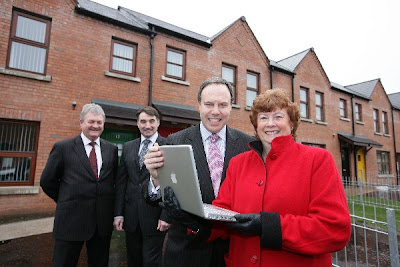
The Ofcom report also highlights a couple of Fibre trials in NI. In conjunction with the Department of Enterprise, Trade and Investment (DETI), Virgin Media is installing 20Meg broadband to 70+ houses in Lavinia Square, a social housing development near the Ormeau Road in Belfast, using Fibre To The Cabinet/Kerb technology. And up the street, Bytel are supplying Fibre To The Home into another ten houses – capable of 100Meg, but limited to 20Meg for the trial.

Photo (c) fibresystems.org - Enterprise Minister, Nigel Dodds visits the site of the Next Generation High Speed Broadband Trials on the Ormeau Road, Belfast. Pictured from left to right are: Alan McLeod, Virgin Media's New Developments Manager; John Simpson, Managing Director of Bytel Ltd; Minister Nigel Dodds; Alderman Geraldine Rice, Chair of Clanmil Housing Association.

A further 43 homes will be connected as part of the second phase by October. And a formal project evaluation is due by the end of the year. DETI is funding the project to the tune of £67k to install the infrastructure. However, much of the £33k cost that was poured into the ground used to dig the trenches in which to lay the fibre optic cable could be avoided if the developers planned this in to their foundations!

Tuesday, June 17, 2008

Number of mobile-only homes on the increase - 3G lagging rest of UK

Ofcom Nations and Regions Communications Market Report 2008 (Northern Ireland)

Mobile cropped up a lot in this year’s Nations & Regions Communications Market Report (general overview). Northern Ireland continues to have amongst the highest mobile ownership in the UK.

Across Northern Ireland, just over one in ten households no longer has a fixed telephone line, replying on mobiles instead. Focusing in on the two largest cities and that proportion more than doubles: around a quarter of household in Derry (27%) and Belfast (23%) rely solely on mobiles.

Chart showing households with no land lines and only mobiles

There is a general hypothesis that Derry has a younger-than-average population that take full advantage of everything techie. So living off a mobile fits that stereotype. But what about Belfast? Could this reflect the larger number of rented properties in Belfast, with more transient occupiers (students, migrant workers, etc) who have landlords that prohibit the installation of telephone lines/cable etc or find the minimum contract periods too restrictive or too costly given their circumstances?

Or maybe Belfast really is buzzing and city dwellers expect to be out most of the time, making a home phone line and answering machine a nuisance compared to mobile voicemail. Whatever the reason, the lack of a fixed line does mean opting out of higher speed broadband services, and moves internet usage towards work/college and mobile devices.

Last year Ofcom highlighted the issue of inadvertent or unavoidable cross-border roaming which was driving up many people’s mobile bills. Two of the mobile networks operating in NI – O2 and Three – have responded by launching new roaming tariffs or boltons which alleviate the problem of excessive charging . During the year, the EU also curtailed mobile roaming charges within Europe – which could cut some previous high call charges in half.

The level of cross-border roaming reported in the 2008 report was similar to last year. And awareness of the new tariffs in the worst-affected border areas was a paltry 20% – whereas awareness in Belfast where roaming frankly isn’t a great problem, was up at 42%. Sounds like there’s still room for improvement. (Perhaps the corporate business community has been targeted with the advertising rather than individual border consumers?)

There’s a very stark contrast between the well-established GSM (2G) mobile coverage – with over 99% of all NI post code areas having at least one mobile operator serving them – and the extremely limited local 3G coverage (44%).

3G coverage in Northern Ireland is poor

Across the UK, 90% of the population live in an area served by at least one 3G operator. The Northern Ireland figure stands at just 44%, far lower than Scotland (72%) and Wales (68%).

Amazingly, London has 100% coverage. In fact, 100% of London is served by not just one, but by four or five operators!

Yet, the marketing must be getting through, as Northern Ireland take-up of 3G mobiles stands at 17%, equalling the UK average.

But if you don’t live around Belfast, Lisburn, Holywood, Bangor, Carrick, Antrim, Derry or Coleraine – think twice before you bother to save up for the 3G Apple iPhone just yet, as you might be stuck on EDGE with no 3G coverage!

And while GSM (2G) coverage is high, Northern Ireland has the lowest overall satisfaction with mobile phone reception (78%). Rural areas are markedly lower at 59%. Could that be driven by the poor 3G reception? Or maybe all those drumlins in Down are creating a lot of localised black spots?

Mobile network use in Northern Ireland is dominated by O2 with 59% of mobiles using their network. The other network providers run: Orange (14%), Vodafone (14%), T-Mobile (4%), Virgin (4%), 3 (3%), other (2%).

Away from mobile ...

At the report launch, Ofcom highlighted that approximately 38 of Northern Ireland’s 191 telephone exchanges are now unbundled and offer competition to BT through one or more of AOL, Carphone Warehouse, Sky and Tiscali. While quite a low proportion of exchanges, it does represent 51% of the population, and an improvement on the 10% figure at the end of 2006.

Northern Ireland has the most rural population of the UK, so some of these exchanges may never be sufficiently commercially lucrative o be unbundled. Across the UK, the unbundled figure is much higher, with 80% of UK households connected to unbundled local exchanges.

I’ll cover broadband in another post.

Sunday, June 01, 2008

NI - not the gogglebox champions

Ofcom Nations and Regions Communications Market Report 2008 (Northern Ireland)

So having had a general look at Ofcom’s Nations & Regions Communication’s Market Report for Northern Ireland and a look at the radio figures, it’s now time to see that the almanac has to say about our TV habits.

The average Northern Irelander certainly isn’t top of the gogglebox chart - watching only 3 hours 12 minutes of TV each day, 24 minutes less than the UK average. Mind you, a shade over three hours of TV every day isn’t bad going. That’s 22 hours 24 minutes of telly a week - just under a full day. Thank goodness for media stacking - people using two or more different types of media at the same time.

Media stacking while watching TV

Across the UK, viewers are deserting the five main terrestrial channels (BBC1/2/ITV/C4/five), but according to Ofcom NI “the PSB channels in Northern Ireland are not haemorrhaging like the rest of the UK regions”, with audience share only falling 5 percentage points (down to 66%) since 2003 compared to a 12 point drop (to 64%) UK-wide. Only one other ITV region dropped less than 10 percentage points of share since 2003, so this kind of loyalty is unusual.

Access to digital television

Away from just the terrestrial channels, the take-up of digital television (DTV = cable, Freeview, satellite) has locally risen from 69% in 2006 up to 79% in Q1 2008. Northern Ireland still lags behind the UK average of 85%. If you live in an urban area you’re more likely have DTV in your home than rural friends. And more likely in the east of the province (85%) than the west (66%).

“In multichannel homes, the most popular channel choice [in NI] beyond the five PSB channels was ITV2, with a 2% viewing share, followed by E4 (1% share) and the Disney Channel (1%).”

Before the report’s launch, I hadn’t realised that RTE availability and take-up was just so high in Northern Ireland. Guess who was brought up in a house that had no RTE aerial!

A massive 71% of the local population can pick RTE1/2/TV3/TG4. (Not sure from the wording whether that’s a theoretical reception or whether it’s folk with an aerial/cable and TV channels tuned in.)

Viewing of Republic of Ireland TV channels in NI

And roughly one third of NI adults (16+) watch RTE1/2 daily, and 40% watch at least once a week. (TV3 and TG4 viewing is a bit lower.) Viewing is skewed towards border regions with daily RTE 1 viewing up to 44% in Ofcom’s border area whereas Belfast viewing is just 9%. And the access to RTE and TV3/TG4 is valued:

“We asked respondents how they would react to not having access to channels from the Republic of Ireland. Around two-fifths said that losing RTÉ 1, RTÉ 2, TV3 and TG4 would be ‘a major problem’ and that they would be ‘very unhappy’, while roughly another third said that it would not be a major problem, although they would prefer not to lose them. The remaining proportion of respondents said that it would not be an issue.

By channel, the loss of RTÉ1 would be a major problem for 28% of respondents, rising to 49% in the border region. Corresponding figures for the other channels for Northern Ireland as a whole (and for the border region) were: 26% (47%) for RTÉ2, 16% (35%) for TV3 and 15% (34%) for TG4.” (slight adaption from original wording)

Trend of local early evening news viewing

No doubt due to Northern Ireland’s conflict and political shenanigans, we lead the UK in viewing of early evening regional news programmes. While the trend across the UK is wobbling, and trending downwards, Northern Ireland viewers are watching an increasing amount of early evening regional news.

So that’s an overview, radio and TV done. Just online and telecoms scheduled to post later in the week.

Thursday, May 29, 2008

A quick DAB at Ofcom’s radio figures

Ofcom Nations and Regions Communications Market Report 2008 (Northern Ireland)

Part two of a look at Ofcom’s Nations & Regions Communication’s Market Report for Northern Ireland that was launched this time last week. So what does the Almanac have to say about radio?

Norn Iron likes its radio.

The quarterly RAJAR figures quoted by Ofcom show that BBC Radio Ulster/Foyle remains dominant – partly at the expense of the BBC national radio channels (except Radio 1) – with a stonking 25% of the local share of listening hours compared to much lower tallies for regional BBC services in England (10%), Scotland (9%) and Wales (15%).

Share of listening hours by nation (RAJAR 2007)

Our share of listening to available local commercial stations is 31%, roughly in line with the UK average, a bit higher than Wales (27%) but lower than Scotland (43%).

But at 7% share, local listening to national commercial stations (like Classic FM, talkSport etc) is low: at least four percentage points lower than the rest of the UK. Unsurprising given the lack of variety of stations to listen to.

Perhaps the most differentiating stat about Northern Ireland’s share of listening hours is the 10% allocated to Ofcom’s Other category – a basket which includes RTE Radio as well as community radio and short term licensed stations. That’s eight percentage points higher than the UK average. (RTE are shortly to ditch MW broadcasts.) RTE listening figures for Northern Ireland are scarce - I can't find any - and the UK quarterly RAJAR survey only covers UK-based radio stations. But the community stations are contributing some of the listening in the 10% too.

Number of community radion stations (average per million head of population)

A total of fourteen community licences have now been awarded in NI - seven are already on air. Per head of population, this is more than double any other region of the UK, and serves to further highlight NI’s love of local – local news, local gossip, local radio.

But what about digital? AiB’s all about the widgets, gizmos, and things that don’t last long but do look shiny.

Northern Ireland’s two DAB multiplexes (local commercial + BBC national stations) cover approximately 87% of the population. The UK-wide commercial multiplex - Digital One - doesn’t cover Northern Ireland: apparently not enough available digital spectrum to squeeze it in!

“The implementation of DAB in Northern Ireland is particularly constrained by the presence of analogue television in Band III in the Republic of Ireland. After the Wiesbaden Agreement in 1995, one channel (Channel 12) was made available for DAB and its use is shared between Northern Ireland and the Republic. A consequence of this is that only two multiplexes are broadcast in Northern Ireland, the BBC’s multiplex and the Northern Ireland ‘local’ multiplex, operated by Score Digital.” Appendix D: Options for DAB replanning from Ofcom’s Radio –Preparing for the Future report

But with only a poxy 20 stations available to listen to, your jaw will hardly hit the ground when you realise that the local ownership of DAB radio sets has only risen from 11% to 13% over the last year, compared to a four percentage point growth across the UK (now up to 22%). At the moment, DAB’s limited audience reach wouldn’t pay for new stations like U105 to rent a slot on the local commercial multiplex. Though back in 2000, RTE did (unsuccessfully) apply for slots on the local commercial multiplex.

(All this talk of DAB does want me to reminisce about one of the early DAB receivers: the curiously-styled and pulsating Psion Wavefinder that eventually fell foul of the USB drivers in Windows XP Service Pack 2 before working again with the more recent XP SP3.)

And even the raw awareness of DAB lags behind. Just over half (54%) of those surveyed in NI have heard the term “DAB digital radio” compared to 75% across the UK. (Can’t find any mention of awareness in previous year’s reports to compare back to.) But perhaps part of the long term answer is some kind of reorganisation of the multiplex structure - like Ofcom are proposing for Freeview to squeeze HD into the same spectrum. It's all in the hands of the recently formed digital radio group to come up with a way forward for the digital radio industry, and more importantly, the listeners.

Proportion of respondents who have ever listened to radio via DTV, Internet or mobile phone

Widening out from DAB to listening to the radio by any digital means (Freeview/Satellite, Internet or a Mobile phone), Northern Ireland is still the Luddite region of the UK.

In Northern Ireland, you’re three times as likely to live in a household where someone has watched TV or video online than one in which someone has listened to the radio online!

Proportion of adults living in a household that has used the internet to watch TV or video content

(Except if you live in Belfast where the video stat is unusually low, but the radio figure is in line with other local regions.)

Online radio listening doesn’t seem to be affected by broadband penetration (the thin green line), pointing to the fact that radio was, and still is, usable over dialup connection speeds or GPRS.

(Charts all reproduced from Ofcom's report.)

Tuesday, May 27, 2008

Ofcom's Nations & Regions Communication's Market Report - what does it say about Northern Ireland?

Ofcom Nations and Regions Communications Market Report 2008 (Northern Ireland)

The launch of Ofcom’s Nations & Regions Communication’s Market Report has become an annual event. AiB mentioned it back in 2006. It’s basically the results of a huge survey carried out across the UK (backed up by figures from various Ofcom stakeholders – telcos and broadcasters etc) looking at television, radio, telecoms and (new for this year) a section on converged communications.

It’s kind of the Wisden Cricketers’ Almanac for media and comms anoraks.

For their 2008 report, nearly six thousand people were interviewed across the UK in January and February, with 629 surveyed in Northern Ireland. The analysis is published in four parts – England, Scotland, Wales and Northern Ireland. The NI report was launched by Ofcom NI in their shiny white and friendly offices in Belfast’s Gasworks on Thursday morning.

Denis Wolinski (Director of Ofcom NI) at the launch of the Nations and Regions Communications Market Report 2008 (Northern Ireland) in Belfast

That’s Denis Wolinski (Director of Ofcom NI) on the right, the only one in the room with a Manchester United mug – he was pleased with the previous night’s result in Moscow!

Now Northern Ireland might be small, but it’s not uniform in its tastes and can be sliced and diced in so many ways. So for the first time there wasn’t just a rural/urban comparison for the NI stats. From this year it includes figures for east/west of the Bann (both further divided into urban/rural).

And then there are specific figures for Londonderry/Derry and Belfast as well as Small towns (Enniskillen, Omagh, Newry, Dungannon, Armagh, Ballycastle, Cookstown, Coleraine) and Border areas (Derry, Newry, Strabane, Portstewart, Warrenpoint). Forgive me for thinking Newry was a small city rather than a small town!

There’s enough in the report for a series of blog entries, so I’ll eek it out and bore you over the next few days! (Some of the raw only slightly processed data is also available from Ofcom for download and further analysis.)

But a few facts and figures to whet your appetite:

On average, people in Northern Ireland watch less TV than the rest of the UK. And our viewing of the main five terrestrial TV channels is “not haemorrhaging like the rest of the UK regions”.

We’re the Luddites of digital radio with the lowest awareness of DAB, lowest ownership of DAB radios, and the lowest number of people who’ve ever listened to radio by any digital means (DAB, cable, Freeview, online, etc).

With highest speeds and DSL availability in urban areas, broadband take-up is actually strongest in rural areas. And if you have broadband, use of wireless hubs is particularly popular in Northern Ireland with particular peaks in the rural east and border areas. Though Swansea, Yorkshire, Newcastle upon Tyne and the rural east/south east of England can top that.

Inadvertent mobile roaming across the border is still a problem, and very few people affected are aware of the new tariffs that O2 and 3 have introduced to address the issue. If you live in Belfast you’re twice as likely to know about the new tariffs than someone living in a border region.

3G covers only 44% of NI – yet take-up of 3G handsets equals the rest of the UK (with an average of 90% 3G coverage).

Northern Ireland has a higher than average use of mobile phones to listen to audio content (such as radio, MP3s or podcasts). Derry is particularly high, though behind the audiophiles in Liverpool and Birmingham.

I’d never heard of the term media stacking before seeing the report. Basically, using two or more different types of media at the same time. Like rubbing your tummy and patting your head. Perhaps, watching TV and talking on a mobile or surfing the internet.

Comparison of indigenous minority language articles and contributors on Wikipedia

And the Ofcom random stat of the year ... as of January 2008 there were over 6,000 Wikipedia articles in Irish and over 2,000 in Ulster Scots. Trivial Pursuit, here we come.

Two years ago it felt like Northern Ireland was on the wrong side of the digital divide. But the 2008 figures offer some hope. I’ve update the quick summary table from the blog post two years ago to give some kind of rough comparison.

Comparison of some Northern Ireland digital divide figures from Orcom Nations and Regions Communications Market Reports from 2006, 2007, 2008

We still lag behind, but not by as much.

See later more detailed posts covering radio, TV, mobile & fixed telecoms, broadband and online.

Thursday, April 27, 2006

NI's digital highs (texting) and lows (TV & radio)

In the second half of 2005, Ofcom surveyed regions across the UK, and their published findings make interesting reading for Northern Ireland.

People in Northern Ireland send the most texts per week – 37 texts against a UK average of 28 texts – and listen to more hours of radio than the UK average.

People in Northern Ireland rely more on mobile phones as the only means of making and receiving phone calls (12% compared with an 8% UK average).

In Northern Ireland, with a high rural population, more people live further than 5km from a broadband enabled exchange than the UK average and are therefore less likely to receive higher speed broadband services (26% compared with a 14% UK average).

Lower take-up of digital TV in Northern Ireland (52% compared with UK average 65%) is consistent with lower than average availability of DTT and cable, and consumers have higher levels of uncertainty around whether or not they are likely to take-up this service in the future (21% uncertain compared to UK average 10%). Cost may also be an issue.

Northern Ireland has significantly lower take-up of digital radio services (21% vs. UK average 32%). Evidence indicates that listeners are happy with their currentanalogue services or not interested in digital radio.

Only the three main TV transmitters at Divis, Limavady and Brougher Mountain have been digitally enabled. Wales has similar coverage to NI, but has the highest take-up in the UK. Digital cable services from ntl are available to 30% of people in NI (in the more densely populated areas), compared to a UK average of 45%.

Other findings of note include that

  • people in NI and London watch the least TV – just 23 hours a week;
  • other than in London, there are more text messages sent than phone calls made from mobile phones.