Showing posts with label podcast. Show all posts

Thursday, August 29, 2013

Technology & Science podcasts

I’m reviving a long absent series of posts about podcasts worth listening to on the commute into work (or while mowing the lawn).

Click (formerly Digital Planet) from BBC World Service with Gareth Mitchell and Bill Thompson – a weekly ramble through the global technology trends and developments, often noting how some technologies are used in surprisingly distinctive ways in different countries. Recently the show has taken a thematic look at the technology of transport. The live shows in front of a studio audience are fun. There’s an audience-driven Facebook group! [Podcast feed RSS | iTunes | archive]

Even if I was up early to catch a red-eye flight I’d miss the original transmission of Outriders (formerly Pods and Blogs) at 3am on Tuesday morning’s Up All Night on BBC 5 live. Jamillah Knowles brings a weekly menu of interviews and insights into the “frontiers of the web”. The August 20 episode looked at “scientific code review and the DEFCON hacker conference documentary” while previous shows have observed maker camps, children’s coding clubs, citizen science and digital news. [Podcast feed RSS | iTunes | archive]

With the demise of the Guardian’s weekly Technology pull out [stop press – the Observer have just announced they’re launching a monthly Technology supplement on 15 September] the Tech Weekly podcast is the next best way to hear the news and views from regular contributors like Jemima Kiss, Aleks Krotoski, Charles Arthur and Bobbie Johnson. Interviews with authors and technology leaders, a regular focus on gaming, Silicon Roundabout and start-ups. [Podcast feed RSS | iTunes | archive]

The three series of Aleks Krotoski's The Digital Human (Radio 4) are still available looking at control, privacy, memory, serendipity, homogeneity, social and moral boundaries, detox, loneliness and love. [Podcast feed RSS | iTunes | archive]

While the episodes are sometimes a little too long, Alok Jha’s Science Weekly podcast for the Guardian tackles big subjects without being scared of depth: bio-engineering and synthetic biology; dangerous numbers and statistics; the chemical origins of life on Earth; interviewing the driver of the Mars Rover. [Podcast feed RSS | iTunes | archive]

From a statistical perspective, Radio 4’s More or Less takes a light-hearted look at the series issue of numeracy abuse. Politicians and journalists are amongst the people who misuse and misquote statistics to form mistaken conclusions. Tim Harford and frequent contributor Ruth Alexander debunk, entertain and inform … in partnership with the Open University. Ten minute BBC World Service episodes are interwoven with the half hour Radio 4 shows. [Podcast feed RSS | iTunes | archive]

Tim Harford’s short series of Pop-Up Ideas are also worth a listen. [Podcast feed RSS | iTunes | archive]

Locally, Chris Taylor and Matt Johnston produced 26 episoides of Tech Show looking at local technology and industry issues as well as tracking their love for Android and iOS. The last show was uploaded to EamonnMallie.com in November 2012. [Podcast feed RSS | iTunes | archive]

Until its demise in April 2012, PRI’s The World had a fantastic Technology Podcast hosted by Clark Boyd. Its focus was “not on gadgets or gizmos, but rather the people behind those gadgets and gizmos”. And like Click it looked beyond the US borders to appreciate world-wide advances and applications. There’s an archive of shows on PRI’s website and I’m slowly working my way through several years of backlog on iTunes.

While not a podcast, worth mentioning Tech 24 programme on France 24’s English channel which spends 10 minutes each week looking at new technology, gadgets, often with a French (or at least a refreshing non-UK/non-US) twist. While it only covers three or four items each week, it’s a quick way to keep up with trends in gaming and nascent technologies that will impact mobile computing and telephony … and Bluetooth-controlled drones! [Facebook | archive]

If you’ve other techie podcasts to recommend, why not leave a comment …

Wednesday, January 25, 2012

Something Beautiful Podcast - recently discussing difficult issues

Something Beautiful podcast logo

Every now and again I dip into the Something Beautiful podcast feed. “Stories worth talking about” is the apt strap line for the audio series.

The two part interview [click on the links to listen] by Jonathan Blundell with US army veteran Luke Harms was fascinating listening during recent late night shopping and while making tonight’s dinner.

He explains the emotional and family impact of a six month tour in Iraq followed by an extended one year tour in Afghanistan, and a voluntary return to cover the same duties for eighteen months as a civilian contractor.

The second part was the most captivating as Luke described the disjoint between religion – and even the message of army chaplains – and his day to day work targeting enemy personnel. While perhaps not surprising, it was still disturbing to realise that he couldn’t match his day job with his faith while on tour with the army. Feeling that you have to turn your back on faith in order to complete your job is a big step.

Mentally it hooked in two other recent trains of though: an article on the BBC News website about a retired US Army sniper who killed in excess of 250 people; and the merciless killings at the centre of Tom Clancy’s novel Dead or Alive.

Luke Harms raises difficult issues which don’t come with trite answers. Thought-provoking listening from the folks at Something Beautiful.

Wednesday, March 17, 2010

Belfast - Re-imagining the City // Radio 4 Choice podcast

Each week's Radio 4 Choice podcast is like dipping your hand into a goodie bag and pulling out a prize. This week's gem was an unusual documentary about Belfast by artist Bill Drummond. It's still available to download for another couple of days.

At times it feels like Drummond lives in an alternative universe, describing a different city than the Belfast we know. (As a man who burnt a million pounds and called it art, this may be the proof that he does indeed live in an alternative universe!) Yet it's full of wit and made me smile on the drive home last night after a very long day.

"When artist Bill Drummond discovered Belfast wasn't twinned with anywhere he made a sign and put it up under the city's welcome notice. It said 'Belfast: Twinned with Your Wildest Dreams'. In this programme, Bill shares his vision of the city: his memories of glamorous 1930s cinemas with glittering curtains, of spontaneous creative happenings and a landscape where the smell of the mountain heather seeps down to the city centre. With a range of urban guides, Bill offers a tour of Belfast unlike any you've heard before."

On the ArtsExtra blog last month, Marie-Louise Muir described her night out with Drummond which you'll hear near the end of the programme.

Monday, May 04, 2009

Radio 4's iPM, the East Belfast Herald, and the rights issues that mean podcasts are shorter than the original radio programmes

iPM logo

I've been listening to Radio 4's iPM for ages, and I usually resist the temptation to participate by commenting on their blog or emailing in a sentence to describe an event in my week. But their trail a couple of weeks ago for an upcoming piece on the demise of the local newspaper trade came right on the back of meeting Fiona Rutherford, editor of the recently launched East Belfast Herald (mentioned on AiB).

So I popped a comment on the iPM blog and thought nothing more about it until I listed to Saturday's podcast - and was ever so slightly disappointed that they hadn't picked up the story of a local paper launching in the face of an industry trend that favoured closure.

East Belfast Herald logo

Then Fiona emailed this evening to say that she'd been interviewed on Saturday for iPM.

Did I sleep through that bit of the podcast?

No. Sure enough, on Listen Again/iPlayer (the one week catch up service for the radio programme) the interview is there just before the 8 minute mark, tucked in-between the end of the Andy Burnham interview and listeners' news. But because the item was overlaid with some scene-setting Van Morrison music, it had been stripped out of the podcast.

Unlike the Listen Again version, the podcast doesn't spontaneously combust after a week, but lives on on your hard drive until you delete it, so the rights payments for using the music would presumably be higher.

The upshot? BBC podcasts are usually shorter than the original radio programmes, with any significant music (and the words spoken over the music) removed. And in this case, about two minutes shorter: Fiona's interview - the one item in the programme I was looking out for was completely missing. Edited out.

Saturday, September 06, 2008

Creative Camp Belfast

This morning I pottered across town to Creative Camp Belfast. An un-conference, held in the Blick Shared Studios on the Malone Road. A conference in that a load of people pile round to the one location, sit and listen to talks, ask questions, muse over tea and mini-muffins, and catch up with old and new friends. An un-conference in the sense that the speakers are the attendees, everyone has the opportunity to pitch in with what they know and volunteer a session, and the agenda isn’t finalised until everyone has arrived.

I only managed to stay for the morning sessions, but we’d a real range of thought-provoking topics.
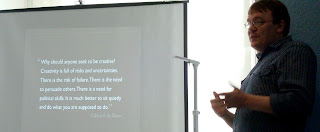
Employing Creativity by David Braziel

David Braziel took an honest look at Employing Creativity and how to encourage creativity at work and still get stuff done. A lot of us resonated with the traits of creative people – I particularly picked up on the messy desk, the fetish for stationery and being picky about layout! I also liked the idea that

Creativity = Randomness + Editing

He analogised that evolution was a strong example of creativity, with genetics providing the randomness and natural selection the editing. In business, the editing will often come from the involvement and review by other people – whether the wider team or clients.


Getting Things Done GTD by Davy Mac

Getting Things Done had been a much requested opportunity for Davy Mac to explain the basics of David Allen’s GTD approach that reverse engineers advanced common sense into a system/methodology. Like a lot of people, I’d prefer if work was less about trying to be a world class fire-fighter, and more about having the peace of mind that the right things were being done at the right time without getting into a complete pickle.

So there was talk about projects, physical actions, contexts, treeware vs electronic tools, and the reality that falling off the wagon isn’t the end of the world! But not addressing the chaos of paper and to do lists is not an option.
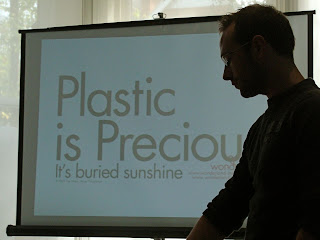
Wonderland

We briefly drifted into the Wonderland world of plastic bottles that would disappear when empty and thrown out (designed to disintegrate and decay into something life-giving rather then toxic), water purification and dresses that dissolve in water. Check out the exhibition (Q&A and workshops) that’s passing through the Ormeau Baths Gallery between 8 October and 8 November for more details.
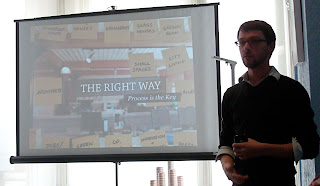
Pitch Visuals ... Jamie Neely from Front

In the final session of the morning, Jamie Neely from Front took a look at Pitch Visuals & Winning Work the Right Way. While intended to be a look at how the website pitching process works, it resonated with my experience of large-scale tendering (ITT/RFI) exercises in work over the last couple of years. Jamie is not alone in noticing that some firms have “a talent of making things look shiny” that helps win work but distracts a client’s attention from bids that are probably technically better less slickly presented.

“A shiny thing is a distraction to the relationship.”

Other advice that crossed over well into the less-webby side of the IT world included his thought on the danger of early visualisation:

“Don’t show them [the client] something they won’t get out of their minds for the next three months.”

After all, if it’s a third client, a third agency and a third end users, only one third was present when the unpaid-for design visuals (or prototypes/mock-ups) were created. Better to win work by explaining the process you’ll be following to the client, educating them about what you’ll be doing and what they’ll get to show them how you’ll understand their problem, rather than rushing in with ideas.

Lots of food for thought, and probably the best morning’s professional development in the last five or six years.


Asking questions

Lovely to meet Sharon and chat about life, home schooling, wooden trains and blogging. If you haven’t already, cast your eye across to The Voyage. And good to catch up with Davy Sims who may be did podcasting proceedings, Dave from Amuze/DigMo, Damien, Phil and others.

A big, big thank you to Andy, Mairin and the other un-conference un-organisers who did such a good job in rounding up a venue, sponsors, projectors, food and coffee!

My one big mistake of the day was pouring a hot cup of sustenance from the flask marked tea ... but on swallowing turned out to be coffee. I suppose the real mistake was not setting it down. But instead I drank it. First cup in about eight years. Yuchh. Sickly. Sore head. Feel ill.

Update: reflections on Creative Camp Belfast from attendees ...

Monday, August 04, 2008

Saturday’s often turn out to be interesting ...

Two week’s ago featured Eddie Mullan’s Podcasting workshop in the Waterfront, run as part of the Trans festival in conjunction with 4talent.

trans festival logo

Last week followed up with a Writing for Film workshop, talking about the basics of short film plots, storylines, plot narratives, plot points, the climax, the resolution. (The Trans website suggests that Vincent Kinnaird is running a repeat session in the Waterfront on 9 August.)

A couple of weeks ago at the animation training offered by the good people at NI Screen to the Tech Camp leaders had started off with a quick look at film grammar, and a listen listening to a short animated. No picture first time through. Trying to figure out the location, the characters and the action based on auditory clues alone. A really interesting way to get underneath the skin of a film.

The equivalent exercise at the Trans/4talent workshop was to do a read through of a short film’s script. Getting a feel for the storyline, figuring out the various plot points, and sensing the symmetry before watching the finished product.

It was really interesting. And despite being a non-writer of fiction (the blog’s not made up!) working along with Bob we managed to dream up a plausible plot for a short film inside twenty minutes and made a pretty good 70 second pitch of our idea. (And the more I think about it, the more I’d like to see the story developed and made!)

Oh, and there was an unexpected vicarage tea party ... a tea party, complete with cucumber sandwiches, lots of cake, and fruit punch, in the back garden of a vicar’s house. Quaint, yet delightful.

This Saturday’s excitement could have been breakfast at Sainsburys. Or the fun as Littl’un looked approvingly and climbed into her car seat in the back of the Aygo for the first time. (No more sitting in the front passenger seat of the two-seat Smart!)

But rather, the highlight of this Saturday was finding myself sitting behind at the side of the sound desk for a wedding. Sitting behind the sound desk wasn’t that exciting – though it has been a while, and sideways-on mixing (desk at right angles to the pew) really is a recipe for disaster. But there’s always something in the air at a wedding. A feeling of expectation. Couples in various states of union sitting in the rows facing the front, thinking about their pasts, presents and futures.

I hadn’t realised before the different shades of fake tan – can be scarily deep – and this year’s trend for strapless dresses is pretty strong – though I’m not sure I have the shoulders.!

Wedding

The bride was a mere 25 minutes late, accompanied by the usual flotilla of bridesmaids and a film crew – one person with a camera, tripod and a backpack of tapes. Watch out for Stags and Brides appearing on BBC NI in the autumn (?), reliving the wedding preparations, parties, ceremonies and receptions.

Hats off to the Park Avenue Hotel for their great meal on Saturday night. Good soup and beef tha fell apart at the slightest threat of being cut into by a knife.

But all this Saturday excitement has distracted from the crucial task of clearing up the junk, paper, boxes and spaghetti cables in the study, and getting sorted out for Tech Camp.

Next Saturday, it’ll be the family and friends BBQ at the close of camp to showcase the campers’ work ... and the clear up to lug all our gear back home again! And the joy of getting home to catch up with family, my own bed, and mealtimes without dishes for eleven people!

Sunday, July 27, 2008

Editing audio ... Why can't Audacity be more like video editing software?

About ten years ago, you could have found me sitting behind the sound desk at the back of a church, where recordings of services were made available on tapes for those housebound (or just unable to make it out that morning).

Getting a decent master tape to duplicate was a bit of an art. No point including three minutes of ambient coughing while the collection is taken, or the entire minute of banging and shuffling while the kids go out to Junior Church half way through the service. So a bit of careful pausing and (when remembered) un-pausing.

The end of side 1 of the C95 cassettes we used always seemed to coincide with some crucial bit of the sermon (as opposed to a throw away line) and if you misjudged the little dance of hitting Stop-Eject-turn the tape-Rec-Play - there was no auto-reverse button on the deck! - you could lose the main point and make a nonsense of the whole thing.

Sony MZ-R30 MiniDisc recorder

So I tended to record the whole service onto a MiniDisc as backup.

I came across my original MD MZ-R30 player recently while tidying up the study - and it started the train of thought behind this post.

The MD capture was great, as the MZ-R30 could automatically break the recording into tracks as it went along. Two seconds or more of silence and it would make a new track. So it was pretty fast to skip through the service afterwards, and a piece of cake to label (or title) some of the tracks to mark the start of songs and sections of the service to make mid-edit navigation even faster.

Splitting tracks with too much trailing/leading silence was simple, and then deleting the unwanted gaps. And easy to chose a suitable sentence to end side 1 and turn the tape.

The only downside of a week when I had to revert to using the MD backup was having to go back and re-record the master tape from it in real time to go off for duplication.

Now whether a church service, a podcast or a radio show, editing in chunks is what you want. Self-contained packages of content that can be moved around, cropped, shortened and if necessary reordered.

So why is it that tools like Audacity (and I think Garageband - though I've less experience and could be wrong) make editing audio so cumbersome? Insisting on (or defaulting to) a single loooong track of sound, navigation is lousy, labelling is difficult, and everything seems to take five times as long as it did on a handheld MD recorder ten years ago.

Example of storyboard within video editing software

Surely the storyboard metaphor used in video editing software is what audio editors need too? Something to compartmentalise content and decompose it into more manageable chunks? And then once the smaller pieces are refined, and sound effects added in the appropriate places, the timeline can be brought back for final finishing?

Maybe I've got it all wrong and am missing the features and usability of the audio tools? If so, I'm sure you'll not be slow to correct and enlighten me! Or maybe you'll agree that when it comes to editing audio that lasts longer than 10 minutes, we're poorly served by the software available.

Saturday, September 01, 2007

Belfast Flickr meetup - social networking, in real life

A gaggle of Belfast Flickr Group members in Belfast

There is a lot of stuff written in the press, even the more serious end of the market, doubting the value of social networking and highlighting the paper electron-thin relationships that it supports.

And I’ll not deny that there’s a whole of truth in many of those arguments and articles.

Yet when I think about it, the modern workplace (at least mine) quite often reflects the kind of social networking relationships that are so easily criticised. Working as part of international teams, with people spread over two or three continents at a time, we don’t always see a lot of each other. While we might talk regularly on the phone, over the last ten years or so I’ve worked with off-shore developers and designers who I’ve never actually met, or only met six or twelve months into a project. Yet these relationships are meaningful ... we verbally celebrate each other’s marriages, births, holidays, and mark the sadder occasions too.

Sounds a bit like the local blogging scene? I’ve exchanged comments and emails with quite a few folk, and am aware that some must live within a quarter a mile of me. In fact, one even works in the same building. But I’ve only ever met one or two.

So it was fun this afternoon to step out of the security and anonymity of the Alan in Belfast buddy icon, and meet up with some folk in the Belfast Flickr group, who Red Mum had organised to gather in Custom House Square at 2pm.

St Anne's Cathedral - with spike

Would we recognise each other? Of course. The ones carrying cameras instead of skateboards. Finally an excuse to get inside St Anne’s Cathedral to see the recently installed spike from the inside.

(In case you’ve only ever seen it from the outside, it doesn’t go all the way down to the ground. Instead, it’s stops just a few metres underneath the roof ... an impossibly balanced spike resting in the middle of a glass window.)

St Anne's Cathedral - the spike from the inside Getting a picture of the spike inside St Anne's Cathedral

Now the area directly under the spire may have been cordoned off, but with a big of scurrying around, we got the shots we wanted! Jett - must have helped that the Cathedral staff were fans of Just of Laughs!

Parkour in Belfast Writer's Square

While skateboarding became trendy again a few years ago, parkour is what the fit guys are doing around Belfast. Incredibly fit and strong, with gymnast-like moves, but no lycra in sight, these guys can launch themselves backwards off the nearest piece of street furniture in Writers' Square, landing securely (nearly) every time.

So social networking hit real life this afternoon. And it was good to put faces to buddy icons, real names to blog titles, and real accents and stories to the written words and pictures that get published on the internet. Maybe next time we’re wandering around Belfast or Dublin, we’ll recognise each other, and stop to say Hi! And maybe we’ll be more likely to meet up again and do a bit more social networking without hiding behind keyboards and screens. (Just cameras.)

Friday, May 25, 2007

Podcast update

Podcast Icon (c) Apple Computer, Inc

I recently caught the first of the Mark Kermode & Simon Mayo movie review vodcasts, the video version of the normal Friday afternoon movie podcast. Or in the old fashioned world, the show you can catch on your steam-powered transistor radio if you tune it to 909 kHz on its medium wave dial.

Mixing between the existing static Five Live studio webcams, and stills of the featured films’ posters. It’s a bit heavily edited, with much too frequent cutting between camera angles for my liking. The upside was seeing Mark Kermode waving his arms about as he ranted and raved.

The first show has now expired from the vodcast feed, though it has been preserved over at YouTube.

Another film podcast worth checking out is the Jett and Dr Higgins’ show – Film Talk – though it isn’t release quite as regularly as the weekly Kermode one.

A new Northern Ireland podcast has sprung up over the last couple of months. The weekly shows are still sitting on my iPod gathering dust while I get around to sampling them, so I can’t vouch for the quality. But Let me know what you think of Hit The North (they have a companion blog too)

Sunday, April 01, 2007

Recollections of the Falklands – a Telegraph podcast worth listening to

Catching up with the interesting bits of the daily Telegraph podcast (about one in four segments), I stumbled across a fascinating recollection about the Falklands War.

The ten minute piece is still available to listen to.

Ian Martin served on HMS Hermes (of which I made a poor cardboard model while at primary school—very patriotic) and describes what life was like on the aircraft carrier, packed in, hot bunking, telling jokes about the sinking of the Belgrano (which felt right at the time but now seem less appropriate), receiving post from home out of sequence! The piece features recordings of some of the HMS Hermes tannoy announcements from Rear Admiral Sandy Woodward.

Makes me wonder about how the military deal with death. Sinking the enemy’s boat is a victory, seen abstractly as the enemy’s defeat, but not thought of at the time as a series of human deaths. The death of your own countrymen is very personal and drives the war effort on.

As a child in P5, the Falklands was my first taste of big war, world scale. And it was fascinating to follow what news there was. Updates were sparse, no satellite linkups in those days. So hearing about the sinking of HMS Sheffield on Sunday 2 May is quite vivid. Sandy Woodward was somewhat of a hero.

And Max Hastings / Simon Jenkins book The Battle for the Falklands (still available to purchase) about being embedded with the Paras on the Falklands was a great find at the bookstall at a school May fair. Wikipedia explains why Hastings was a prototype for John Simpson:

“When Hastings was with the 2nd Battalion, The Parachute Regiment as part of the British press corps reporting the Falklands War, the troops were ordered to stop but Hastings received no order and walked on, becoming the first man with the Falklands Task Force to arrive in the capital, Port Stanley. He then arranged an interview with the commanding officer of the Argentine forces who had occupied the islands.”

Tuesday, January 23, 2007

2012 days to get their website sorted out - hunt the podcast!

2012 days to go until the 2012 Olympics. Start queuing now!

The London Organising Committee for the Olympic Games and Paralympic Games(LOCOG) have promised that it will be the greenest ever Olympics. And given the rate of global warming combined with the reality while it’ll be hotter we’ll not escape the rain, the grass around the London sporting sites will no doubt be a lush, verdant green.

According to the BBC News ...

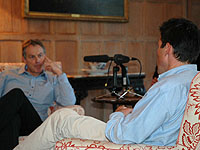
"London Olympic Organising chairman Lord Coe and Mr Blair responded to the strategy in a joint podcast."

How modern of the London organisers! But while Seb Coe and Tony Blair may have recorded an interview to let the world know about the Games green credentials, will anyone ever hear it?

After five minutes I still hadn't found it on the London 2012 website. to find it on their website. Even using the search facility (try it yourself) didn’t throw up any results.

Ah … Blair’s involved. So maybe it’s a Number 10 podcast. Strangely not part of the existing Downing Street podcast feed listed on iTunes No, not that one. But there is a news story on their awful-styled pages. Turns out it’s on a completely different feed that errors when added to iTunes!

Nicely signposted. Ummm … might have been a waste of their time to record the interview if no one can find it or listen to it.

Update: Turns out that if I’d gone straight to the 2012 blog, I could have downloaded the MP3 of the Coe/Blair interview/podcast, but no link to an RSS feed.

Reading on further down the blog, I came across Kevin Woolmer’s story. (Not that the post actually mentions his surname!) Kevin's the vicar of St Pauls - in Stratford, not the cathedral in EC4M - and the official chaplain to the construction workers building the London stadium and other venues.

Thursday, November 30, 2006

Novelty DAB Radios - Pure's Marshall Amp!

Imagine squeezing a Pure Evoke-1 DAB Radio and a small Marshall guitar amp into your microwave and set it to fizzle for 10 minutes. Ding! When you open the door, the melted fusion that will greet you (along with the noxious fumes - please don’t try this at home) will look something like the newly launched Pure Evoke-1XT Marshall DAB radio.

Complete with a button dedicated to the Planet Rock station. (Though you’ll not be able to catch that station on the Northern Ireland multiplex.)

What next? Well, the Stuff magazine podcast (variable quality) suggested that Pure could bring out a DAB radio “shaped like a book that just plays [BBC] Radio 7 and OneWord”.

Thursday, October 12, 2006

Culture (in) Northern Ireland

If you’re interesting in the local cultural scene, check out Culture Northern Ireland’s podcast (feed).

Some interesting content in the first two editions, including a quick interview with Brian Keenan in the second show.


There’s also news on the site about The Grand Opera’s House and Belfast Festival’s enhanced support for deaf and hard of hearing audiences. The the GOH extension ACT II opens in October - check out the time lapse photo show of the building works.

Sunday, July 30, 2006

BBC video podcasting - STORYFix

News this week that the BBC are going to extend their current podcasting trial into video. Around 30 programmes will be made available as video clips for download to iPods etc.

So a weekly video digest of Newsnight will now accompany the audio highlights.

One of the more interesting video podcasts on offer is STORYFix, described as

Who, when, why, and what it might have meant - the week at high velocity. Updated every Friday.

The editor Mark Barlex says it's "uniquely difficult to describe". It is short. Less than five minutes. And fast. Very fast indeed. It is just as well that it is now available as a podcast because you might need to watch it more than once. But if traditional news is not your thing, you might enjoy this.

Pick up a few new facts, probably of no use whatsoever. Have a laugh at a politician's expense. See famous presenters at moments of embarrassment. Help keep the BBC graphics department in business. STORYfix is presented by regular Emily Maitlis or the occasional guest talent, and published as a podcast on Friday evenings.


Might be worth checking out (for the first week at least).

Saturday, April 29, 2006

Podcasts to travel to

Podcast Icon (c) Apple Computer, IncSo what does Alan in Belfast listen to during the drive into work, on the plane, in the Tube or standing doing the dishes at the kitchen sink?

There’s a lot of dross around – and I still subscribe to some of it in iTunes! But some of the podcasts that rise to the top include:
  • Broadcasting House. Catch up on what happened at 10am over on Radio 4 each Sunday morning. It’s the next best to Five Live’s Sunday Service when Fi Glover presented it prior to flitting to Radio 4. [Podcast Feed]
  • Channel 4 News Podcast. A short three minute weekly snippet from Jon Snow. Often humorous , yet with a serious edge to cast a critical eye over some aspect of the world. [Podcast Feed]
  • The FT.com Podcast. I only listen to Lucy Kellaway's column, and delete the other half of the content. I’m not a regular reader of the pink paper, but Lucy often has a twisted way of viewing office politics and modern business nonsense. [Podcast Feed]
  • Latest ZDNet Podcasts. Working in the IT industry, I blast through a selection of the ZDNet podcasts every couple of weeks. Particularly good to get a flavour of what the big technology companies (Sun, Apple, BEA, Google, SAP, Intel, etc) are up to. [Podcast Feed]
  • Letter to America. Not for the faint-hearted or easily offended. A weekly window into the larger-than-life and often crisis-hit world of Jett Loe – he lives in Belfast so you don’t have to. [Podcast Feed]
  • Mark Kermode’s film reviews. Snipped straight out if Five Live’s Simon Mayo show each Friday afternoon. Listen to Mark’s film reviews on the way to London. Then go and see one of the more interesting-sounding films that night and see if you agree with his off-beat opinion. [Podcast Feed]
  • Slate Explainer Podcasts. Daily three-minute random explanation of something you didn’t know you need to be told about. Worth hearing about half the time. Tip: don’t listen to them – just scroll through the transcript that’s helpfully provided on the each podcast’s show-notes. [Podcast Feed]
  • The President’s Weekly Radio Address. The official parody of the White House’s Weekly Radio Address. Hard to differentiate from the real thing! [Podcast Feed]