Showing posts with label book. Show all posts

Sunday, October 13, 2024

2024 Belfast International Arts Festival – some theatre, dance, circus and literature treats from the 39 day programme #biaf24

The Belfast International Arts Festival is upon us, with a bumper 39 days of events, artistic experiences and exhibitions. Here are just a few of the theatre, dance and literature events from the full festival programme

The Tragedy of Richard III // Wed 16 Oct–Sun 10 Nov // Lyric Theatre // The very hotly anticipated tragic adaption of Shakespeare’s history play opens the festival. Adapted by talented duo Oisín Kearney (who also directs) and Michael Patrick (who stars as Richard III in some shows), it explores the hunger for power of the disabled brother of the King even in the face of certain death. With a lead actor who was diagnosed with motor neurone disease last year playing the lead role and manoeuvring around the stage in a series of ever more elaborate wheelchairs, and Deaf actor Paula Clarke playing the chief villain Tyrell communicating with Richard through sign language and gesture, it’s an ambitious production that takes an old story and promises to give it purpose for modern times with a vivid staging. You can catch an interview with Oisín and Michael on last Friday’s The Ticket (starts 29’16) that will whet your appetite. [reviewed]

Yerma // Thu 17 Oct–Sun 3 Nov // Lyric Theatre // A few feet away from Richard III you can find Tinderbox Theatre Company’s adaptation of Spanish poet and dramatist Federico García Lorca’s Yerma in the Lyric’s studio space. The story about a childless woman living in rural Spain has been shifted to rural Ireland. The set is novel, the characterisaton is tight, This imaginative reset of the story is rich and intriguing. However, the runtime exceeds some audience members’ bladders, triggering disruptive coming and going in the stalls. (Maybe not an artistic priority, but still a practical one that is worth considering.) The set with its crazy entrances and exits is novel, the reset story is compelling, and the casting – particularly Caoimhe Farren in the titular role – is excellent. [reviewed]

The Piece with the Drums // Fri 18–Sat 19 Oct // The MAC // One of the festival’s annual gifts to the city is bringing over artists and concepts that wouldn’t normally have a following or a ready audience. This production from David Bolger and CoisCéim Dance Theatre treats us to a visual and aural conversation between a dancer and percussion. Toes tapping, limbs flapping, and drums beating.

David Park // Wed 23 Oct // The Linen Hall // Novelist David Park in conversation with Hugh Odling-Smee.

Aurora: A Modern Myth // Thu 24 Oct–Sat 2 Nov // The MAC // Another highly anticipated theatre production from Prime Cut with Dominic Montague’s tale opf environmental concern and activism merging gaming technology, animation and live theatre to create a magical experience. Directed by Emma Jordan and starring Meghan Tyler, Maria Connolly, Conor O Donnell, Thomas Finnegan … and a tree. [reviewed]

North Star // Thu 24–Fri 25 Oct // The Telegraph Building // An immersive night of live music inspired by a speech given by abolitionist Frederick Douglassin Belfast in 1845. Features performances by Kaidi Tatham, Nandi Jola, Leo Miyagee, Winnie Ama, Hannah Peel, Colin Salmon, and nearly 100 pupils from four Belfast schools. Part of Belfast 2024.

Losing It & In Between // Fri 25–Sat 26 Oct // The MAC // In this double bill, Losing It explores the lingering trauma of war through movement and sound with Palestinian dancer and choreographer Samaa Wakim. How does growing up in a war zone and inheriting the pain of previous generations manifest itself in your body and your movement. And to open the show, in In Between circus performer Esam Sultan “depicts an innocent Palestinian born into a life of struggle”, dreaming of a better life, but battling against alienation and loneliness. [reviewed]

WILD // Sat 26 Oct at 13:00 and 15:15 // CS Lewis Square // Free // In recent years, the festival has brought circus into the fold and Motionhouse’s latest production places its performers on a forest made of tall scaffolding poles and platforms high up in the canopy. Described as “gravity-defying dance-circus”, head over to east Belfast to get a glimpse of the acclaimed acrobatic outdoor show.

The Vanishing Elephant // Thu 31 Oct–Sat 2 Nov // Grand Opera House // Cahoots is a theatre company with an incredible still in telling stories suitable for young and old that captivate through their sense of closeness or intimacy, fine gestures, elaborate puppets and magic. The shows are curated in a theatre environment which has an incredible control of sound and light. This latest tale from long-time collaborate Charles Way follows the paths of a boy born in Bengal who befriends an Asian elephant. Years later as an old man he hears that Houdini will vanish an elephant live on stage in New York. Expect gasps, magic and maybe even tears. [reviewed]

Granny’s Jackson’s Dead // Thu 31 Oct–Sun 2 Nov // 47 Malone Road // Big Telly Theatre Company’s favourite grandmother is getting another wake. Step into her home and pay your respects alongside her family as they remember this larger-than-life character who lives on the hearts of so many. Immersive, subversive and thought-provoking. The show premiered earlier this year in NI Science Festival and alongside the overtly theatrical elements, it gently explores our attitudes, tolerances and reaction to death, grief tech, and the ethics of loss.

Austin Duffy & Phil Harrison // Tue 5 Nov // No Alibis Bookshop // two Irish authors in discussion about their latest works, the turning points of the Troubles, and the legacy of masculinity.

Michael Longley // Wed 6 Nov // Seamus Heaney Centre // Recording and live-streaming events, I witness all kinds of performers, lecturers and events hunched behind a sound mixer and a preview screen of video feeds. One of the most memorable this year was doing sound for an academic conference in a subdued Ulster Museum art gallery as poet Michael Longley read from a selection of his work and threw in wry comments on their context. It was captivating … and I say that as someone who rarely ‘gets’ or looks forward to poetry. Longley is back, this time in conversation about his new selected poems collection Ash Keys with poet and novelist Nick Laird.

Impasse // Wed 6 Nov // The MAC // Two performers confront the biased narratives etched onto Black bodies throughout history. Considering cultural imperialism, racial projections, autonomy and self-determination. The first presentation of work in Northern Ireland by Luail, Ireland’s (new) National Dance Company.

Chicken // Wed 6–Sun 10 Nov // Lyric Theatre // A Kerry Cock shares his feathery story of getting a big break in the world of acting, winning awards, and sliding into ketamine addiction. A one woman show like no other. Expect chicken suits and clucking in this biographical tale and absurdist satire.

Lots more treats in the online festival programme.

Sunday, February 26, 2023

The Life and Times of Belfast writer Mary Beckett #looknorth23

One of the weekend’s Look North! The North Belfast Festival events assembled a panel of authors to discuss the overlooked Belfast writer Mary Beckett.

Lucy Caldwell was joined by Jan Carson and Riley Johnson to discuss the work and impact of one of Ireland’s finest writers, an award-winning author who captured the voice of ordinary women at the time. And there’s a surprise appearance by a member of Beckett’s family.

The Life & Times of Belfast writer Mary Beckett was recorded and edited by me in Ulster University on Saturday 25 February 2023.

Enjoyed this video? Why not click on the Buy Me a Tea button!

Friday, October 14, 2022

Extraordinary Times – Linen Hall Library commit to publishing a chapter a year of Rosemary Jenkinson’s border poll novel for 32 years

Given the political instability in Northern Ireland and the UK, you might well ask when are we not living through ‘extraordinary times’? (I write this as the Tory Chancellor’s plane has just done a U-turn over Surrey as it comes into land at Heathrow … he may well have joined the Former Chancellors WhatsApp group by the time you read this.)

Extraordinary Times is also the title that local author and playwright Rosemary Jenkinson has taken for her new novel set in the fortnight leading up to a future, fictional referendum on Irish unity.

We could be waiting a long time – or maybe not so long, depending on which political tea leaves you read – for an actual border poll to be called. But in the meantime, Jenkinson’s second full-length novel explores how sex interlocking individuals navigate the final throws of campaigning and get caught up in violence to disrupt the poll. And we could be waiting a long time for the final chapter of the story.

In a curious parallel with those who don’t feel that they have a proper home the north-east corner of a partitioned Ireland, Jenkinson finds herself without a home for her full-length novels. The first (A City Like No Other) was going to be printed by Doire Press, but the publisher walked away in the aftermath of Jenkinson’s scathing critique of her writing peers in Fortnight magazine and elsewhere).

Her second novel is going down the Charles Dickens’ route of being published episodically, but, true to form, with a Jenkinson twist. While the finished book is complete, locked and will not be changed, only a single new chapter will be released each year … meaning that the whole story won’t be out until 2054. (In the event of a border poll, the publication of whatever remains of the novel will be brought forward, allowing the real events to be compared with Jenkinson’s 2022 imaginings.)

The Linen Hall Library are taking on the mantle for this novel stunt of slow publishing. The library already hosts Jenkinson’s living archive, including dole letters proving that an author’s lot is not always a well renumerated one. Extraordinary Times is a small part of their digitization project that is properly integrating their digital assets with the library website. Jenkinson says:

“I’ve always chosen posterity over prosperity and am delighted therefore to unleash this living futuristic novel into the world.”

Chapter one has now gone online. In a world with an ever-shrinking attention span, it’s a bold move to eke out a 32-chapter book over such a long time. The characters David and Kyle are introduced in the first installment, so it could be a while before readers are familiar with the whole cast. Let’s hope it’s not a trend that catches on.

Saturday, February 22, 2020

Terry Brankin Has a Gun (Malachi O’Doherty, Merrion Press) – a well-spun, thoughtful tale that enjoys its foray into past times but also has some dark and critical warnings to flag up about our future

Does the world need another piece of Troubles fiction? The answer for me depends on the quality of the storytelling and whether or not a book revels in long-lost wars or tries to explore something new about our understanding of what might make Northern Ireland tick in the future.

My reading list last summer was dominated by a bedside table of such tales.

Michael Hughes’ Country takes the competitive infighting that inflicts nearly every organisation and exposes what it might have been like in the South Armagh IRA. The cleverness of echoing Homer’s Iliad is somewhat immaterial as the sheer brutality of the tale and the broken humanity at its heart is sufficient to get you turning the pages at great enough speed to become wrapped up in the story.

Someone described Anna Burns’ Booked Prize-winning Milkman to me as being “one of the most bought but least read books” that often languishes ostentatiously but unfinished on people’s shelves. It was certainly only on the third attempt that I could muster momentum to get past the early chapters. Ultimately, it was a joy to spend time in the life of middle sister as she traversed Belfast, got to know maybe-boyfriend and the older ‘milkman’. The dystopian vision of with an inner city crippled by rules, taboos, and complicated lists of who was naughty and nice, never mind the unpacking of how sexual violence sat alongside the more often talked about forms of violence and a late scene when women fight back made it a rewarding if shocking book to read.

Dave Duggan’s excellent novel Oak and Stone explores what happens when a former paramilitary joins the PSNI during a recruitment experiment and finds himself distrusted by his colleagues and many in the community as he takes advantage of his old fieldcraft to investigate complex crimes. The novel situation, strong characters, and a recognisable Derry cityscape make it a cracking read.

Finally, Jan Carson’s Firestarters was both disturbing because of the realisation that it wouldn’t take much to ignite such actions as the book describes in east Belfast during a long hot summer, but also because Carson is such a gentle, caring person in real life and it was hard to fathom how her pure mind could imagine such an evil plot and serve it wrapped up in such delicious prose. It was definitely my favourite book of 2019.

For decades, Malachi O’Doherty has been writing about life in Belfast and the impact of religion (and cycling), as well as broadcasting his opinions on local politics and events. The stories he tells at Tenx9 evenings are distinctive and often fiercely funny tales from his own life. He’s expert at measuring words, constructing rhythmic phrases whose beat enhances their metaphor.

O’Doherty’s first full-length novel Terry Brankin Has a Gun has just been published and was launched earlier this week. It’s a real page turner. The titular character joined the IRA and got his hands dirty in operations before becoming a lawyer. When the spotlight of the Cold Case team is brought to shine on an incident from his criminal past, his portfolio of rented property comes under attacked and violent threats are made against his wife.

In the blurb, Henry McDonald (whose book Two Souls is still on my list to finish) appropriately describes it as “highly filmic”. As this modern-day story of a man unable to leave the IRA behind him is gradually unravelled, each chapter reveals a little of what connects the cast of friends and associates, how they met, how they came to carry such deep scars and secrets. It’s terribly satisfying as the jigsaw pieces slot into place and tick off questions that lingered from earlier in the book.

Everyone starts off as a good person until their flaws are slowly exposed. Basil McKeague is a deeply religious (though oddly sweary) police detective whose drive to expose sin turns out to be greater than his respect for proper investigatory processes and truthtelling. Kathleen Brankin discovers to her cost that she didn’t ask her husband enough about his past. Loyalist paramilitaries are realised to have much in common with their republic counterparts.

While the motivations for people’s past decisions are wedded in the murky days of the Troubles, O’Doherty also exposes how a Cold Case review process (think HIA in 2020 legacy terms) could be derailed by societal attitudes and personal vendettas. It reminds me of David Park’s The Truth Commissioner, another cautionary tale about the destabilising potential of a truth and reconciliation process.

Radio phone-in host Nevan Toland is as beautifully crafted as top republican Dominic McGrath. Your mind will see parallels with real life figures – which makes Toland even funnier that he is written – but there is also a definite sense that these aren’t cartoon characters. O’Doherty reminds readers not to misuse stereotypes: not everyone living along the Falls Road supported the IRA back in the day.

There are some fictional sleights of hand. Information held by a public service broadcaster for purposes of journalism is exempt from Freedom of Information requests, so party leader McGrath’s idea of getting hold of his BBC obituary via an FOI is a complete non-starter. Just how McKeague knows to turn up at the Welly Park Hotel to visit Kathleen escapes me, as does why Brankin would ever talk so openly on a mobile phone knowing that his position as suspect in a major investigation would likely lead to it being tapped. And the enduring good relationship with Nools is more convenient than it is convincing. But these are minor asides.

O’Doherty exposes the duplicity of politics and political ideology, shows how fear can bind up the vulnerable until their anger overflows, demonstrates the abuse of power and religion, and reinforces the nagging doubt that it’s difficult to separate justice from truth even if there is legislation in place to do so. And he questions how very long we’ll have to wait until guns – and violence – will be absent from our narrative.

Terry Brankin Has a Gun is a well-spun, thoughtful tale that enjoys its foray into past times but also has some dark and critical warnings to flag up about our future. The creaking shelf of Troubles fiction has another tome justifiably squeezed onto it. And O’Doherty’s readers will be wondering which world the talented wordsmith will take them too in his next novel.

Tuesday, February 18, 2020

Doctor Who: The Scripts Tom Baker 1974/5 – a dip into the old ways of making classic science fiction

Peter Davison, the first fifth Doctor, is my favourite, the affection cemented by the actor’s performances in the A Very Peculiar Practice drama (which also featured two, never-explained, bin-hoking nuns who drove around a new university campus in a tiny Mini).

As a young child, I remember catching episodes of the long-scarfed Tom Baker (the fourth) on Saturday evenings while visiting my Granny in Ballymena. Picking up a copy of Doctor Who: The Scripts Tom Baker 1974/5 from his first season on the show – somewhat before my TV viewing began – it was interesting to see how both the scriptwriters, script editors and the actor himself had shaped the evolving personality of the Time Lord.

Five stories spanned the 20 episodes (each 24–25 minutes long) that made up this series, a far cry from the 50-minute standalone episodes with a loose overarching story arc that make up modern Doctor Who.

The scripts for each episode are annotated with the intended text struck out where it was replaced with (often) shorter dialogue contrived during rehearsals and filming. Two episodes were recorded every fortnight, with most of the action shot in chronological order, unless particular sets were only needed for a couple of scenes.

In an age of CGI and visual effects, the 1970s were simpler times. Fast cuts were scarce. Sets were built, but only had to stand up to the scrutiny of standard def TV sets, no HD or 4K to worry about. Scale models were built, and video footage was mixed with film.

The TARDIS materialisation/dematerialisation was achieved in camera by filming the first part of the scene with the TARDIS and its flashing light, then rolling the film back, removing the prop, and filming over it to create the illusion of fading away. Then just add a wheezing sound effect in the edit, which sometimes only seems to have been completed in the week before transmission.

While chromakey video is an everyday occurrence, particularly in TV news and weather studios, it was used – often with a yellow background – in order to superimpose models of monsters and explosions on top of real scenes. Some

Running a video storyboarding course some years ago, I used a one-minute clip from the Jon Pertwee era (The Green Death) to get the class to dissect the shots. The slow pace of storytelling and cuts meant that it was possible to sketch out the six-shot storyboard in real time!

The season featured Davros and the Daleks (sounds like a 1970’s band!) and much like the fabulous Thirteenth Doctor’s current series, finished with Revenge of the Cybermen in which the Doctor escapes his bonds with a trick he learnt from Harry Houdini and destroys the cyborgs (who are allergic to gold) just in time to race back to Earth to respond to an emergency space-time pager alert from UNIT’s Brigadier Lethbridge-Stewart.

Wednesday, January 08, 2020

The First Day by Phil Harrison – a tale of biblical knowledge, love, loss and revenge

Phil Harrison’s The First Day is a phenomenal debut novel. Immersed in a protestant evangelical world, it explores the repercussions an east Belfast mission hall pastor Samuel Orr’s passionate love affair with a younger unchurched Beckett scholar and poet Anna Stuart. It’s a setup that doesn’t seem so fanciful with the sad news this weekend from a church in Newtownards.

Initially narrated from Anna’s viewpoint before switching to the thoughts of their son some thirty years later, we watch how father of three Orr manages to rationalise his adulterous behaviour with his faith’s view on sin. Soon we also watch his inability to control the violent fallout from his fall from grace, and discover how judgement waxes and wanes in a society that only pretends to distinguish between good and evil in its most binary form. Though the gospel hall easily separates his no longer tolerable leadership with his continuing membership in a way the Presbyterian Church in Ireland’s General Assembly might find harder to swallow.
“… the way he looked at her, opened her up. The way a farmer looks at a field he’s about to plough.”

This is the second book I’ve read this year that is laced with issues of male ownership of female bodies. Harrison creates unusual similes that surprise, intrigue and often entertain, lightening the flow of reading what is at times a dark and sinister tale.

The somewhat mysterious yet warm narrator and the shifting perspectives are well crafted and don’t distract. The fact that 30 years into the future everything still seems to be the same as today is perhaps part of the books message and metaphor. Biblical text and lines from Beckett, sermon snippets and fine art criticism are melded together with beautifully written passages that describe love, lust, loss and revenge.

Harrison writes with elegance, an accessible intellect, and while Anna and Orr’s relationship has a somewhat rarefied and cinematic feel – The First Day could make a great film split across Belfast and Manhattan – there’s a pace and urgency that propelled this reader to squeeze in another ten or twenty pages before switching out the bedside light in the wee small hours of the morning.

Sunday, January 05, 2020

A Run in the Park – an all too brief treat from the pen of David Park

Having missed the first episode but listened to the next three on BBC Radio 4 catch-up on the drive down to an appointment to get stabbed in Newry – a travel vaccination administered by a Boots’ pharmacist rather than anything more sinister – I was delighted to realise that the text of David Park’s ten part series was available in print.

A Run in the Park listens in to the thoughts of some of the participants in a nine-week Couch to 5k programme. I’m shocked, nay devastated, to discover that David Park has taken part in such an exercise regime. I can only trust that this phase of getting his breath in short pants was purely for research purposes and won’t mark the abrupt change of his normal sober and sceptical sensibility that first came to my notice 12 years ago in 2008 with the publication of The Truth Commissioner!

Maurice is a widower who can’t seem to help his family but has decided to step out and tackle his weight and lethargy. Cathy is a sweet librarian who worries about her pregnant daughter in Australia. A young couple are planning a wedding but while a silver spoon was popped in Angela’s mouth shortly after birth, nurse Brendan is unsettled by the ambitious preparations. Yana is perhaps the youngest yet most experienced runner in the group who meet three times a week to train. Exercise was her escape in a sprawling refugee camp before being relocated in Northern Ireland under the UK government scheme to help Syrian families.

The metaphor of individual runners working as a team finds its way into the structure of A Run in the Park. While each episode stands alone as its own short story, they come together to create a powerful narrative about an encouraging cross-generational community, sharing goals, experiencing loss, and the healing power of touch.

It’s a short set of stories, ten internal monologues each spanning nine or ten pages. You can read it end-to-end in a couple of hours. Another one or two hundred pages could have been added to flesh out the backstories and show the reader how Park imagines it all ends. But instead, the accomplished author revels in paring back the detail and leaving every reader or listener to write their own stories for these characters.

Despite the brevity, there are still gut-wrenching scenes from chapter four onwards, and as I switched off the light last night and turned onto my soggy pillow to fall asleep, the pathos of the turmoil facing many of the central characters remained vivid as I closed by eyes. It’s a privilege to join Angela, Brendan, Cathy, Maurice and Yana as they overcome inertia and set their bodies and minds in motion. And hopefully a taster of more fully pledged titles from Park in the near future.

Wednesday, June 12, 2019

The Girl on the Train - a great adaptation and superb set mechanics deliver a modern theatrical whodunit (Grand Opera House until 15 June)

While many in the Grand Opera House audience seemed familiar with either the original novel or the film adaptation, for those of us who were coming fresh to Paula Hawkins’ plot of The Girl on the Train, we found a fabulous piece of modern whodunit theatre.

The premise is that Rachel, an alcoholic woman with an unreliable and incomplete memory, discovers that someone she has regularly seen – out of her commuter train window while it’s been stopped at points – has gone missing. The house was only a couple of doors away from where her ex-husband still lives, and in parallel with the police investigation, Rachel inveigles herself into conversations with key witnesses and associates of the missing woman.

She’s like a modern-day Miss Marple feeding the local police detective with information he couldn’t normally be expected to uncover through his traditional methods, all the while making herself look more and more like the chief suspect as she weaves an ever larger and more complicated web of deceit.

Jack Knowles’ lighting is precise and Andrzej Goudling’s projections subtly animate the dark space and create an impressive representation of a moving railway carriage. The train theme is kept running with some of the James Cotterill’s detailed sets moving onto the stage as if on rails. Scenes flick between locations with a speed and lack of fuss that many other productions could learn from: it’s often as fast as turning a page. Kirsty Oswald appears on stage as the missing woman in flashbacks, with an elegant costume which slowly fades to black as we speed towards her character’s dark end.

Samantha Womack is convincing in her role as the subdued and through-other titular character. As Rachel reduces her alcohol intake, Womack becomes noticeably less clumsy and more stable. John Dougall triggers much levity with his dry wit as DI Gaskill. Naeem Hayat (the therapist), Adam Jackson-Smith (Rachel’s ex-husband) and Oliver Farnworth (the missing woman’s boyfriend) bring a hint of menace and uncertainty to their less-than-perfect characters.

Superb set mechanics and lighting add to the air of mystery and keep the plot speeding down the tracks in this modern theatrical thriller. If you haven’t read the book or watched the film, The Girl on the Train is still an attractive and enjoyable drama that will keep your brain second guessing all the way through to the reveal near the end.

Just make sure you silence your phone if you do attend. This evening’s first half was interrupted by the Top Gun theme music erupting in the front circle while after the interval another phone interrupted a crucial scene (the actor froze and waited very patiently).

The Girl on the Train continues in the Grand Opera House until Saturday 15 June.

Production shots: Manuel Harlan

Friday, October 19, 2018

Chapter & Verse - discovering the artist VerseChorusVerse through prose and song #BelFest2018

Tony Wright walks onto the stage wearing his trademark hat, carrying a guitar case and pulling a suitcase behind him. A solo musician needs to become a seasoned traveller in order to survive nomadic touring schedules and grabbing gigs were destiny offers them.
“I wrote a book. I get bored. You spend a lot of time by yourself when you’re a solo musician.”
Chapter and Verse is a bit of a departure for the artist known as VerseChorusVerse. He’s more used to stepping up to the mic to sing, yet his ebullient nature can also carry an audience with excerpts from his recently published memoir Chapter & Verse(ChorusVerse) which is packed full of stories about being out on the road for twenty years. [Update - now vailable on Kindle (at £5 for a limited period)]

Dressed in black and with a mop of ginger hair that beautifully tones in with the wood of his guitar, he peppers stories from his networking trip to the US with songs from his back catalogue.

As we move across New York, Nashville and Napa – a networking tour brought to us by the letter ‘N’! – we are entertained by his erudite recollections people and places, with dramatic readings interrupted by his riffing on the written word and extra commentary. If the music ever dries up, Wright’s voice would be a gift for the audiobook industry.

As each anecdote ends he heads back to his guitar and gifts the sold-out Belfast International Arts Festival audience at The MAC (including one man who’s come all the way from Belgium) with another song. The biggest fans mouth along with the words; the newest fans shake their heads – in a good way – as his voice shifts from a whisper to a guttural rasp and then to powerful growls. Who needs a backing band when your larynx can accompany your guitar-picking fingers. That’s what the punters at the New York SideWalk Café open mic night discovered.

The mix of stories and songs is a bit like listening to really well-constructed album, full of good tracks that together add up to something greater; in this case, a better understanding of the artist pacing up and down in front of us. As the reverb for his final Shakedown Sally dies down the audience realise that we have heard a performer who not only grasps every chance he’s given but appreciates them, who has a pair of high capacity lungs hidden behind his guitar, and who can still pull of a Mid Ulster drawl.

Tony Wright is currently artist in residence at The MAC. Hopefully he’ll return to its stage before long. In the meantime, you can catch Chapter & Verse as he heads out on tour with his solo memoir show across Northern Ireland. If you spot a guy with a hat, guitar and suitcase at the bus stop or train station, say hello: you’ll have found a great travelling companion … though you may end up in the next book!
  • 2 November – Waterside Theatre, Derry
  • 4 November – Seamus Heaney HomePlace
  • 8 November – Theatre at the Mill, Newtownabbey
  • 9 November – Down Arts Centre, Downpatrick
  • 10 November – Riverside Theatre, Coleraine
  • 22 November – Sean Hollywood Arts Centre, Newry
  • 23 November – Island Arts Centre, Lisburn
  • 1 February 2019 – Market Place Theatre, Armagh


Wednesday, June 06, 2018

Belfast Book Festival – alt-right, autonomy, autism, football and politics (6-16 June) #belfastbook

Belfast Book Festival has begun, bringing 11 days of literific talks, readings and entertainment in the annual celebration of all things bookish.

The opening day gives a flavour of the breadth of the festival: Q Radio’s Stephen Clements looking back on childhood memories, war time campaign history from John Kiszely, local author Bernie McGill whose new book is set on Rathlin Island, an evening of Refugee Tales and an interview with Alastair Campbell.

Some highlights from the rest of the festival …

Thursday 7 June

Diarist, author and former-politician Chris Mullin is speaking about his new autobiography Hinterland in The Crescent at 6.30pm.

Friday 8 June

Kathy D’Arcy will read a selection of stories, poems, memoirs and essays from the book Autonomy she compiled and edited to explore people’s experience of being forced to stay pregnant against their will. The Crescent at 6pm.

I’ve a very short list of poets whose work I can bear to engage with. Performance poet David Brazil has a secure place on that list and will be taking part in an evening of spoken word – Hymn to the Reckless – in The Crescent at 9pm.

Saturday 9 June

It was only in her twenties that Emily Reynolds was diagnosed as bipolar. Reading from her “blackly funny, deeply compassionate and extremely practical” book A Beginner’s Guide to Losing Your Mind she discusses living with mental illness, dealing with it and understanding it. The Crescent at 6pm.

Sunday 10 June

Michael Walker’s Green Shoots examines why we (still) have two football associations on the island. It promises to be an engrossing account of the inside stories, dramas and dreams of the game in Ireland and a definitive history of a footballing nation and its many paradoxes. Strand Arts Centre at 11am.

Huw Kingston spent 12 months circumnavigating the Mediterranean, travelling 13,000km in a sea kayak, an ocean rowboat, on bike and by foot. Mediterranean – A year around a charmed and troubled sea tells the story of the physicality, the landscapes and the humanity he encountered in his journey to fundraise for Save the Children’s programmes with children affected by the crisis in Syria. The Crescent at 3pm.

Monday 11 June

Two authors address autism. Laura Jones wrote Odd Girl Out about her reaction to diagnosis in her mid-forties. Jessie Hewitson wrote the book she wished she would have been able to read when her son was given an ASD diagnosis. Personal, practical, inspiring and enriching. The Crescent at 6pm.

Tuesday 12 June

Join Lucy Collins, Maria McManus, Nessa O’Mahony and the HIVE Choir as they look back on women’s representation in literature and sound, from suffrage to the present. Who is silent? Who speaks? Who is listening? What is said? What is unsaid? What is heard? What happens in the space between? The Crescent at 6pm.

Wednesday 13 June

Mike Wendling is an editor at BBC Trending and has spent years covering extremism and internet culture for radio, online and television, and is author of Alt-Right: From 4chan to the White House. He’ll be joined by Elizabeth Nelson Gorman to analyse the movement that was prominent during Trump’s presidential campaign. The Crescent at 8pm.

Friday 15 June

John Lennox will be in conversation with Stephen Shaw about Cosmic Chemistry: Do God and Science Mix? Fisherwick Presbyterian Church at 8pm.

The full Belfast Book Festival programme is available online.

Wednesday, January 27, 2016

18th Belfast Children's Festival (4-9 March) - Ali FitzGibbon looks back over her time at Young at Art

Belfast Children’s Festival 2016 runs from 4 to 9 March and its programme (PDF) was launched at lunchtime today.
“Going to a theatre performance, going to an exhibition, taking part in a workshop, sends people on a journey that shows them that the world can be other than as it is.”

Festival director Ali FitzGibbon explained to me that Central Station was an appropriate venue for the launch since it’s the hosting the interactive I Think I Can (via Australia’s Terrapin Puppet Company and the Ulster Model Railway Club), inviting audiences to inhabit a miniature town and become active members of its tiny community. Watch out for the diminutive antics being reported in an online newspaper during the festival. I Think I Can is free and runs for the duration of the festival (8 years +).


The festival programme brings together international artists (Swiss Vorstadt Theater’s Bambi 4-5 March/8 years + and two clown shows from Norwegian Katja Lindeburg on 8 and 9 March) as well as performances from local companies like Replay Theatre’s fantastically named Snoozle & the Lullabugs (4-6 March for under 5s with profound and multiple learning difficulties or severe learning difficulties) and Maiden Voyage Dance’s Pause & Effect (5-8 March/4-8 years).

You can hear from authors and illustrators like Marie Louise Fitzpatrick (5 March/4-7 years) and Sheena Wilkinson (6 March/11 years+), Doodle Live in the Strand (5 March/7-10 years) and check out the portable Library of Stories (5-6 March) written by children and young people.

The Office of Important Art has relocated upstairs to the first floor of Castlecourt this year (opposite Costa coffee shop) and will host local artist David Turner’s autobiographical Ordinary Extraordinary images.

And don’t miss the Baby Rave (6 March/0-4 years) or the live bands at Pre-Teenage Kicks (6 March/8-teens).

- - -


Interviewed about the development of the Belfast Children’s Festival over past years, Ali FitzGibbon acknowledged that “there have always been artists who make good work for children in Northern Ireland”.
“There have always been really passionate and really dedicated people who create projects that work with children. What the Festival does is puts [this] into a very large international scale. It’s certainly put Northern Ireland on the map over the last 18 years.”

Ali explained that they consciously “use the Festival as a showcase and platform for local artists”.
“There are many people who have been working with children in Northern Ireland for many, many years who have received opportunities to travel and to have their work internationally recognised as a result of being in the Festival.

“I think people can trip off the tongue that ‘this is an international festival’ very easily. Children learn diversity. Children learn difference. They don’t start thinking ‘that person is different from me’. We’re very interested in what happens when you introduce children to the idea that other people see the world differently because they’re in – or from – an other part of the world.”

This year sees artists from Switzerland, Norway and Australia coming to the Festival.
“Children don’t have a lot of the inhibitions that adults have. They are very open to quite abstract and complex concepts of narratives and stories and themes of human emotion. They’re instinctive audience members and instinctive artists and participants. As we grow up we tend to start to code everything and say ‘that goes in that pigeonhole’ and we come up with responses.”

While adult-orientated festivals may find it difficult to build audiences for contemporary dance, this genre sells out at the Children’s Festival.
“Families and schools now understand that dance is a really interesting way to communicate with children. Dance is an amazingly powerful art form and children respond to it and talk about it. They see signals in the performance that they can take back into their home and back into their classrooms and discuss with their parents and their teachers afterwards.”

Baby Rave is a festival stalwart, a fun-filled disco for babies and parents with non-stop music, colourful visuals, soft materials and sensory toys. Ali explained:
“Baby Rave is my baby.

“In my second festival in 2005 we could see that we have people coming to us with four and five year olds and we couldn’t find anything we could use to bring in that younger age group. I had a very young child at the time and was trying to see what as a parent would I want? I wanted something very free style, very sensory … The Baby Rave comes from that.

“What we didn’t realise when I first brought a team together to make it was that nobody had done a baby rave. Subsequently we got to travel round the world doing Baby Rave.

“We were the fastest selling act in the Adelaide Fringe Festival in 2007. We sold out in thirty seconds. The youngest we’ve ever had was 5 days old … You get young couples, lots of first time parents coming along and they really engage with its dancing, its visuals, its design and its really well selected music. It’s really informal and people can come in and out in the course of an hour … That gets people with us who haven’t come across us before and they stay with us on a journey.

“The festival goes up notionally to fourteen years old. So we now have the first baby ravers beginning to get too old for the festival. My big challenge is who’s responsibility is that to take over and what provision is there for 14+ because there’s a finite limit to what one small charitable organisation can do. And what I do know as a parent … is that fourteen year olds don’t want to hang out with four year olds unless they’re getting paid!”

(Outside of the festival, Young at Art work with young people all the way up to the age of 18.)

The public subsidy of arts organisations and events is sometimes criticised whenever there is fight back against cuts to cultural funding.
“The most expensive we have in the festival this year is something like £13. There are a huge number of free events. We have Big Festival Days Out – a new programme we’re running – which is about trying to get people to see some of the great venues we have: The MAC, the Lyric, the Strand and the Duncairn Arts Centre. Most of what’s going to happen in those spaces is going to be free of charge. For the whole of the week of the festival we have exhibitions on, [for instance] David Turner’s amazing toy exhibition in Castlecourt.

“If we introduce charges every single person who took part in something for the Festival would have to pay about £30. We know that people are struggling and a lot of families are under pressure.

“We also know that there isn’t a habit of going to arts events with your children [other than panto] … These experiences are the stuff of lifetime memories. I still have ten and eleven year olds come up to me at the Festival and they talk to me about things they saw when they were three years old …”

Ali will shortly step down from Young at Art after twelve years. Her most memorable highlights included Land of Giants, a collaborative community project in the Waterworks Park (that may have dyed the duckpond in the process!), as well as the ongoing Fighting Words project.

She perceives “a tendency [in the public sector] towards short term pressures versus long term investment” adding that “nobody in the arts sector is looking for handouts … but what Young at Art is looking for is some realistic investment” that values and delivers cultural experiences.
“In Northern Ireland we are way behind where cultural provision could and should be for children. If anything there’s a spreading-the-butter-very-thin approach which says that every child will have some element of experience and there’s not enough time being spent looking at the quality and duration of the experience, what kind of support they get within the school system and the youth sector.

“As an organisation we’ve had two or three of the most challenging years we’ve had in eighteen years. And it’s a sad thing when you look at an 18 year old organisation that has been on an upward trend, that has been growing and growing [but] last year because of the in year cuts we saw our numbers roll back a bit for the first time, largely because the free events had to be cut or bringing an international show costs a certain amount of money and if we don’t have that money in the kitty and can’t offset it with ticket sales then it doesn’t come.”

As an organisation, Young at Art don’t just look for public sector funding. Ali explained that “all the education programmes are financed through private trusts and donations”. Corporate sponsors are involved too, including Translink Castlecourt, Belfast Harbour and Easons.

Ten years ago, Young at Art’s board of directors came to the decision that “survival was not good enough”.
“Keeping in business is not worthy of merit. Keeping the doors open when so many people are on the brink of closing their doors is not good enough. You have to be good. You have to be good for your audiences. You have to know what’s coming up on the horizon. You have to see how your audiences are evolving. You have to see who’s not coming and try to find ways of making sure that they come. You have to be able to articulate purpose. And if you don’t do that, then you shouldn’t be doing it.”

Thursday, April 30, 2015

Cathedral Quarter Arts Festival (30 April-10 May): music, theatre, dance, talks and cultural sunshine

The sun is shining, the marquee is up, and the 16th Cathedral Quarter Arts Festival is ready to rock’n’roll, dance, talk, entertain and challenge in venues across the city of Belfast until the 10 May.

This year’s CQAF programme has a particularly strong list of theatrical performances.

What lengths will some people go to in order to pull themselves out of dire straits? Lanciatore – The Juggling Man is a credit crunch-hit Medieval Italy street performer trying to negotiate loan sharks, card games, priests, prostitutes and bailiffs to get his family out of the red.

Based on Paul Kennedy’s dark comic script, Rawlife Theatre Company directors Martin McSharry and Patrick J O'Reilly are joined by a fantastic local cast – Roisin Gallagher, Terrance Keely, Michael Liebmann, Julie McCann, Jo Donnelly and Claire Connor – in Belfast Circus School at 8pm between Thursday 7 May and Sunday 10 May. Tickets £12.50. Don’t miss it. PS: After CQAF finishes it's back on Friday 15, Saturday 16 and Sunday 17 May at 8pm in the same venue.


Check out the promo video for Lanciatore and get your tickets booked!
Posted by Rawlife Theatre Company on Wednesday, 29 April 2015


The Dutiful Wife is a new piece of high energy immersive dance theatre looking at the role of ‘the wife’ in politics through the initial highs and later public humiliation of ‘Stepford Wives’ who often suffer the immense personal pain when a charismatic crowd-wooing male politician goes off the moral rails.

An innovative and well-scheduled piece in the run up to Thursday 7th's election, The Dutiful Wife is the brainchild of choreographer Eileen McClory (interviewed below) and performed by Off The Rails Dance company in The MAC on Friday 1 and Saturday 2 May (8.30pm) and Sunday 3 May (3pm and 6pm). Tickets £10. As an unfunded company, they're also crowdfunding support for the costs of performances.


Prepare to be individually admitted to a hospital bed and using eye masks and headphones experience being Reassembled, Slightly Askew. Novel storytelling based on writer Shannon Yee’s experience of falling critically ill with a rare brain infection and her journey through rehabilitation and living with an acquired brain injury. Running in The MAC at 11am, 2pm and 4.30pm and 7pm between 30 April and 5 May. Tickets £10. SOLD OUT.

Three Strikes sees Belfast’s “shiniest and best lubricated” theatre company Shot Glass as they bring three short comic plays out of the theatre and into the pub. The Dark Horse at 8pm on Monday 4 and Tuesday 5 May. Tickets £5.

Other highlights from this year’s bulging CQAF programme

Saturday 2 May

Dramatisation of George Orwell’s social inequality classic Down and Out in Paris and London. Join the characters as they go from “a sepia tinted view of poverty in Paris to the more black and white existence in and around London” in 101 The Redeemer (101 Donegall Street) at 8pm. Tickets £10.

Sunday 3 May

Queen of the psychological thriller Val McDermid will speak about how her crime writing means she’s Killing People for Fun and Profit in The Black Box at 2pm. Tickets £8.

Described as “whimsical and witty, weird and wacky”, The Kiss of the Chicken King is a multi-media performance monologue as Jimmy sits in his rundown 1980s bedsit and escapes from jingoism and Thatcherism into his fantasy and imagination. The Black Box Green Room at 3pm. Tickets £5.

Join New York-based post-religious Reverend Billy and & The Stop Shopping Choir in The Black Box Green Room at 7pm as the “planet criers, gospel shouters and punk disrupters” pursue “the mysterious catalyst that ignites collect knowledge and collective will”. Tickets £6.

Lucy Porter wonders “whether she’d rather be a bewhiskered Victorian explorer, a 1920s Hollywood starlet or Hatshepsut the Egyptian Pharaoh in Me Time in The Black Box at 8pm. Tickets £10.

Monday 4 May

Having moved from Australia to London, comedian Bec Hill wrote a show about how she had never won an award. But the whole premise was ruined when the show won one at the 2014 Edinburgh Fringe! The comic, animator and comic creator brings her new show In…Ellipsis to McHugh’s at 8pm. Tickets £8.

Join Kitty (Áine Ryan) for a dark and devastating evening as she sits alone in her kitchen mourning the loss of her brother while her father lies dying in the room next door and she waits for her late (time challenged, not dead!) boyfriend to pick her up for an evening out. Shocking and witty. Kitty in the Lane is in The Black Box Green Room at 7.30pm. Tickets £6.

Wednesday 6 May

Martin Rowson was the first in a long list of cartoonist and caricaturists who’ve failed to be satisfied with the image they’ve captured of me! He’ll being romping through “a 32,000 year old history of visual satire … the power of giving and taking offence” in a timely lunchtime talk in The Black Box at 1pm. Tickets £6.

Expect comedy as well as social and political commentary when Andrew Maxwell takes to the stage of the Festival Marquee at 8pm. Tickets £12/£10.

Thursday 7 May

Owen McCafferty’s play Mojo Mickybo is back to tell another generation about two boys growing up in 1970s Belfast, one from ‘up the road’ and the other fro ‘over the bridge’. 101 The Redeemer (101 Donegall Street) at 8pm. Tickets £8.

Saturday 9 May

Join your host John Lindsay for a morning of 1970s and 1980s classic Saturday morning children’s TV in the Belfast Film Festival’s Bean Bag Cinema at 10am. Tickets £4.

Sunday 10 May

When your only visitors are squirrels and getting rid of them becomes an obsession then maybe it’s time to look at what’s really going on. Phoenix Nights’ Janice Connolly brings Barbara Nice and hew show Squirrel Proof to The Black Box at 2pm. Tickets £7.

The Hackney Colliery Band is east London’s unique take on the brass band and having played at the closing ceremony of the London 2012 Olympics, they’re now bringing their acoustic mix of “funk, hip-hop and high-octane rock” to Aether & Echo at 8pm. Tickets £8.

This year Open Source is no longer constrained by four walls and will run its free hour-long sessions around The Big Table on Lower Garfield Street (outside PLACE and Aether & Echo) for a weekend of activity looking at “The Love Economy – Cooperative Alternatives to Free Market Economics”. Their website now lists the full programme of volunteer-led events.

Wednesday, April 29, 2015

Catch David Park in conversation with Bernard MacLaverty at Linen Hall Writers on Writers Festival

The Linen Hall Writers on Writers Festival is running from 13-16 May with discussions and workshops on all manner of writers and writing topics.

One highlight that jumps out from the programme is the In Conversation with Bernard MacLaverty & David Park on Wednesday 13 May at 6pm. (Tickets are free, but advance booking advised.)

I grew up with MacLaverty books on the shelves at home, and read Cal numerous times as a teenager (though there are lots more novels Lamb, Grace Notes, The Anatomy School and short stories to choose from).

David Park's novel The Truth Commissioner was the first book anyone sent me as a blogger and the plot's challenges about the cost of truth are still apt for a Northern Ireland that has failed to start any process to deal with its past. A film adaptation is currently filming in Belfast.


Check the Events section of the Linen Hall Library for other festival events.

Wednesday, April 08, 2015

Danny Morrison’s "West Belfast": a coming of age novel set against the backdrop of a city in conflict

I grew up hearing Danny Morrison’s name on the radio at breakfast time as Sinn Féin’s Director of Publicity. More recently I’ve known him as chair of Féile an Phobail and spotted his attendance at many of the festival’s events in St Mary’s and the annual West Belfast Talks Back debate. But I’d never realised he was an author until his book (re)launch earlier this year at the end of January.

Spread over a decade, West Belfast is a coming of age story of John O’Neill growing up around the Falls against the backdrop of the civil rights movement, heightening tensions and the start of the Troubles. As well as watching John fall in love, move jobs, and explore the world, readers follow John as he deals with his inner tension, at first distancing himself from what was going on in his community before deciding to become involved.
A strange sort of a fella … I used to think he couldn’t open his mouth. Very quiet. But he’s grown up now … Good looking and kind. Maybe a bit too serious.
That’s how John’s girlfriend Angela described him early on in their relationship. It’s the age of Saturday night dances and cozying up to the sound of the Beatles.

After his first experiences of discrimination in a low wage job at an Ormeau Road engineering firm, John got work as a galley-boy on ships out of Belfast, before shifting to bigger trans-Atlantic vessels and becoming a trade union official. Returning to Belfast between crossings, John noticed the changes in his area:
They were no longer the British Army but were now called “the Brits”. Confrontations were regular and people complained that the soldiers were worse than the RUC, assaulting young people and firing tear gas into streets at any pretext.
John began smuggling weapons from Montreal back to Liverpool and onto Belfast, and quickly became more involved with the IRA.

While the story is told through a republican lens, the novel doesn’t overly glorify violence or set the IRA up as heroes. Instead the author finds humanity and dignity in unexpected places and allows for the complexity of characters’ motives adapting as the situation around them changes.

The book describes a familiar slip from innocence into activism, personal tragedy, and portrays the chaos of fast-moving events like the Divis Street riots. The chapter that relives the experience of “The Hooded Men”, tortured and thrown out of an army helicopter that the men didn’t know was hovering just above the ground, is a gruelling read.

Angela’s tale is gentler and provides a good counterbalance to John’s descent into violence. Yet her life too is affected by the changing vibe in Belfast and necessitates a rapid flit to England before eventually returning home to be reacquainted with old friends.

Early on the text is thick with landmarks and street names, nearly trying too hard to root the narrative in its real location. The storytelling adopts a mixture of styles and the plot switches between characters, even spending a chapter inside the mind of an IRA sniper at work.

It was a couple of years before Danny Morrison told anyone that he’d started to write a novel. Soon after West Belfast was published in 1989 he was arrested and imprisoned. (The conviction was overturned in 2008.) “He wasn’t around to do much publicity” novelist and playwright Ronan Bennett explained at the launch of the novel’s new 2015 edition.

Originally typed up on his 512k Amstrad computer, when Danny came back to republish his first novel it didn’t exist in digital format. So he scanned it in, fixed the spellings, and realised that back in the 1980s he had often used three words rather than one. So although this latest edition has the same story, same characters, the same beginning, middle and end, the text has been tightened up and apparently some of the more embarrassing sex scenes have been removed.

While not strictly history, Danny Morrison’s novel captures the spirit and some of the events of a time not long before I was born. At times an uncomfortable read, over two hundred pages it develops a sense of people and place that will long stick in my mind. If you’re looking for a book that clearly identifies the goodies and the baddies, move along the shelf. But if you’re keen to explore the complexity of conflict and how it shapes lives, West Belfast opens an insider’s window into Irish republicanism.

West Belfast is published by Elsinor Press, priced £10 and available from Amazon, Sinn Féin’s Falls Road bookshop or direct the author’s website.

Thursday, January 15, 2015

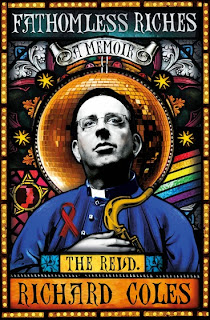
Fathomless Riches - a very public confession from Rev Richard Coles

Fathomless Riches (Or How I Went From Pop To Pulpit) is Rev Richard Coles’ no holds barred public confession. From the early pages through to the end, it’s a shocking book as Coles candidly reveals the hedonistic behaviour and lifestyle that dominated his late teens, twenties and thirties.

Now a parish priest and radio presenter, Coles documents his upbringing and gravely disappointing O-level results at a fee-paying school before transferring to drama school and finding a growing confidence in his sexual identity as well as his first steps in a lasting relationship with drugs.

His musical talent with saxophone and keyboards led to his involvement with band Bronski Beat before forming The Communards with Jimmy Sommerville in 1984, achieving chart success with Don’t Leave Me This Way, touring, partying, arguing and beginning the long slide towards the band’s split in 1988.

While not conscious of it at the time, Coles was often surfing the cultural zeitgeist and throughout the book there are references to familiar events and people. The film Pride and play Pits and Perverts reminded 2014 audiences about the Lesbians and Gays Support the Miners movement formed during the Miners’ Strike which left a lasting legacy within the TUC and Labour Party of treating lesbian and gay rights as equality issues. Bronski Beat played a benefit concert for LGSM. Later in the book there’s a photo of Coles staying over at Hillsborough Castle as the guest of Secretary of State Mo Mowlan. A few years later he conducted her funeral.

Amongst the music and partying, about a third of the way through the book a terrible sadness descends as Auntie Ada came to visit and AIDS killed many of Coles friends and acquaintances. The sense of loss, and hopelessness is overwhelming. Chapter after chapter, close friends are infected with HIV and die.
This was to be a common experience over the next few years, meeting in a dead man’s flat for the distribution of their effects, or the concealment of things which needed to be concealed from their families, and sometimes, most awkwardly, negotiating funeral arrangements with a middle–aged couple who had only just learned that their son was gay in time for him to die.

The Communards’ success with their first album was not easily replicated and Coles admits to being jealous that “Jimmy got more attention than me, more credit than me”. Despite staying in larger and larger hotel suites and travelling with an expansive entourage, Coles “sulked about being ignored in interviews” and “hated it that when I was signing an autograph the fan would see [Jimmy Sommerville] and pull their book from my hands leaving a zigzag of biro where my name should be”. Sickness caused Coles to worry about his own health.
… I got a message to call the doctor. ‘Good news,’ he said, ‘I have your test results. They came back negative.’ And that is how I became the only person ever to be disappointed to hear he was not HIV positive.

Having jumped the gun and told colleagues and friends that he was HIV positive, Coles lived with the lie. “I was treated more considerately than I had been and it did mean I now had a leading role in the drama.” Years later he swallowed his pride and made humiliating confessions.

Drug abuse and his ability to fund it took over Coles’ life, while presenting on Radio 3 and some musical commissions kept him in work.

Choral Evensong in Edinburgh and a visit to York Minster (in which he “went in a tourist but came out a participant”) reignited his childhood Anglican experiences and led to a serious flirtation with becoming a monk and a wobbly walk along the Anglo-Catholic tightrope in which he signed up for a theology degree from Kings College London, crossed over to Catholicism, before returning to train for ordained ministry at the Anglican College of the Resurrection at Mirfield in West Yorkshire.

Coles reserves his harshest judgements for himself. While many friends and co-conspirators are named throughout the book, some blushes are spared with enough anonymity granted to shield identities. His honesty and frankness extends to his feelings for the college at Mirfield, calling out the bullying from the year above and his disappointment at the behaviour he and other students experienced.
I don't think I really believed in evil until I went to Mirfield.

Ouch! While his entry into ministry has been unconventional, the emotions, experiences and talents that he brings to his calling are clearly usable by the church.

Romantically, Coles suffered from sustained sadness with his interest and lustful notions not being consistently returned by many of the people he longed for. That frustration extends to institutions as well as people.
I love the BBC. I love the Church of England. But it is not wise to love organisations because they do not love you back. They do what organisations do, sometimes close ranks, lie, betray, disappoint, take you out at dawn and shoot you. All institutions are demonic, a cleric once observed, but the ones that have the clearest sense of their own high calling are most vulnerable to demonic activity. I support it is because where aspirations are high and reach is limited there’s plenty of room of disappointment and frustration to play out and that can curdle one’s feelings for a place.

Coles enjoys the fine things of life. His stint in The Communards has left him with a ‘pension’ that allows him to book into the best hotels, enjoy fine food, wine and clothes. While he has the capacity to appreciate what he can afford, and while he’s happy in the company of those who don’t share his tastes, some of the later anecdotes in the book left this reader with the hope that he discovers freedom in reining in some of these excesses and rediscovers a little of his monastic leanings.

Fathomless Riches was a great Christmas present. Its author’s honesty and ability to shock and sadden makes it an engrossing read. Throughout the darkness there is thread of hope; hope imbued with faith that ultimately ends with Coles’ sense of peace in his new vocation.

Ultimately I hope that Coles will write a follow-up memoir, starting off with settling into parish life of Finedon in Northamptonshire and carrying on to document his journey through ministry, civil partnership and beyond. While he knows “second albums are notoriously difficult”, his capacity to tell a story deserves another outing.