Showing posts with label space. Show all posts

Saturday, September 27, 2025

Secrets of Space – wonder and perspective, music and maybe even a wee tear (Cahoots NI at Cityside Retail Park until Sunday 28 September)

Cahoots NI have turned their base in Cityside Retail Park into a theatre space with a rich programme of shows running between now and Christmas. There’s no permanent children’s theatre venue in Belfast although the city is blessed with a children’s festival and theatre makers with international reputations like Cahoots NI and Replay Theatre.

Down at Cityside, The Musicians of Bremen Live! will get its local premiere at the end of October along with the world premiere of magician Caolan McBride’s Unlocking Sherlock full of deduction and deception, all part of Belfast International Arts Festival. And then throughout December, audiences can step inside The Secret Bookshop and discover the mystery, mayhem and magic inside.

Before then, Cahoots NI’s Secrets of Space is back. I caught its first run back in 2019 and it was a delight this week to once again be enchanted by its most recent incarnation.

Teenage Mae lives in Tennessee and has spent a month each summer visiting her cousin Suni in Belfast. The pair are space mad, and over the years, Suni’s bedroom has become a collection of model rockets, telescopes and even an international space station.

Philippa O’Hara (Suni) and Kellee Broadway (Mae) giggle, tease each other, and get on like the best friends they are portraying. They make the Earth rotate around the Sun, discuss the planets in our solar system (much to the delight of young space geeks in the audience), and voice the mission control commentary counting down the Apollo 11 launch that would first land humans on the moon. By the end they are – somewhat ambitiously – explaining travelling at the speed of light and the effect on time.

There are so many moments that create a sense of wonder and perspective – there’s a song with the lyric “I saw the whole world breathing … like one living thing” – that may bring a tear to your eye. And none more so that Suni and Mae harmonising along with Chris Hadfield’s reworked version of Space Oddity which he recorded while up on the International Space Station (and which David Bowie described as “possibly the most poignant version of the song ever created”). The easy blend of O’Hara and Broadway’s voices throughout the hour-long performance adds to the spellbinding nature of the show.

Charles Way’s script is full of gentle education about the concepts fundamental to astronomy and space travel. A whole host of creative input then brings the ideas to life through song (musical director Peter J McCauley), intricate props (Diana Ennis), video wonders on the circular screen (BNL) and artistic director Paul Bosco Mc Eneaney’s ability to leave audiences young and old wondering – often out loud – “how did they do that?” Children’s theatre benefits from repetition and it’s beautifully woven into Way’s script which introduces concepts that the show will then return to. “Nothing lasts forever” say the girls, but the 60 minutes spent experiencing the show feel very short.

Elegant effects and tricks are performed so casually that they hide the hours of planning and rehearsal to get them tight. The shadow effect while ‘walking’ behind the LED wall is dropped in without any need for fanfare. A silent motor moves the sun up and down with pinpoint accuracy. Gravity is explained, and then its absence is demonstrated with Suni effortlessly floating into space (cue some of the audience humming Defying Gravity from Wicked into themselves). And I’m delighted that the dinosaurs still come, and then go with a flick of a hand into a box of many tricks.

Suitable for children from the age of seven and over, Secrets of Space is a production made in Belfast that has toured internationally. If sitting with a grin on your face at the end of a performance is a sign of quality and success, then don’t miss this chance to see it in Belfast before it inevitably jets off to far flung places. And sit near the front to catch the astounding detail in the miniature prop that finishes the show.

Appreciated this review? Why not click on the Buy Me a Tea button! 

Tuesday, October 20, 2020

The University of Wonder and Imagination – a magical journey through time and space – Cahoots NI as part of #BIAL20

Different Northern Ireland theatre companies have different traits that often pop up in their work. Paul Bosco Mc Eneaney infuses his company’s work with magic, surprises, slick stage management, and a great control of light and sound. And in these socially distanced times, he’s managed not to let go of his secret ingredients to create an experience that goes far beyond what would be expected online through the sometimes tired medium of Zoom.

The University of Wonder and Imagination plays to deliberately small audiences – six remote devices/families at a time – involving everyone in the journey through time and space. The show relies on a variety of close magic, predictions and wonder as we zoom around the underground rooms of the underground teaching bunker, with a feeling of control over our destiny, where we go, and what we do.

Sean Kearns inducts every new cohort into the performance, while Lata Sharma floats around Armagh’s Robinson Library (neatly grounding the show for Northern Ireland audiences) and gets us to note down various numbers and shapes for use later on. Then it’s up to magic-fingered mathematically-savvy Caolan McBride to wow us with his numbers, musical astronomer Philippa O’Hara to send us off around the solar system at the speed of light, and Hugh W Brown to finish the show with some pleasant thoughts about a mid-term break somewhere sunny.

The usual approach to online theatre, particularly performances that are aimed at entertaining families and children, is to be incredibly high-energy and include lots of actions. Cahoots NI manage to avoid the need for a sugar rush frenzy, replacing it with intrigue, wonder and amazement. The cast don’t try to be larger than life or shouty. Instead, rich costumes that stand out against the often sometimes physical backdrops (not everything is green screened) help bring the characters to life. And the small numbers in each show mean there’s lots of name-checking and unmuting families to pick numbers and direct the next part of the show.

Looking through a screen undoubtedly takes away from the intimacy of breathing the same air as on-stage performers. The spine-tingling moments of a show like Secrets of Space can’t quite be reproduced over the interwebs. But Cahoots have made a wise decision to go with a bespoke magical variety show rather than one that overly relies on plot. Intelligent choices given the constraints of the medium. Where they stand out from other companies and have created something that can play to homes around the world from their Belfast base is the high production values (acted in a studio environment with good internet and reliable sound, not cast’s bedrooms) and the investment in real-time visual effects (the joins between live and prerecorded segments are pretty seamless unless you know where to look) and Garth McConaghie’s backing track that captures another sense.

Northern Ireland has proved quite pioneering in pushing the innovation cycle in the emerging market for Zoom theatre. With this show, Cahoots take another step up the ladder with something that is very transferable to any English-speaking market, with no flicking between windows or rooms, yet several shows overlapping in behind-the-scenes to get more bums on seats.

The University of Wonder and Imagination is playing this week as part of Belfast International Arts Festival before touring living rooms in Ireland and beyond. Tickets are charged at £20 per screen (which a whole family can sit behind) and there is still some availability. Sit down, relax and be amazed at what is possible which technicians, magicians and actors let their minds run wild with ambition.

Friday, October 04, 2019

Secrets of Space: an intimate show about the infinity of space (ages 7+, Cahoots NI in The MAC until 13 October + tour)

Cahoots NI latest show keeps their trademark sense of awe and wonder, yet uses it in a much more educational application in Secrets of Space. Essentially two sisters grow up obsessed by the mystery of the planets and stars, and the thrill of spaceflight.

They’re curious explorers, who open up the heavens to reveal that li’l ole Earth is in fact part of this great space around us. The universe does not revolve around humankind … though humans do orbit the Earth once every 92 minutes, and the pair sing along with one such astronaut on the International Space Station at the midpoint of this rather delightful hour-long show.

Younger children (aged 7+) in the audience seemed to be fascinated by the models and the interaction with the animated backdrop. Older children (their parents, aunts, uncles and middle-aged reviewers) marvelled at the intricacy of the props – the smoking chimney near the end is a beautiful touch – and the seemingly trivial way that technology interacts with the physical throughout the show. And the adults definitely enjoy the nods to the science fiction shows of yesteryear.

Real-life sisters Jolene (who has an engineering degree) and Philippa O’Hara (they perform together as The Songbirds) play Suni and Mae. The siblings talk, sing and play, though the songs take a relative back seat to the factoids and astrophysics. Well-rehearsed sequences with complex cues are performed under very controlled lighting, with a little magic added, all the while explaining the concepts of gravity and time-travel in scientifically robust yet repeatable ways.

The child beside me probably wasn’t the only audience member to loudly whisper “how did they do that?” as the show progressed.

Nearly four years ago I interviewed European astronaut Jean-François Clervoy over the phone. The a veteran of three Space Shuttle missions was a guest on the Russian Mir Space Station for a week. and he explained that despite the hundreds of movies available:
“… the most favourite activity of most astronauts is to look out the window, to look at the Earth … The thing I will remember the most from my spaceflights at the end of my life will be the earth seen from space … When you look at the Earth it looks really unique, isolated, finite. When you see it with your own eyes it’s beautiful, you’ve tears in your eyes …”
I’ll confess now to tearing up as he spoke about the view from the space station. He was being reflective rather than bragging when he mentioned “the moon reflecting on the Ganges over Nepal”, adding “I’ve seen that”.

This show manages to make space emotional, which is a phenomenal achievement given Cahoots’ normally softer subjects of magicians and illusionists, penguins and characters from children’s books. I forgot to suppress a little yelp of delight as a dinosaur ‘went’ down into its box. It was only the first of so many lovely moments in the show.

Directed by Paul Bosco Mc Eneaney, who co-wrote the show with Charles Way, Secrets of Space puts the ‘A’ firmly into STEAM without diluting the subject matter’s integrity. And it quietly emphasises the leading roles of women and encourages female participation without making a song and dance out of it.

For me, what makes this production stand out from standard scientific educational fare is the way that Cahoots blend creativity, technology and information together into a seamless package. In front of the black backdrop sit three screens. That’s normally enough to put fear into a reviewer’s pen. But these ones float in mid-air. They enhance rather than distract. (And they’re incredibly high definition when compared with more commonplace LED video walls.)

Secrets of Space is full of wonder and imagination. It’s intimate yet it presents a universe of infinite possibility. It runs in The MAC until Sunday 13 October, before touring through Ennis (Wednesday 16), Dún Laoghaire (Sunday 20), Sligo (Monday 21–Tuesday 22), Armagh (Thursday 24) and Omagh (Thursday 31).

Monday, July 01, 2019

Apollo 11 – letting the first manned mission to the moon tell its own story (QFT until 11 July)


The 50th anniversary of the Apollo 11 mission to the Moon is just weeks away. While I’m not old enough to have been alive when lunar module Eagle touched down on the Moon’s surface, NASA’s space flights were the focus of displays and exhibits at childhood visits to Armagh Planetarium.

There’s no single authoritative and complete account of the mission. Last year’s First Man provided a window into the character of test pilot and astronaut Neil Armstrong. Nineteen years ago, The Dish told the quirky story of how pictures from the mission were beamed – or nearly, not beamed – around the Earth.

In recent weeks, it has been fun to dip into BBC World Service’s 13 Minutes to the Moon podcast which uses the final descent as its hook to explore hair-raising moments on that voyage as well as the build-up to the mission over the previous decade. Recommended listening.

Todd Douglas Miller’s documentary Apollo 11 constrains itself to the period of the launch until the crew arrive back on Earth and sit out 18 long days in quarantine. Never guilty of under-documenting anything, NASA’s film footage from numerous angles in the launch and mission control rooms and from the Saturn rocket, command and lunar modules is combined with the 30-track tapes of voice recordings.

There are no distracting talking heads. No looking back through halcyon spectacles. The complexity and significance of the mission is allowed to speak for itself. Split screen effects allow different perspectives to be compared. Simple graphics signify increasing speed and convey where we are in the timeline.

As we walk through the stages of the mission, Matt Morton’s excellent sound track provides the only external interference, setting a sense of tension and manipulating emotion as it pumps out booming heartbeats during the launch, and piano/string sequences as the Eagle heads back to dock with Columbia. The crew’s portable tape player supplies John Stewart’s Mother Country and the extraordinarily-apt lyric “just a lot of people doing the best they could”.

Rows of men (reckoned to be just one woman among 500 men) dressed in white shirts and ties (except a few extroverts with a sense of occasion wearing bowties) sit behind banks of warning lights, green on black monitors and sensor printers. Audience chests tighten and the cinema barely seems to breathe as we discover the three astronauts are being strapped into the rocket while a couple of engineers use wrenches to fix a leak somewhere below them on the huge structure.

Moments of mission audio jump out, phrases like Buzz Aldrin’s expressive comment “magnificent desolation” and his alter understatement “it’s been a long day”, as well as Neil Armstrong speaking of the “symbol of the insatiable curiosity of all mankind to explore the unknown”.

Apollo 11 offers a fresh look at a well-understood space mission. The over-familiar stock of photography is replaced with multiple angles of moving images from inside the heart of the mission, some of the footage being used for the first time.

There’s no subtitling, conveying the sense of sometimes garbled audio links that left experts on the ground fitting incomplete information together to understand the mission status. The panicky significance of the 1201 and 1202 program alarms flagged up during the lunar descent is somewhat lost to the inexpert cinema audience who are watching in real time. Armstrong’s manual search for a safe landing place is the subject of a quick discussion after they are safely landed.

In some ways, the hype-less Apollo 11 film underplays the drama of the mission. The filmmakers trust that the implicit danger and the obvious dedication of the NASA staff and Apollo crew are sufficient to carry the 93 minute film. Their bet pays off with a documentary that still enthrals and excites.

Apollo 11 is being screened in Queen’s Film Theatre as well as Dundonald Omniplex.

Tuesday, May 07, 2019

High Life – taboo-ridden, hell-bound sci-fi tale of reproductive genetics and inhumanity (QFT from 10 May)

Director Claire Denis eschews the normal space vistas and shiny white sets to examine the worst sides of humanity as a set of prisoners head off on permanent day release towards a black hole in a dingy craft that looks like something Blue Peter might have created.

Living anything but the titular High Life, the prisoners are granted a second chance to escape long prison sentences to adventure into space on a mission that plans to harness the energy of a black hole. However, the ship’s doctor has a second plan, to harvest sperm and experiment with reproduction against the backdrop of dangerous levels of radiation.

Told in a non-linear fashion, the story begins with Monte (Robert Pattinson) maintaining the ship and tending to the needs of a toddler whose screams create discomfort in the otherwise lonely environs. Slowly, the fate of other crew members and the genesis of the child are revealed. Stuart Staples’ score staples the switches of scene and time together, perhaps the only beautiful aspect of the film.

Juliette Binoche plays Dr Dibs as a sensuous siren with waist-length hair and some unorthodox methods of collecting sperm samples. When two ships dock you’re left in no doubt that they’re mating together. Flying into a black hole sounds a lot like labour. The ship’s pleasure ‘box’ adds to the sleaziness (way more explicit that Woody Allen’s ‘orgasmatron’ in Sleeper, establishing Dibs’ sexual tension and guaranteeing the film’s 18 rating, while a violent sexual assault furthers the screenwriters’ premise that sexual desire and a thirst for satisfaction is at the basest end of both humanity and inhumanity, surviving depression and certain death.
“What do you know about cruelty?”
Playing the calmest and most collected character on board space ship ‘7’, Pattinson is rugged and resilient, with Monte never visibly aging throughout the 15 or so years period covered by the film. Without Pattinson’s sense of control and perspective, High Life could have descended even further into its black hole of depravity.

While the budget may have been small – with a small set and brief exterior model shots – the ambition for High Life was large, though I’m not sure it was fully achieved over its 113 minutes. The ending faces the same issues Soderburgh’s version of Solaris (2002), and yet avoids the nearly-happily after ever fate of Sunshine (2007).

Given the rules around how long young children can remain on set, it’s very unusual to have such a young cast member. We watch little Willow grow up and are left wondering what her ‘normal’ will be given the circumstances of her birth and life. Yet there is a paradox to the reproductive experiment at the heart of the plot: since the mission has little expectation of surviving the black hole, and has not had much success by the time the vessel arrives in its vicinity, Dr Dibs’ research is nearly as vacuous as the space she’s travelling as there will be no new Adam and Eve to propagate if they survive to the other side.

Aside from the changing aspect ratios at various moments of the film – which feel ragged rather than artistic – High Life is an amazing piece of filmmaking. The flashbacks are never accidental, woven tightly into the unravelling story. It doesn’t need Alien’s monsters to uncover the evil on-board the ship. But ultimately the film’s subject matter is taboo, human rights-busting and frequently vile and violent, this hell-bound spacecraft is too much like life on earth to be enjoyable.

High Life will be screened in Queen’s Film Theatre from Friday 10 May.


Thursday, December 10, 2015

Sleeping on the ceiling, staring at the Earth and what goes through your mind before launch? ESA's Jean-François Clervoy speaking ahead of Tim Peake's launch to ISS

Reposted from Slugger O'Toole ...

- - -

The little Osborne book of Space was well thumbed. Details of Russian and American space missions, orbiting the Earth, trips to the moon, and promises of a reusable Space Shuttle. Trips to the Armagh Planetarium and seeing the low res images being transmitted from weather satellites. I remember the first Shuttle launch being delayed ...

Ahead of Tim Peake’s launch at 11.03am on Tuesday 15 December from the Baikonur cosmodrome in Kazakhstan and rendezvous with the International Space Station, I spoke to veteran European astronaut Jean-François Clervoy. He’ll be the special guest on Tuesday at W5 in Belfast as part of a day of events at the science centre and Armagh Planetarium with the UK Space Agency to mark the start of the Principia Mission and the first British astronaut in space for over twenty years.

If you want to find out more about space nutrition and how space research affects local food production, find out how planes and rockets fly, as well as Jean-François Clervoy your own question, check out the details from W5 [PDF] and Armagh Planetarium. This year’s NI Science Festival (18-28 February) is themed around space technology and exploration and some events and tickets have already been launched.


Jean-François Clervoy flew on three Space Shuttle Missions in the 1990s. I asked him what goes through an astronauts head in the days running up to a launch?
Astronauts focus on their task they have to do at the time of take off, the checks in the cockpit, the proper donning of the flight suit. The flight itself – although it’s a fantastic event and experience in a lifetime – but psychologically we’re prepared months in advance so what’s happening on the 15th December is normal in Tim Peake’s life because that’s what he’s been preparing for for seven months …

The day of launch, usually you are full of serenity, you feel very at ease intellectually and mentally because you know that you’ve done everything that you had to do and you’re just thinking calmly about the extraordinary experience you’re going to have. So when it comes really close to walking to the rocket you feel excited because you’ve done everything you needed to do and you feel you’re ready – and people are telling you that you’re ready and the launcher is ready – and then when you sit in the capsule and you wait for the launch control centre to do the various checks then for ten to thirty minutes you have periods where you have nothing to do. Then you can let your mind float thinking about what you’re going to leave, thinking about your family. But you feel very serene because you are doing things that at this time of your life are just normal. You’ve been working on it for months. If just before going to the rocket someone tells you “sorry, we have to cancel the flight” or “we have to delay for one month because of a technical detail” then you would feel frustrated.
Tim Peake will be docking with the International Space Station. On one of your three Shuttle trips, you docked with the Russian Mir Space Station and stayed for a week. What will be the first thing he notices when the airlock opens?
He may likely feel a slightly different smell as the environment is not the same as in the Soyuz capsule … That will not be a disturbance that will attract his attention or priority.

The first feeling is meeting humans in space that have been there for some time. You met them several months before during your training and you feel happy – it’s like a [reunion] of your family. You get so close to your crew mates because you know you’re going to share something so unique, so extra-terrestrial, so extraordinary that you build up family links between crew members.

Joining with them in space is quite special because you know they’re happy to see you – “it’s nice to get visits” is what the Russians used to tell us when we went to Mir – and you know that you will be able to count on them to help you when it is your first flight.

You’ll not be totally at ease: where are things? where to put things? how to be efficient for basic logistic tasks? Usually we are very well trained for sophisticated tasks like space walks and robotics, activating complex scientific experiments, but for the daily activities – putting your clothing in the trash, getting the food out, cleaning, getting the vacuum cleaner out … These are things you don’t spend time training because it’s very basic. You just need practice …

When Clervoy was in space, he was relatively isolated from family and friends, there to do a job for 7-10 days and then come home. There will be a lot of pressure on Tim Peake to be communicating about what he’s doing while he’s in space working.
On the short duration missions even now the timeline of our agenda is so packed that we have only a chance once every week to do a real time Skype chat with family, but we have daily email synchronisation. On my missions [1994, 1997, 1999] we could do email. There were two or three synchronisations per day. From the [International] Space Station it’s almost like in the office in terms of connectivity. You can tweet, you can go through your email anytime, you can phone any phone number in the world starting by the country code, anytime, without receiving any bill! Some astronauts call their family every day for three minutes to [talk] about basic things; some prefer to wait once or twice a week for a longer period.

But in terms of feeling connected with family, it’s not as restricted as before. I have friends from the ISS who were calling their family about a problem in the house, seeing if the plumber did the right job. In terms of isolation, I think Tim will not feel that. He will see the Earth and he will be able to communicate anytime he wants with the Earth – of course, anytime within his spare time – you have one minute here and there in-between different activities.

Especially for Europeans who are from different member states of the European Space Agency they have some pressure to accept to do video conference with VIPs, with ministers, to report regularly, to use Twitter. It is relatively easy on a long duration space mission (six months) there is more free time. We know the rhythm that was imposed on the crews of the Space Shuttle is not acceptable for more than two or three weeks because you then get too tired. The number one priority for astronauts on long duration missions is to have enough sleep time!
What about sleeping in zero gravity? Light sleep inducing pills are available if you’re still awake two hours after bedtime but most astronauts don’t take those pills for long.
[Some astronauts] attach a pillow with a band to their forehead, keeping it pressing on the back of their head. It floats, which doesn’t help to rest the head – your head is at the same place whether you have a pillow or not – but they like to feel their head pressuring on the pillow.

Sleeping bags are relatively comfortable now. You can attach it in the four corners with bungees or strings to anywhere. Personally I used to sleep on the ceiling. That was quite fun!
Clervoy says that the ISS astronauts “don’t complain any more about the food”.
Life is nice. On board, their weekends are free. There is some housekeeping to do at the weekends, and some astronauts dedicate their free time for optional outreach activities – they record videos for kids and schools – but they have seven hours of free time on Saturdays and Sundays because we try to mimic the typical work week on Earth.

They exercise a lot, around one and a half hours a day dedicated to exercise, aerobic and anaerobic … Some come back from flight in better physical shape in terms of muscle than on the ground because they were not exercising that much before. But that’s quite rare: most of the time there is some atrophy of muscles.

There is a variety of activity: work on the computer, work on scientific experiments, operational work with rendezvous docking, spacewalks, robotics, some leisure activity, listening to music, watching movies (they have hundreds of DVDs on board) but the most favourite activity of most astronauts is to look out the window, to look at the Earth, at the sky. This is probably what marks the life of an astronaut forever the most from spaceflight. The thing I will remember the most from my spaceflights at the end of my life will be the earth seen from space.
Does that truly change your perspective on Earth when you return? Are astronauts different because you have seen the Earth from the outside … and you judge its problems and its crises differently because you’ve had that perspective?
I don’t think a spaceflight changes who you are. It definitely changes your perspective on Earth, the way you think about the Earth because first you see it on the background of the deep blackness of the cosmos. You don’t see stars unless you do something to see the stars. I know astronauts who forgot to see stars from space! To see stars you need to be in an orientation where the Sun and the Earth are not in the field of view and switch off all the lights in the environment where you are in the space ship and let your eyes adapt and then it’s marvellous. The stars don’t twinkle and you perceive very well their colour. They’re very crisp. You see the colour of nebulae with your naked eye. It’s fantastic.

When you look at the Earth it looks really unique, isolated, finite. When you see it with your own eyes it’s beautiful, you’ve tears in your eyes. Even if you are the most experienced commander like Matt Kowalski in the movie Gravity, three times in the movie you hear or you see the guy who has done it all – the commander who is over everything and this is his last mission – three times during the movie he says “Wow!” and the other one asks “What happened?” “You should see the moon reflecting on the Ganges over Nepal”. I’ve seen that.

You see the Earth and you become like a child totally impressed by the beauty of the planet because it is beautiful, it’s contrasted, it is alive. And uniquely from space for the first time in your life from space the field of view carries your vision beyond 2,500km around. You see far around. And what you see in that field of view evolves very fast. After ten minutes it’s all different. You cross the whole field of view that you see in less than ten minutes.

And what you see is beautiful. You see colours of phytoplankton blooming in the French Polynesia, you see glaciers, you see desserts, you see tropical forests, all this one minute after another. You go around in one and a half hours, so sixteen world tours a day. Every 45 minutes the sun sets or the sun rises. You see winter colours, all white, for 45 minutes when you fly over the north hemisphere, and the next 45 minutes you are above the south hemisphere where it’s the opposite season.
Do you dream about looking out the window looking down at Earth?
Oh yes. And I have plenty of movies and pictures from my flights. Sometimes I open my photo book and I look at that and I say “is this me who saw that in my life?” It is so extra-terrestrial in terms of sensorial experience that you feel it was in another life. You need to think concretely intellectually about it and the you remember, yes, it was me that did that. You have changes in your body, you see things that you’ve never seen before, you exchange with colleagues that you’ve never exchanged with before: it’s a totally different experience in terms of sensory, intellectual, and even spiritual experience.
Clervoy admitted that he’d love to be the one returning to the ISS. He was party of the ‘jury’ that selected Tim (who scored the best marks in his training and beat the Americans in Nasa’s underwater expedition training exercise).
He’s really a top guy and I would really enjoy flying with him. I would go with him eyes closed. This what I told the jury. There were looking at me: “what do you think?”

“That guy, I would fly with him anytime in space, I would take him with me anytime in space”.
High praise for the man who Clervoy describes as “the ideal astronaut”.

You can follow Tim Peake's progress on his blog, on Twitter @astro_timpeake and watch the launch and rendezvous/docking online.

Saturday, April 05, 2014

Sepideh - a starry eyed teenager whose stubborn pursuit of her dream to study the heavens is an inspiration

Sepideh – Reaching for the Stars is a beautiful film about a very special teenager who has a passion for astronomy.

Teacher Mr Kabari runs an astronomy club for boys and girls and started to build an observatory on a hill just outside the town, 800km south of Tehran. But with support not forthcoming from the Ministry of Education the buildings were never finished and instead Sepideh lugs her 14 inch telescope up to observe the constellations.

He believes in expanding girls’ minds so they know that “the world does not end at the end of the street, or the end of the block, or the town’s edge”.

Sepideh’s late night trips up to study the stars are viewed with suspicion by neighbours and family. While her mother covers for her absences from family meetups and wedding parties, she is torn between appreciating Sepideh’s drive to excel, and wanting a traditional route into adulthood for her daughter.
“Those who have learnt to cook – what have they become?” asks Sepideh.

Her father is dead, and her uncles have not gone out of their way to take responsibility and stand in his place to help her mother. The field inherited from her dead husband is the only source of income. Yet the men in the wider family have blocked the repair of the water well. While all their fields around are lush green with produce, Sepideh’s mother’s field is brown and barren.

While astronomy is her passion, the peace and tranquillity found in the open space and time outdoors is also a vent for Sepideh’s frustration. Her entry to a prestigious Kharazmi Project that could have granted her a free place in university was outright rejected.


She’s not easily defeated or deflated. Mr Kabari may have spent 20 years not getting assistance from the Minister of Education, but Sepideh’s gets their support to buy a larger 16 inch telescope and accessories. Jokingly the official asks if she can guarantee to find a new supernova with it. She replies that she will, but can’t say how long it will take.

Despite Mr Kabari’s reassurances that famous historic astronomers didn’t have an easy time – it was 400 years after Galileo’s death that the Catholic church changed their minds about his discoveries – he too ends up trying to selfishly constrain Sepideh’s plans and prospects.

Aged 18 and nearing the end of school, Sepideh receives a marriage proposal from an older man in the Astronomy Club. He studied astronomy, has a PhD, works for the local municipality and is supportive of Sepideh’s dream. Her teacher believes that engagement and marriage will divert her attention away from the stars to more earth-bound distractions. And when she comes to Mr Kabari to explain that she needs to move on from amateur astronomy to study it more seriously at college, he conspires to clip Sepideh’s wings and expresses how let down he feels that she won’t he around as a role model for the younger students in his club.

It is heart-breaking. One of the early heroes of the film exposes his feet of clay.

One of the film’s devices are letters that Sepideh writes to “Mr Einstein” in her diary. But it was on the back of an email sent by Sepideh that she received a phone call from the first astronaut of Iranian descent Anousheh Ansari who paid to spend eight days on the International Space Station in September 2006. And by the end of the film we see Sepideh meeting Anousheh in Dubai and read in the closing titles that the astronaut is going to guide this inspirational Iranian women through her studies.

The film Danish director Berit Madsen explained to Wall Street Journal’s Barbara Chai that the intervention of Anousheh was unexpected:
Q: Did you know that Anousheh Ansari would befriend Sepideh and support her, when you began filming?

A: No, not at all. It was a surprise. Actually, that’s why it kept taking so long to finish the film. It was already done before all this happened about Anousheh. We had finished the shooting, even the ending. Which of course now is different. It was new and made me hurry back to Iran and see what was going to happen. The last scene is shot in Dubai a year ago, and that was the first time I talked with Anousheh.

While some scenes feel unnatural and staged to summarise developments and drive the story forward, this afternoon’s screening in the Queens Film Theatre on the closing day of Belfast Film Festival was a very encouraging story of hope, a zeal for learning and a yearning to make a difference. I wasn’t alone shedding a tear or two during the film.

It is well worth seeing this film if it is playing in at a festival near you or is being screened on general release this summer. We need more girls (and boys) around the world like Sepideh who can dream big and dream long. And we need parents and teachers and adults to mentor young people and help them fulfil their potential.

Tuesday, December 03, 2013

Dame Jocelyn Bell Burnell: an unsung hero of Belfast ... and deserving of a statue

I don't normally post sponsored infographics. Every month I get one or two emails from companies who are wanting to boost their SEO and brand awareness through some charts that are vaguely related to their business. However, Jurys Inns (they have a hotel in Belfast!) have created a list of Unsung Belfast Heroes which includes Dame Jocelyn Bell Burnell, an astrophysicist and past pupil of Lurgan College. They explain:
A Northern Irish astrophysicist (Belfast born), Dame Jocelyn Bell Burnell discovered the first radio pulsars while under her thesis supervisor. This discovery resulted in her supervisor Anthony Hewish, and Martin Ryle sharing a Nobel Prize in Physics. The omission of Bell Burnell from the prize sparked outrage and has been a point of controversy ever since as she not only found the initial anomaly, but also reviewed and reported on as much as 96ft of paper data per night, even against Hewish's scepticism.

Despite helping to build the four-acre radio telescope and being omitted from the discovery, Bell Burnell stated that Nobel Prizes would be demeaned if they were awarded to research students unless in very exceptional cases, which she deemed that hers was not. However, many institutions awarded her recognition for the discovery and she continued to rise in her career serving as the president of the Institute of Physics for two years.

Bell Burnell attended Lurgan College where she was one of the first girls permitted to study science in place of subjects such as cross-stitching and cooking.

You can hear a little of her story in her TEDxStormont talk earlier this year.


You can also watch clips of her explaining pulsars, listen to her discussing being a woman in the scientific community, and listen to her Desert Island Discs! On a BBC News Channel HARDtalk programme she explained:
I have discovered that even if you do describe it as an injustice you can do incredibly well out of not getting a Nobel Prize.
What a great success and role-model for Belfast City Council to celebrate with freedom of the city and a statue?

And the infographic ...

Belfast Unsung Heroes Infographic by Belfast Jurys Inn
Unsung Heroes of Belfast, by The Belfast Jurys Inn Hotel

Sunday, December 09, 2012

Sir Patrick Moore


As a teenager I remember hearing Sir Patrick Moore delivering a talk one evening at Queen’s University. My memory is that he was speaking about mapping the moon, illustrated with slides of his own photographs of craters and the moon’s landscape.

My strongerer memory is that there was a loud bang in the middle of the lecture, which turned out to be the sound of an explosion at the side of the City Hall. Sad how so many events in Northern Ireland can be associated with a terrorist attack that took place about the same time.

Proudly eccentric, yet clearly expert in his field, Sir Patrick Moore communicated his love for space and science with passion and enthusiasm. He could convey complicated facts to amateur viewers and listeners in a way that was both engaging and accurate without watering the truth down to bland watered-down science. A character big enough that The Sky At Night has survived years of cuts at the BBC and remaining on air. And let's not forget his role in the show Gamesmaster!

What I hadn’t realised until today was that he had been director of the new Armagh Planetarium between 1965 to 1968 before Terrance Murtagh’s reign in the 1970s.

A fine example of an astronomer, a scientist, a broadcaster, a communicator … and a xylophone player.

Sunday, November 18, 2012

The Infinite Tides (Christian Kiefer)

First sentence: “The airlock opened.”

The Infinite Tides is a book about emptiness. The emptiness of space. The emptiness of astronaut Keith Corocan’s family relationships which he sacrificed in order to pursue his training at NASA. The emptiness of his house which had nearly all its furniture removed by his wife while he was circling the Earth in the International Space Station.

Up on the space station, Keith was a respected engineer, responsible for fitting a complex robotic arm that he had redesigned. With the arm fitted, he looked down at his home planet and admired the beauty and completeness:

“It was a moment as glorious and transcendent as any he could have imagined and he would realize only later that it represented the single coordinate point in which he understood that he had done it, that at last he had entered the long incredible upward-turning arc that had been the trajectory of his life, and that he was, finally and undeniably, an astronaut.”

Towards the end of the space walk he was astonished by the “green and brown continents and blue oceans and white clouds”. Ready to go back into the airlock he had “a strong feeling that he had lost something”.

Soon after returning inside the space station, a colleague took him aside and broke the tragic news that Keith’s teenage daughter Quinn had died in a car accident. Technical difficulties meant that his return home could not be expedited and he eventually departed from the space station three months later, suffering from migraine headaches and separated from his wife.

Back on Earth, Keith was no longer deemed fit for work. Other than flashbacks to his training and time in space, the plot follows Keith as he prepares to sell the empty family home he had spent so little time in. The estate is an anonymous suburbia: four or five plans of houses laid out in endless cul-de-sacs.

Keith is no longer in control. He is in denial about incoming bills and the boxes of personal effects that his wife moved to the garage. He is enchanted by his next door neighbour, Jennifer. Initially irritated by a Ukrainian man’s antics in the local Starbucks, Keith warms to Peter Kovalenko’s love of astronomy and spends countless hours with him sitting in a field looking up at the stars.

As an engineer with a deep understanding of mathematics, Keith’s thinking is crammed full of infinite parallels, angles, planes, vectors, apogees and perigees. The mathematical prose adds to the beauty of the book and does not distract. Keith’s daughter shared his mathematical gift, but to his disappointment latterly chose cheerleading over academia.

Confronted by an expert in another discipline who is also out of luck, the novel explores whether Keith will have the capacity to reach out and help Peter to overcome his difficulties? Or will Keith’s lack of grasp of his own personal situation leave him unable to help another human being?

Christian Kiefer’s first novel is a dark tale. Happiness is always tinged with sadness and regret. Depression is not just a state of the mind, but a state of suburbia. Helplessness is combined with a difficulty to accept help. Academic intelligence does not equate to emotional intelligence or even an instinct to dig out of a hole quickly.

Despite its 400 or more pages, The Infinite Tides is a fast read that draws the reader into the life and plight of revered astronaut, ex-husband and absentee father Keith Corcoran. While the lead character’s back story adds a sprinkling of magic space dust, the emotions and dilemmas are very Earth-bound and common. A good, if bleak, read from musician, poet and first-time novelist Christian Kiefer.

Available from Amazon in paperback and Kindle formats.

Wednesday, May 16, 2012

Iron Sky - Nazis from the dark side of the moon - one night only at the QFT!

If I told you that the QFT was screening a film this time next week about Nazis in space, you’d perhaps question whether seeing Morons from Outer Space as a child had affected my ability to distinguish good science fiction from flawed sci fi!

And if I added that the Finnish-German-Australian film took six years to produce and is only being released for a single day in UK cinemas – next Wednesday – you might also tilt your head to one side, raise an eyebrow and slow shake your head.

But for your delight and delectation, the Queens Film Theatre are screening Iron Sky at 9pm on Wednesday 23 May. It’s certain to become a comedy sci fi cult classic. And it’s probably* not quite as terrible as it sounds.
In the last moments of World War II, a secret Nazi space program evaded destruction by fleeing to the Dark Side of the Moon. During 70 years of utter secrecy, the Nazis construct a gigantic space fortress with a massive armada of flying saucers. [They planned to return in 2018 to conquer Earth.]


When American astronaut James Washington (Christopher Kirby) puts down his Lunar Lander a bit too close to the secret Nazi base, the Moon Führer (Udo Kier) decides the glorious moment of retaking the Earth has arrived sooner than expected...
The US President in the film looks (and acts) a little like Sarah Palin …

As one reviewer on IMDB said:
The script is absolutely cheesy, the visual effects are astonishing, and the action is non-stop. There isn't much to say about the film besides the fact that it's a strange yet entertaining time at the movies and you're sure to not forget it because, even though some people will hate it and others will like it, the story is just so random you can't not remember it. Definitely one to check out for yourself, but just a heads-up for everyone; there's NOTHING realistic about the film. That's another reason why it's really fun.
Tickets still available from the QFT. See it on the big screen before it comes out on DVD and Blu-ray on 28 May!

* I’ll confirm the veracity of how terrible it is after I see it next week!

Friday, January 27, 2012

Newt Gingrich: a space cadet with ideas that are out of this world?

By the end of my second term, we will have the first permanent base on the moon and it will be American. (Newt Gingrich)

It certainly qualifies as a BHAG - Big Hairy Audacious Goal for anyone lucky enough to be steeped in management speak. An injection of ambition and cash into the state space industry would be a big sweetener to people listening to Newt Gingrich's message at his Florida campaign rally.

We will have commercial near-Earth activities that include science, tourism and manufacturing, because it is in our interest to acquire so much experience in space that we clearly have a capacity that the Chinese and the Russians will never come anywhere close to matching.

But does the US have that kind of money to spare given the economic conditions and the problems it faces down on Earth? In the Telegraph, Ed West argues that Newt Skywalker's idea is inspired rather than foolish:

Then there is the money; a manned mission to Mars, which would be the next logical step, is estimated to cost in the region of $450 billion, which is quite a lot. But put it in perspective: the total cost for American taxpayers of the wars in Iraq and Afghanistan was recently estimated to be between $3.2 and $4 trillion. And on welfare, one think-tank estimates that Barack Obama’s various programmes will cost a staggering $10.3 trillion over a decade.

However, the return on investment of establishing a moonbase is going to be small ... unless someone opens a tuck shop and alien species queue up to buy coke and fries! Monetising the research discoveries made in space is likely to be slow. And eight years is a short time in which to develop, design and test an enormous range of kit to create a moonbase, never mid transport it up there. As Ed West notes:

... after the retirement of the US space shuttle fleet, NASA can’t even get to the International Space Station alone, let alone 250,000 miles away.

Perhaps Newt's answer to his doubters - which include fellow candidate Mitt Romney - should be to look across the border and enlist the help of two Canadian 17 year olds.

Mathew Ho and Asad Muhammad sent a Styrofoam capsule carrying a Lego figure holding a Canadian flag 24km up into space - that's "three times the typical cruising altitude of a commercial aircraft". Lifted by a weather balloon and carrying four cameras (including a GoPro) and a mobile phone that sent out its GPS position when it was within 7km of the ground - particularly critical to help find the device when it returned 97 minutes later! - the home made space vehicle even had a home-made parachute to soften its landing. Check out the article in the Toronto Star for more details.

Maybe a couple of teenage Canadians could inspire the US to the moon ... and beyond?

Cross posted on Slugger O'Toole.

Wednesday, July 20, 2011

Supermassive Black Holes and Killer Asteroids - 2011 Michael West Lecture Series at QUB

Two public lectures coming up for astronomically interested readers.

The 2011 Michael West Lecture Series presented by the Astrophysics Research Centre at QUB starts this Friday evening with a lecture about Supermassive Black Holes [and hyperbole?] by Prof Reinhard Genzel. Friday 22 July at 7pm in the Larmor Lecture Theatre (in the Physics Building which sits behind the Botanic Gardens side of the main quadrangle).

Over the past two decades, compelling evidence has been obtained for the existence of black holes with masses millions of times that of our Sun. In 2008, Reinhard Genzel won the prestigious Shaw Prize for establishing the existence of such a supermassive black hole in the centre of our own Milky Way.

That will be followed by Dr Robert Jedicke speaking about Killer Asteroids in the same venue on Wednesday 3 August at 7pm.

The current surveys for 1km near-Earth asteroids have almost completed their goal of finding 90% of the population, but the telescopes used are too small to discover more than a fraction of the dangerous sub-km objects. A renowned asteroid hunter, Jedicke is leading the search for dangerous asteroids with the new PanSTARRS1 telescope in Hawaii, the largest and most sensitive telescope built for this task.

While admission is free, the organisers note that reservations are required.

Monday, May 03, 2010

We have (video of) lift-off: slowmo footage from bottom of Apollo 11 launch pad

Ever wondered what it's like on the launch pad when the engines of a space rocket ignite and thrust the craft up into the air against earth's gravity?

The video above is raw footage from Camera E-8 on the launch umbilical tower/mobile launch program of Apollo 11, July 16, 1969. It's been transferred to HD from the 16mm original. The camera was running at 500 fps, making the total clip of over 8 minutes represent just 30 seconds of actual time. Narration is provided by Mark Gray from Spacecraft Films.

Saturday, July 25, 2009

Moon - will the real Sam Bell please stand up?

A group of us headed up to the QFT on Thursday night to see Moon, a low-budget, independent science fiction film that got its release timing just right to coincide with last week's Apollo 11 anniversary.

Still from the 2009 film Moon

Lunar Industries are harvesting Helium-3 from the moon which is returned to Earth to be used as clean energy. The process is pretty much automated, using four huge harvesters named after the four gospels! So they've just one employee on the moon - Sam Bell (played by Sam Rockwell) - who's contracted to live alone, keep an eye on the heavy machinery and load the harvested fuel pods into what looks like an escape pod and send them back down to Earth.

Technical difficulties mean that there's no real time comms link to Earth. So instead all his messages arrive as videograms. So Sam's only day-to-day conversation is with GERTY - a robot (voiced by Kevin Spacey) designed to look after him. As the film starts, Sam has only a few weeks of his three year contract left to run and is looking forward to returning home.

Just why Sam was chosen for this role is ambiguous. From the video messages we see, the relationship with his wife Tess had been strained. Had he been in prison? His background is never explained. But it's been a lonely three years, and his mental health is beginning to suffer.

Shot in 33 days in the K and W stages at South West London's Shepperton Studios, Moon is only 97 minutes long and feels like a screen play that grew out of a classic science fiction short story. About a quarter of the way through the film, Sam has an accident while out in the lunar rover to collect helium from one of the harvesters. He wakes up in the base's infirmary, and is told by GERTY that's he must be confined inside until a rescue crew arrive to fix the harvester and take him home.

I want to avoid totally giving away the film's big plot point. (The film's press kit has lots of detail to digest after you've seen the film!) But while Moon has shades of Solaris and Sunshine, it's not a psychological thriller. There's tension, but not in huge quantities. Clint Mansell's music sets a lonely and mechanical tone to the film. Perhaps the film's biggest failing is that the audience largely fails to empathise with Sam Bell. We understand his dilemma, but don't feel his pain. No one cries!

The ending is satisfying and appropriate - even though it seems to create unnecessary holes in the plot. And the last few seconds may well tee up director Duncan Jones' next film that will be set in the same universe as Moon.

It's on in the Queens Film Theatre for another couple of days. It's a film that asks questions about the value of life, corporate ethics (Lunar Industries is a "green" company, but it's not entirely transparent), as well as a healthy dose of bioethics.

Worth catching. And don't forget the £3 tickets on Mondays! Though the screen in QFT1 is looking a bit grubby these days ...

Thursday, November 20, 2008

One of our spiders is missing ... arachnoid adventure in space

I'm sure Pete Baker will shortly make a longer comment about it over on Slugger, but there's breaking news that Nasa have lost misplaced one of the two spiders that were ferried up this week on the Shuttle to the space station orbiting the Earth.

The Times have published a beautiful article explaining the whys and wherefores (should that be curds and whey?) of this arachnoid adventure, together with some commentary on the art of zero gravity web-spinning.

... the lead spider is so confused by the zero-gravity conditions that it has filled its tank with a tangle of silk to try to stop itself floating around and cure its space sickness, obscuring the search for the runaway.

The pair were prepared for their space adventure by scientists at the University of Colorado who hope to help answer school children’s questions about how spiders spin webs in space. The answer would appear to be, ‘with difficulty’.

Spinning his way out of the crisis to listening media, Kirk Shireman - Nasa’s deputy space station programme manager - told the Times.

“I’m sure we’ll find him spinning a web sometime here in the next few days."

They're a lot less likely to find the tool kit that drifted off earlier this week. Let's hope they take more care with the Buzz Lightyear toy that made the trip up with them to the space station in June.

Saturday, March 22, 2008

Armagh Observatory under financial pressure ... not sure if Planetarium affected

We were recently talking at home about Armagh Planetarium, thinking that in a year or so Littl'un will be old enough to wander around the exhibitions; she might stand a chance of sitting in the dark and getting something out of the star show, in awe at the thousands and thousands of pinpricks of light that would appear on the planetarium's roof. (Though all but one of the star shows require children to be 6+.)

So sitting tonight in Ballyhackamore's The Orient waiting for a number 67 to be prepared, it was disappointing to read in the Belfast Telegraph that the two hundred year old Armagh Observatory is under is severe financial pressure. The article didn't make it clear whether the recently renovated and reopened Planetarium (the public bit) is under the same threat as the Observatory (the science/research end).

This isn't the first post where I've made reference to my happy childhood memories of trips down to the Planetarium, and I hope the current difficulties won't mean that the next generation will miss out on an opportunity to look beyond the confines of Earth and start to explore the Solar System and universe.

To infinity and beyond ...

Monday, January 28, 2008

Challenger ... 22 years ago

Space Shuttle Challenger exploded 22 years ago on 28 January 1986, killing all seven astronauts on board.

Back in July I blogged about my childhood fascination with space, with a little Osbourne book of Space that was packed full of facts and figures about the early Sputnik and Apollo space flights, trips down to Armagh Planetarium, watching the first Space Shuttle Columbia take off (second attempt) ... and the memories of the day when Challenger blew up a minute into its flight.

The iconic image of the Challenger disaster - 28 January 1986

The awfulness for the astronauts’ families who would have watched the death of their loved ones on live TV. Perhaps the best known member of the crew was Christa McAuliffe, a mother of two, and was to be the first teacher in space. Before the launch she spoke about her hopes for the mission:

“I cannot join the space program and restart my life as an astronaut, but this opportunity to connect my abilities as an educator with my interests in history and space is a unique opportunity to fulfil my early fantasies.

One of the things I hope to bring back into the classroom is to make that connection with the students that they too are part of history, the space programme belongs to them and to try to bring them up with the space age.”

Another teacher, Barbara Morgan trained alongside McAuliffe as her mission backup. Having returned to teaching a few months after the Challenger disaster. But she kept up her links with NASA, and was selected for astronaut training in 1988 and finally flew into space on mission STS-118 in August 2007.

Following the mission failure, President Reagan had to postpone that night’s State of the Union address. He commented:

“We will never forget them, nor the last time we saw them this morning as they prepared for their journey and waved goodbye and slipped the surly bonds of earth to touch the face of God.”

Tuesday, July 04, 2006

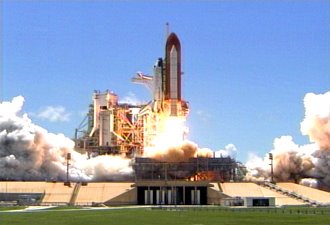
We have lift-off ... Space Shuttle Discovery


As a child, I remember watching the television at home waiting for the Space Shuttle Columbia to take off for the first time in 1981. My memory is that it didn't launch on the intended day, and it was sometime the next week that it eventually took off (to a smaller TV audience).

Memories of visits to Armagh Planetarium are fond - they had a suite of strange computers (MSXs?) for a while that accessed material off laser discs.

And I can remember going down to the local newsagent in 1986 - the Candy Box in Lisburn - on the night after the Challenger disaster to buy a copy of the papers. It was the first time I'd seen the UK papers with the front pages filled with a single image.

There was a sick feeling when Columbia disintegrated on re-entry in 2003. A sickness of being able to watch it happen from so many different angles. A feeling of disappointment that they'd come all that way to lose it right at the end.

The interest in all things space has waned, but not been totally extinguished, over the years. I'm looking forward to my baby daughter being old enough to go down to Armagh - assuming it reopens sometime soon (though their website suggests 31 July 2006!)- and enjoy her delight at seeing the space suit, the weather satellite display, and the enthralling star show in the planetarium. The overwhelming darkness, and the thousands of stars that just appear out of no where as your eyes adjust. Wonderful memories.

And so tonight, I sat on the edge of the sofa, watching the News 24 coverage of Discovery taking off. The fear of wondering how soon it would be out of danger as it powered into the sky burning half a tonne of fuel a second. It was a relief when the shuttle separated from the booster rocket, reoriented to take some photos of the booster, and manoeuvred into position to drop into the right orbit to catch up with the Space Station on Thursday.

Happy Independence Day.