Showing posts with label maths. Show all posts

Monday, April 18, 2016

The Man Who Knew Infinity - a fond (if masculine) memorial to an important mathematician

Srinivasa Ramanujan (played by Dev Patel) is a self taught mathematician living in Madras, India. He perceives that his discoveries are accurate and important, but without a degree no academic in India will take a risk of working with him.

But G. H. Hardy (Jeremy Irons) in Trinity College Cambridge is already an outsider and a political radical in the hallowed environs of Trinity College Cambridge. He invites Ramanujan across to England and cajoles the instinctive prodigy to produce the proofs that will add rigour and allow his broad range of breakthroughs to be published.

“Change gentleman, it’s a wonderful thing. Embrace it!” says Hardy, not knowing that a war that will forever change the nature of his college is around the corner.
“I doubt a dark face will ever grace these walls, never mind become a fellow.”
The Man Who Knew Infinity is a story of talent mixed with academic snobbery and a huge dollop of 1920’s racism (which pretty much mirrors 2010’s racism), ill health, disrupted love and the effect of the First World War.

Ramanujan’s wife Janaki (Devika Bhise) frees her husband to travel to the UK to pursue his maths, but her mother-in-law frustrates her attempts to keep connected. Bhise – who doesn’t seem to appear in production shots for the film – makes the most of her limited scenes, displaying an on-screen sweetness and longing that pay off in her final distraught scene. Irons manages the complexity of supporting his protostar while being dismissive of his Indian clothes and customs.

Dev Patel is superb as his autodidactic character extends his independent thought from the realm of number theory to widen his worldview before succumbing to his failing body, all the while maintaining an enviable composure. It’s a long way from his previous roles in Skins, Slumdog Millionaire or The Newsroom.


The Man Who Knew Infinity falls into the category of movie that celebrates forgotten heroes. A few token mathematical concepts are explained in a 108 minute film that otherwise summarises formulae as “paintings” and mathematics as a series of “patterns”. To avoid the theorems, the audience suffer a lot of philosophical dialogue (and a few appearances from Bertrand Russell) that pads out the film but adds little to the storyline.

Released four years before the centenary of his death, The Man Who Knew Infinity is a fond memorial to the life and work of an important mathematician. It’s being screened in Moviehouse and Omnipex chains as well as Odyssey Cinemas.

Tuesday, February 17, 2015

NI Science Festival (19 Feb-1 Mar): maths, sound science, films, games, zombies & stars

The inaugural NI Science Festival starts this week and over 11 days it will explode 100 events in venues across Belfast, Derry, Armagh, Glengormley and beyond.

Festival Director Chris McCreery jumped from a career in lobbying and public affairs to set up and run the science festival. He told me at the festival launch that being able to programme so many events in its first year “reflects the vibrancy of Northern Ireland’s tech sector, universities and the real interest amongst the general public as well as public interest”.


We wanted to create a festival for all, focussing on both kids and adults … Science is such a core part of culture and society that it had to be celebrated.

There are hands-on workshops for children – and a world record breaking World’s Largest Science Lesson – as well as theatre, film, music and comedy for adults. Many of the shows have been developed specifically for the festival, and local universities, science bodies along with the Department for Employment and Learning and Belfast City Council have added their support.

The full programme is available on the festival website. and you can follow last minute updates @niscifest.

Some highlights ...

Thursday 19 February

The Internet’s Own Boy: The Story of Aaron Swartz // 7.30pm // Belfast Film Festival Beanbag Cinema // £6 // If you missed the screening of a shortened version on BBC Four, head down to the Beanbag Cinema at 23 Donegall Street to discover the story of programming prodigy and information activist Aaron Swartz. He co-founded Reddit, helped develop RSS, but also had a passion for social justice and political organising combined with an aggressive approach to information access that ensnared him in a two year legal nightmare. It was a battle that ended with the taking of his own life at the age of 26. A personal story about what we lose when we are tone deaf about technology and its relationship to our civil liberties.

Saturday 21 February

The Art and Science of Sound // 3-5pm // QUB Sonic Arts Research Centre // Free // SARC is an ear and eye-opening research facility dedicated to all things sonic. Between 11am and 2pm, they’ll be running workshops (booking required) and then at 3pm they’ll throw open the doors to everyone to get their hands on demos of:
  • Haptics in Virtual Reality - Ever wanted to be inside a video game? Well now you can! Come and experience virtual reality first hand with the Oculus Rift head mounted display and Leap Motion hand tracking.
  • Two Weeks - Lose track of real-time as you delve into the sounds of 'Two Weeks' – a sound installation compressing a whole week in one hour which will run on a loop for the duration of the open session.
  • Shaping sounds with gestures - Try out (or watch) two digital gestural interfaces developed to manipulate different types of audio synthesis, pre-recorded video files and live video feeds.
  • Robots in Education - This display shows how humanoid robots are used in Electrical Engineering to interactively teach students how to program.
  • The DIY sound-artist – Learn how to turn your Rock Band 3 controller into a polyphonic synthesiser, your Wii mote into an audio scrubber and your Xbox Kinect into a granular engine.

Sunday 22 February

Zombie Science: Brain of the Dead // The Black Box // 1-2pm, 2.30-3.30pm, 4-5pm // £6/£3 // A spoof lecture from the Zombie Institute for Theoretical Studies lifts the lid on the Zombie skull and peers into the brain of the infamous movie monster. Presented by expert Zombiologist Doctor Ken Howe. Brain of the Dead is the third show in the Zombie Science spoof lecture series, which has attracted sell-out performances at the Edinburgh Fringe Festival. This is the science you need to survive the inevitable zombie apocalypse!

Tuesday 24 February

The Higgs' Boson and Cancer Therapy // 7-8pm // Ulster Museum // Free // Belfast-born Prof Steve Myers will talk about our relationship as a civilisation with particle accelerators, sophisticated and often enormous machines that are normally seen as providing us with insight into the dawn of the universe. But they also have a use in the treatment of cancer, scientific research into the properties of materials and in security.

Armagh Planetarium Open Night // 7-9pm // Free // The planetarium is hosting a viewing session providing views of the Moon, planets and deep sky objects through our 12 inch telescope. Observations require clear sky. Pre-booking required if you also want to enjoy the free Beyond the Blue digital theatre show at 7.30pm.

Lifting the Lid: Ongoing Adventures in the World of Pseudoscience // 8pm // Sunflower Bar // £5 // Join Belfast Skeptics and Michael Marshall (Project Director of the Good Thinking Society and Vice President of Merseyside Skeptics) who will explain what happens when you begin to crack the surface of pseudoscience, revealing the surprising, sometimes shocking and often-comic adventures that lie beneath.

Wednesday 25 February

Sir Bernard Crossland Lecture: Alligator, Sex and Scars // 6-7.30pm // Riddel Hall // Free // Prof Mark Ferguson illustrate how unexpected discoveries open up new scientific and commercial opportunities.

Thursday 26 February

Turing Lecture // 5.30pm-8.30pm // Belfast City Hall // Free // The BCS and IET are bringing this year’s Turing Lecture to Belfast. VP of Global Technology at Cisco, Dr Robert Pepper will talk about The Internet Paradox: How bottom-up beat(s) command and control and discuss the next market transition to the Internet of Everything and the interplay between policy and technology as well as highlighting early indicators of what the future may hold for the Internet. FULLY BOOKED

Friday 27 February

Friday Salon: Stargazing with Mark Thompson // 1-2pm // The Black Box // £6/£3 // Join the “people’s astronomer” as he reveals the hidden nature of the universe and brings it to life with mind-blowing demonstrations.

Be An Astronomer for the Night // 6.30-9pm // BBC Blackstaff Studios // Free // Operate a real life telescope and take your own images of your favourite astronomical objects by joining Mark Thompson (BBC Stargazing Live) and astronomers from the Open University for an evening exploring the night sky with the Open University’s remotely-operated PIRATE telescope in Mallorca. Drop in to Great Victoria Street, no booking required.

Sunday 1 March

How to (Almost) Solve the Riemann Hypothesis // 1.30pm // The Black Box // £3 // Four years ago musician Colin Reid watched a BBC documentary about Leonard Euler's famous result pi squared over six. This is what happened next ... an alternative look at mathematics's most famous unsolved problem.

My Life As An Experiment // 8pm // The Black Box // £8 aged 18+ // A scientist puts his life, his career, and his field under the microscope in this theatrical essay on the scientific method as he communes with the Muses of Science: Curiosity, Diligence, Inspiration, and Obsession. Live music, songs, and flights of imagination, devised and produced by the always incredible Wireless Mystery Theatre along with Drs Ruth Kelly and Alan Trudgett from QUB.

Other events …

Make it Digital With the BBC is taking over BBC NI’s Blackstaff Studios on Great Victoria Street for three days. Open on Thursday 26th 10am-7pm, Friday 27th 10am-9pm and Saturday 28th 10am-7pm, you’ll find no end of interactive digital goodness: coding games inspired by Doctor Who, digital fabrication, gaming, robotics, workshops, Open University talks. You’re free to drop-in and join in the fun, though it may be worth booking for workshops with limited places. See the BBC’s programme brochure for details.

Playspace // Gaming culture takes over the Queens Film Theatre for a weekend of workshops, screenings and tournaments, including Halo on a cinema screen. Local game developers will be showing off their creations in the café/bar. See the QFT’s leaflet for full details and times of events over the two days, Saturday 28 February and Sunday 1 March.

  • Saturday 28 February at 3pm – From Bedrooms to Billions, the story of how a small number of individuals fuelled the creation of the video games industry.
  • Saturday 28 February 7.30pm – Tron and a panel discussion on the shared future of film and gaming at 7.30pm on Saturday.
  • Sunday 1 March at 6pm – Scott Pilgrim vs The World, a hilarious homage to the 8-big gaming world, based on Bryan Lee O’Malley graphic novels and directed by Edgar Wright (Shaun of the Dead).

Glasgow Science Centre’s Bodyworks exhibition is visiting W5 from Friday 20 to Sunday 22 February. Dozens of hands-on exhibits taking a look inside the human body, examining synthetic body parts and taking a 3D virtual journey through the body’s systems and a walk through a giant heart.

Following the NI Science Festival, watch out for the monthly science café that will be organised in the Black Box, along with the regular Friday Salon lunchtime events.

Monday, October 13, 2014

Celebrating William Rowan Hamilton in the Linen Hall Library on Thursday ... it's Irish Maths Week

It's Irish Maths Week. Whether deliberately tied in or not, the Linen Hall Library are celebrating the life of nineteenth century William Rowan Hamilton on Thursday evening at 6pm in Belfast.

Poet and Fellow Emeritus at Trinity College Dublin, Iggy McGovern will perform pieces from his sonnet sequence A Mystic Dream of 4 based on the Irish mathematician's life.

Hamilton's son is quoted describing his father's approach to problem solving:
He used to carry on, long trains of algebraic and arithmetical calculations in his mind, during which he was unconscious of the earthly necessity of eating; we used to bring in a 'snack' and leave it in his study, but a brief nod of recognition of the intrusion of the chop or cutlet was often the only result, and his thoughts went on soaring upwards.
Admission is free, all welcome.

Saturday, September 27, 2014

e and Euler

Thanks to Norwin/Destroy All Onions for a tip off the other night that e and Euler were being features on Radio 4’s In Our Time.

My first PC in work – some twenty years ago – was a 486 (50 MHz) machine. In those days, staff could choose their own hostname, and since there was already a series of computers named after mathematicians on the floor, I added to that list and plumped for Euler.

Euler is long dead – both the mathematician (died in 1783) and my first PC (which is no doubt rusting away and polluting a landfill).

Leonhard Euler was born in 1707 and schooled in Basel (Switzerland). He was nearly pushed into being a pastor, but went into mathematics, worked and married in St Petersburg (Russia), and transferred to Berlin before later returning to St Petersburg.

Married to Katharina, they had 13 children; however only 5 survived beyond childhood. After her death, he married Katharina’s half sister Salome Abigail. He became almost blind in his right eye, developed a cataract in his left, before becoming almost totally blind.

Not an easy life, but a tremendously prolific and productive one mathematically.

No pun intended, but Euler was a polymath, curious about nearly every discipline of mathematics in those days. He provided the solution to the Seven Bridges of Königsberg problem. He also contributed to physics and astronomy. To modern students of maths, he’s probably best known for Euler’s formula and the beautifully elegant Euler’s identity.

(Beautiful since it combines addition, multiplication, exponents, equality as well as five basic constants 0, 1, e, π and i.)

As I type this up I realise that I’m bound to have mentioned Euler on the blog before. And sure enough he got a mention on his 300th birthday back in April 2007. In that post I explained that Euler’s Identity is:
… the only piece of mathematics that I’ve had to prove from first principles since graduating from university. During an afternoon coffee break ten years or so ago, a summer student in work (who did engineering rather than applied maths), wondered how it could be proved. One paper napkin later, happy student. But my maths has faded, so don’t ask for a repeat performance.

Thankfully lots of other (non-mathematical) parts of by three year degree have come in useful during twenty years of employment in the IT industry: mostly social skills and tea drinking, though debugging programmes and learning Unix for fun might feature too.

You can find out more about the history and simplified explanations of the mathematics behind Euler’s number and the man himself by listening to this week’s episode of In Our Time. It was a great listen while mowing the lawn for the last time this year.

Melvyn Bragg was joined by Colva Roney-Dougal, June Barrow-Green and Vicky Neale for the episode that I suspect the presenter will glad to put behind him!

Google marked Euler’s 306th birthday with a doodle.


Tuesday, December 03, 2013

Dame Jocelyn Bell Burnell: an unsung hero of Belfast ... and deserving of a statue

I don't normally post sponsored infographics. Every month I get one or two emails from companies who are wanting to boost their SEO and brand awareness through some charts that are vaguely related to their business. However, Jurys Inns (they have a hotel in Belfast!) have created a list of Unsung Belfast Heroes which includes Dame Jocelyn Bell Burnell, an astrophysicist and past pupil of Lurgan College. They explain:
A Northern Irish astrophysicist (Belfast born), Dame Jocelyn Bell Burnell discovered the first radio pulsars while under her thesis supervisor. This discovery resulted in her supervisor Anthony Hewish, and Martin Ryle sharing a Nobel Prize in Physics. The omission of Bell Burnell from the prize sparked outrage and has been a point of controversy ever since as she not only found the initial anomaly, but also reviewed and reported on as much as 96ft of paper data per night, even against Hewish's scepticism.

Despite helping to build the four-acre radio telescope and being omitted from the discovery, Bell Burnell stated that Nobel Prizes would be demeaned if they were awarded to research students unless in very exceptional cases, which she deemed that hers was not. However, many institutions awarded her recognition for the discovery and she continued to rise in her career serving as the president of the Institute of Physics for two years.

Bell Burnell attended Lurgan College where she was one of the first girls permitted to study science in place of subjects such as cross-stitching and cooking.

You can hear a little of her story in her TEDxStormont talk earlier this year.


You can also watch clips of her explaining pulsars, listen to her discussing being a woman in the scientific community, and listen to her Desert Island Discs! On a BBC News Channel HARDtalk programme she explained:
I have discovered that even if you do describe it as an injustice you can do incredibly well out of not getting a Nobel Prize.
What a great success and role-model for Belfast City Council to celebrate with freedom of the city and a statue?

And the infographic ...

Belfast Unsung Heroes Infographic by Belfast Jurys Inn
Unsung Heroes of Belfast, by The Belfast Jurys Inn Hotel

Sunday, September 29, 2013

Belfast Festival Preview (17-27 October) #BelFest

The Ulster Bank Belfast Festival at Queen’s starts in three weeks and runs from Thursday 17 to Sunday 27 October.

Jimmy Titanic is a one man show written by Bernard McMullan. Set between heaven and the ship, Colin Hamell plays over 20 characters on the ship and up above, telling the story of proud shipyard workers coping with the legacy of their ‘Wondership’. Up to now performed in the US, the play comes to Northern Ireland and the Titanic Belfast building as part of the festival. Thursday 17 to Sunday 20 October at 7.30pm (and Sat/Sun matinee at 2pm). £12.50 (over 18s only)

The Simpsons and Their Mathematical Secrets. Coinciding with the launch of his new book which has the same title, Simon Singh investigates the maths math that infiltrates The Simpsons in a way that is both accessible and funny … like when baby Maggie nonchalantly pies up her building blocks to read EMCSQU! The Crescent Arts Centre, 7.30pm, Friday 18 October. £6.

PianOrquestra features two pianos played by sixteen hands using gloves, sticks, picks, nylons, rubber, metal, wood, fabric, plastic and electronics. Inspired by John Cage, composed by Pedro Rebelo and Justin Lang. QUB Sonic Arts Research Centre (SARC), 5pm, Sunday 20 October. £8.

Pending Vote is the Irish premiere where the theatre becomes a parliament and the audience have remote controls to vote to decide the future of our community and the evening’s performance.
Voting on relevant issues for the Northern Ireland public without avoiding topics such as health, education, civil liberties and identity. Pending Vote explores our personal and political affinities and questions the nature, benefits and contradictions of our modern democratic process. Do we run the system or does it run us?
Lyric Theatre – Naughton Studio, 8pm, Monday 21 and Tuesday 22 October. £12.

A Secret History of Torture. Drawing on official documents and witness accounts, Guardian journalist Ian Cobain discusses Britain’s secret use of torture in the Second World War, Kenya, Northern Ireland and the War on Terror. Followed by a Q&A chaired by William Crawley. The Great Hall QUB, 7.30pm, Monday 21 October. £6.

Bernard MacLaverty in conversation with Marie-Louise Muir. Author of Cal, Lamb, Grace Notes, on the eve of publication of his new book of Collected Stories. The Great Hall QUB, 7.30pm, Tuesday 22 October. £6.

Sarah Maple’s exhibition in the Golden Thread Gallery promises to be “graphic, witty, controversial and wholly original, simultaneously sincere and tongue-in-cheek” using painting, photography, video and performance to ask what it is to be a woman and a Muslim in 21st century Britain. The first major solo exhibition in Northern Ireland of the “heir to Tracey Emin’s throne” launches on Tuesday 22 October (6pm-8pm) and will remain open Wednesday to Friday (10.30am-5.30pm) and Saturday (10.30am-4pm)

Alternative Ulsters. Mark Carruthers has spent the last 18 months interviewing forty public artists, writers and politicians about for his new book Alternative Ulsters : Who Do We Think We Are?. Chaired by William Crawley, Mark will be joined in The Great Hall QUB by some of his key contributors, Baroness Blood, Joe Brolly, Brian Kennedy and Ian Paisley Jnr to discuss whether identity is fixed or continually changing, and whether more people are embracing a Northern Irish identity. 8pm, Friday 25 October. £6

Rhinoceros is a bilingual adaptation of Ionesco’s tragic farce. A whole town has been struck with ‘Rhinoceritis’ turning all but one of the inhabitants into rhinos. Bérenger remains untouched in a world where no-one else speaks the same language. Does not require an understanding Fench to enjoy! Lyric Theatre – Naughton Studio, Friday 25 (8pm), Saturday 26 (8pm) and Sunday 27 (7pm).

Edit-Point and The Gildas Quartet (website) combine strings and electronics in a programme that includes local man Ed Bennett’s String Factory and George Crumb’s Black Angels. The Crescent Arts Centre, 7.30pm, Saturday 26 October. £10

Some great films showing in the QFT as part of the festival, including three from Switzerland: La Petite Chambre (The Little Room), Hiver Nomade (Winter Nomads) and Jump.

The 51st festival also has its opening and closing concerts, an 11 acre portrait in Titanic Quarter that can be viewed from nearby tall buildings (or the air if you’re flying in or out of Belfast City Airport) and the 132nd annual exhibition of the Royal Ulster Academy (in the Ulster Museum).

Thursday, August 29, 2013

Technology & Science podcasts

I’m reviving a long absent series of posts about podcasts worth listening to on the commute into work (or while mowing the lawn).

Click (formerly Digital Planet) from BBC World Service with Gareth Mitchell and Bill Thompson – a weekly ramble through the global technology trends and developments, often noting how some technologies are used in surprisingly distinctive ways in different countries. Recently the show has taken a thematic look at the technology of transport. The live shows in front of a studio audience are fun. There’s an audience-driven Facebook group! [Podcast feed RSS | iTunes | archive]

Even if I was up early to catch a red-eye flight I’d miss the original transmission of Outriders (formerly Pods and Blogs) at 3am on Tuesday morning’s Up All Night on BBC 5 live. Jamillah Knowles brings a weekly menu of interviews and insights into the “frontiers of the web”. The August 20 episode looked at “scientific code review and the DEFCON hacker conference documentary” while previous shows have observed maker camps, children’s coding clubs, citizen science and digital news. [Podcast feed RSS | iTunes | archive]

With the demise of the Guardian’s weekly Technology pull out [stop press – the Observer have just announced they’re launching a monthly Technology supplement on 15 September] the Tech Weekly podcast is the next best way to hear the news and views from regular contributors like Jemima Kiss, Aleks Krotoski, Charles Arthur and Bobbie Johnson. Interviews with authors and technology leaders, a regular focus on gaming, Silicon Roundabout and start-ups. [Podcast feed RSS | iTunes | archive]

The three series of Aleks Krotoski's The Digital Human (Radio 4) are still available looking at control, privacy, memory, serendipity, homogeneity, social and moral boundaries, detox, loneliness and love. [Podcast feed RSS | iTunes | archive]

While the episodes are sometimes a little too long, Alok Jha’s Science Weekly podcast for the Guardian tackles big subjects without being scared of depth: bio-engineering and synthetic biology; dangerous numbers and statistics; the chemical origins of life on Earth; interviewing the driver of the Mars Rover. [Podcast feed RSS | iTunes | archive]

From a statistical perspective, Radio 4’s More or Less takes a light-hearted look at the series issue of numeracy abuse. Politicians and journalists are amongst the people who misuse and misquote statistics to form mistaken conclusions. Tim Harford and frequent contributor Ruth Alexander debunk, entertain and inform … in partnership with the Open University. Ten minute BBC World Service episodes are interwoven with the half hour Radio 4 shows. [Podcast feed RSS | iTunes | archive]

Tim Harford’s short series of Pop-Up Ideas are also worth a listen. [Podcast feed RSS | iTunes | archive]

Locally, Chris Taylor and Matt Johnston produced 26 episoides of Tech Show looking at local technology and industry issues as well as tracking their love for Android and iOS. The last show was uploaded to EamonnMallie.com in November 2012. [Podcast feed RSS | iTunes | archive]

Until its demise in April 2012, PRI’s The World had a fantastic Technology Podcast hosted by Clark Boyd. Its focus was “not on gadgets or gizmos, but rather the people behind those gadgets and gizmos”. And like Click it looked beyond the US borders to appreciate world-wide advances and applications. There’s an archive of shows on PRI’s website and I’m slowly working my way through several years of backlog on iTunes.

While not a podcast, worth mentioning Tech 24 programme on France 24’s English channel which spends 10 minutes each week looking at new technology, gadgets, often with a French (or at least a refreshing non-UK/non-US) twist. While it only covers three or four items each week, it’s a quick way to keep up with trends in gaming and nascent technologies that will impact mobile computing and telephony … and Bluetooth-controlled drones! [Facebook | archive]

If you’ve other techie podcasts to recommend, why not leave a comment …

Sunday, April 10, 2011

Charting the Assembly election candidates

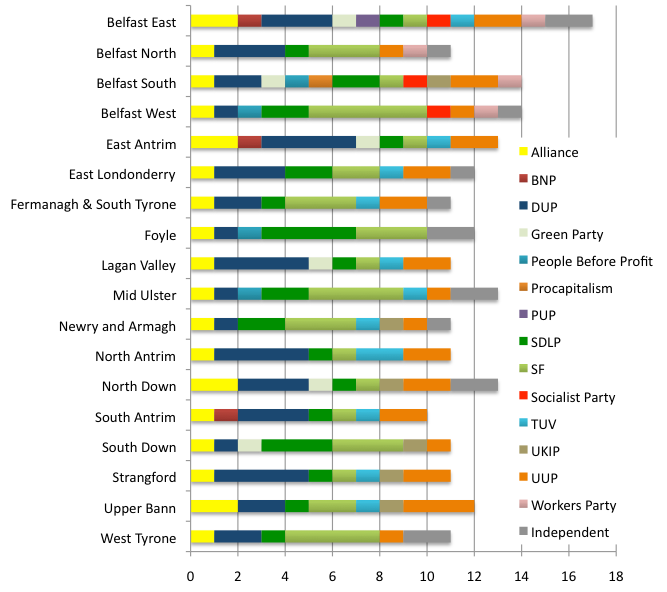
Following on the Assembly candidate nominations, we now know that Belfast East will have 17 candidates listed on its long ballot paper. Belfast South and Belfast West are next largest with 14 candidates each. South Antrim will have the shortest ballot papers with only 10 candidates listed.

Newbie/Old hand candidate ration in 2011 Assembly elections

We also know that just five constituencies have all six “sitting” MLAs standing again for re-election – Belfast North/South/West, Newry and Armagh, and South Antrim. Four constituencies have just four of their existing MLAs fighting to be elected. And as Stratagem point out

"The only constituency in which all six MLAs elected in 2007 are running again in the 2011 Assembly Elections is Newry & Armagh"

Number of parties standing in each constituency along with number of independents - Assembly election 2011

In terms of party diversity, Belfast East has 11 distinct parties standing along with two independents. Similarly, Belfast South has 11 parties ... but no independents. No constituencies have more than two independents on the ballot paper. West Tyrone and Foyle both have just candidates from five parties standing, and both have two independents on the ballot paper too.

Number of candidates per party (split by gender) in 2011 Assembly elections

The DUP are running the most candidates (44), with Sinn Fein (40) not far behind. The UUP (29) and SDLP (28) are neck and neck. Alliance are running 22.

Chart showing how many candidates from each party are running in each constituency in 2011 Assembly elections

In the chart above you can see how many candidates each party is running in each constituency.

Candidate gender ration in 2011 Assembly elections

Gender wise, Newry and Armagh has no female candidates. Five constituencies only offer one female candidate. Belfast East, South Down and Upper Bann have four female candidates on the ballot paper.

Percentage of female candidates in 2011 Election assemblies

Technically, the BNP are running the highest proportion of female candidates (1 out of their total of 3 candidates = 33.3%). Alliance are next with 31.8% female candidates, then Sinn Fein (27.5%). Of the other main parties, the DUP is a mere 15.9%, SDLP at 14.3% and UUP lagging at 10.3%.

(Cross posted from Slugger O'Toole.)

Monday, February 21, 2011

Regional newspaper sales in NI in decline ...

A weekend post on Slugger O'Toole about the year on year decline in the sales of the local NI daily newspapers sparked by curiosity, so I dug out* the longer term data and graphed it to show the performance (using the six monthly Audit Bureau of Circulation figures) of the Belfast Telegraph, Irish News and News Letter. I've added in the the Irish Times sales for comparison.

NI newspaper sales 2004-2010 - Belfast Telegraph, News Letter, Irish News (and Irish Times for comparison)

The overall trend is one of decline. However, it is significantly more pronounced for the Belfast Telegraph.

In fact if simple linear trend lines are added to the graph, sales of the Irish News and Belfast Telegraph will collide towards the end of 2012/beginning of 2013.

Statistically, a more sophisticated trend analysis would be required before drawing any formal conclusions. (Applying a polynomial trend line keeps clear water between the two publications for much longer.)

- - -

* dug out is a euphemism for did a Google search to find different archive newspaper articles that quoted the six monthly figures as I only have access to the last set of stats on the ABC website!

Wednesday, December 01, 2010

Just the lift the Irish economy needs: "Accenture is to create 1 new job ..."

snippet from Belfast Telegraph website article about Accenture creating jobs in Dublin

With all the doom and gloom, today's short article on the Belfast Telegraph website will surely bring a cheer to Irish spirits with the news that Accenture are creating jobs in Dublin.

MANAGEMENT consulting firm Accenture is to create 1 new jobs over the next four years at a research and innovation centre in Dublin. The company, which already employs 1,3 staff in Ireland, said the centre will develop advanced statistical modelling techniques known as analytics. The investment, which is backed by IDA Ireland, will form part of a wider global network.

The Irish Times have a more believable version: 100 new jobs on top of 1,300 existing ones!

On a serious note, it's the biggest set of jobs in the field of statistics and mathematics that I've seen announced for a long time. Now where did I put my STA304 notes from university days ...

Wednesday, October 20, 2010

Benoît Mandelbrot (1924-2010)

An enlarged portion of the Mandelbrot Set - (source Wikipedia)

Never during three years of studying for a Applied Mathematics degree did fractals appear. But as a teenager I spent a lot of time improving my speed typing skills and entering programmes from Acorn User magazine.

Over a year or so, ever faster fractal generation assembler programmes appeared balancing the BBC Micro’s limited screen resolution with its even more limited 6502/65C102 processor.

Photo of Benoit Mandelbrot - source Wikipedia

The “father of fractals” was Benoît Mandelbrot, a Franco-American mathematician born in Poland who discovered the mathematical shapes known as fractals. He died of cancer on 14 October last week, aged 85.

The MathsBank blog have a good post about him, along with links to explore the Mandelbrot Set and other fancy fractals.

Monday, June 14, 2010

The History of Mathematics - BBC Radio 4, weekdays at 3.45pm

Promotional image of Marcus du Sautoy - (c) BBC

As I'm increasingly aware, Radio 4 is full of treats.

This week's gift is a daily 15 minute programme, The History of Mathematics, presented by Prof Marcus du Sautoy. Daily at 3.45pm, he looks at the life of one or more mathematicians who have shaped scientific thinking.

Today it was the turn of Newton and Leibniz. Like chicken and egg, which invented calculus first? Tomorrow it's the turn of Euler - after whom my first work PC was named!

(Given there are 10 episodes, that's really this fortnight's gift ...)

Thursday, May 13, 2010

What kind of a mandate do you need to be elected as an MP?

Not as big as you’d think! On average, you only need to persuade one in four voters in your NI constituency to support you. In some areas, less than one in five voters would be enough.

Most of the figures you see at election time talk about the percentage share of the vote, ie those who turned up at a polling station (or posted in their vote). But what about the percentage share of the eligible voters?

What kind of mandate do our local MPs achieve at the ballot box?

  • Willie McCrea was returned to Westminster as South Antrim’s MP with a mere 18.30% of the eligible electorate voting for him.
  • David Simpson topped the poll with 18.73% of Upper Bann’s eligible voters.
  • And 19.13% of people issued with a polling card in East Londonderry put an X in the box for Gregory Campbell.

At the other end of the scale ...

  • Despite having the fourth smallest turnout (54.91%), a whopping 38.37% of West Belfast voted for Gerry Adams.
  • Next best, 34.90% of the eligible electorate in North Down voted for Sylvia Hermon (though turnout in the constituency was the fifth smallest with only 55.26% of people coming out to vote).

The graph below is sorted by the size of the mandate and also shows the overall turnout. (Click on the graph to enlarge it.)

Bar chart showing percentage of eligible voters in a constituency who voted for the winning candidate along with an indication of the overall turnout

On average, the 18 MPs elected last week required just over 17,000 voters to give them their X, giving them an average mandate of 26.3% (with a 45.5% share of the votes actually cast).

(Cross-posted from Slugger O'Toole.)

Saturday, October 31, 2009

Playing post code Russian Roulette with life expectancy in North Belfast

I referred to Malachi O’Doherty’s challenging blog post and podcast during this week’s Blogtalk NI.

Along with other diverging statistics, in North Belfast life expectancy differs by a massive fifteen years between Ardoyne and Fortwilliam.

Malachi asks why this is? He also questions why politicians find it hard to get excited about this reality? Why we can always explain away individual deaths with a good reason, and fail to talk about the annual trend of 5,000 “early” deaths? And he asks why we don’t just build high rise flats in Fortwilliam to solve the problem ...

Well worth listening to the podcast linked to from his blog post.

Wednesday, September 23, 2009

Pascal, four party responses, Wordle and a case of inverse proportionality

I’ve oft agreed with the words of Pascal:

“I have only made this letter longer because I have not had the time to make it shorter.”

It might be slightly cruel, but the situation can be summed up ...

There was this thing, with a panel, except they were all too busy to attend and take their places behind the table ... except one. Oh, and the public turned up in good numbers. But the other thing was more important, so most of the panel stayed at it. And no one else took their places.

You may wish to skip this post ... but if curiosity gets the better of you, I conducted a quick experiment in political engagement around lunchtime today when I fired off the same email to the various parties who failed to show up on the panel at the Assembly Roadshow in East Belfast last night.

Have you a quick comment on how last night your party balanced (1) the importance of the Justice debate and division at Stormont versus (2) your agreement for an MLA to appear in front of the members of the public (voters) assembled a mile down the road in the Park Avenue Hotel for the Assembly Roadshow?

As one of the fifty or more people assembled, am I right to be disappointed that your party couldn’t sacrifice one MLA to come down and join Dawn Purvis on the panel, perhaps before returning to Stormont for the division?

Given that they could see each other’s email addresses in the To: line and knew that the responses (or lack of) might be blogged, I expected most would reply. And at the time of posting, only Sinn Fein haven’t replied. Alliance replied with a direct quotation from Naomi Long; the other parties replied with a comment from their spokesperson. A big thank you to those who did reply.

As a mathematician who wishes he’d done more statistics, the intriguing thing for me is that the length of time taken to reply was inversely proportional to the number of words used to reply. Which means if Sinn Fein do ever reply, it’ll have to be pretty terse not to break the trend!

  • (UUP) 43 minutes, 265 words
  • (Alliance) 54 minutes, 260 words
  • (DUP) 82 minutes, 210 words
  • (SDLP) 137 minutes, 113 words
  • UPDATE Mon 28 Sep - And just over five days later ...
    (SF) 7368 minutes, 204 words - which broke the trend!

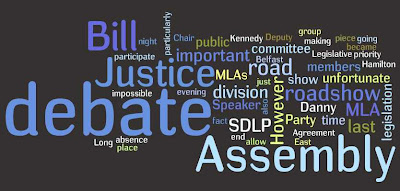
Putting the four responses through Wordle.net nicely summarises their content.

Wordle: Northern Ireland Assembly Roadshow party responses - www.wordle.net

Much of what the parties said was very similar. The UUP and SDLP both pointed out in their statements that they had contributed to previous roadshows. Both these parties felt the scheduling of the roadshow against the Justice debate was “unfortunate”.

All four parties felt that the Justice Bill was important:

  • (UUP) “a particularly significant piece of legislation”
  • (Alliance) “legislating last night on a major issue”
  • (DUP) “clearly very important to the community and the DUP”
  • (SDLP) “ultimately most important debate of this Assembly year”

Other than wanting to send panellists, only one party articulated any importance of the roadshow:

  • (UUP) “an important role in maintaining contact between the Assembly as an institution and the voting public”

Did it catch them out?

  • (UUP) “The length of time taken by the debate did catch us unawares. The Business Office’s indicative timings had set aside a mere 3 hours for the Bill.”
  • (Alliance) “Because the speeches are not time limited it is virtually impossible to predict how long the session will last, and it was not impossible even at 8 o'clock that members could have voted and then gone.”
  • (DUP) “This was scheduled to be quite a short debate, which would have freed up MLAs later in the evening. However, it quickly became apparent that the debate was going to run into the evening and there would be a division at the end.”

So why did everyone have to stay?

  • (SDLP) “… given the importance of the Justice Bill and its negative implications for the core values of the Good Friday Agreement, the SDLP Assembly Group took the decision to impose a three-line whip for the whole debate, not just for the division … defending the principle of inclusive democracy enshrined in the Agreement with all the resources at our disposal has got to be the priority for the SDLP.”
  • (UUP) “MLAs absenting themselves from a crucial debate and only turning up to vote would not, in our view, represent an adequate approach to this particularly significant Bill. It was important for MLAs to be present in force to hear the various contributions and to weigh the arguments.”
  • (DUP) “the DUP had many members who wished to participate fully in the debate … Simon Hamilton MLA was scheduled to participate in the Assembly Roadshow but also wished to be a participant in the Justice Bill debate. He was unable to speak in the debate on the Justice Bill until after 7pm, but participation in the debate is not simply confined to making a speech, but in making and taking interventions to and from other speakers as well as participating in the division at the end.”

Could pairing not have freed people up?

  • (Alliance) “When we realised that this debate was not going to conclude in time, we tried to put pairing arrangements in place; however, the added complication was that most of the people on the panel were also active in the debate.

    Danny Kennedy and I are Chair and Vice Chair of the OFMdFM committee which will handle the committee stage of the Bill, and therefore had to be there for the Ministerial response, Alban Maginness is SDLP Justice Spokesperson, Francie Malloy as deputy Speaker was deputising to allow the Speaker to go to the Roadshow and Simon Hamilton is on the Assembly and Executive Review Committee which is dealing with justice, so we not only needed pairs but alternates from each voting group.

    When that was agreed at just after 8.20pm, we were then advised that it was past the point where they would be able to make it.”

It was such a good explanation, I didn't shorten it!

And for their final punch lines:

  • (UUP) “While we apologise for the absence of an Ulster Unionist MLA last night, we trust that the public and responsible commentators will recognise the highly unusual circumstances, evidenced by the fact that the Assembly did not rise until 12:50am.”
  • (Alliance) “I have written to the Speaker, asking that they avoid scheduling Roadshows on sitting days as the unpredictability of the timings will leave them a hostage to fortune. It doesn’t happen often but it shouldn't really be allowed to conflict at all.”
  • (DUP) “The Assembly is sometimes criticised for not giving scrutiny to legislation passing through. Whilst this was merely a piece of enabling legislation it did receive detailed scrutiny and debate and as a Member of the Legislative Assembly the legislative process should be a key priority for all Members.”
  • (SDLP) “… defending the principle of inclusive democracy enshrined in the Agreement with all the resources at our disposal has got to be the priority for the SDLP.”

Lastly, Hansard has caught up with last night’s proceedings up on “the hill”. For all the interest in the {significant | important | major} {debate | legislation}, can you guess how many of the 108 MLAs (well, 104 MLS if you subtract the speaker and the deputy speakers) were in attendance and voted in the division just before 9.45pm?

Answer: 80.

And the rest sure weren’t down sitting in the Park Avenue Hotel!

snippet from Hansard showing Justice Bill voting (c) Northern Ireland Assembly Commission 2009

Thursday, September 03, 2009

Mathematicians and black sheep

There are a relatively small number of mathematical jokes. There's the one that ends "he worked it out using pencil and paper" and the one ending "Consider a spherical cow", but that's where my supply dries up.

Until I read a third one over on Never Trust a Hippy ...

An astronomer, biologist, an engineer and a mathematician were crossing the border into Scotland from England on a train when they saw a field with a black sheep in it.

The astronomer said, "Look--all sheep on Earth are black."

The biologist said, "Look, in Scotland the sheep are black."

The engineer replied, "No, in Scotland some of the sheep are black."

The mathematician rolled his eyes to heaven and said, very patiently, "In Scotland, there exists at least one field, in which there is at least one sheep which is black on at least one side."

Updated with a link to the Spherical Cow wikipedia entry ... thanks to Ryan for pointing that out.