Showing posts sorted by relevance for query "BBC Micro". Sort by date Show all posts

Thursday, March 20, 2008

BBC Micro and Literacy Project - teams reuniting at Science Museum (this afternoon)

BBC Computer Literacy Project Owl logo

Every now and again, AiB reverts to some Acorn reminiscing. Formative teenage years spent compiling assembler to load into sideways memory banks, getting a programme published (incomplete) in Acorn User, and being taught how to make letters fall down people’s screen by an IT teacher.

So my eye caught the Technology section’s headline on BBC News online this morning ...

'Beeb' creators reunite at museum

Bit late notice unless you’ve got a few hours free in London this afternoon. But you could do worse than head around to the Science Museum and join in the seminar being hosted by their Computer Conservation Society.

It’s in the Fellows Library of the Science Museum, Exhibition Road, London, SW7 2DD. An exhibition of BBC micro hardware is available from 1.30pm, while the main event runs from 2.30pm until 5pm.

At selection of the original Acorn/BBC Literacy teams will be speaking:

  • The role of the micro within the BBC Computer Literacy Project - the genesis, scope, and impact of the project, and the role of the Micro within it. John Radcliffe, the Executive Producer for the BBC Computer Literacy Project will illustrate his talk with extracts from “The Computer Programme”.

  • Its legacy for the BBC - Micro applications, telesoftware, Domesday, and further innovations- led by George Auckland, Head of Learning Innovation at the BBC.

  • Steve Furber
  • Its technological legacy - ARM processor applications, the Cambridge phenomenon, computer architecture research. Steve Furber, CBE, Professor of Computer Engineering at the University of Manchester, and one of the key designers of the BBC Micro will lead the discussion, including mention of the ARM microprocessor that is the dominant architecture in today’s mobile and embedded systems, as well as unpacking the cluster of companies and investors that continue to work in the high-tech economy around Cambridge.

  • Its educational legacy - Computer hardware and software in schools, standards and applications. The lead speaker is Mike Bostock, a key educational adviser in the 1980s, who will talk about the educational impact, its ease of use in schools, the take-up of hardware and software, innovation and consolidation, BBC Micros, Macs and PCs, and the continuing influence today of the 1980s generation of teachers.

Herman Hauser is also due to attend the event.

The exhibition this afternoon

“... will be displaying and running several computers from its collections as part of the meeting: a BBC Model B, a gold-plated BBC Micro, an Acorn Atom, Archimedes and Electron and a BBC Domesday System.”
BBC Micro

Watch out for a fuller BBC Micro exhibition in the Science Museum in 2009, coinciding with Dr Tilly Blyth’s book about the BBC micro project which is due to be published next year by Macmillan. Curator of Computing and Information at the Science Museum , Dr Tilly Blyth will be attending this afternoon, no doubt picking up some more history and background about the machine and the literacy project that surrounded it.

Ah ... just remember the deafeningly loud beep when you turned the machines on, or using Shift-BREAK to boot off a floppy.

Update - interviews with Steve Furber, Hermann Hauser, Sophie Wilson and John Radcliffe, along with a quick video.

Thursday, November 01, 2007

The owl is back

BBC Computer Literacy Project Owl logo

This is a post about an owl ... but it’ll take a while to get to the point!

You’d think that within any business or institution the IT community would be at the bleeding edge of innovation. But sometimes they’re so busy deploying other people’s innovations that they don’t quite get around to taking full advantage of it for themselves.

And so it is that many, many months after the BBC’s News and Sports Editors stepped out of the background and started talking directly to the public, it’s only this week that the boffins over in the Future Media & Technology (FM&T) department have started their own BBC Internet blog. (Though until lunchtime, they were having trouble with their RSS feed.)

The sharp-eyed (or those reading this post) will notice a familiar owl up in the blog’s banner. All of the BBC-badged Acorn computers (BBC Micro, BBC Master, Archimedes 305/310, and A3000) displayed the logo of the BBC’s Computer Literacy Project somewhere on their keyboard ... and it’s good to see it back in use again - even if it is now back to front!

BBC Internet blog banner - with owl!

Brings back many happy memories of hours spent during school summer holidays writing programmes and even getting one published in Acorn User! (Though due to a printing mistake they had to publish a correction in a later issue!)

Back to the blog ... for the more technically-minded, there’s already a Backstage area that provides information on APIs and feeds for existing BBC services that can be taken and mashed into other applications and widgets. (What a horrible sentence.) Successful prototypes are then showcased, and some might even make their way into properly supported services on bbc.co.uk over time.

World News Gadget screenshotWorld News Gadget screenshot

I particularly like Al Petfield’s World News widget which shows the latest world headlines along with a mark on a revolving globe showing where the story originated.

Update: There’s been a U-turn in the blog’s banner! And the owl’s claws are now facing left as they did above the keyboards in BBC Micros. (Though there do appear to be other examples of the owl logo being used in the claws-right formation.)

BBC Internet blog banner - with owl facing the old-fashioned way

Saturday, December 29, 2007

New Year Honours ... and Steve Furber who designed computers that could run a 22nd century intergalactic cargo ship

I've noticed that the New Year Honours list always dominates the BBC News homepage on the last Saturday morning of the year. Not only does it lead the top story, but it's the same for England, Northern Ireland, Scotland and Wales, and most of the categories below (technology, business, etc).

As the day progresses, the sections with most news eventually drop the honours story from the coveted home page slot, and lead on something else. But Technology is usually quiet on a Saturday, so it's no surprise that one particular story is still up top tonight.

Steve Furber

Steve Furber - a key designer behind the BBC Micro and other Acorn computers - has been awarded a CBE in the New Year Honours list. According to a report, he got into computing when

... in the late 70s he became involved with the Cambridge University Processor Group, a club for computer hobbyists. "There was a gang of us who used to order integrated circuits and microprocessors from the very small number of shops that sold them," he said. "We got these bits and started building machines." During this time he was approached by Herman Hauser, co-founder of Acorn.

Pity it took 25 years or more to honour him. Those of us who honed our programming skills (that would be 6502/65C102 Assembler as well as BASIC!) on BBC Micros etc owe Steve Furber and his colleagues at Acorn a big thank you too.

An interesting aside from Mike Cowlishaw's Acorn web pages tells the story of an earlier microprocessor kit - the Acorn System 1 - that preceded the Atom and BBC Micro.

“... the System 1 was entirely designed over an Easter vacation ... Sophie produced the monitor program by hand (hand assembly of 6502 code), we blew it into a PROM and it worked straight-off. There may have been a minor bug or two, but basically it ran first time, previously untested.

Acorn System 1 - in the middle of Blake's 7 Slave computer

The System 1 had a starring role in the BBC’s Blakes 7, I seem to recall. It was used as the control panel on the cargo vessel they went around in, and I seem to recall Sophie noting that they even pushed the right key sequence to run a program.

This was the time when Sinclair was quoted as saying that a ZX81 could run a nuclear power station.

The Acorn riposte was that an Acorn System 1 could run a 22nd century intergalactic cargo ship!”

Thursday, February 01, 2007

Local radio listening - ups and downs

I was tuned into Downtown Radio (DTR) this morning, listening to its awful Caroline & Roy breakfast show. (Though it’s marginally better than Pete Snodden over on its sister station Cool FM’s early morning programme).

Anyway, one of the main news stories was their pleasure to announce an increase in the audiences for the two Newtownards-based radio stations. This only a few days after the holding company, EMAP, announced job cuts hitting up to 15 full time positions in newsroom and engineering posts. With a staff of only 35 – excluding presenters – this is a significant blow to the local company.

This morning’s news story came from the latest set of RAJAR quarterly results, statistics published about the UK radio listenership. Browsing through the RAJAR stats, I was surprised to see the reach and popularity of Downtown.

I remember touring Downtown’s studios one Easter back when I was sixteen, standing quietly in the Cool FM studio as Carolyn Stewart introduced the next record. Their pioneering use of an Acorn Archimedes and a large tracker ball to control the CD jukebox was intriguing (certainly to a BBC Micro nut), but not enough to make be a fan.

There are lies, dammed lies and statistics. And then there are the RAJAR figures which stations up ad down the UK pull and twist to suit their needs. Direct comparisons are difficult. In Northern Ireland, the potential listenership for any station depends on which transmitters used, and the power output from the masts up those hilltops. Oh, and the main figures are based on listeners who are aged 15 or over.

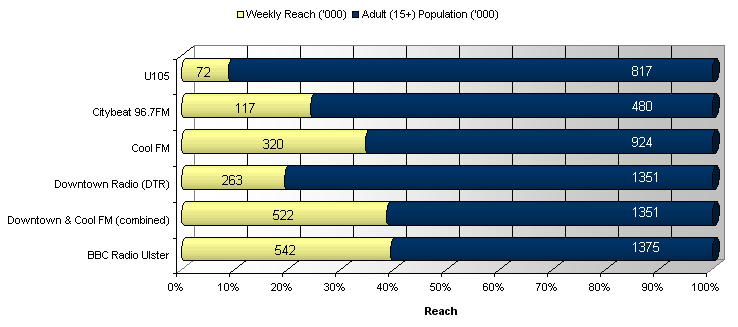
BBC Radio Ulster has the greatest potential reach, one a half times the size of Ormeau Road’s U105, and nearly three times the size of Citybeat 96.7FM down at Stranmillis. So we would expect Radio Ulster’s to be heard my more people than any other station. But given that, the percentage of potential ears that actually tuned during a week is a more useful figure.

The graph above (a beautiful creation from Excel) shows that Radio Ulster is listened to by 39% of its potential audience at least once a week. Cool FM scores a weekly reach of 35%, very impressive given that it probably draws in more under 15s that the others too.

Since the good folks at Newtownards operate two stations, each aimed at different audiences, RAJAR supply a joint figure so that management can assess how well they cover the overall market. Neck and neck with Radio Ulster in terms of weekly reach. In fact their weekly reach has increased for the past two quarters, catching up fast with Radio Ulster.

The losers are Citybeat, which has been steadily falling all through 2006.

Now U105 only went live on 14 November 2005, and didn’t appear in the RAJAR ratings until Q2 2006. The Q4 results show them hitting a new personal best with a reach of 9% … following a particularly poor dip. Notice how they issued a press release this morning to welcome the 44% increase this month, but there wasn’t a corresponding press release three months ago on 26 October 2006 to announce the 20% drop in weekly reach.

Turns out that pinching Radio Ulster's listeners is quite tricky. Instead John Rosborough, their Managing Director, focussed on the future and wasn’t “so not unduly concerned with a 2% drop in our market share at this stage”. (Update: just discovered that the Belfast Telegraph commented on the slow uptake a couple of weeks ago.) However, with Radio Ulster’s ousted afternoon presenter George Jones now back in the afternoon hot seat around the corner in U105, their weekly reach figures should be expected to continue to rise.

One final stat to ponder is the average hours per listener. (I think it’s a weekly figure.) While they bounce around, BBC Radio Ulster is firmly in the lead. U105 is on the rise, perhaps at Citybeat’s expense. And Downtown didn’t bother to mention in their breakfast news that their combined stations’ average hours per listener had fallen back to the levels of early 2006.

And a word of warning. I think that those figures only cover people listening on AM and FM and don’t take online, DAB and Freeview listeners into account. More on that another time.

Friday, March 15, 2013

A feast of fantastic films at the 13th Belfast Film Festival (11-21 April)

The programme for the 13th Belfast Film Festival was launched this week and in a little under a month, cinema screens across Belfast will be screening local and international films – shorts, features and documentaries – to suit all tastes and pockets. (Most of the films are £4-6 a ticket.)

I’ve previewed some of the screens and events below to whet your appetite before delving into the full programme. Festival programmer Stephen Hackett spoke to me at the launch and talked about some of his highlights in the dense programme of cinema.


Thursday 11 April

Made in Belfast, 7pm, Moviehouse, £6 // Local actor Paul Kennedy has turned writer and director and his film premieres and opens the festival. A story of friendship and betrayal, of an author returning from Paris to face the friends and family he treated so badly.

La Traviata, 8.30pm, St Anne’s Cathedral, £8 // Members of NI Opera's Young Artists’ Programme will perform pieces by composers inspired by Verdi before the screening of La Traviata in a fabulous location.

Saturday 13 April

Spoof or Die, 5pm, QFT, £4 // In this short film set in modern day Northern Ireland, Craig and Nicky are bullied at a bus stop and decide to bunk off school. But as the ghosts of conflict emerge, their brash youthful anarchy leads them towards a darker, older world, and from that towards an unexpected closeness. Written by Stacey Gregg and directed by Prasanna Puwanarajah.

Only the Young, 7pm, QFT, £6 // A documentary following three teenagers living in a small desert town in South California. Skateboarding, friendship, heartbreak, desolation. “Delicate and ethereal filmmaking” from Jason Tippet and Elizabeth Mims.

Cool Hand Luke, 8pm, Crumlin Road Gaol, £10 // Clips from classic prison movies precede the outdoor screening of Cool Hand Luke starring Paul Newman. Tours of the gaol from 8pm; film starts at 9pm.

Sunday 14 April

A Hijacking, 7pm, QFT, £6 // Kasper from Borgen turns up in this Danish film written and directed by Tobias Lindholm. A tense thriller develops as the crew of MV Roven are taken hostage by Somali pirates while the shipping company CEO is a hostage to ever-escalating negotiations conducted from his corporate prison. Filmed on a real freighter that had once been hijacked off Somali.

Monday 15 April

What is this film called Love? 7pm, QFT, £6 // Mark Cousins is back at the Belfast Film Festival with his “poetic documentary about the nature of happiness” filmed for just £5.80 over three days in Mexico. Travel, homecoming, solitude and looks like it was filmed on a pocket Flip camera. Miles away from Mark Cousins’ previous output: the epic fifteen and a half hours of The Story of Film that tracked the history of cinema over more than a hundred years. Update - review and interview with mark Cousins.

Brief Encounters, 7pm, Beanbag Cinema, £5 // Documentary following photographer Gregory Crewsdon as he creates elaborate portraits of suburban American life and his own anxieties, dreams and inner desires. To get his still images, he sets a house on fire, builds enormous sets with large crews and shuts down city streets.

Tuesday 16 April

Dead Dad, 8.30pm, Beanbag Cinema, £6 // A story of loss, sibling relationships and resentment. Three siblings come home to attend their dad’s funeral. There’s an abandoned dinosaur themed mini golf course, the dad’s ashes and the need to get together to give the man who split them up a proper goodbye.

Last Tango in Belfast, 9pm, QFT, £7 // In the summer of 1973, Belfast City Council was “focused beyond the escalating unrest on the streets and firmly fixated on the cinematic souls of its citizens”. The Council’s viewing committee debated Last Tango in Paris over the summer and ultimately banned the Oscar-nominated film. Forty years on, Belfast Film Festival audiences will get a chance to review the film and come to their own conclusions.

Wednesday 17 April

Politics and Drama Debate, 6pm, Belfast MAC, £4 // Stratagem’s Quintin Oliver chairs a panel discussion asking why political drama is in short supply on these islands? Why do we know more about the workings of the fictional Danish parliament via Borgen than the devolved institutions in Belfast, Cardiff and Edinburgh.

The Fifth Season, 7pm, QFT, £6 // A small Belgian agricultural community struggles as spring does not follow winter. Instead crops fail, cows stop producing milk, and human relationships deteriorate, perhaps at a faster rate than mother nature.

Thursday 18 April

Doctor Who, 7pm, Micro Cinema, Free // A screening of the colour-restored six Doctor Who episodes in the serial The Mind of Evil from the Jon Pertwee era. Free screening, but booking necessary.

Friday 19 April

Devices of Attachment, 6pm, Micro Cinema, £5 // Damian Gorman’s critically acclaimed 1992 film for BBC Two followed the writer across Northern Ireland with poems read against the backdrop of violent scenes of conflict and interviews with “ordinary, decent people”. This will be the first screening of the film in Ireland for 21 years, and will be followed by a Q&A with Danian Gorman and producer/director Hugh Thomson.

Pictures of the Pope, 8pm, Micro Cinema, £5 // Join William Crawley as he “assesses the best and worst onscreen portrayals of the pontiff, and what they tell us about the spiritual times in which they were made”.

Saturday 20 April

Niall Óg, Culturlann, 7pm, £6 // On top of the BBC documentary, another crew from Belfast Media Group followed twenty six year old Lord Mayor Niall Ó Donnghaile throughout his year in office. A year in Belfast’s life dominated by MTV and Titanic, but also conflict, regeneration, mental health and investment. Irish language documentary directed by Siobhán Ní Chiobháin and produced by Sorcha Nic Eochagáin featuring interviews with Niall as well as UDA leader Jacie McDonald.

The Evil Dead II at Ormeau Park, 9pm, £8 // Want to be scared witless in Ormeau Park? The organisers encourage you “to wrap up warm and bring your own seating, chainsaws, umbrellas, raincoats and hot drinks” to the “gaudily gory, virtuoso, hyper-kinetic horror sequel/remake”.

Sunday 21 April

We are Legion, 1pm, Beanbag Cinema, £5 // A feature length documentary looking into the birth, growth and culture of the Anonymous hacktivist movement with its online cyber attacks and offline protests. Copyright abuse, censorship, police brutality: We are Legion examines what motivates people to get off their sofas and join the risky world of civil disobedience and Anonymous activism. [This is the original film that was reedited and shortened in a recent BBC Four Storyville episode.]

Ernest and Celestine, 2pm, QFT, £6 // On the last day of the festival there’s an animated children’s film. “Giant bears and tiny mice don’t tend to socialise much, but when grumpy deadbeat bear Ernest and crafty orphan mouse Celestine cross paths, the two become inseparable friends and embark on a journey that will turn their worlds upside down.”

My Brooklyn, 3pm, Beanbag Cinema, £5 // Documentary exploring the forces reshaping Downtown Brooklyn and Fulton Street Mall (a popular shopping destination in New York City) as government policies and corporate development join forces to displace small businesses and long-time neighbourhood residents. Followed by discussion organised by Forum for Alternative Belfast.

Final Cut, 7pm, Moviehouse, £6 // György Pálfi’s premiers and closes the festival. It combines scenes from over 450 other films and marries them into a new narrative. A “master class in both film history and editing” as well as a storyline that can’t be carried by a lead actor or a common location.

There are also a couple of films looking at Human Trafficking as well as a series looking at pregnancy, motherhood and two shorts and a timely debate looking at abortion.

BBC Northern Ireland are also working with the festival to profile the work of playwright Stewart Parker. Details to be added when available

And if that’s not enough, Northern Visions (who recently won the Belfast community TV digital licence) are running chargeable workshops on Interview Techniques and Working with the Media (Tuesday 16 April) and Final Cut Pro 7 Editing for Beginners (Wednesday 17 and Thursday 18 April).

Wednesday, October 20, 2010

Benoît Mandelbrot (1924-2010)

An enlarged portion of the Mandelbrot Set - (source Wikipedia)

Never during three years of studying for a Applied Mathematics degree did fractals appear. But as a teenager I spent a lot of time improving my speed typing skills and entering programmes from Acorn User magazine.

Over a year or so, ever faster fractal generation assembler programmes appeared balancing the BBC Micro’s limited screen resolution with its even more limited 6502/65C102 processor.

Photo of Benoit Mandelbrot - source Wikipedia

The “father of fractals” was Benoît Mandelbrot, a Franco-American mathematician born in Poland who discovered the mathematical shapes known as fractals. He died of cancer on 14 October last week, aged 85.

The MathsBank blog have a good post about him, along with links to explore the Mandelbrot Set and other fancy fractals.

Saturday, January 09, 2016

Star Wars Episode VII: The Force Awakens … or should that be Indiana Jones and the Lost Droid?

I’m not a big fan of Star Wars. I remember reading one or two of the novelisations while at primary school, but the Force wasn’t strong. It’s okay if you find my lack of faith disturbing. In 1999 I watched Episode I: The Phantom Menace (with its podrace mash-up of hot rod racing and Formula 1) in the cinema with work colleagues and was thoroughly unimpressed.

A couple of years ago I gave in to curiosity and borrowed the boxset to watch the first six films (in episode order I-VI). It was clear that Episode IV: A New Hope (the original Star Wars film) was the best, and everything went downhill as you moved left or right through the rest of the franchise.

So I’d no plans to view the new Disneyfied Episode VII: The Force Awakens until so many friends saw it but so few reported hating it. Barely a hint of discontent. How could they not have been disturbed by JJ Abrams’ treatment of George Lucas’ science fiction universe? So this intrepid blogger went along to a matinee screening to see for himself …

The first character on screen is the crowd-pleasing spherical BB-8, a rolling football with a head. Disappointingly while most of the universe has standardised on English, personal droids haven’t evolved past burbling that could have been produced by the sound chip in a BBC Micro Model B back in the 1980s.

It’s very retro and full of cliché (mostly thirty nine year old Star Wars clichés and memes). Intergalactic inter-species bar scenes. Tick. John Williams score is familiar with sinister horns blowing over sweeping strings. Tick. The style of over-the-top fancy wipes when switched between scenes and locations are retained from earlier episodes. Tick. TIE Fighters, X-Wings and even the Millennium Falcon make an appearance. Tick. (Though the Millennium Falcon is a real work of science fiction as the only space ship in fictional history that can bounce off desserts and bump into solid objects like a car driving through Paris without sustaining damage.) Not to mention C-3PO who is as forthright as ever (“it would take a miracle to save us now”) and is still king of the understatement.

It’s not terribly subtle. The contradiction of nameless pristine white-suited Storm Troopers who are accustomed to carrying out genocide is made all the more obvious by one soldier who carelessly gets blood on his otherwise immaculate white helmet and starts to show emotion.

At its heart, Star Wars has a family tree with the dysfunctional tragedy and messed-up loyalties of Dallas combined with Dynasty. Yet despite the light years that separate one side of a star system from another, the main dream team protagonists have the knack of dropping into each other’s back yards to impossibly reunite without as much as a glance at a map.

One leading character whose position in the family tree has been left ambiguous until mid-2017 and Episode VIII is Rey (played by Daisy Ridley). She fights, she flies, she flees, and she just happens to be female.

“Without the Jedi there can be no balance in the Force.”

[Spoiler alert] The Jedi remain absent for much of the 135 minute film. So lightsaber rattling is kept to a minimum … though Kylo Ren’s red cross-shaped lightsaber is a neat innovation.

It’s very commercial. Some scenes only seem to have survived in the final edit to introduce animals and animatronic creatures that can later be given away in Happy Meals. Though I can’t see any food franchise wanting to licence the dodgy looking green muffins Rey prepares. A lot of the flying and dogfighting sequences have a video/arcade game feel to them that will easily jump to consoles.

Old friends reappear. One being-chased-by-a-monster sequence feels more like Indiana Jones and the Lost Droid than Star Wars (Indiana Jones is another George Lucas vehicle for Harrison Ford), and there’s definitely a little of Hillary Clinton in Princess Leia.

“Why are you doing this?” “Because it's the right thing to do.”

The dialogue is streets ahead of the latest Bond abomination Spectre: Episode VII’s lines are better and there are a lot more of them. Thankfully the temptation to launch into grandstanding speeches and space philosophy was avoided.

It’s quite repetitive. You don’t seem to need names in space: time after time, major characters only drop their names in twenty minutes after the audience (and the rest of the cast) first meet them. There are a few too many meaningful glances thrown across the set.

Peril is the norm, and at times the stress of relentless chasing and fighting was nearly too much for me, particularly since Abrams favours cutting his daring escape sequences boldly short which further compresses the audience recovery time. Though everything slows down to near bradycardia whenever R2-D2 is involved.

I’m baffled by the improbability that every major sequence in the film takes place during daylight. Other natural orders have been suspended too: allowing cast members to shout from one end of the Millennium Falcon to the other (eg gunning turret to the bridge) and be heard!

At its heart, Episode VII: The Force Awakens has truth and lies, loyalty and treachery, modernity and antiquity. And more than a touch of Highlander. But its nostalgic reliance on the very first Star Wars film for look and feel must be the reason that I – along with so many others – don’t dislike the film and (at the very least) grudgingly appreciate its blockbusting success.

Thursday, January 01, 2009

(not so quick) Review of 2008

The most common question in our house on 31 December was

“What were your highlights of the year?”

Cue lots of head scratching, memories of holidays, trips away, and minor reminisces. But the question stuck with me today and I remembered more and more. So, quickly trawling back through a year of blog posts – which tend to cover major thoughts or events – here’s my less-than-compact review of 2008. (I'll add in some photos to break up the link-fest tomorrow.)

January 2008

January started as snow fell fast on the first Thursday night, delaying return to work by a day and instead we spent Friday building snowmen with Littl’un. After posting an unfavourable review, we were invited back for a second meal in two rooms on University Road and enjoyed it a lot. Toby Hadoke provided lunchtime titters as he explained how Moths Ate My Dr Who Scarf at the Out for Lunch festival, followed by a slightly bizarre “conversation” between local authors Glenn Patterson and Malachi O’Doherty. There was a rather full weekend that started with a conference in Windsor (including Evensong in Windsor Chapel followed by nibbles in the cloister) and finished with the building of seven of Ikea’s finest BILLY bookcases. Oh, and the yellow Mini went back and was replaced for six months with a second hand Smart Roadster and the first of many attempts to get a second key cut!

February 2008

February saw in the Chinese New Year (year of the rat), voting for the next Presbyterian Moderator Donald Patton (and my rational desire of a Panini sticker book of PCI ministers), a Romanian film 4 Months, 3 Weeks & 2 Days (“brokenness ... offset with determination”), the launch of David Park’s superb book The Truth Commissioner, the relocation of the Jaffe Fountain, and a look at CCTV cameras around the Waterfront.

March 2008

In March, AiB was two years old. Victoria Square opened to much fanfare, reasonable crowds, the sound of a hundred shutters taking photographs of the elaborate structure, and the (tedious) game of where and when will the Apple Store open started in earnest. There was mention of looming Muppetry in the Sesame Tree, a blogger meet-up in church followed by a great evening of Ladino music at the Los Desterrados concert in Belfast’s Synagogue and one of my photos from the night ended up in the national Jewish Chronicle – whose website is strangely theJC.com! The BBC’s Passion provided food for thought over Easter and there was a superb concert of Big Tunes & Anthems by Shaun Davey in the Waterfront on St Patrick’s’ Day. I also announced that single parents should be issued with medals ... at least annually and reviewed a purloined copy of the redesigned Third Way magazine (the one with that Ben Elton interview in it).

April 2008

April was the month that Northern Ireland Post Offices came under threat. Philip Johnston returned to estate agency in East Belfast and rescued MCW Residential. Ryanair made dubious and unsubstantiated claims about their flightpaths out of Belfast City Airport over Belfast Lough and I favoured Ikon (later Mystery Worshipped) over the Celebration of Hope. Belfast Courts erected a squiggle. The bookworms - Samson and Goliath - finally appeared on-screen alongside Potto and Hilda in Sesame Tree. Belfast had a miniture flash mob. And car problems meant I caught the bus to work.

May 2008

May saw little fanfare until the last minute when the display MOT certificates became mandatory. AiB started to scrutinise supermarkets’ pricing policies of different sizes of boxes of tea bags. We went to Streamvale Open Farm on a blistering hot May Day (summer came really early). Freesat launched, though it was hard to find any set top boxes in Belfast. And after April’s car problems, the Polo turned into a C-Max (with the inevitable second key fiasco). At the Eurovision Song Contest, Dustin turned out to be a turkey. AiB took illicit photos at the Barry and Basil Show up at Stormont and returned to the grounds for some Red Bull Soapbox racing. Cheryl threw herself off the top of the Europa Hotel. I mused on what makes a good or bad church website, and then reflected on Ofcom’s latest nations and regions market communications report.


June 2008

In June, the Post Office consultation results were published and Belmont Post Office was confirmed for closure. More on tea bags. The NI peace process was compared to a game of chess and there was a visit to Cultúrlann McAdam Ó Fiaich over on the Falls for a spot of Irish chorale music. We went to France, didn’t book seats in advance for the TGV, didn’t climb the Eiffel Tower, and I didn’t enjoy the experience of ordering (and eating) profiteroles that arrived filled with cottage cheese and served with lettuce. Meanwhile a Lexus SUV tried to drive over a Porsche Boxster and a Toyota Celica in the Lisburn Road Co-Op car park. And a Sunday morning visit to Summer Madness with Littl’un was good despite the atrocious weather.

July 2008

At the beginning of July I ordering a new car for delivery in August and I noticed that my cars have been shrinking over time. Belfast rolled out it’s new branding. I met someone I’d previously blogged about and he unexpectedly remembered what I’d written. Always write to be read! I discovered just how deafening Lambeg Drums could be in a small community hall at the beginning of a cultural exploration of all things orange while a Swiss journalist and his family stayed with us over the Twelfth. So we took in the Belfast launch of Orangefest (and an interview with First Minister Peter Robinson) before things hotted up with a tour of East Belfast bonfires. The next morning witnessed the main Belfast Twelfth parade (all two hours of it) before discovering what happened afterwards at the field. The Belfast County Grand Lodge never did come back with any comment about the "Peace Keepers" toy guns on sale at the Belfast field. Being part of a photographic exhibitionAdd to Set – as part of the Trans Festival in the Waterfront Hall was an unexpected (and undeserved) opportunity and a great end to a busy month.

August 2008

In August I handed back the Smart Roadster and picked up the Toyota Aygo after a short delay. (Though I never bored you with the tale of the subsequent key cutting!) Tech Camp dominated the start of the month with a superb scavenger hunt and visits galore, more stop-go animations than I could fathom, and including an interesting one to SARC and a brilliant (and unexpected) one to the production company behind Sesame Tree. Other excitement included attending a wedding that was being filmed (for an as-yet unbroadcast late-night TV series), the new Broadway underpass on the Westlink turning into a gigantic swimming pool and Dalek cookies. Meanwhile, the Apple Store was furtively built and photographed while a Sheffield car park turned into another photo opportunity.

September 2008

September's Creative Camp Belfast was excellent. The big red switch was thrown on the Large Hadron Collider at CERN (which spun off a rap and a hymn). I bought some monster ginger, the Proms came to Belfast City Hall ... oh, and AiB blog visit stats went through the roof as the Apple Store finally opened in Victoria Square (and I snuck in for a tour before the queue). The Independent newspaper went full colour (but had teething problems in Northern Ireland).

October 2008

In October, AiB went along with The Slugger Awards in the echoey atrium of W5. There was an architectural focus on Micro Compact Homes and a walking house. Sir Jeremy Isaacs had interesting things to say about diversity and Public Service Broadcasting at the Belfast Festival, while “Oxymoron” was defined as “a DUP minister for culture” at a conversation hosted by William Crawley between authors David Park and Glenn Patterson. The Festival forgot to say that the John Cage concert at SARC had been postponed … but the when it did go ahead it “asked more questions than it gave answers” (but was never blogged about).


November 2008

November again witnessed one of the side effects of blogging - the random invitations that occasionally arrive. So I donned my tux and bow tie to attend a free local showing of the new Bond film Quantum of Solace and met more Aston Martin owners that I realised existed in Northern Ireland. Obama won the US Presidential election, CNN experimented with holograms, and McCain gave a concession speech that will surely not easily be bettered. Vodafone’s Liveguy was nearly persuaded to come to Northern Ireland to hand out free 3G-enabled netbooks - but in the end didn't. There was a great Thanksgiving dinner. The Presbyterian Mutual Society came into the news when a minority of its members stopped acting in the mutual interest of all its members. And I went to see Hunger.

December 2008

December was the month in which David Cameron came to town and answered questions about The-Thing-With-No-Name set by local punters. The doors closed on Woolworths for the last time. Bells were rung for climate change outside St Anne’s Cathedral. A carol service was enjoyed, a cake was superbly decorated and an old Mac turned up in a stocking.

A busy and varied year ...